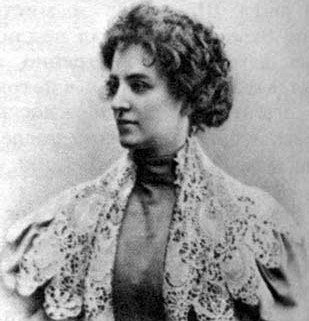
Zinaida Gippius, early 1910s
*****
Zinaida Gippius (1869–1945) was the dark genius of Russian Symbolism and Decadence. Her poetry ventured so far in the direction of Lovecraftian Horror that Trotsky wrote, in Literature and Revolution, “I don’t believe in witches, but I’m quite sure Gippius was one.”
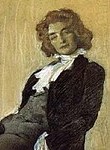
She was also a gay trans-man, who lived in a menage-à-trois with her husband, the then world-famous novelist Dmitri Merezhkovsky, and the male lover she procured for him. She dressed as a male (eighteenth century male attire set off with a monocle and a long cigarette holder), and wrote her poetry with male pronouns. Her gender dysphoria manifests in her unique poetic blend of body horror and eroticism.
Greatly admired by Virginia Woolf and Gertrude Stein, she is almost untranslated into English. Soviet censorship, universal homophobia and misogyny, and the aesthetic intolerance of Modernism, have relegated this brilliant gender outlaw to the horrified footnotes of literary historians.
Note:
Seraphina Powell‘s translations are followed by her own poem written in memory of Zinaida Gippius.
*****
Zinaida Gippius: Two Poems
translated by Seraphina Powell
SNOWFLAKES
Along a far-off, soundless path
as the descending day
fades into shades of gray,
I follow my sadness into the snowy woods.
The road is uncannily silent;
the forest, as ominously quiet
as a thing that lies in wait;
no sight-soothing evening mist
descends from the dead winter skies.
Snowflakes eddy by thousands,
settle to rest in front of me,
sifting countlessly down, they shroud the world.
Large, soft weightless flakes
float around, like a swarm of playful bees;
the fearless flakes play
and chase after me,
they fall and go on falling to the ground,
it’s as though the sky were crumbling whitely down
to earth in an infinity of bits.
Thoughts of silent cessation, of death,
arise and weirdly please my heart.
Dream and reality change places,
flow together, merge;
the darkening, scowling sky lours down on me.
Walking on, I stumble,
fall to my knees as if in submission to fate.
I feel mysterious satisfaction,
and I think of you.
I love what can’t ever be achieved,
what may not even exist—
O my dear child,
my only one, my world!
I seem to sense you breathing beside me
as I fall asleep. The soft sweet blanket
of snow covers me up
with gentle endless bedding.
Eternity comes soon.
I can almost hear my pulse going slower,
my heart-beat’s hammer stammers,
softer comes its stutter of blood.
Boundless is the silence
and the twilight and the love.
NIGHT-BLOOMING FLOWERS
Never trust the hour when night arrives;
perfect is the beauty and the evil of that time.
Then, when darkness first darkens,
death is closest, the sick are most at risk—
but the flowers take on a new, equivocal life.
These walls become warm as living tissue,
even though the hearth fire’s been out for hours—
The walls almost seem to pulsate.
I wait in the darkness and silence of the room;
the flowers are waiting too,
in ambush—I know it. They hate me.
Among all these blossoms in their vases,
I’m anxious. I begin to sweat.
Their scent suffocates. I can’t slip out of range,
there’s no place their power doesn’t penetrate:
they’re inescapable as my own flesh.
The setting sun arrows down its final rays,
the silk curtains are drenched in their red
like a bandage; the lurid light
bleeds onto the page as I write.
I feel, as if it were my own body
stems coming to life,
shifting their slender vegetal limbs.
The evil flowers wake.
The poisonous lily drips liquid,
at intervals, onto the carpet,
from its tongue-like pendulous petals.
Now the flowers mysteriously whisper
something I can’t make out,
it sounds like a distant argument,
I can’t distinguish words,
but this doesn’t end well for me.
The flowers rustle, they’re stirring,
they breathe, they watch me, hostile;
they hear my thoughts, they wish
their perfume could poison me.
Never trust the evening hour!
Always be wary of its evil beauty,
in this hour we’re closer to death,
and the flowers take on an independent life.
*****
Seraphina Powell: A poem for Zinaida Gippius
ZINAIDA GIPPIUS
A castle-grand apartment block
done up in moorish style:
vaults honeycombed with hexagons,
wide horizontal stripes,
the windows horse-shoe arched, surreal
without—more so inside,
for there Zinaida ruled her own
Alhambra of the mind.
Funereal in sweetness,
her tuberose perfume;
a Russian Cleopatra,
in a rich Art-Deco tomb.
As slender as a wasp; a tongue
that stung; sheathed, shawled in white,
her thin-hipped breastless body
seemed a Beardsley come to life—
all angles and adornments.
A queen of Nile or night,
her smoke curled arabesque in air
like spells revealed to sight;
the holder of her cigarette:
long, black—a magic wand
that ruled the room as music
does conductor with baton.
She lay upon her roman couch,
propped up on elbow, peered
at you through monocle
as if deciding what you were.
Her hair was dyed, her cheeks were rouged,
her lips were painted—red;
her powdered face, the purplish white
of the unquiet dead.
Though winter’s cold in Petersburg
this Venus went in furs
to show how sphinxlike feral
was the nature which was hers.
Her necklace: linking wedding rings,
the tribute of those men
who promised they would leave their wives
to be with her again.
Seraphina Powell works as a freelance copy editor and proofreader, which is what one does with a humanities MA with a concentration in Russian. Her leisure is spent rummaging through second-hand bookstores and knitting sweaters for her much-blinking Sphynx cat, Casaubon—Powell is something of a George Eliot fan. Here translation of Akhmatova’s Evening and Tsvetaeva’s Girlfriend are available as linked.

