By following the links below you can browse the work of all of The High Window‘s previous Featured Poets. You can then return to the full list by clicking on the link at the top after each date:
Gil Learner • Robert Etty • Mike Farren • Fiona Larkin • Jeff Gallagher • Daniel Bennett • Moniza Alvi • Rosie Jackson • Stephen Romer • Jenny McRobert • Alan Jenkins • Emma Lee • Iain Britton • Dino Mahoney • Dónall Dempsey • Gregory Woods • Liam Guilar • Estill Pollock • Allen Prowle • Ken Head • Neil Elder • Michał Choiński • Jude Nutter • Jean O’Brien • Tom Phillips • Kim Waters • Keith Howden • Kitty Cole • Peter Riley • Abeer Ameer • John Cassidy • Kate Noakes • Patricia McCarthy • Alice Allen • Tony Flynn
*****
Gil Learner
*****
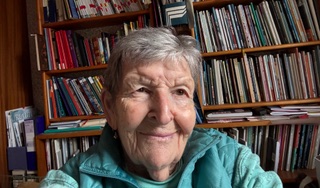
Gill Learner introduces herself and her work
In 1999, shortly after retiring from teaching Printing Studies, I won membership of the Poetry Society in a competition in the Independent. For some years I’d followed Ruth Padel’s poetry column ‘Ways of looking at a poem’ in the Sunday Correspondent but not since my teens had I thought of writing them myself. I began to subscribing to magazines, started buying collections (which now threaten to overwhelm bookcase space), and joined a poetry writing class. After a dispiriting series of rejections, I had some poems accepted in journals. In 2008, one published in Poetry News won the Hamish Canham Award – I thought I’d made it! In 2011 my first collection appeared from Two Rivers Press and received gratifying reviews. I also garnered a few other awards: I came second to S. Armitage(!) in the Keats–Shelley prize 2010, won the Buxton 2011 & 2012, have had a number of Commendations and, most recently, won the International Welsh Poetry Competition 2024.
Poets who’ve inspired me vary widely: Seamus Heaney, Lesley Saunders, Liz Berry, Carol Ann Duffy, and Billy Collins, among others. The environment, particularly my garden, composers’ lives and music, technology, crafts, family and friends all spark ideas. Twice a month I co-ordinate Thin Raft, a long-standing feedback workshop for which it’s an old-established rule that one must have a poem; other members have contributed hugely to my spasmodic successes in helping knock my words into shape.
The poems below reflect my interests; the last is a recent, light-hearted one.
*****
Gill Learner: Eight Poems
THE LAST OF THE WHITBY WHALERS
Now Fiddler’s Green is a place I heard tell
Where the fishermen go if they don’t go to hell
Traditional song
Canvas cracks in a fierce March breeze,
capstan clanks as the anchor’s weighed:
Phoenix is sailing for whalefish grounds.
To the raucous urge of the shantyman’s yells
the hands heed commands to ease or trim.
There’ll be days of praying for bellies to calm;
weeks of looking at nothing but waves.
They’ll sleep, drink, sing through foc’sle hours;
try not to think of Porpoise, Hope, whose crews
are now dancing on Fiddler’s Green.
At last, the longed-for shout: Land ho!
Soon ice-cliffs glare. All eyes are keen.
At A fall! A fall! they slacken sail.
Harpooners throw – a crimson gout.
They haul to lee; slice, flense and strip,
pack barrels waiting in the hold,
hack baleen free, release the kreng
for sharks to eat. If their luck stays true –
repeat … repeat … no sleep, no rest,
just haul and cut in slither and stink.
Low in the water for voyaging south;
only seal-meat now and gritty hard tack.
But beef and bread, fresh water, beer,
if they make port, not Fiddler’s Green.
Aimwell, Valiant, Esk did not.
As Phoenix nears shore, she’ll flaunt success
by lashing two jawbones against the mast.
Not one man jack would ever believe
that by the start of Victoria’s reign
there’ll be no whalefish left to catch.
CUTTINGS FROM A HAUNTED GARDEN
Mum, my gardening mentor,
xxxxxinhales happily by the choisya which came
xxxxxxxfrom her, and fills the April air
xxxxxxxxxwith luscious scent,
xxxxxand, as I stretch across the pond to dead-head
xxxxxxxmy white irises, I glimpse
xxxxxxxxxher reflection in the water;
xxxxxthe two euonymus – Silver Queen and Golden King –
xxxxxxxevoke the memory of her laughter
xxxxxxxxxwhen I asked:
xxxxxxxxxxxxWhy should the queen
xxxxxxxxxxxxxx be of lesser value?
My dear friend Pat
xxxxis at my shoulder every autumn
xxxxxxxas I prune the small hibiscus trees –
xxxxxxxxxxseedlings dug
xxxxxxxxxxxxfrom her brother Tom’s plot;
xxxxxshe murmurs Take care!
xxxxxxxas I trim the brittle stems of salvia
xxxxxxxxxxwhen its shocking pink flowers are done,
xxxxxbut applauds as I snip the dying blossoms
xxxxxxxfrom burnt-orange lilies
xxxxxxxxxxevery June.
And my husband’s voice at the garden door
xxxxwhen I work till dusk:
xxxxxxx For God’s sake, woman,
xxxxxxxxxcome inside.
xxxxxxxxxxxxYou must be mad!
THE TROUBLE WITH MUSIC
It carries so much freight – flashbacks to places
from the past. So anything by Martinů or Janáček evokes
our Czech friend, Rudi. He guided us round Prague
and later sent recordings of their works on Supraphon.
‘Smooth operator’ sung by Sade brings back the days
we ambled through Avignon and it was being played
in cafés lining the Rue de la République. Any Vivaldi
recalls the hours in Venice when I made my poor friend,
Megs, traipse the fondamente searching for the Ospedale
de la Piéta, where he taught music to young girls.
Folk-tunes like ‘The Shepherds’ Hey’ set leg muscles
a-twitch from gym-hall dancing in wet dinner-hours.
Our voices soared at school with Stanford’s ‘Bluebird’.
A few bars of ‘The Cutty Wren’ will whisk me back
to singing it in pubs with teenage mates. And how Jan
and I were galvanised to ‘rock around the clock’.
Hundreds of works remind me of events Trevor and I
enjoyed for sixty years: Proms, operas, recitals, in England
and in France. And, of course, the Scherzo from Mahler 5
and the overture to Tannhäuser chosen for his funeral.
Most venues remain but so many friends from school,
from teenage, and more recent, times are gone.
Do they dance on among the clouds, and sing –
do their voices ring out still but in a heavenly choir?
THE STONE
i.m. CM, Master Printer
An altar to words, as even as glass
to steady characters which editors
were not allowed to touch.
brevier bourgeois pica minion pearl
Slate once, then steel but always
‘the stone’, solid for mirrored fact or fantasy
that only Chapel brethren could correct.
shoulder shank nick bevel kern
Where pages were slid from galley trays,
locked up in patterned schemes
for work-and-tumble, work-and-turn.
quoin reglet chase furniture forme
Hub of jobs, communing point where
union dues were paid, discontents
chewed over, resolutions passed.
apprentice devil time-served journeyman
Now cast out into shed or yard to stand
with chimney-pots and iron grates
collecting sacraments of dust.
binary HTML print on demand
First published in The North 49,
then Chill Factor (Two Rivers Press, 2016)
THE CRAFT
As for a boat he worked the wood:
curving it wide at the shoulders
by cutting the internal ply, the two-by-one struts,
narrowing down to the foot.
It was measured and made for a friend.
Unvarnished it hung some years in the barn
with a glossy canoe –
a Shire stabled next to an Arab –
without brasses, not meant for show or endurance,
a simple container.
Death arrived. Not for the man who bespoke it
but for the carpenter’s mother.
It was manhandled into the Astra,
ferried across the Cambrian mountains, the Severn
and down to the Solent.
Padded with straw
and New Forest beech leaves
under a sheet of drawn-threadwork,
it was set up on trestles, lid off for looking or chatting
in lavender-rosemary air.
A gentian-blue cover was scattered
with primroses, iris, an apple-flower wreath.
Four women lifted and steadied it, strode with it;
carried their grandma
not to the sea but the fire.
First published in The Leaf,
then The Agister’s Experiment (Two Rivers Press, 2011)
SPANISH LESSONS, 1966
For Bruce
Twenty years before the Hand of God there was
the Foot of Hurst in black and white on a rented set –
four times for victory. One month earlier
we’d quelled distaste for El Caudillo, forgot
mini-skirts and moptops, pointed the Cortina south.
Greeted by a storm from the Picos de Europa
we learned that what had failed in the hotel
was luz, laughed as we drank beer and gave you tea:
un vaso de leche with pan y mantequilla begged
from the kitchen. Next day beyond the fishing boats
we found great swathes of sand, began
a kick-about. From our scant lexicon we’d taught you
por favor and gracias; ¡hola! and adios but here
you spoke the lingua franca of small boys.
Soon a pair of pallid legs flickered among
sun-browned thighs and calves. Gulls flounced away
from your cries of Pelé, theirs of Bobby Moore
and shouts from everyone of Pass and Goal!
First published in The Stare’s Nest,
then Chill Factor (Two Rivers Press, 2016)
THE CALORIFIC VALUE OF ANXIETY
For Emma
I stalk you through the atlas,
study weather, calculate the time
it must be there, decide you’re heartless
then that probably it doesn’t seem
an aeon-and-a-half to you, among
the smells, noise, flavours of exotic places;
and when at last the phone does ring
I shrug away your reasons or excuses.
Consider all the parents, lovers, partners
fretting for backpackers, peace-
keepers, explorers, migrant workers,
their worry gathering in clouds like gas.
Harnessed, this energy could power
a small country for a year.
First published in The Leaf,
then The Agister’s Experiment (Two Rivers Press, 2011)
TREACHERY
Who did they think they were? Throughout three millennia,
I kept the secrets of our land. Then Pierre-François Bouchard,
an interfering Frenchman, poked his nose into my affairs.
For thirty hundred years the mysteries of our pictograms
were ours alone. But, in the rubble of Fort Julien
in Rashid by the Nile, an officer in the army of Napoleon
spotted a slab of rock with carvings. Later it was seen
by another man from France. He, being smarter than
the first, soon discerned links between three versions
of a text – in hieroglyphs, in Greek, and in the local script.
In Alexandria, the British Army snatched the stele
from the French and carried it to their capital.
Here I stand in a museum: goggled over, marvelled at.
The enigma of our images – spells, charms, memorials –
can now be understood by anyone: they’re no longer solely ours.
I feel I have betrayed my land.


1 thought on “Featured Poet: Gill Learner”