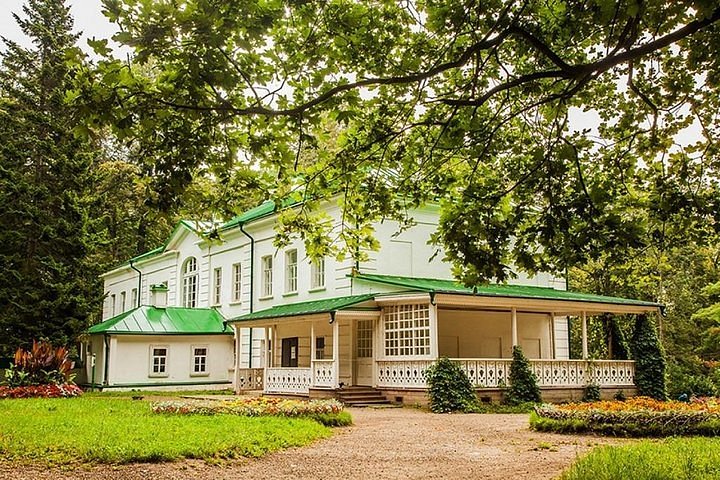
Leo Tolstoy’s estate at Yasna Polaya
*****
Translators: Agents for the Dead
Does anyone every say: ‘I want to be a translator when I grow up’? Reflecting on the reading, writers and mentors along the way, I can see now, that, for me, translation resulted from a serious of love affairs…not something you can always plan. It starts with me as nine-year-old, mooning for weeks over my ‘secret friend’, Peter Pan, before progressing to The Forsyth Saga’s Young Jolyon, Gone with the Wind’s Rhett Butler, and my final life-changing passion for Pierre Bezukhov in the 1972 BBC Production of War and Peace. From here I devoured every Penguin Russian classic I could get hold of – those seventies’ editions with their delicately realist Russian paintings like Alexei Savrasov’s ‘The Rooks have come Back’ or Ilia Repin’s ‘Religious Procession in Kursk Governorate’. A chance TV viewing of Chekhov’s The Lady with the Lapdog (Lenfilm,1960) gave me the icing on the cake: the sounds of spoken Russian and the clear decision to do a Russian degree.
Throughout all this, Tolstoy was a key driver, but I was also to benefit from Arnold McMillin arriving as professor in my first year at Liverpool, lighting up the place with his empathy for his students and a desire to innovate with new courses – no easy task, given the small size of the Russian Department. Thus, the highlight of my final year was our Friday tutorial on the Silver Age poets, Arnold and myself – me, no longer relying on Penguin Classics – unpicking the complexities of Mayakovsky, Akhmatova, Pasternak, Mandelstam and Tsvetaeva, before heading off for a well-earned lunch and a pint at the Everyman Café in Hope street.
And the appeal of those poets was their amazingly affirmative, deeply emotional poems in the face of Stalinist repression: Boris Pasternak’s pantheistic merging of the self and nature as in the untitled: ‘My sister – life, is today in flood,/having been battered with spring rain everywhere’; Anna Akhmatova’s inexplicable faith in the future given Russian’s Revolution and subsequent famine:
Everything is looted, betrayed, sold,
the wing of black death has fluttered in,
everything is gnawed at by famished anguish,
then why has it become bright for us?
(Trans. Richard McKane’)
Osip Mandelstam’s uncompromising belief in his blessed Word:
We shall meet again in Petersburg
as though we had buried the sun in it,
and we will pronounce the blessed
senseless word for the first time.
(‘Trans. Richard McKane)
And, finally, Vladimir Mayakovsky’s and Marina Tsvetaeva’s shared passion, hyperbole, defiance, and, ultimately fragile masks for their own insecurities, such as here in Mayakovsky’s unrequited love for Lili Brik:
When a tired elephant wants to rest
it lies down majestically in the scorched sand.
Apart from your love
for me
there is no sun,
but I don’t even know where you are and with whom.
(‘Lilichka! Instead of a letter’)
And, though a poet ‘off piste’, Sergei Esenin – that Rudolf Valentino look-alike – also caught my imagination, here with his tragic suicide note, supposedly written melodramatically in blood:
Goodbye my friend, with neither hand nor word.
Don’t grieve, or drop your head in sorrow.
In this life there’s nothing new in dying,
likewise there’s nothing new in living.
Though, unaware at this point, the seed was being sown for translation to act as a form of reparation for the tragic fates of so many of these poets, given they all suffered either state repression – Akhmatova and Pasternak, or suicide – Mayakovsky, Tsvetaeva and Esenin.
Now – a literary grown up – my degree having taught me that it was Tolstoy’s verisimilitude that had enabled his living, breathing characters, I was drawn to the similarly concrete detail of Robert Lowell’s heart-breaking, confessional poems, on his manic depression in Life Studies:
One dark night,
my Tudor Ford climbed the hill’s skull;
I watched for love-cars. Lights turned down,
they lay together, hull to hull,
where the graveyard shelves on the town….
My minds not right…
(‘Skunk Hour’)
The little-known fact that he had translated Mandelstam’s poetry, gave me a research topic that brought me full circle back to my Russian poets. And comparing drafts of his Mandelstam versions was a good as taking a course in translation. His trust in ‘prose clarity’, as he called it, along with visualising and interpreting Mandelstam’s complex imagery, created translations that helped one understand the poems. This placed him head and shoulders above all other versions. As well as this, I discovered the emotional value of translation for Lowell and his fellow Americans, hungry for this Russian culture closed off until the East West relations relaxed following Stalin’s death in 1953. Lowell was also drawn because, as he noted: ‘…there’s a great charm in doing a first – or a near first, nobody ever seems to do a real first. But you do an almost first, Mandelstam, say, and that’s wonderful.’
My research led to a friendship with Lowell’s collaborator, the Russian émigré Olga Andreyev Carlisle who gave me the same access to her world that she had given these American poets. Her grandfather was the playwright Leonid Andreyev and her father and uncle the poets Vadim and Daniil Andreyev, so her childhood home in France was regularly visited by émigré writers. One of the first journalists to interview Boris Pasternak on Russian soil, she subsequently published Poets on Street Corners: Portraits of Fifteen Russian Poets (1968), a collaborative translation project with American poets. In San Francisco, in 1988, we spent a week discussing Lowell as well as all these émigrés – really bringing home to me what they suffered as well as the impact Stalin’s purges had on those who remained. By now, I was beginning to feel Silver Age poets were my personal property.
As a result, the seriously strange, Surrealist Boris Poplavsky (1903-1935) became my new obsession. One of the younger generation, his poetry offers a haunting mix of the French flâneur, combined with a highly individualised network of images influenced by the little-known Isadore Ducasse’s Surrealist text Les Chants de Maldoror (1868/9) (the self-styled Le Comte de Lauréamont):
The town is dark, its parks mysterious,
while above, the sky is a shimmering sea
of emeralds. Salome – the soul forgets,
how your voice was like death.
And now I remember, you came out of the sunset,
a black cup in your slender hands. To the song
of the white acacia, the evening walked away…
beyond the river and into the clouds.
(‘Romance’)
Other poems, rich in pathetic fallacy, show Poplavsky, Hamlet-like, expressing the unbearable pain of living in the world, frequently portrayed wandering Paris’s snow-covered streets. Thus, I was off on a painful, labour-intensive ploughing through my Russian dictionaries. Olga and I also kept in touch intermittently over the years, meeting a weekend in Paris and finally for three weeks in Provence in 2003 for more reminiscences as well as a peaceful place and time for me to translate a book of Vadim Andreyev’s translations.
These few meetings aside, the completion of my doctorate left me in a limbo re: soulmates, given I was now combining school teaching with research on Silver Age poetry. Translation rose naturally out of this, since there was little out there. This was to include: Lev Gumilev, Viacheslav Ivanov, Daniil and Vadim Andreyev, Alexander Blok, Zinaida Gippius and Boris Pasternak. Attempts to meet with academics, revealed people as just too busy with the increasingly accumulating workload of the nineties – gone were the halcyon Liverpool days of one-to-one tutorials sharing a leisurely pint. This meant that, after three years, I was a bit of a sad loner, scratching away in some death zone expecting one day to be found asphyxiating from the dust of my vast tomes of ancient Russian dictionaries……
And then I met Richard.
Richard McKane’s name walked before him as a Russian and Turkish translator. All of his key works were sitting on Waterstones’ shelves published by Anvil or Bloodaxe. He’d made his name while still a student, doing his own ‘first’ with his Selected Poems of Anna Akhmatova (1969) – my main ‘crib’ throughout my degree. It was a heady time for him given Akhmatova had come to his college in Oxford in 1966. He was subsequently invited to the Union of Soviet Writers to Moscow for the 100th anniversaries of Akhmatova and Pasternak, and in 1978 was the first UK citizen to be given a one-year poet’s residency in Princeton. So, my chance letter to him at the Pushkin Club was one to which I was expecting, at most, a brief, formal, if courteous reply….
I was thus somewhat stunned by the subsequent hour-long phone-call which revealed Richard, seemingly, as desperate to talk Russian poetry as I was. I remember our first actual meeting in London – heading off for what was to become a regular Liverpool-style leisurely lunch and a pint! – Richard holding up one hand to reveal the number of Russian poetry translators out there. From that time in1996-2015, we met regularly in London to collaborate on translation projects, or just to chat, and Richard, for me, became the full embodiment of all these gradual discoveries regarding translation I’d learnt from my earlier encounters, not to mention, possibly, the most totally altruistic individual I have ever met.
A quick google will reveal the numerous accolades to Richard following his sudden death from pneumonia in 2016, given both his dedication to bringing so many Russian and Turkish poets to the world’s light, and his work on human rights, interpreting at the Medical Foundation for the Victims of Torture, as well as being vice-chair of English PEN’s writers in prison committee. So, I will just tell you about the Richard I got to know. There was something cohesive about all that I remember of him. From the first phone-call he came across as funny and innocently flirtatious. In all the time I knew him he was always in love, but as with me and Tolstoy’s Pierre Bezukhov, it was generally hard to distinguish between his love for the – always beautiful Russian woman – or for their poetry. And, in fact, for Richard, I would say there was no difference.
Travelling to work each day by tube he would work at pace either writing his ‘London poems’ or translating entire collections of these loved poems. His full life’s output is daunting and each book conceals a whole relationship with often, not just the poet but their whole family. His most perennial passion was for the poetry of Leonid Aronzon which he published as Life of a Butterfly with Waterloo Press in 2011. He combined this translation with regular letter-writing on behalf of, generally Turkish imprisoned dissidents. And along with encountering Richard as someone with a wide network of friends and associates all tied to this life of dedication, I saw it in the midst of him living with serious mental health issues that he had to cope with from early adulthood. Yet, even this tragic element seemed absorbed into that cohesive life, feeding into what was already an already deeply empathetic nature. Only meeting Richard on occasion, I had never had first-hand experience of him unwell, but sometimes on the phone if we discussed any current affairs, what, for others, were just really awful events, seemed to literally cause him emotional pain, and he would weep on the phone, reacting similarly in 2015 when I had told him of my own, as it turned out treatable, breast cancer diagnosis. I think he was in this unique.
As far as working together, he certainly became very much my mentor. I had earnt his respect at the start I think simply by being able to introduce him to the work of Boris Poplavsky, whom he had heard of but knew little about. This got us started, collaborating on a group of poems for his Anvil Anthology, Ten Russian Poets: Surviving the Twentieth Century (2003, and we later brought out Poplavsky’s Flags (Shearsman, 2009). It was a handy truth that I had preferred his Akhmatova version of ‘Requiem’ to Lowell’s in my thesis, and these showed us to be on the same page with respect to getting that Lowell-style prose clarity. As we got to work together he took on the role of picking up my awful Russian clangers, while I could help him at the editing stage in agreeing nice turns of phrase. Thus, he we subsequently became each other’s second readers: he checking all my subsequent Tsvetaeva work and me checking his own poems and texts such as the Aronzon. But what was the most valuable, for me, was how he behaved towards others. He had one very important rule. He knew what every other Russian translator was working on and so it would be hands off, say, Khlebnikov, because that was such and such a person’s patch. Not a courtesy that was always afforded to him in reverse.
Like everyone, he suffered the frustrations of the machinations of the poetry world. Our biggest proposed project was a large selected Pasternak, but unfortunately, it hit something of a road block with respect to copyright, so though completed, is thus still, to date resting there waiting its moment. Richard was very philosophical about all this, quoting a much-loved phrase of some famed Russian poet with respect to this, all in an entertaining Russian accent: ‘What’s half of nossing – nossing!’ Richard, though, knew how to handle things. When we had submitted our first group of Poplavsky to a particular journal. I was mildly upset to then be told their checker had found the translations ‘riddled with lexical inaccuracies’. Richard switched very much into fatherly mode: – ‘Now don’t worry. Pah! ‘lexical inaccuracies!’ – that’s clearly some native Russian speaker – probably academic linguist’. Just email them back and say: In the spirit of glasnost’ would the editor be willing to send us the checker’s notes’. Pleased to say, with a few minor tweaks, said translations are now happily placed in that same prestigious journal.
All in all, I have so many wonderful Richard memories in his various flats needing nothing but a room full of Russian books, visiting his favourite Turkish cafes or bars, always on route stopping to talk and donate to people on the street. When he was interviewed on Radio three’s The Verb, at one point, he just starts singing a Paul McCartney song from one of his poems – spontaneous, child-like. Indeed, our very last meeting when physical disability required him to move to a care home – a place which he still managed to turn into an opportunity, supporting others in the home – he still kept cheerful provided he could get out to write and smoke his pipe. When I visited him there, we went on a small expedition to get a stash of books he was desperate for from his previous flat. A bit out of my depth, I had no idea the difficulties of getting Richard in and out of the car. When we got back we – or rather I– got my knuckles rapped: ‘Now we are quite happy for our residents to go out but you should hire a special taxi for this.’ I can still see Richard sitting in his wheelchair with a look that was: ‘naughty and knowing and – I’ll just keep my head down’. He knew he’d landed me in it but like all kids he wasn’t going to take the blame!….my last treasured memory of him.
Belinda Cooke is a widely published poet, translator and reviewer. She has published seven collections of her work, including translations from both Russian and Kazakh. Best known for her translations of Marina Tsvetaeva, she has also written a prose memoir of her mother’s life: From the Back of Beyond to Westland Row: a Mayo Woman’s Story (The High Window Press, 2022). Her latest collection, The Days of the Shorthand Shovelists, is due out from Salmon Poetry this year.
*****
 The High Window