*****
*****
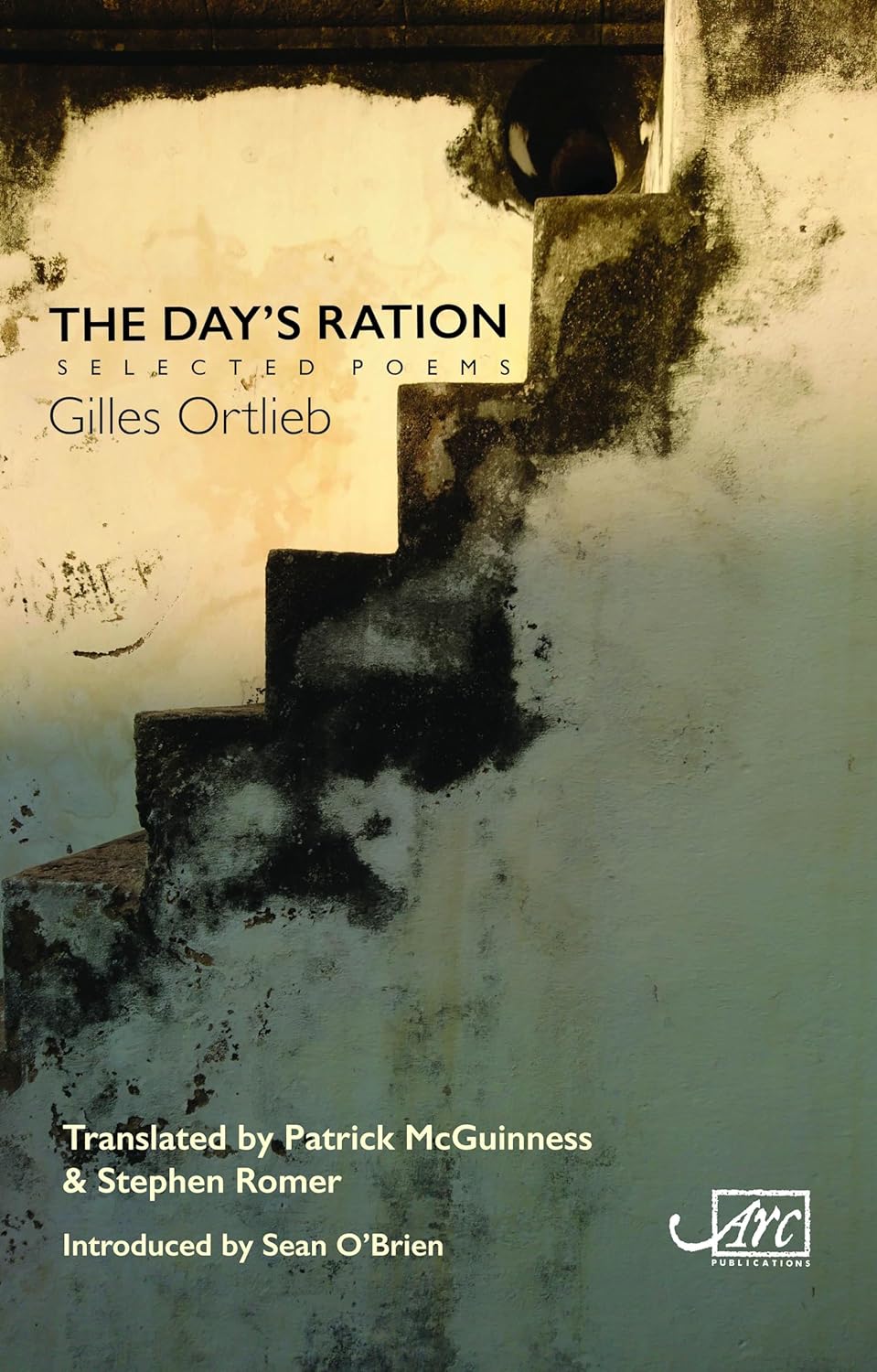
Gilles Ortlieb: The Day’s Ration, Selected Poems, translated by Patrick McGuinness and Stephen Romer with an Introduction by Sean O’Brien. £11.99. Arc Publications. ISBN: 978-1911469421
Modern French poetry has a reputation for being somewhat abstract and artificial and I must confess that even as a graduate of French Language and Literature I have struggled over the years to tune into its wavelength. From time to time I have discovered poets like André Frénaud or Jules Supervielle who seemed to have something to say me, but even they at times can be wilfully obscure and a tad precious. It was not until I discovered Jacques Réda in the early 1980s and then, a little later, Jean Follain that I found that French poety could be rooted in the real world. More recently, I have caught up with Into the Deep Street, an anthology of seven 20th century French poets, edited and translated by Stephen Romer and Jenny Feldman. I was already familiar with Treading Lightly, Feldman’s bilingual edition of Jacques Réda’s selected poems, and discovered that both he and Follain were represented in this anthology alongside Philippe Jaccottet, whose early work I had also enjoyed. In addition, there were four more poets about whom I knew nothing. One of these was Gilles Ortlieb, the subject of this review.
Ortlieb. like Réda, is a flâneur who keeps a logbook in which he scrupulously notes down everything that crosses his path. In an afterword, Patrick McGuiness explains the process by which Ortlieb distils his poems from these myriad observations. From the opening poem in this volume it is clear that Ortlieb has a natural talent for capturing the haecceitas of objects whether he is describing a zinc roof, winter trees or gravel:
With its recent rail ballast, still grey therefore
(and not red, or rust-orange oxide, or black)
bearing its weight of melted snow
rather as roof gables carry the sky
or canals their uneven and greeny
reflections;
(Companies)
Although Ortlieb’s eye is focussed on the minutiae of concrete reality, his vision goes beyond mere observation to create an atmosphere of isolation and rootlessness that is redolent of Edward Hopper or film noir. His is a world of late night cafés, railway stations, hotel lobbies and abandoned streets:
By the end you’re tired of the peppery smell
of hotel staircase carpeting,
of those evenings strapped to your shoulders
as you lounge along damp corridors in the wind
between shop-fronts you don’t recognise.
The opening section of this volume, Logbook of Days, is typical in its precise description of ‘A zinc roof laid bare / through the broken dented snow,’ but a few lines later concludes with its own more personal brand of despondency:
…the weary kiss
that ivy lays upon the waters,
light thrown up on the bridges
and on all of us, from the poorer quarters,
veterans of seasons past.
This untitled poem is followed by seven more in which the protagonist trudging stoically onwards ‘in headlong flight’ could be could be Raskolnikov in St Petersburg or Hamsun’s anonymous ‘hero’ in Kristiania:
Absurd to trudge on like this
against the oozing wind of fixed
winters ….
The perspective here is that of the archetypal outsider who watches ‘the pedestrians file by / their washed-out gaiety …’ but is forced to acknowledge that ‘the dubious one is you …’ One may perhaps object that Ortlieb’s tone is unrelievedly downbeat, but nevertheless there is something addictive about his stoicism and the way that it is so frequently shot through with memorable insights and images that stay with you:
Words on the wind, anxiety prevailing,
no one should venture barefoot on the razor’s edge of day …
It is the evening hour, between day and dusk
between self and other, a handful of my familiars …
… Then he hugs
his coat about him tighter, at the idea
of memories, insects sheltered
under stones, that have to be disturbed.
In the next section, ‘East of Here,’ the locale becomes more particularised. It is that post-industrial borderland where Luxembourg, Belgium, Germany and France all meet: ‘There are no more mines in Volmerange-les-mines; no cinema either …’ The perspective widens also beyond that of the lonely flâneur towards what can be seen from a train:
The same landscape, of course,
races by, but reversed, seen by the driver where it
hurls itself under the wheels of the locomotive
between signals, beacon lights and flattened insects.
(Rear Carriage)
In ‘Crossings,’ with its litany of town names, Ortlieb is particularly successful at conveying his fleeting impressions of this largely unremarkable landscape:
At Naninne (or was it Louzée?)
constellations of cows
on the sloping pastures, mud
frozen. After Gembloux,
escarpments, and yes,
at Chastres, collapsed roofing,
reflecting a whole country.
Frequently, his observations of mundane reality lead him on to metaphysical insights as when, in ‘Setback’, a poem about a missed train connection, he explores his perceptions of time:
… nothing, no nothing, burns like time when squeezed
into seconds before a departure, and how it stretches out
to infinity, grumbling all the way, in the wait for the next.
Impressive, also, in this regard is ‘The Bad Evenings,’ a masterly encapsulation of Pascal’s dictum that ‘all of humanity’s problems stem from man’s inability to sit quietly in a room alone,’ or, in Ortlieb’s rendition: ‘bad evenings’ are those ‘when you scarcely / venture out of the self let alone the house.’
Finally, because of their significance in Ortlieb’s oeuvre, the editors have included a few extracts, in English only, from the poet’s carnets. Interesting in their own right, these throw an invaluable light upon the poet’s creative processes. In ‘Notes in February,’ he writes perceptively about his inability, after frequent attempts, to write a poem about the unique dullness of a place called Hagondage. In the end, he can only conclude that ‘the lack is indeed in the eye that observes and not in the object observed.’ It is Ortlieb’s achievement that in these finely wrought and haunting poems he has given such memorable expression to seemingly intractable material. This is a volume of poetry which has much to offer discerning readers and which has been brilliantly rendered into English by McGuinness and Romer, both of whom are themselves fine poets. Remaining true to the spirit and letter of the French, they have an unfailing sense of le mot juste and have produced versions that are worthy of the originals and which are authentic poems in their own right.
David Cooke is the editor of The High Window
*****
Gilles Ortlieb: Four Poems translated by Stephen Romer
and first published in the High Window 17 December 2021

BROUILLARD JOURNALIER (Obsidiane, Paris, 1984)
A zinc roof laid bare
through the broken, dented snow :
first inklings, bitterness recouped,
the streets still untempting
and the quayside, stiffened trees.
Not so long ago
a penny whistle could topple cathedrals
—winter glimpsed, through the thousand
declensions of thought. And the weary kiss
that ivy lays upon the waters,
light thrown up on the bridges
and on all of us, from the poorer quarters,
veterans of seasons past.
ABSURDE DE S’OBSTINER
Absurd to trudge on like this
against the oozing wind of fixed
winters. Experience teaches you to scarper quick
when your steps freeze under rags of storm.
There’s a pocket knife, for the day’s rations,
papers scattered round the sleeper and the certitude
—recognized on waking—
nothing will absolve him from his headlong flight.
À NOUVEAU, LA CHASSE
Once again, it’s the sardonic but stubborn
quest, floated along the streets. Pencil, tobacco
and book, the requisite paraphernalia,
until writing wearies, and being alone
with one’s own verses.
Then hunger calls, to appease itself,
and I’m drawn to the lights for a bit of warmth.
I watch the pedestrians file by
their washed-out gaiety, eternally played out
and a voice at my shoulder
‘alas, you doubt everything, and yourself…’
QUE LA RUE
So let the street be my addiction,
the acrid vapours over the termini
the intermittent spitting of the storm :
the summer’s allotment, and slow afternoons
where I walk, trapped in a cipher of footsteps,
to watch the barges disappear under the arches
and smoke my endless, thin cigarettes
to bring these syllables to the surface.


i have really enjoyed reading about Gilles Ortlieb – he reminded me of Jacques Prévert – and i am definitively going to buy the book in French. but i am also curious to read the English version. so thank you for bringing this poet on your website. marie papier
LikeLike
Hi.
LikeLike