*****
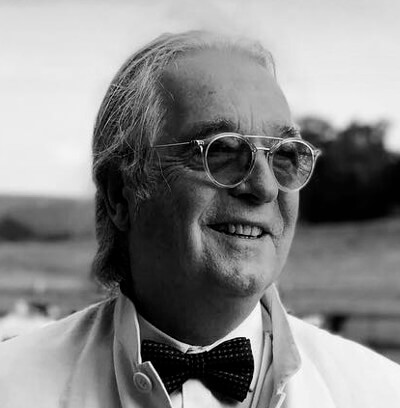
London & Greek island based poet Konstandinos Mahoney, won publication of his collection, The Great Comet of 1966 in the 2021 Live Canon collection competition. His first collection, Tutti Frutti, was a winner of the Sentinel Poetry Book Competition 2017. He is also winner of the Poetry Society’s 2017 Stanza Competition. He teaches Creative Writing at Hong Kong University (visiting lecturer) and is Rep for Barnes & Chiswick Stanza.
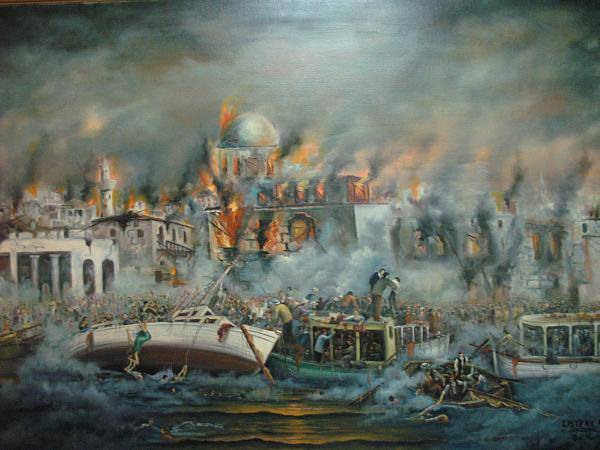
He writes: Last year was the 100th anniversary of the burning of Smyrna, an event marked by a major exhibition at the Benaki Museum in Athens, amongst other memorials. My grandparents were from Smyrna, they were lucky enough to escape to Alexandria, and so the anniversary meant a lot to me and prompted me to write this poem. It’s a narrative poem that maps the before and after of the Smyrna in the Greco-Turkish War (1919-1922), and explores the universal theme of lost utopias.
*****
Dino Mahoney: Poem
LOST CITY OF MYRRH
To the angel of the church in Smyrna write:
Do not be afraid of what you are about to suffer.
(Revelations 2: 8-11)
1919
Sun shines bright on reunited Smyrna,
Pearl of Anatolia, shines on cheering
crowds packed along the promenade,
on quays lined with cargo ships – figs,
carpets, currants, cotton, olive oil,
bound for London, Naples, Marseilles,
shines on restaurants, banks, bazaars,
mansions, konaks, kiosks, clubs, bars,
on church, mosque, temple, synagogue,
on French and English warships in the bay,
on The Kilkis, flagship of the Hellenic fleet
firing a booming twelve-inch gun salute,
shines on soldiers in khaki, white kilts,
disembarking to patriotic applause,
shines on the Metropolitan Chrysostom,
hand raised to bless the holy mission,
reclamation of the ancient hinterlands.
Five hundred years of Ottoman rule ended.
Greek hearts rejoice, Ionia regained,
Homer’s ancient city, Hellenic once again.
1922
In singed kilts, scorched khaki, vacant eyed,
defeated soldiers slink through Smyrna streets
down towards the harbour, acrid taste of smoke
on cracked lips, thirsty for a ship to take them home.
The city sees them, pauses, looks out at allied
warships anchored in the bay, reassured, goes back
to business, deals struck in Ladino in waterfront cafés,
the jingle of shop-bells on Rue de Franque.
At night the Cordon’s a crescent blaze of light,
supper at the Hotel Kraemer, cocktails at the
Café de Paris, audiences fill theatres, operettas,
fleeting pleasure in backstreet hotel rooms.
Next morning word goes round, Stergiades, Cretan
governor, hand firmly on the city’s civic rudder,
is leaving on a Greek destroyer. Somber crowds
along the waterfront, watch their future sail away.
The city tenses, shutters closed, doors locked.
Clouds of incense rising, The Metropolitan
raises supplicating hands to the Theotokos.
Clatter of hooves along the waterfront,
General Altay on a captured stallion,
behind him Turkish cavalry, sabers drawn.
Chrysostom, goes out to parlay, is dragged
like Hector, backwards behind wheels.
A gale blows up, petrol splashed, torches
tossed, a two-mile wall of sky-licking fire
roars down towards the waterfront. White-hot
furnace at their back, sabers pricking spines,
men, women, children on the sweltering
Cordon cry out to deaf warships in the bay.
On deck, brass bands pumps out jaunty waltzes,
drown out the siren call of human wailing.
Nine days the city burns, the sun, shrouded
by smoke, becomes a pallid moon.
Men are force-marched inland to oblivion,
families exiled to an alien motherland.
Three thousand years of Greeks in Asia Minor
ended, a fabled city gone. What’s left?
A cosmopolitan joie de vivre, an ache, a scar,
the gutsy music of rebetika.
*****
 The High Window
Thank you for sharing. I find these poems relate an interesting story but they are too much of an enumeration of facts and description. i would like to see some personal poetical forms in them.
Marie
LikeLike