*****
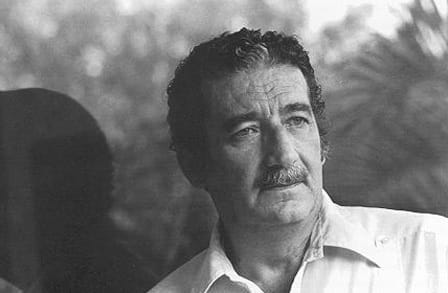
Jaime Sabines Gutiérrez, Mexico’s most influential modern poet, was born in Chiapas in 1926. His first collection, Horal, appeared in 1950 and met with widespread critical acclaim. Several of his later titles are considered classics, and his poetry continues to be anthologized and widely translated. He received numerous literary awards and honours over the course of his career, including the City of Mexico Prize, the National Prize for Literature, and the Belisario Domínguez Medal of Honour, the highest award bestowed by the Mexican government. Often regarded as one of the major poets of the twentieth century, he died in Mexico City in March 1999.
*****
Essay • Translator’s Introduction • Poems
*****
The Poetry of Jaime Sabines: ‘With a Bitter Mindfulness Seize the Dark Day’.
Belinda Cooke
Having devoted many years to translating Sabines, the Irish Canadian poet Colin Carberry is the perfect conduit into Sabines’ life and work, noting that, ‘unlike ideologically committed Latin American contemporaries, Sabines speaks for himself – resulting in a paradoxical mix of neutrality and admiration for Cuba.’ In his introduction, he explains how Sabines was drawn in by family ties, and firsthand experience after the Cuban missile crisis and Bay of Pigs. However, despite later serving two terms as a senator for PRI[i], the ostensibly left-wing party that ruled Mexico uninterruptedly from 1929 to 2000, he grew disillusioned due to both Castro and PRI’s repressive practices, and, more generally, with the Left in Medico. While in Havana, he read his poetry alongside such luminaries as Pablo Neruda, Camilo José Cela, Roque Dalton, Allen Ginsberg and Nicanor Parra, with whom he formed a close friendship. Carberry’s own voice is well attuned to the directness and authenticity of Sabines’ experience throughout the four sections which includes one on Cuba. A universalized interpretation of love and death drives his poetry – all captured in his unique, self-deprecating, self-mocking tone, engaging us with his quirky, dark, yet strangely humorous take on how we must grasp life’s nettle, with all its vicissitudes.
To understand Sabines’ wide appeal in Mexico, think of the standard Simpson’s episode, a mix of satire and slapstick. There is an apparent simplicity – edging into cliché – in some lines, such as here on Cuba, ‘You will be a house for everybody / a beautiful simple house’ (‘Cuba, vi’). Yet his simple diction often conceals the Shakespearean complexity of, say, Hamlet’s ‘To be or not to be’. Don’t be misled, for example, by the seemingly casual, prosaic opening to his Cuban sequence, as if inviting us to read his diary or share in the drafting process: ‘I didn’t know, at this altitude, how to describe what’s happening’, in two minds about Castro: ‘I subscribe to what the world’s reactionary press says (that’s how I was going to begin)’ (‘i’). For, suddenly he catches you on the hop as with the strange and puzzling impact of ‘comfortable / hopelessness’ as he transforms to the armchair politician: ‘I’m more like a comfortable bourgeois, / comfortable with life, with death, with hopelessness’. He frequently uses such oxymorons for a more nuanced take on emotions: ‘darkly / joyful’, ‘tempestuous / tender’, ‘peace / melancholy’. Thus, what at first sight seems to be a simplistic portrayal of the Cuban people as a noble disenfranchised mass – transforms the poems to living monuments of the struggle for freedom. Consider below, for example, how ‘darkly’ saves ‘joyful spirit’ from cliché, just as the balance and cadence, and alliteration of the contradictory ‘tempestuous and tender’ followed by ‘ebbing and flowing’ lifts the following lines, with much credit to Carberry’s translation at this point:
There are sad people everywhere,
but the Cuban is a darkly
joyful spirit, a source of sunlight,
a well-spring of water,
at once tempestuous, and tender,
he shouts aloud ebbing and flowing.
(‘v’)
Once one gathers that he is not focusing on the complex spectrum of individuals but a symbolic portrayal of the dispossessed, it’s easier to get into his mindset – ‘every youth in the university / is one hundred years old’ (‘’), he tells us. In ‘Cuba, vii’ on Banagüises, his father’s village, he does this beautifully with individuals all a part of the earth’s elements, all caught like objects in a painting:
They are like the trees:
women children the bakery with the earth
beneath their feet, the sun above them.
Things happen slowly here.
They graze on ideas, contemplate food,
arms emerge from the earth,
the grazing fields sway in the wind
A stone dog runs through the street
and a well of holy water flows.
A dead youth is an obelisk
and the air is a beautiful girl’s dream.
In the second section ‘Toy shop and Songs’ he moves to a personal reflection with poetry of the street. He combines this with a stylistic shift from free verse to mellifluous prose poems, with more of those unusual contradictions resounding against one another, seen here in this personification of rain:
Shorn of its legs from first light the day drags, itself through rough streets and has its fill of fun along the big avenues, and lies down like a tired dog under the trees in the plaza surrounded by the buildings’
Then it hides itself away, disappears, becomes one truth with the air, breathes. It tints the light with melancholy, lengthens the hour of the lovers, prolongs the solitude, deepens misfortune.
(‘It rains it drizzles…’)
The poem’s conclusion continues to deepen the metaphorical implications of this gambolling dog that is the rain of creativity and destruction: ‘The water over the city laughs, mocks time. It hardens window panes, turns them to mirrors, lights up the street lamps one by one.’
From here, he gets down to the bare bones of living and dying – reminiscent of T. S. Eliot’s ‘I have measured my life in coffee spoons,’ as contemplation of our days falls naturally into a consideration of death, another favourite topic of his:
What would Lazarus have thought as he was about to die the second time? The second death: was it different from the first, as Monday is different from Tuesday? How many deaths does each of us have the right to? Because life is always the same, but Death…
(‘Eleven-Fifteen…’)
The poems in this section leave you feeling grateful for life’s tragedy – a poetry of intense, melancholy mood – a case of seizing the dark day with a bitter mindfulness not with a naïve joy but some abrasive anger at the horrors of death and violence.
When he shifts into his other favourite topic of love poetry things lighten up with his distinctive humour, but as with his Cuban poems, these are poems addressed to a generic interlocutor rather than someone specific, here with an amusing playing around with the concrete and the abstract. Yet, still there is something tragic behind his words, built as it is around accumulated memories of past lost loves with the overriding theme that it is better to have loved and lost than not at all:
Would you mind if I loved you for only a week? It’s neither too much nor too little. It’s plenty. In a week one can gather up all the words of love that have ever been uttered and set them ablaze. I’m going to ignite you with this bonfire of burned-out love. And silence too. Because the finest words of love are between two people who say nothing.
There is sheer joy in some lines such as the rich emotion of, ‘Empty Stomach: Light Heart’: ‘Let’s learn to make love as the doves do. Let’s cry like children. There’s still time to rise with the sun.’ Yet, even here, we have a hypothetical situation built around the past. Indeed, this consistent drive to the universal is now explored further to suggest that all of his losses all feed into his poetic voice and all he can say about experience. This is beautifully caught here in ‘In The Gunny Sack of my Heart’, especially the final image of gratitude – ‘I take inventory of my stars’:
In the gunny sack of my heart everything fits, from infamy to tenderness, from the grapes of loved women to the bottle caps the children whip at me. Each hour deposits something different in my heart, and every time I take a memory out it emerges blood-streaked.
I duplicate myself relentlessly. Every day I try on hands and mouths, switch skins, eyes and tongue, and I put on a soul whenever the occasion calls for it.
From sunrise until nightfall the light varies and it is called day. Just like my name is Jaime. But I too linger in the darkness, beyond the impenetrable moment when I take inventory of my stars.
It is perhaps this dominant optimism about life that allows him to go on to his very unusual take on the meaning of death such as this very funny poems suggesting we should be just more chilled about it:
Whenever you feel like dying
hide your head under the pillow
and count four thousand sheep.
Go two days without eating
and you’ll see how beautiful life is:
meat, beans, bread. Go without women: you’ll see.
Whenever you feeling like dying
don’t get all worked up: just die.
and leave it at that.
The final two sections give us poetry increasingly heartbreaking in tone. The third section ‘Autonecrology’ signifies a personal obituary – a strange notion in itself, except that the I and the you suggest everyman: ‘I emerge from ashes / from tarnished ruins, / I m a choir of invalids dying’ (‘i’). Life is, paradoxically, a burden but one nevertheless loved: ‘What’s this thing I lug on my back? / it’s a sack full of my beloved vital organs’ and the poem’s subtly beautiful closing line hints at full petals as at the point before they drop: ‘immense petals of the open night’.
One feels also a connection back to the Cuban poems for this is also social poetry of the dead, giving tribute to victims of violent or repressive ends: ‘doors of vacant rooms… / concentration camps, wires / behind which famished gods cry out for water.’ (‘iii’) This poem is dense in wide-ranging novel imagery verging on a satanic mass for the dead. Then in ‘iv’ he reintroduces the love theme but now inseparable for a deathly lament for lives lost – fragments of all the past loves left as just fragments: ‘I am a stain, a dot on the wall, a scuff mark… / a scar no longer visible / a kiss worn away by time’. It is this love death connection that really connects these later poems – reminding us that violent death deprives the victim of that very personal right, but the spiritual sense of connection of death and past loves is hauntingly portrayed in ‘xi’:
Give me nothing at all, my dear:
I’ll draw you out of the wind;
drain you from the river shadow,
the spinning light, and silence;
from the skin of things
and the blood with which I board time.
Despite your protests, you are the fountains,
and I am parched.
Don’t speak to, touch or acknowledge me,
if you don’t wish: I no longer exist.
I’m but the life that pursues you,
and you the death I resist.
Sabines is a poet who just gives and gives and, as one explores the sequence ‘Night Flight’, we learn that ‘The city is huge like an enormous orphanage’ (‘I left my Body…’) and observe a Baudelairean flâneur engaging with the agony and ecstasy of the street. yet even in such melancholy moments, we sense that this is a poet inspired by his intense love of life.
Belinda Cooke has published her poems and translations in many journals. She has published an edition of Kulager, an epic poem by the Kazakh poet Ilias Jansugurov (Kazakh N.T. A., 2018) and Forms of Exile: Selected Poems of Marina Tsvetaeva (The High Window Press, 2019). She also played a major role in co-ordinating and contributing translations to Contemporary Kazakh Poetry (C.U.P, 2019). Her own poetry includes Stem (The High Window Press, 2019) and Days of the Shorthanded Shovelists forthcoming (Salmon Poetry).
*****
Colin Carberry: Translating Jaime Sabines
I had been living in Linares for about six months before I heard of Jaime Sabines. A year earlier I had backpacked through parts of Central America and from Chiapas to the Texas border, before dwindling funds cut short my three-month adventure. For the rest of that long, depressing winter, I resolved to return. In 2001 I boarded a Greyhound bus in Toronto and seventy-five hours later I was back in Mexico’s arid north. But for those first lonely months living in a dilapidated house, immersed in the works Rulfo, Paz, and Rosario Castellanos, I was struck by the feeling that something fundamental was eluding me.
Then it happened. Ostensibly for the purposes of improving my limited Spanish, I had begun to meet for coffee with a charming young teacher from a private school where we both worked. When Verónica read me the opening lines of a prose poem in Hotel Plaza one rainy August afternoon I felt a sharp, visceral shock—
I HOPE TO BE CURED OF YOU one of these days. I have to stop smoking you, drinking you, thinking you. It’s possible, following the moral guidelines of our times. I prescribe time, abstinence, solitude.
—I realized that I had stumbled upon a major poet. So why hadn’t I heard of this Jaime Sabines?
A few weeks later, after attending a cultural event at the local theatre which featured an effusive recitation of another of Sabines’s prose poems, “I Love You at Ten in the Morning,” one of us turned on the car radio to hear the same poem fading through the poorly tuned static…On November 2nd, the Day of the Dead, stopping to admire the altares de muertos that some of my pupils had erected in memory of famous Mexicans, I spotted a framed photograph of a mustachioed, curly-haired man with thick glasses and vaguely Arabic features grinning from behind a haze of cigarette smoke. I must have commented on this, because the following morning a student loaned me her mother’s copy of a selection of Sabines’s work. The author photo on the cover was the same one I had seen atop the altar. Two days later, the school principal handed me a volume of Sabines’s love poetry called Poesía amorosa—which I immediately began to translate.
Jaime Sabines’ enormous popular appeal derives in part from his ability to communicate universal truths in an original and accessible, authentically Mexican colloquial diction (which predates the anti-poetry of Nicanor Parra by many years) utterly without pretensions. Sabines wrote about everyday themes (love, death, social unrest, existential anxiety), people, and places (hospitals, bars, parks, rooming houses, brothels). For over two decades he earned his living selling cloth in his brother Juan’s store in Tuxtla Gutiérrez. He later sold animal feed to buyers in Mexico City before being elected to the federal legislature from 1976 to 1979 and again from 1988 to 1991. But if the quotidian struggles of working life coloured and informed his poems, strangely, for a two-term politician who identified with the ideals of the Cuban Revolution and thought capitalism had failed, he wrote few overtly political poems, and saw no contradiction between his working and his writing lives: “Poetry happens like an accident, a mugging, a love affair, a crime; it happens every day, when, alone, a man’s heart begins to think about life.”
Beyond being a truly popular poet, he received almost universal critical acclaim for his work. “One of the finest contemporary poets of our language,” Octavio Paz said of him as early as 1972; and in 1983, when Sabines received the National Prize for Literature, the Nobel laureate added, “His intense personal opus is in my view among the most important in Latin America and the Spanish language.” José Emileo Pacheco, himself one of Mexico’s foremost poets, counted Sabines’s poems “among the finest of his language and of his times,” while Mario Benedetti regarded him as “one of the indispensible poets, not merely of Mexico but of all Latin America and the Spanish language.” Interviewed by the New York Times shortly after Sabines’s death, the American poet W. S. Merwin said, “He has a voice completely his own. His poetry is extremely intimate and plain, but powerful, sometimes shockingly powerful. It spoke to anybody.” And Philip Levine writes: “His best poems are revelations of truths, odd truths, truths we immediately accept, which we have long suspected as truths but have never before heard articulated.”
Since that rainy August afternoon twenty-five years ago when Verónica introduced me to Sabines’s work, I have published three volumes of his poetry in translation: Adam and Eve and Weekly Diary and Poems in Prose (2004) and Love poems (Biblioasis, 2011), and I am currently putting the finishing touches to Yuria, one of his best and most influential books. Sabines remains a constant presence in my life and an influence on my work. I invite you to enjoy these English translations of classic poems by “one of the indispensable poets, not merely of Mexico, but of all of Latin America and the Spanish language.”
Colin Carberry is a Toronto-born Irish writer and translator now living in Linares, Mexico. His work has appeared in numerous journals, newspapers and anthologies worldwide (Poetry Ireland Review, Cyphers, Exile: The Literary Quarterly, The Irish Times, Reforma, Jailbreaks: 99 Canadian Sonnets, El Norte, and The Antigonish Review) and in three poetry collections, and his poems have been translated in many languages. His Selected Poems, Ghost Homeland (Scotus Press, Dublin), was translated into Bangla and published in Kolkata, India, in June 2024.
*****
Jaime Sabines: Six Poems translated by Colin Carberry
I JUST DROPPED ROSA OFF
I had just dropped Rosa off at the railway station. Rosa has cancer and is returning to Tuxtla to die. She knows, and we have been entrusted with the care of her daughter.
Like bulls, at the hour of death we seek out the place we hold most dear. We take with us the smell of the earth, seeds, and the tree-leaves of the country beneath the skin, the sand and the air in which we were raised, the baptismal water of all our days. We want to get mixed up with all these things when we feel mortally wounded.
Rosa’s corpse is headed off in search of its rightful place. Today she takes the 8:25 train en route to Tuxtla. Bon voyage!
IN THE OPEN EYES OF THE DEAD
In the open eyes of the dead
there is a strange, lustrous sheen!
Film of air in the motionless pupil,
shadowy veil, tender light.
Love keeps vigil in the open eyes
of dead lovers.
The eyes are like a coveted,
impenetrable, half-open door.
Why does death defer lovers, entomb
them in a place of silence like the earth?
What is it about the weeping light
in the water of the eye—in that wasting
meniscus of trembling glass?
Guardian angels took them to their breasts;
in their gaze, they breathed their last,
died of their own veins.
Those eyes are like stones
left by a blind hand on the face.
Mystery spirits them away.
Ah, the beguiling sweetness
in the casket of the air that entombs them!
QASIDA OF THE TEMPTRESS
They all desire you but none of them love you.
No one can love you, you serpent,
for you are bereft of love,
you are as dry as dried straw
and you bear no fruit.
You have a soul like the skin of old men.
Face it. You can do little more
than inflame the hands of men, and seduce
them with the promise of your body.
But cheer up. In this profession of desire
there is none like you to feign innocence
and to beguile with those immense eyes.
C U B A 6 5
I
I don’t know, at this stage, to know what to think.
I’m feeling a bit down, sad, jaded and empty.
I purposely let three months drift past,
to go within, to study you from a distance,
safe and sound from you, Cuba caliente.
(Here’s my first mistake. I don’t want to bind
myself to words or to rhythm.
God free me from myself
as I have freed myself from God.)
I subscribe to what the world’s reactionary press says.
(That’s how I was going to begin.)
In Cuba, there are deprivations, scarcity, a lack of chickens,
there are no fancy clothes or new cars,
few medicines and lots of work for everyone.
I subscribe to this.
I want to make clear I’m not in the pay of the Communist Party,
nor do I receive dollars from the American embassy.
(Aren’t things going so well for the gringos
in Vietnam and Santo Domingo!)
I don’t generally dabble in political poetry
and I’m not trying to sort out the world.
I’m more like a comfortable bourgeois,
Comfortable with life, with death, with hopelessness—
everything. I don’t have sound habits;
I’ve yet to learn to laugh or make small talk.
I’m a bit of everything,
and I think if these were a pirate ship,
it’d be all the same whether I was cook or captain.
I I
“Hunger and thirst for justice”—
is it more than hunger and thirst?
Since when does a whole nation tighten its belt
because the situation calls for it?
From what root of anger
what depth of pain,
from how much deferred vengeance,
how many deferred dreams
does today’s force surge?
But this much must be said:
To get rid of socialist Cuba,
they will have to wipe out six million Cubans;
they will have to flatten Cuba with a gigantic shovel
or hurl every atom bomb and demon in their arsenal at her.
(Mister President Johnson:
Let’s sink Cuba
because the island of Cuba sails dangerously
close to America.)
I I I
“Who is Fidel?” they ask me,
and I don’t know.
One night, on the Malecón, a girl I was with
started clapping and shouting: “There goes Fidel,
there goes Fidel,” and I saw three cars pass.
Another time, at a baseball game,
the people shouted at him:
“Give it up, Fidel”
the way you might talk to your brother.
“Fidel showed up and he said…”—says the peasant.
The worker says, Fidel was here.
The conclusion I have drawn from all this
is that Fidel is a Cuban duende. [1]
He has the gift of omnipresence:
he is in the schools, the countryside,
the ministers’ meeting, the mountain hut
between the sugarcane and the bananas.
Truly, Fidel is the name
of the wind that rouses every Cuban.
[1] According to Diccionario Para La Enseñanza de la Lengua Española, the Spanish word duende refers to “an imaginary being who dwells in certain places, who commits acts of mischief, and who appears in the form of an old man or a child,” but according to The New Oxford Dictionary of English the word also refers to a “spirit” and also connotes “a quality of passion and inspiration.”
I V
I’m fed up with the word revolution,
but something is happening in Cuba.
It is not a painless childbirth, but a whole
convulsed, hallucinatory one.
It has broken up families, separated
those who don’t want to see or to witness,
the wounded and the powerless.
Why does my eighty-year-old uncle, Ramón,
with children in Miami, and others
from Colon to Havana,
want to die in Cuba?
Why do children sing in class, between classes,
and on their way to work?
(One Sunday in Cienfuegos
I saw them heading out early on a truck
into the country, and it was as if Cuba
was dawning in their songs and laughter.)
Why do América and Celeste
and the other hotel maids study daily?
Why have books suddenly
made such a major comeback?
In truth they have departed,
furrowing the sea, the gusanos,
and the men and women are gone;
the certain or deceived,
the violent, the lost, the daunted,
have departed; they have fled—blackened—
into the mutilated future that awaits them.
Cuba is on the march, at the vanguard,
of the heart, still whole,
Cuba is on the march, has held the line.
Cuba surrounded by enemies.
Cuba alone in the sea.
Cuba has held the line.
V
It grows laboriously, but
transparently.
This growth is cleansing—in it, there is
something pure and painful;
these are the years of change, of adaptation;
of learning to live in a different way.
Where did I ever see so much joy spill out
over the fresh blood on Playa Giron?
school of combat: fishermen,
seafaring boys, blackboards gone spastic.
There are sad people everywhere,
but the Cuban’s is a darkly
joyful spirit, a source of sunlight,
a well-spring of water:
at once tempestuous and tender,
he shouts aloud, ebbing, flowing.
V I
Building your house, Cuba’s
hands are clean.
You will be a house for everybody:
a beautiful and simple house,
a house for bread and for water,
a house for air and for life.
V I I
One day, in a small village called Banagüises,
I felt the people, the country, the truth of Cuba.
They are old and peaceful people
(I wept with Ignacio and Jabay and Juanita)
houses of wood and broad porches
(I wept in their peace and their melancholy).
A modern tarmac road criss-crosses
the vicinity as far as the railway tracks.
Nearby, trains haul sugarcane
and load up the midday.
They are there like the trees:
women, children, the bakery, with the earth
beneath their feet, the sun above them.
Things happen slowly here.
They graze on ideas, contemplate food,
arms emerge from the earth,
the grazing fields sway in the wind.
A stone dog runs through the street
and a well of holy water flows.
A dead youth is an obelisk
and the air’s a beautiful girl’s dream.
Banagüises, which my father wore
like a relic on his chest,
is a young and ancient village
in this new and ancient Cuba.
V I I I
I want to state that Martí was already here
in these trenches—that all these present
were there by his side.
Camilo Cienfuegos is one hundred years old
and every youth in the university
is one hundred years old.
(It’s so tough this fighting and this dying
and this rebirth and this re-fighting for freedom!)
Those who are here now were here before.
By tomorrow their number will have multiplied,
because the leaven of justice is righteous
and they only want to live in peace.
The machine-gun-toting youth,
the uniformed girl,
the boy walking with a notebook on his head,
the old man shouting at the ball game,
the dockers, the bakers,
good God, even the poets,
only want to live in peace.
Those who die in the streets
want to live in peace as well.
I X
It is essential to stand facing the sea.
The dark sea is Miriam’s colour,
it has her swell and her clarity.
On the village beaches I felt it was easy,
enormously easy, to love.
The sand and the wind,
the trees and the people
can all join in unison.
Cuba, let us fight
to live in peace.
AFTER THINKING THINGS OVER
They tell me I should exercise in order to lose weight,
that round 50’s when the fat and smokes do the damage,
that I must keep myself in good shape, and wage
the good struggle against time and old age.
Well-intentioned experts and doctor friends
push diets designed to promote the belief
that life can somehow be stretched past its due date.
I’m grateful to them all, but I have to laugh
at all such ultimately futile attempts.
(Death, too, gets a kick out of all this stuff.)
The only recommendation I take to heart
is to find a young woman for my bed,
because at this stage of the game
youth alone can hope to reach us second hand.
NOTE TO ROSARIO CASTELLENOS [2]
Only a fool could dedicate her life to solitude and love.
Only a fool could electrocute herself with a lamp,
if the lamp was live,
squandered lamp of the day are you.
Double fool for being defenseless, disarmed,
for offering your basket of fruit to the trees,
your water to the well,
your warmth to the desert,
your wings to the birds.
Fool again, re-Chayito, re-mother of your son and yourself.
Orphaned and alone, like in the novels,
little mouse acting the tigress,
not letting yourself be seen for your smile,
masking yourself with transparent shells,
covering your extreme nakedness
with velvet quilts and words.
I so love you, Chayo, it guts me to think
they’re bringing back your body! —as they say—
(Where did they leave your soul? Could they not
just have scraped it from the lamp,
scooped it up off the floor with a broom?
What—they don’t have brooms in the embassy?)
It kills me, I tell you, that they are bringing you back
so they can put you, place you, manhandle you,
drag you from funereal honour to honour!
(Like they’ll be pulling that Illustrious Men [3]
shit with me; yeah, like fuck they will!)
I’m devastated, Chayito! And that’s it, then?
That’s it all right, end of story!
The good news is the big write-ups in El Excélsior,
and I’m quite sure more than a few tears were shed;
they’re going to dedicate whole supplements to you,
better poems than this one, glosses, critical studies.
You have all the fame you could hope for now!
The next time we meet
I’ll fill you in on all the rest.
I’m not angry anymore.
It’s hot as hell here in Sinaloa.
I’m off to the pool to have a drink.
[2] Prominent Mexican feminist writer and diplomat (Mexico City, 1925-Tel Aviv, 1974.).—Tr.
[3] In an irony she might have enjoyed, she was buried in Mexico City’s “Rotunda of Illustrious Men.”—Tr.
 The High Window