*****
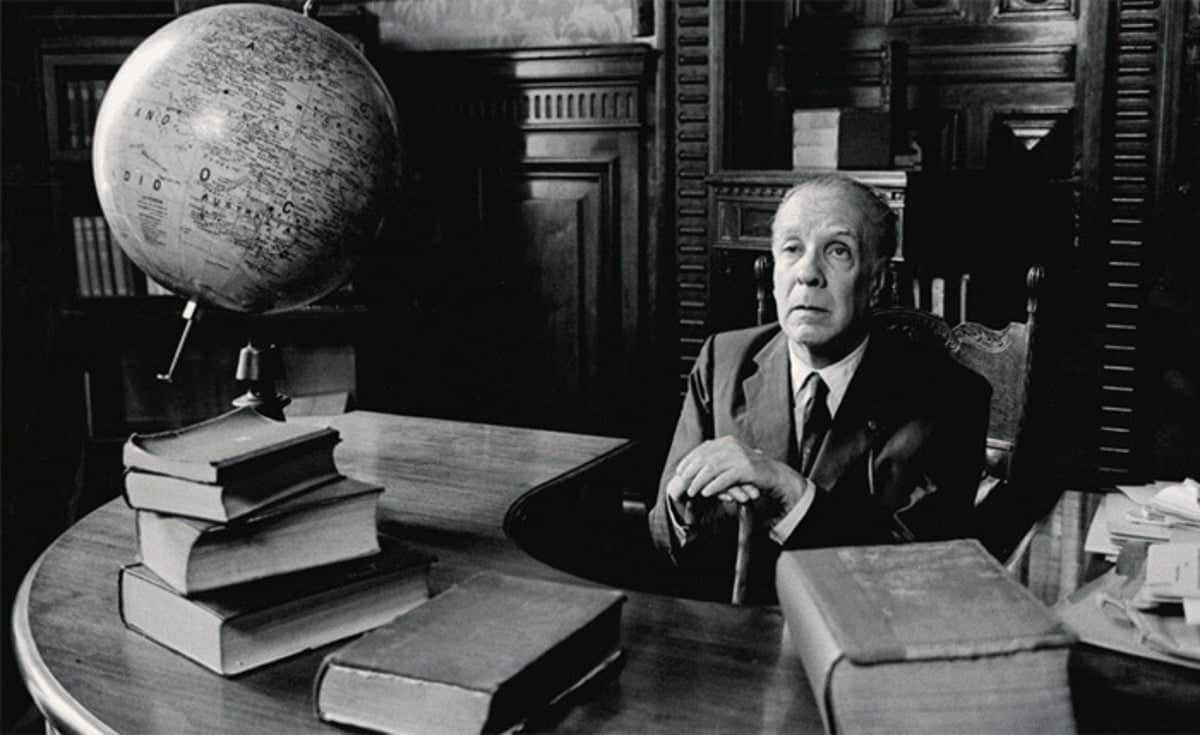
JORGE LUIS BORGES 1899 – 1986
Jorge Luis Borges was born in Buenos Aires into a highly educated family of Argentine and British ancestry and always claimed that his father’s vast library was the seed bed for his creativity and erudition. He was bilingual from an early age, was widely read and profoundly erudite, able to discourse on the great writers of Europe and America. Thanks to his grandmother, he learned to read English before he could read Spanish. He recalled reading even Cervantes’ Don Quixote in English before reading it in Spanish.
He became blind when he was 55, and this perhaps explains his reclusiveness and why he was nearly unknown in most of the world until 1961 when, in his early sixties, he was awarded the Prix Formentor, the International Publishers Prize, an honour he shared with Samuel Becket. This made him internationally famous.
When his own work came to be translated into different languages, he was said, on occasions to have assisted his translators. In this selection of a dozen translations, I hope to have reflected something of the extraordinary extent of his culture and knowledge.
*****
Jorge Luis Borges: Twelve Poems
translated by Allen Prowle
ONE OF URBINA’S SOLDIERS
Whether he could ever be as brave again
as he had been at sea, this soldier had his doubts,
and so, resigning himself to menial tasks,
wandered alone in his hard land of Spain.
Seeking to shun the world’s brutality,
or soften it, he went in search of the sublime,
finding the magic of an ancient time
in the heroic tales of Roland and of Britanny.
Each day he gazed about the open land
bathed in the sinking sun’s relentless copper
glare, and thought he was undone, alone and poor.
Quite unaware of music that awaited his command,
he moved through some deep dream, entranced,
seeing Don Quixote and Sancho ride out upon their quest.
*
Un soldado de Urbina
Sospechándose indigno de otra hazaña
Como aquélla en el mar, este soldado,
A sordidos oficios resignado,
Erraba oscuro por su dura España.
Para borrar o mitigar la saña
De lo real, buscaba lo soñado
Y le dieron un mágico pasado
Los ciclos de Rolando y de Bretaña.
Contemplaría, hundido el sol, el ancho
Campo en que dura un resplandor de cobre;
Se creia acabado, solo y pobre.
Sin saber de qué música era dueño;
Atravesando el fondo de algún sueño.
Por él ya andaban don Quixote y Sancho.
***
TO A SAXON POET
In the snow your footprints’ trail Northumbria
has often seen, and now it has forgotten,
numberless the sunsets which have been
between us, my grey brother.
Slow, in the slow shadows, you would fashion
those metaphors of swords crossed on high seas,
of the horror at home among pine trees,
of the solitude the days bring in.
Where can one look now for your features and your name?
These an already ancient darkness
hides. So, I can never know just how things
were when on this earth you were a man.
You journeyed along roads of exile,
now you live only in your poems of iron.
*
A un poeta sajón
La nieve de Nortumbria ha conocido
Y ha olvidado la huella de tus pasos
Y son innumerables los ocasos
Que entre nosotros, gris hermano, han sido.
Lento en la lenta sombra labrarías
Metáforas de espadas en los mares
Y del horror que mora en los pinares
Y de la soledad que traen los días.
¿Dónde buscar tus rasgos y tu nombre?
Ésas son cosas que el antiguo olvido
Guarda. Nunca sabré cómo habrá sido
Cuando sobre la tierra fuiste un hombre.
Seguiste los caminos del destierro;
Ahora sólo eres tu cantar de hierro.
***
A POET OF THE THIRTEENTH CENTURY
He looks again through drafts he struggled with
of that first sonnet, still to be named,
sees now the haphazard way he intermingled
tercets and quatrains, his flouting of good taste.
With a slow pen, he smoothes its roughness,
then pauses. Did he perhaps just hear,
portent of some future and its holy terror,
the distant singing of nightingales?
Will he have felt that he was not alone,
that the incredible Apollo, the arcane,
had just revealed an archetype,
unclouded, voracious to embrace
whatever night conceals or day reveals:
Daedalus, labyrinth, enigma, Oedipus?
*
Un poeta del siglo xiii
Vuelve a mirar los arduos borradores
De aquel primer soneto innominado,
La página arbitraria en que ha mezclado
Tercetos y cuartetos pecadores.
Lima con lenta pluma sus rigores
Y se detiene. Acaso le ha llegado
Del porvenir y de su horror sagrado
Un rumor de remotos ruiseñores.
¿Habrá sentido que no estaba solo
Y que el arcane, el incredible Apolo
Le había revelado un arquetipo,
Un ávido cristal que après aria
Cuanto la noche cierra o abre el día:
Dédalo, laberinto, enigma, Edipo?
***
CAMDEN, 1892
The smell of the coffee and of the papers,
Sunday and its tedium. Morning,
and on a glimpsed page some allegories
in verse, the self-preening publication
of a lucky poet whom he knew. He lies, an old man,
prostrate and pale, in his respectable
poor person’s dwelling, holding the reflection
in the dull mirror of his feeble stare.
He knows, without surprise now, this face is what he is.
His mind elsewhere, his hand touches
the unkempt beard, the paralyzed mouth.
The end is near. I am almost not, his voice declares.
But through my poems drums the pulse
of Life in all its splendour. I was Walt Whitman once.
*
Camden, 1892
El olor del café y de los periódicos,
El domingo y su tedio. La mañana
Y en la entrevista página esa vana
Publicación de versos alegóricos
De un colega feliz. El hombre viejo
Está postrado y blanco en su decente
Habitación de pobre. Ociosamente
Mira su cara en el cansado espejo.
Piensa, ya sin sombre, que esa cara
Es él. La distrait mano toca
La turbia barba y la saqueada boca.
No está lejos el fin. Su voz declara:
Casi no soy, pero mis versos ritman
La vida y su esplendor. Yo fui Walt Whitman.
***
LINES COMPOSED AND WRITTEN IN AN EDITION OF THE SAGA OF BEOWULF
Sometimes I wonder what compels me,
without the slightest hope now, as my darkness falls,
of accuracy, to grind on with this study
of the language of those flinty Saxons.
Worn down by time, my memory
fumbles with words which, time and again,
I have repeated, and, in this way, is so much like my life,
which spins and then unspins its flagging story.
And then I tell myself that it will be
because the soul knows, in its secret, arrogant way,
it is immortal, that its huge, determined
circle can embrace and can accomplish everything.
So far beyond this yearning and my verse,
waiting for me, inexhaustible, is the universe.
*
Composición escrita en un ejemplar de la gesta de Beowulf
A veces me pregunto qué razones
Me mueven a estudiar sin esperanza
De precisión, mientras mi noche avanza,
La lengua de los ásperos sajones,
Gastada por los años la memoria
Deja caer la en vano repetida
Palabra y es así como mi vida
Teje y desteje su cansada historia.
Será (me digo entonces) que de un modo
Secreto y sufficiente el alma sabe
Que es immortal y que su vasto y grave
Círculo abarca todo y puede todo.
Más allá de este afán y de este verso
Me aguarda inagotable el universo.
***
A COMPASS
To Esther Zemborain de Torres
For every single thing there is a word.
Day in, day out, in someone’s or something’s language
is written an illimitable verbiage,
which narrates its history of the world.
Carthage, Rome, you, me and him, into the same herd
it drives. My unfathomable life, the heartbreak
that is being an enigma, puzzle, stroke of luck,
the whole of Babel’s riotous discord.
Behind the name lies something still
which has no name. Today, I sensed its shadow quiver
in that blue, keen, delicate needle
probing towards some ocean’s rim.
I thought it was like a clock seen in a dream,
or a sleeping bird’s sudden shiver.
*
Una brújula
A Esther Zemborain de Torres
Todas las cosas son palabras del
Idioma en que Alguien o Algo, noche y día,
Escribe esa infinita algarabía
Que es la historia del mundo. En su tropel
Pasan Cartago y Roma, yo, tú, él.
Mi vida que no entiendo, esta agonía
De ser enigma, azar, criptografía
Y toda la discordia de Babel.
Detrás del nombre hay lo que no se nombra;
Hoy he sentido gravtitar su sombra
En esta aguja azul, lúcida y leve.
Que hacia el confín de un mar tiende su empeño,
Con algo de reloj visto en un sueño
Y algo de ave dormida que se mueve.
***
EMERSON
That tall American gentleman
closes the volume of Montaigne and then goes out,
hoping for just as great enjoyment
in an evening which simply exalts the plain.
Towards the deep and setting sun,
towards the horizon which this sunset gilds,
he walks through fields, as now through memory
does the one who writes. He thinks:
I have read the essential books, have written
others which a dark oblivion should not bury.
A god has gifted me whatever knowledge
is allowed to mortals to acquire.
Throughout the continent my name is known.
I have not lived. I would I were another man.
*
Emerson
Ese alto caballero americano
Cierra el volumen de Montaigne y sale
En busca de otro goce que no vale
Menos, la tarde que ya exalta el llano.
Hacia el hondo poniente y su declive,
Hacia el confin que ese poniente dora,
Camina por los campos como ahora
Por la memoria de quien esto escribe.
Piensa: Leí los libros esenciales
Y otros compuse que el oscuro olvido
No ha de borrar. Un dios me ha concedido
Lo que es dado saber a los mortales.
Por todo el continente anda mi nombre;
No he vivido. Quisiera ser otro hombre.
***
JONATHAN EDWARDS (1703-1755)
Far from the town, its meeting place’s noise,
and far from time’s incessant pulling up of roots,
Edwards, eternal now, dreams and advances
to the beckoning shade of golden trees.
Today is tomorrow and yesterday.
Nothing in God’s serene creation,
the gold of evening, the gold of the moon,
but serve to praise Him with their mystery.
He thinks the world is an eternal
instrument of anger, and is joyful,
the yearned for paradise is for a handful,
hell and damnation wait for almost all.
And in this tangle, in its very centre,
there is another prisoner, God, the spider.
*
Jonathan Edwards (1703 – 1755)
Lejos de la ciudad, lejos del foro
Clamoroso y del tiempo, que es mudanza,
Edwards, eterno ya, sueña y avanza
A la sombra de árboles de oro.
Hoy es mañana y es ayer. No hay una
Cosa de Dios en el sereno ambiente
Que no lo exalte misteriosamente,
El oro de la tarde o de la luna.
Piensa feliz que el mundo es un eterno
Instrumento de ira y que el ansiado
Cielo para unos pocos fue creado
Y casi para todos el infierno.
En el centro puntual de la maraña
Hay otro prisionero, Dios, la Araña.
***
SPINOZA
Even in this half-light the Jew’s hands,
as they grind the lenses, seem to glow,
and the dying afternoon is fear
and cold (each afternoon just like another).
His hands, the paling hyacinth-blue air
the ghetto walls shut in, seem hardly
to be there for this impassive man,
lost in that maze of light he dreams.
Fame does not trouble him, that dreams’ reflection
in the dream of yet another mirror,
nor the fearful love of young women.
Free from both myth and metaphor,
he polishes an intractable lens:
infinite Map of One who is all His stars.
*
Spinoza
Las traslúcidas manos del judio
Labran en la penumbra los cristales
Y la tarde que muere es miedo y frío.
(Las tardes a las tardes son iguales.)
Las manos y el espacio de jacinto
Que palidece en el confín del Ghetto
Casi no existen para el hombre quieto
Que está soñando un claro laberinto.
No lo turba la fama, ese reflejo
De sueños en el sueño de otro espejo.
Ni el temeroso amor de las doncellas.
Libre de la metáfora y del mito
Labra un arduo cristal: el infinito
Mapa de Aquél que es todas Sus estrellas.
***
ALEXANDER SELKIRK
I dream that the sea, that sea, surrounds me
still, and from the dream the ringing of the bells
of God restores me, sanctifies the mornings
of these so familiar English fields.
Five years I suffered, gazing at the endless
things of solitude and of infinity,
which now make up that story I repeat,
like an obsession, in the taverns I frequent.
God has returned me to the world of men,
to mirrors, doors, numbers and names,
and I have ceased to be the one who scanned
eternally the sea, a fathomless steppe.
But what now can I do to let that other know
that I am here, among my people, safe and sound?
*
Alexander Selkirk
Sueño que el mar, el mar aquél, me encierra
Y del sueño me salvan las campanas
De Dios, que santifican las mañanas
De estos íntimos campos de Inglaterra.
Cinco años padeci mirando eternas
Cosas de soledad y de infinito,
Que ahora son esa historia que repito,
Ya como una obsesión, en las tabernas.
Dios me ha devuelto al mundo de los hombres,
A espejos, puertas, números y nombres,
Y ya no soy aquél que eternamente
Miraba el mar y su profonda estepa
¿Y cómo haré para que ese otro sepa
Que estoy aquí, salvado, entre mi gente?
***
ODYSSEY, BOOK TWENTY-THREE
Now has the iron sword the rightful
task of vengeance carried out;
now have sharp arrows and the lance
spilled out the blood of the evil one.
Despite a god and all his seas,
to his realm and queen has come back Ulysses.
Despite a god and the grey winds,
the clamour and din of Ares.
Now, in the love of their marital bed,
the radiant queen, her head upon the breast
of this, her king, is fast asleep. But where now the man
who, banished from his home, was forced,
by day and night, to roam about the world,
a dog, who said his name was No One?
*
Odisea, libro vigésimo tercero
Ya la espeda de hierro ha ejecutado
La debida labor de la venganza;
Ya los ásperos dardos y la lanza
La sangre del perverso han prodigado.
A despecho de un dios y de sus mares
A su reino y su reina ha vuelto Ulises,
A despecho de un dios y de los grises
Vientos y del estrépito de Ares.
Ya en el amor del compartido lecho
Duerme la clara reina sobre el pecho
De su rey pero ¿dónde está aquel hombre
Que en los dias y noches del destierro
Erraba por el mundo como un perro
Y decía que Nadie era su nombre?
***
OEDIPUS AND THE ENIGMA
At dawn four-footed, by day standing tall,
with three feet through evening’s emptiness
wandering, was how the sphinx, eternal,
looked upon his inconstant brother, Man.
And then there came a man, towards sun set,
one able to make out, with horror,
in this monstrous image’s mirror
the reflection of his own decline and fate.
Oedipus we are, and, for eternity,
we are this elongated, triple beast,
all that we will be, all that we have been.
It would destroy us if we were to see
our entire being so grotesquely figured.
Merciful God makes time run on, lets us forget.
*
Edipo y el enigma
Cuadrúpedo en la aurora, alto en el día
Y con tres pies errando por el vano
Ámbito de la tarde, asi veía
La eterna esfinge a su inconstante hermano,
El hombre, y con la tarde un hombre vino
Qué descifró aterrado en el espejo
De la monstruosa imagen, el reflejo
De su declinación y su destino.
Somos Edipo y de un eterno modo
La larga y triple bestia somos, todo
Lo que seremos y lo que hemos sido.
Nos aniquilaría ver la ingente
Forma de nuestro ser; piadosamente
Dios nos depara sucesión y olvido.
Allen Prowle was born in Aberdare in 1940. Education took him to England where he has lived ever since, without losing his ‘Cymreictod’. He began writing poetry at Sheffield University where he graduated in French. His poems have appeared in many journals, his first collection, Landmarks was published in 1973. His Europeanism explains his interest in translation; he has translated French Italian and Spanish poems, for Magma, MPT and The High Window. In 2009, MPT published his translations of Rocco Scotellaro in its first-ever single author collection. He was awarded the Stephen Spender prize for translations of Attilio Bertolucci.
 The High Window