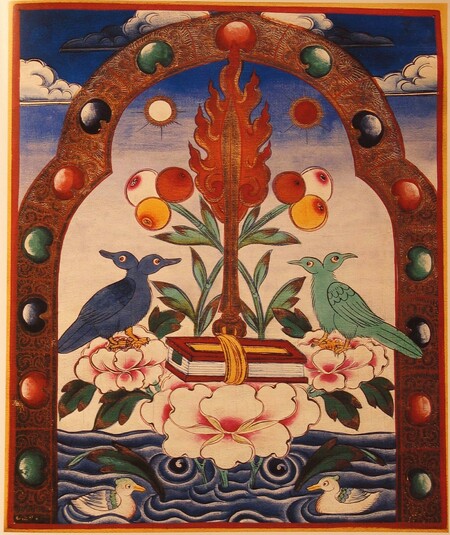
Two translator Birds
*****
Introduction
The ‘Love Songs of the Sixth Dalai Lama’ is a collection of 65 poems popularly ascribed to the Sixth Dalai Lama Tsangyang Gyatso (1683-1706). The Sixth Dalai Lama was notorious for his indifference to the religious and political obligations of his office. He publicly renounced his monastic vows, preferring to spend his time in the taverns and brothels of Lhasa. He died at the age of 26, taken hostage and presumably killed by hostile Mongol forces. (His captors claimed implausibly that he died of natural causes.) Despite his unconventional behavior, the Sixth Dalai Lama is a revered figure in Tibetan culture. Some have tried to interpret his lack of the conventional monastic virtues of celibacy and abstinence as an example of Tantric Buddhism in which the deliberate flaunting of moral norms is seen as a dangerous but potentially more efficacious route to Enlightenment. But the poems themselves suggest a simpler explanation – Tsangyang Gyatso was an ardent young man chafing at the restraints of familial, religious, and political authority. His poems express the desire to escape the ‘fierce demon’ of public disapproval in order to taste ‘the ripe fruit there before him.’
The poems themselves are quite short – four lines of six syllables a piece, almost haiku like in their brevity. But the condensed style of classical Tibetan literature, the tendency, especially in poetry, to omit grammatical particles whenever possible, means that one can pack a lot of meaning into a very small compass. Despite their surface simplicity, these poems can often be read as an indirect commentary on the difficulties of Tsangyang Gyatso’s precarious position in Lhasa. They also touch on specific aspects of Tibetan Buddhism that may not be familiar to the uninitiated reader. For example, the poem beginning ‘I strive to see my teacher’s face’ alludes to the Tibetan Buddhist practice of “guru yoga” in which the disciple visualizes his teacher as an incarnate Buddha. But I believe the poem works, or should work, even for someone completely unfamiliar with this practice. I have endeavored to translate these poems in a way that conveys the only thing that can be adequately represented in English – their lucid surface.
*****
Louis Hunt is a retired professor of political theory from James Madison College, Michigan State University. He has studied both Sanskrit and Classical Tibetan. In Fall 2008, he lectured on politics and studied Classical Tibetan at the Central Institute for Higher Tibetan Studies in Sarnath, India. He has published poems and translations in a variety of print and online journals including Snakeskin, Metamorphoses, The Brazen Head, Interpret, The High Window, New Verse Review and Nimrod.
*****
Seven Poems from ‘Love Songs of the Sixth Dalai Lama’
Translated from the Tibetan by Louis Hunt.
Note: The poem numbers refer to Per K Sorensen’s critical edition: Divinity Secularized: An Inquiry into the Nature and Form of the Songs Ascribed to the Sixth Dalai Lama, Wien 1990.
***
Bowed before my learned teacher,
I ask him to still my wavering mind.
But my thoughts stay only a moment
before they steal away to join my love. (17)
*
I strive to see my teacher’s face
but nothing can bring it to mind.
My lover’s face appears unbidden
as vivid and clear as any vision. (18)
*
Once stamped, this small black seal
shuts out the human voice.
Let modest candor instead
affix its seal to both our hearts. (14)
*
The feathers of this bird of prey
are frayed by forces of rock and wind.
Plagued by intrigue and deception,
I too have been stripped and flayed. (38)
*
A thief stole my love from me.
Now I need a diviner’s art.
For this passionate girl returns
again and again in my dreams. (33)
*
However much I fear
the fierce demon behind me,
I cannot stop from tasting
the ripe fruit there before me. (65)
*
Was she born from a mother’s womb
or sprung from a peach tree’s wood?
Her changing heart will soon exhaust itself
like a peach flower withering on its branch. (35)
 The High Window