
*****
The High Window is proud to publish the following feature on the work of Thomas McCarthy, one of Ireland’s most widely respected contemporary poets. It consists of two reviews by Belinda Cooke of McCarthy’s Questioning Ireland, a collection of his writings in prose, and of Plenitude, his latest volume of poetry.
The editor is also grateful to Carcanet Press for permission to republish three poems from Plenitude (Carcanet, 2025), two poems from Prophecy (Carcanet, 2019), and to Thomas McCarthy himself for one of his unpublished poems.
*****
Thomas McCarthy was born at Cappoquin, Co. Waterford in 1954 and educated at University College Cork. He worked at Cork City Libraries for over thirty years. He was a Fellow of the International Writing Program, University of Iowa 1978/79 and Professor of English at Macalester College, Minnesota, in 1994/95. His poems have been published in Poetry, London Magazine, Times Literary Supplement, The Irish Times, The Guardian, Financial Times, Poetry Review, Southword and Poetry Ireland Review. His many collections of poetry include The First Convention (1978), The Sorrow Garden (1981), Merchant Prince (2005), Pandemonium (2016), Prophecy (2019) and Plenitude (2025) He has won The Patrick Kavanagh Award, The Alice Hunt Bartlett Prize, The O’Shaughnessy Prize and the Annual Literary Award of The Ireland Funds. A former Editor of Cork Review and Poetry Ireland Review, he is a member of Aosdána, the Irish affiliation of writers and artists. His diaries, Poetry, Memory and the Party, were published by Gallery Press in 2022 and Gallery published Questioning Ireland, essays and reviews, in 2024. His work has been translated into many languages, most notably Italian, French, Romanian, Russian and Chinese.
*****
What the critics have said
Reviewing his debut collection The First Convention in The Irish Times in 1978, Eavan Boland wrote: ‘Its strength lies partly in convincing, unrhetorical public statement; but even more in the perceptions that underlie it. This is that rare and long-awaited advent in Irish poetry: a glimpse of de Valera’s Ireland through the eyes of a poet born into the officially-declared Irish Republic. Here is a scrutiny of the dream in the punishing light of the reality.’ Of The Sorrow Garden in 1981, Hugo Williams wrote ‘Thomas McCarthy is yet another Irishman come to haunt us with his youth and assurance’ while Derek Mahon observed in The Literary Review that ‘his is the most interesting debut in recent Irish poetry’ and Brendan Kennelly wrote in The Irish Times ‘Not many poets have McCarthy’s gift of being able to write so tenderly about private affections and so acutely about public figures and events.’
Terry Eagleton, reviewing Mr Dineen’s Careful Parade on RTE1 Television, said ‘McCarthy is writing out of a sense of history and community and memory. Although deeply rooted in his own history, he roams widely: he can be both personal and political in different poems in impressive ways..…’ while Peter Porter, writing in The Observer, noted ‘McCarthy has a tone which is very much his own, a kind of burnished commonplace. He writes true satires of circumstance.’ Bernard O’Donoghue, reviewing Merchant Prince (2005) In The Times Literary Supplement wrote: ‘McCarthy has been one of the leading Irish poets …… The most impressive quality in all his writings has been the ability to represent the politics and society of his local world with wit and fidelity, and yet seeing them in a world of ideas beyond the local…’
Reviewing Prophecy (Carcanet, 2019) in The Times Literary Supplement, David Wheatley wrote: ‘while the poets of Northern Ireland consolidated all-conquering reputations during the 1970s and 80s, their contemporaries from south of the border appeared to lag behind, outside Ireland at least. Among the most distinguished of these is Thomas McCarthy, who has also been among the most prolific of Irish poets.’ Martina Evans wrote in The Irish Times: ‘…Prophecy appears miraculously just two years after his acclaimed Pandemonium…Magnificent, passionate and urgently prescient, Prophecy confronts mortality and materialism, asserting the power of art.’
*****
Questioning Ireland • Plentitude • Poems
*****
Thomas McCarthy: Questioning Ireland. The Gallery Press. ISBN: 9781911338680. Reviewed by Belinda Cooke
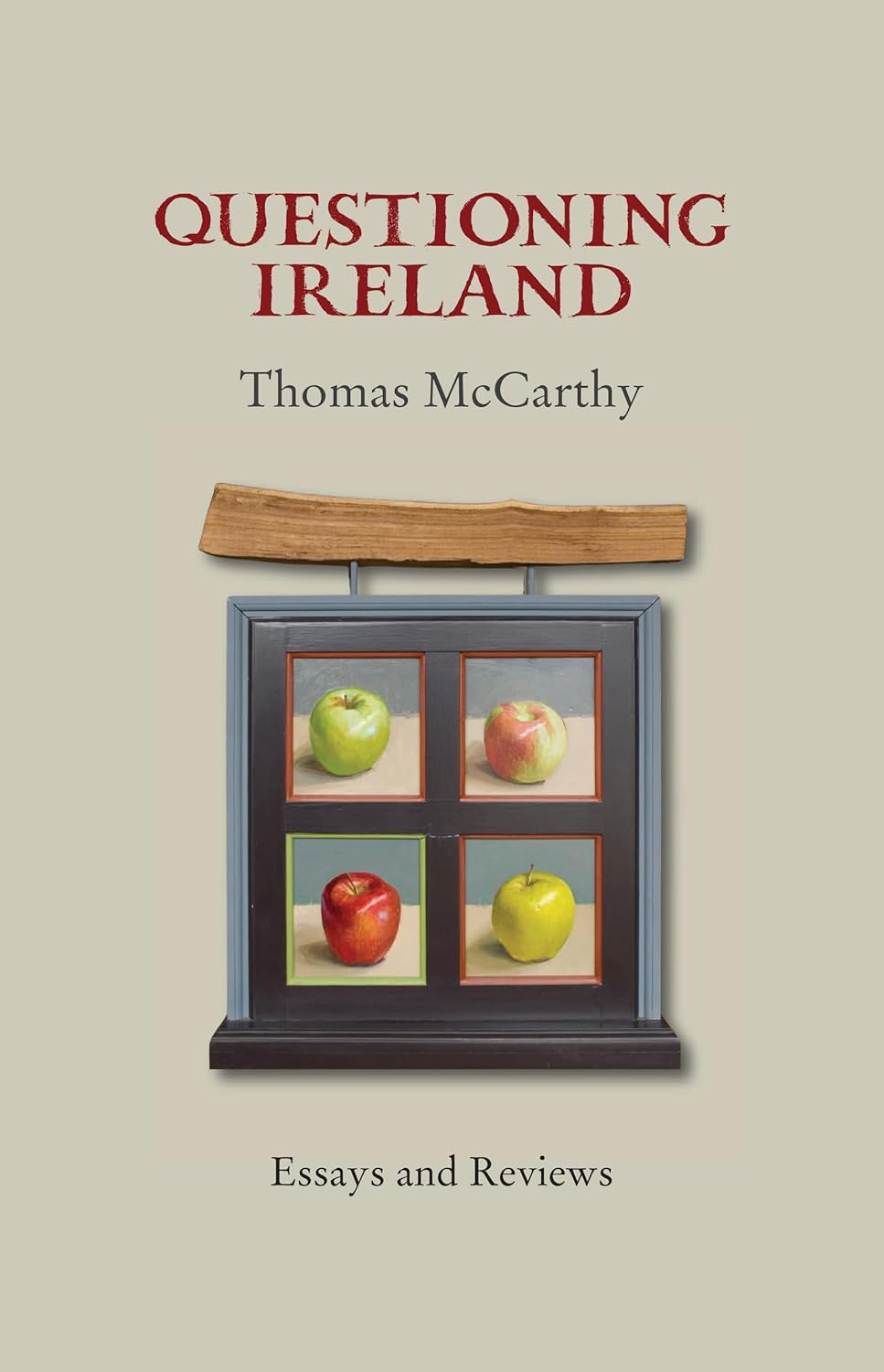
McCarthy’s fifty-years-plus collection Questioning Ireland is a sustained campaign against the often simplistic, impassioned, and traditional narratives that have evolved out of Ireland’s fractured history. He is no less attached to home, but argues that a country will always be ‘more than the sum of its poems’ (p.55) for his Ireland is, ‘fluid, tantalising, varied, hopeful and despairing, uplifting and depressing, all at the same time.’ (p.46). He also trusts himself to tell it like it is: ‘Like James Connolly I love plain facts as well as the sound of them. They are a marvellous antidote to abstract fanaticism.’ (p.26) The result is an impressively erudite, stylish critique, verging on polemic, on Ireland’s history, culture and politics. Whether championing women’s writing, unpicking the complexities of southern Protestantism, raising the profile of sidelined Anglo-Irish poets and novelists, or speaking up for the unemployed, in McCarthy’s book, everyone should be allowed to come to the party.
And it is striking how constant McCarthy’s views have remained. Aside from chastising his own naive schoolboy rejection of Louis MacNeice’s poetry, for the various ways it was not ‘Irish enough’ – ‘What a stupid set of reasons not to read a poet…it is the country of imagination that demands a reader’s loyalty’(p.226) – he has sustainedly spoken up for the underdog or marginalised. A dominant motif is his condemnation of De Valera’s Fianna Fáil decades in power, backed by reactionary, Catholic Church driven authoritarianism. This has resulted in a certain hangdog mindset: ‘deep in the FF soul is that almost Russian acceptance of a society held together by safety pins and binder twine.’(p. 63) Many who may agree with this, might be less prepared for the hard statistics he uses to shoot down Ireland’s sacred cow, the Easter Rising: ‘around half a million live on benefits’, for the 100,000 ‘salaried elite’ and their offspring it is a different story:
‘In truth, while 17% of us went away, that 100,000 are the ones who have inherited our patriotic dream called ‘Ireland’ – our country exists for their intense benefit and through this poetic construct called ‘Ireland’ their children will be the true beneficiaries of the Easter Rising.’
(p. 25)
And in the end, 1916 was not a friend to poets as they saw their books banned and cosmopolitanism stifled. McCarthy clearly wants to cut through all the noise and just make people’s lives better. As a counter to Pearse’s ‘blood sacrifice’ he argues that ‘to live for Ireland is the very best thing’ (p.30) to really change lives: ‘When art and poetry reaches them in their Council terraces and labourers’ cottages the promises of 1916 will be complete.’ (p. 30) He is similarly negative about De Valera’s romantic ideal of the Irish countryside: ‘the romance of the countryside is dead’ (p. 26) vividly taking us back into the pre-Celtic Tiger Ireland that De Valera’s insular policy artificially maintained. This is his own 50s rural childhood in of Cappoquin , a place of nuns and baronets… ‘a kind of vapour of indolence hung over the smaller shops.’ (p. 40) I can’t but think of my Mayo mother whose parents paid for her to get trained as a hairdresser in a local shop that might have one customer in a whole day.
Ireland does slowly creak into the twentieth century, something he lovingly captures via the transformative arrival of free secondary education in the sixties. Suddenly there was hope for working class young people like himself: ‘Thousands of blue Careers leaflets…appearing as ubiquitous as Ladybird books, or broken Marietta biscuits.’ (p.64) Thinking once more of my mother who was deprived of a post-fourteen education, in the forties, this seriously struck a chord – she’d clearly missed that boat. Yet, he is rapidly disenchanted as he observes Ireland’s economic descent downhill in recent years, noting how 3-4000 local highly-skilled local jobs local disappeared overnight following Ireland joining Europe. None of this is helped with the subsequent collapse of the banks after the Celtic Tiger boom. His years working in Cork’s public library has given him a ringside seat in seeing the impact, such as a family all relying on the income from the single family member who managed to get a job.
McCarthy looks to the women poets for Ireland’s salvation. Sweeping in as a rather unusual advocate, for so often the women are left to act as their own critics, he has a deep knowledge and longstanding passion for the Irish women poets along with the early American feminist Adrienne Rich’s work. And as a prolific reviewer in Ireland’s main outlets, take it as read he has reviewed the main texts of ‘everyone’, both male and female. Thus, repeatedly, we see him as the cutting edge reviewer for women as a they come out of the shadows. Eavan Boland gets specific praise for her more progressive take on Irish history to counter the male hegemony holding herself and other women back. His makes no bones about condemning his own sex for such exclusions: ‘The omission of women writers from the canonical Field Day Anthology was the most public act of male episcopal arrogance in contemporary Irish literary criticism.’ (p. 15) He lauds the fact that eventually Eiléan Ní Chuilleanáin and Paul Meehan were appointed as professors of poetry and that, finally, up and coming younger writers are being similarly rewarded. But beyond the fairness of it he sees a specific cultural benefit:
‘It is not just the story of that long struggle that gives women’s poetry its moral power. It is something more ordinary than that … Irish women’s poetry in the last forty years has created a new, larger aesthetic, a larger way of thinking about Irish poetry as well as a new way of thinking about Irish life itself.’
(p.82)
Clearly, in `McCarthy’s eyes atavism and nostalgic provincialism is a bad thing – for art, personal growth and even morality. An affectionate tribute to the poet friend Patrick Galvin, is telling in this respect: ‘I feel his absence terribly, a kind of narrowing of the air.’ (p.18)
And the Anglo-Irish are, finally, another group who have been pushed to the side in ‘modern’ Ireland. Here we see McCarthy promoting the work of the Ascendency writers Elizabeth Bowen and Molly Keane, as well as bringing Louis MacNeice and Hubert Butler in from the cold. From this perspective, McCarthy highlights the predicament of how the Anglo-Irish of the ‘Big House’ era had become an anachronism, again homing in on a deeply ironic fact to make the point:
‘Most of those families chose silence and disengaged from the machinery of Southern politics. It is part of the irony of history that their properties were, for the most part, burned by people who considered their Big Houses as part of the fabric of the New Free State, Liam Lynch and his gang of irregulars who were hostile to the Dáil. But even the Dáil and its political culture excluded these people: the scrupulous policy of Irish neutrality put a seal on the irrelevance of the Anglo-Irish.’
(p.219)
And just as he argues for a warts and all acceptance of an Ireland of complexity, he counters the same reductive treatments of Protestants as a group: ‘There are now so many varieties of Irish Protestant that the category itself has collapsed.’ (p.220) Interestingly in resurrecting the Irish essayist Hubert Butler, he reveals him to be a writer after his own heart, here citing Dervla Murphy: ‘a resolute crusader for honesty in every area of life.’ (p. 221)
A review can barely scratch the surface of a collection of this richness, which weighs in at more than four hundred pages. So the focus has been on McCarthy’s consistent stance to politics and art, but aside from this, take it as read that in such a long career of reviewing, he has written repeatedly on all the major Irish poets of his age, along with many less well known, many of whom he has known as good friends, as well as tracking Ireland’s contemporary history. In this respect it’s a gold mine .
*****
Thomas McCarthy: Plenitude. £11.99. Carcanet. ISBN: 9781800174108.
Reviewed by Belinda Cooke

The gentle tone of Plenitude’s rich gathering of ninety plus poems has McCarthy, like a wise friend, quietly sharing a balanced view of his Irish world with all its troubled history. He sets out with subtly resonating lyrics: ‘Echoes, more than anything else create a way in…’(‘Parallel’);‘The deepest thing has a rumble / That you can never see’(‘A Meadow in July’), before moving on to more open-ended meditative journeys of self-discovery. Both here and in Questioning Ireland’s prose, aside from occasional strong invective: ‘watching Ireland bleed emigrants to death’ (‘The Regent Institute’s Write for Profit’), he maintains a politically inclusive stance, towards, say, often marginalised women writers as well as the post-1916 Anglo-Irish Protestant minority. His unique world-view is layered with memorable aphorisms (‘memory tries to be a frank revelation of the commonplace’; ‘you would think love had never died in this world’), along with an unusual horticultural trope to assist his personal introspection, as well as the celebration of his marriage centred round a shared love of gardening: ‘For thirty odd years flowers had surrounded my wife, waiting patiently, / Making little raids into her heart…’; ‘Together we destroyed a sensational rosa grandiflora that merely // Wished to flourish above all things on this earth.’(‘Salvia Red Huntsman’) Often, with collections, less is more, but here, his substantial poems, edging into prose poems at times, offer us a text, that never stops giving, not to mention the gardening knowledge you will acquire in the process.
He opens with understated lyrics that hint at the individual’s life as unique yet insignificant: ‘A Meadow in July’ gives us an extended metaphor of the writing process that is far more hesitant than the ‘sudden sharp hot stink of fox’ of Ted Hughes’ well known ‘The Thought Fox’ – McCarthy’s poet is just seen hanging about waiting for an unassuming poem to form itself:
The way poems heave in their nervousness
Before small birds hit the windows,
Thinking poetry is a drift of insects
Or some such promise of food.
We gaze beyond our rooms in idleness,
Idly dreaming of things outside ourselves,
And the result is no grand transcendence from word into world: ‘Between our faces and July. See it’s the same poem / Has placed the glass between us and the meadow.’ Ironically, such a low-key approach, only adds to the poem’s subtlety and mystery. In contrast to luxuriant plant poems seen later in the collection, ‘The One Leaf’ has Samuel Beckett’s bare tree of Waiting for Godot as the perfect backdrop to the poem’s bleak existential mood. The poet doesn’t even get as far as that earlier ‘Idly dreaming’: ‘Here beneath a tree time will tell / Whether it was worth getting up this morning…// The self that time makes worthwhile / May never seem whole…’
Art, in the face of such uncertainties, is just a constant complex journeying as McCarthy moves on to analyse painting and photography. ‘Immortal Form in the Margins of Sean Sculley’s “John Antony”’ is a stunning, endlessly inventive stream-of-consciousness, sustaining a focus on the colour of this abstract painting, for thirty-five lines:
xxxxxxxxx…My eyes trace with their finger-tips this long
Voyage between settled land masses of paint, ocean-going
Fingers trace this surface of sunlight between black and grey,
Striations of white that end constantly in a sunburst, a breath
Of light. I turn a corner to find a chasm of yellow, all become
A stream of striations of white and yellow; and white again
In this brushwork ocean.
He goes on to pay tribute to the artist Christo’s art installations, that involve wrapping up of large objects, the Reichstag being one of his most famous: that: ‘…made it seem, momentarily, a tender thing. / The way sunlight fell on it made a sound // Of your heart beating.’(‘Parallel’) Then in ‘The Art of Fixing a Shadow’ we have a microscopic dissection of the workings of early photography linking it to the poem as a frozen memory:
xxxxxxxx…Too late to fume the plates over iodine
Crystals, to begin the process of re-remembering. From the
Collodion negative of what happens, we cut and turn,
We bathe and hope to dry. And the poem, in its own strict
Chemical sense, it is our one fixed carbon or albumen print.
What is great about so many of these poems is the way he sets out from the merest fragment to moving expressions of love and loss. Take the wonderful ‘Late Summer’ with its sympathy towards the decaying world of the protestant ‘Big House’ literary tradition of writers like Molly Keane and Elizabeth Bowen: ‘A butterfly wing, to begin with. // The incongruous remnant of a life,’ opening out onto thoughts of the Anglo-Irish way of life, the ghosts of the past ever present in the interiors they have lived in:
Rooms bear a coffin that will not be silent
But ache to share with us their deaths
Within. When the dead speak
It’s as if a young professor
Newly hired had fallen overboard
With all the notes from Anglo-Irish life
Washed in the swell and lost.
This mansion slips from its own reflection
I late autumn loneliness. Its lawns and patios
Lean back, opening a wet mouth.
And such inclusiveness stands out all the more set beside his own working class Catholic background, with a father struggling to make a living and him as the child paperboy, at Christmas, enviously gazing in on more affluent homes: ‘I was living vicariously off Christmases seen behind glass.’ (‘Christmas Eve, 1963)
Though McCarthy gives the impression that art for him provides compensation for mortality, he also often appears to be niggled by life. Definitions of the past fail to meet his own satisfaction, while he looks anxiously to the future concerned for his children:
We hoard issues instead of wealth; urgent issues fill up our coffers
With lustrous gold, newly minted. There is the issue
Of our young who cannot afford a home: there is no nest
For them in the places where they might begin to live. This
One issues burns a hole in the pocket of my brain, it creates
An unauthorised balance in the place where my soul
Should be at ease.
(‘Lustrous Gold’)
And his immediate present is constantly interwoven with the fragility of plants subject to the vicissitudes of the seasons, often personified to represent shifting states of mind: ‘Yet why should I lust / After some other richness when an Amaryllis… fills // my life already with its own delicious luxury?’ (‘Amaryllis’), and of the camellia:
xxxxxxxxxxxxxxxxxxxxxxxxxxxIts tender attempts
At flowering in the teeth of wind are forgotten by me
Though its every leaf is tearful still, embittered by
The first frosts and fearful of what’s to come.
(‘Apodictic’)
All this, of course, is good news for the poetry. Whatever of the life, poetry so often thrives on the bleak and/or tragic and McCarthy’s misanthropic moments give some of his richest emotion. To conclude, one of my favourites is his moving tribute to his mother who felt she been given a raw deal in life set and wanted God to know about it. McCarthy recalls, in the context, the place that prayer held in her life while drawing together many of the themes on memory and the passage of the seasons seen in so many of the poems. In the process he gives us some very funny disrespectful humour towards his own lapsed Catholicism. Above all he brings her younger self back with great empathy and love:
xxxxxxxxxxxxxxxxxxxxxxxPrayer was taking the strain
As this poem is now; not enough to hug the destinies
Her God had ordained, but to complain atheistically
As if Catholic prayer was one of God’s local Deputies
Who’d deliver a stiff letter to the senior staff of Heaven.
Devoted to prayer, she thought it obvious for God to see
She’d been treated unequally. Here among wet trees
No sound from nature is her sound of getting even –
I can hear her plaintive weakness, its immense power,
Its millions of Irish faithful behind it. Belief like war.
Where November settles a moment, you’d think
Things might settle at my age. But what’s unresolved
Is what ‘s truly permanent, as the fresh water and distinct
Mussel assembles in one pink pearl. Time dissolves
But not our memories that harden and crust over,
Becoming agitated with their own sediment. I feel
Uncannily alone with her on this bleak, wet November
And ready to crack some joke about priests, to release the girl
I always sense in there.
(‘Month of the Dead’)
Belinda Cooke’s seven collections include Russian and Kazakh translation, in particular, Marina Tsvetaeva, and a memoir of her mother: From the Back of Beyond to Westland Row: a Mayo Woman’s Story (The High Window Press). Her latest collection, The Days of the Shorthand Shovelists, is due out from Salmon later this year.
*****
Thomas McCarthy: Seven Poems
WORSE THAN NOTHING
Even then I knew that my life would be far less painful
Than my father had predicted. Cigarette poised
In a very superior gesture, a great gesture
Of idle, ill-deserved grandeur, he explained
That any effort I might make in Ireland
Would come to something worse than nothing.
It is this wet November drain I’m clearing of
Rotted leaves and cigarette-butts that puts
Him in my mind now – a beautiful cynic
For a father, a father who’d laugh at your dreams,
Who only loved that one Noel Coward song
There are bad times just around the corner,
Not realizing as I did, though a boy, that Noel Coward
Must have poked at many versions of that
Before the grey sludge moved, before the song came.
(from Prophecy, Carcanet 2019)
REBELLION
My betters have died for Ireland but I prefer to remember
Chiffon, I mean the sheer black chiffon gown that followed
Ginger Rogers in the perfect revolution of her body, that time
When she ambushed an orchestra. It was her commandante
In white tie and tails, that task master and patriot
Fred Astaire, who turned and turned as if bullets
Were heat-seeking and meant for him. But Ginger
In her folds and folds of shimmering black
Outclassed everything low calibre, rising like a statue
Of some outdated deity turning to molten lead
And spilling across the dance-floor with entire nations
Looking on. It should be just for this that young boys die.
With my betters looking on, I still wish to choose chiffon;
Perhaps because I am a poor mother’s son, working-
Class and politically ignorant. I mean I might have
Fought in a Great War, without my national interests at heart,
Only to come home to this, this one consolation of chiffon
In a dance-hall where we met, in a post-war dance routine.
(from Prophecy, Carcanet 2019)
THE ONE LEAF
Here beneath a tree time will tell
Whether it was worth getting up this morning,
Though none of us are immune.
The self that time makes worthwhile
May never seem whole
In the way Samuel Beckett was
With that one single leaf
On the tree of his entire life:
His bitter truth is not cinnamon, nor should it be.
If time doesn’t want to have faith
Or absorb any scripture
There is simply nothing that can ever be done
With the leaf on the tree or the lost leaf.
Let me be plain about this and never emotional
Because time will tell: there is a purple shellac
Of the one leaf from the crushing of beetles,
And still a holy rood within. It’s just that time,
A leaf, always has the last word.
(from Plenitude, Carcanet 2025)
D.V.
Burdens that the poor seemed to carry were lighter somehow
Between the will of God and the will of God. The hard rain
That fell slantways across your frayed coat, the blue snow
That made your delicate, girlish knuckles also blue; the pain
Of not knowing and never knowing how the house might appear
As you climbed the frightened, ungrateful tenement steps:
Such things were how God ventured, such things were in the fear
You felt for the lives of others and never your own life, except,
It must be said, in the days leading to Christ’s day of birth;
Days when you thought, to the end of Advent, a turning of the key,
That something of Christ’s peace might have landed on earth –
On your own house specifically. Worried, you might say,
Very quietly, “God willing, let’s hope the mood is good inside.
Let’s hope his mood has changed again.” But flesh and state
Would be too weak to yield to our dreams; his crushing diatribes
Awaited your cold, ashen face. My hand in yours, I lost my faith.
(from Plenitude, Carcanet 2025)
A TRUE ORIGINAL
It was at your Bar Mitzvah in old Cork city
In the very long ago when everyone was so happy
That Lord Mayor Goldberg gave you that silver gift
Of a Parker 75, though there was no clip
Set into the tassie, which according to Lih-Tah Wong’s
Handbook means that it was not a true original.
It was ‘The Banks of My Own Lovely Lee’ they sang in Hebrew
And all sang it because everyone was then so happy
To be young and full of beginnings and medical degrees.
A farming uncle had sent a straw box of almonds
So that we might never forget, not even in Cork,
Where a concert could delay us on the way to a Promised
Land. The Rosenberg String Band played on and on, but
“Something’s happened to old Ireland,” Mayor Goldberg said,
“a land once as lovely as a Swan 34,” and moved at a clip
Out of Irish public life. It was at your Bar Mitzvah.
(from Plenitude, Carcanet 2025)
SUNLIGHT ON THE ARCHIVE
(for Louis Marcus)
The archive folder where I let it too long in the sun
Began to curl with the warmth of my own forgetfulness,
Its faded blue label a small finger curling in invitation
As if it wanted to get away from its own subject matter
To dance or breathe. It got me singing of Israel
And sunlight and fruit. Of the musty Lafite Rothschild
We indulged in and all the cut flowers you arranged,
Thinking not of Exbury, but of Béatrice’s Villa
Ephrussi and the Azalea pink sea of St.-Jean-Cap-Ferrat –
Though yours was a Tel Aviv much simpler than that,
A picture-framer’s house in Adelaide Street,
An honest life at the edge of Cork’s edgy Marsh
Where all said a “Gutten Yahr,” not “Shanah Tova”
And only one barrister, one surgeon, made a career –
So it is with this May altar of sunlit May,
This wildflower, the orange sky, memory blazing
In a fitfulness of embers. Float over us, history,
Drop upon us paper roses, crafty wires, clips snapping shut
Upon hieratic glass, bartering pony-trap and baroness –
Words that both save us and condemn, long in the sun.
(Previously unpublished)
MOST HOLY ROSARY
Because you were then so angry with Israel
I lit seven blessed candles in the Church
Of the Most Holy Rosary. I waited patiently
For each wick to take the flame from me
And the light when it came seemed blessed
With good intentions. I wanted to tell you
How much your anger meant to me, how
I valued it in the deepest political sense.
But I also liked when the light of my candles
Illuminated the anguished face of Our Lord
In his alcove. I liked that He reminded me
Of the faces of elders at prayer in William
Rothenstein’s oil of Spittalfields Synagogue
And how light shines on everything we love.
(Previously unpublished)
 The High Window