*****
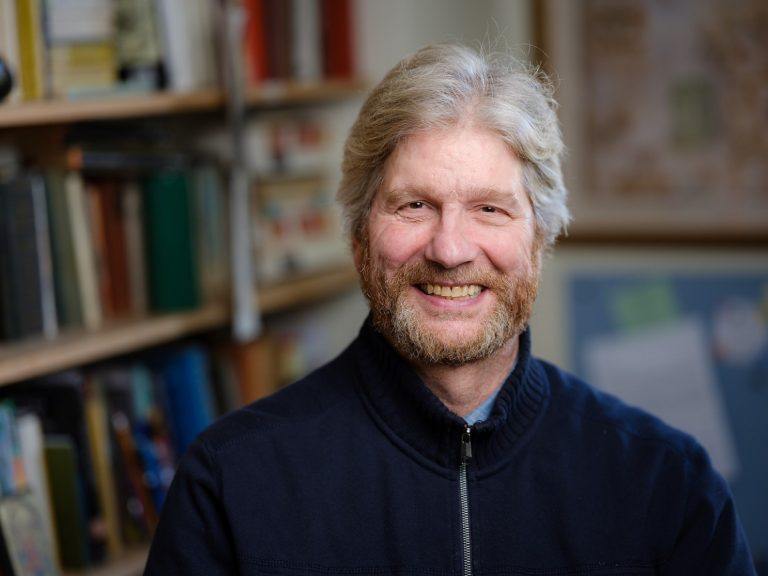
Jefferson Holdridge is Professor of English at Wake Forest University in North Carolina and the author of the four volumes of poetry, discussed below. He has been published in Prairie Schooner, Poetry Ireland Review, Southword, The Irish Times, The Anglican Theological Journal, Mantis, The Christian Century, The Quint, Honest Ulsterman, The Italian Review, The Galway Review, and Poetry Wales, among other venues. In 2017 he co-edited and introduced Post-Ireland? Essays on Contemporary Irish Poetry with Brian O’Conchubhair (WFU Press). His most recent critical work was Stepping Through Origins: Nature, Home, and Landscape (Syracuse, 2022).
*****
Introduction
My approach to poetry has changed over the years… I have always been drawn to formal poetry, with a taste for meter and rhyme, though like many Americans my first poems were mainly blank verse with the best of them reaching towards Imagism, if not quite attaining a good version of it. My American influences are Dickinson, Stevens, Frost, among others, but the taste for the traditional of course led me to Irish and English poetry, where there are many influences.
Thematically I think my poetry has always moved between poems on nature and those on art. This is partly due to having lived in Ireland for fourteen years as well as having visited Italy nearly every summer for the last thirty years. America is nature (as Milosz felt when he came to America ); Europe is culture. My first volume, Eruptions (Belfast: Lapwing, 2013), was inspired by visits to Naples (my wife is a Vesuviana), but I was living in Dublin, so these settings mingled with memories of New England, where I’m from. My next volume , Devil’s Den (Ithaca: Split Oak, 2015), centers around a Nature Conservancy that was just down the road from the Connecticut house in which I grew up. I felt that it had become a map of both my conscious and subconscious mind and in that regard was a source of poetic inspiration. My third volume was titled The Sound Thereof (Bradford, UK: Graft, 2017) and was very much moved by the birth of my daughter later in life as well as a heart operation I underwent, which led to months of jealously guarded quiet at home. My fourth (The Wells of Venice, Eugene: Resource, 2020) was the product of many months spent in Venice, Italy and examined those moments when the imaginative audacity that is Venice is somehow chastened by the pressure of a felt and actual experience. The wells built to supply fresh water in a saltwater lagoon are themselves works of art that serve an urgent purpose.
In my volume in preparation (The Bond) I have aimed to write of how nature and art, nest and urn, mirror each other and often combine. The Bond compares the forms and purposes of nature and art. The basis for this comparison is laid in the first poem, “Next to Nature, Art,” and summed up in the last poem of the volume “Nest & Urn.” These poems consider Walter Savage Landor’s epigram on nature, art, life and death, sometimes called “The Dying Speech of an Old Philosopher.” The volume as a whole searches for a poetry that links art and nature. The artist’s vision, sometimes Orphic, sometimes Christian, is what links art and nature in the end. The spirit moves as number and metaphor. The poems included here are the most recent and I would like them to appear in a volume provisionally titled Disorder and Rule, which takes up many of themes and places of earlier work, but with a sharper sense of the social/political turbulence in which we find ourselves caught. [JH]
*****
Jefferson Holdridge: Seven Poems
THE LAST FACE
In this three-dimensional work of art
The creator clothed in personal dress has bent
The wire toward him to complete the outline
Of the last face to set upon a plinth,
Where each face has an expression and a part
In the fore and background of the box,
Leaving the viewer to find out what it meant.
Red, blue, green, and black highlight the design.
It’s been many years and travels since
You saw the original and noted how it locks
The facial attitudes implying a conversation
That remains mid-flow yet always changing
Waiting for the next enunciation
Which never comes. He’s frozen while arranging
The faces and not finishing one at hand.
Without its plinth we wonder where it would stand.
Or perhaps he had decided to finish
Where he was and remove the last wire
Though that would have left a blank space.
As is, the creator fills his own wish
To be done. Fixed in his strength, his face
Hidden from view. The faces much higher
Than he could have reached, as if another power
Had helped him to create the display
Which will forever continue to tower
Above like the gods of Rome and Greece,
Never merciful, never bothering to allay
Our fears or grant a moment of peace.
But no, there he is and there he will stay.
Lord of his work, judging every day,
Knowing the work he began will never cease.
ROSE OF JERICHO OR THE RESURRECTION PLANT
A tumble weed that can wait for a decade
Before reviving in unexpected rain,
Which grows wherever it’s transitively laid.
Planted by the wind, threatened by the sun
And watered on the day of resurrection.
A movement that has intransitively lain
A witness to its own objective stance
Of death in life — a picture of resilience —
Of life in death, of time and space colliding,
Of the need to travel and the desire for rest.
While all around the sands are sliding
Over the shifting dunes where once they lay.
Few beside this plant withstand the test
That drained to the edge of death will roll away.
ADULT CARTOONS
The decadence has become that twisted.
Nudity in cartoon characters and profanity
In a bugs bunny voice. Because we insisted
On breaking taboos, the joke of the firetruck
Can’t put out the fires so that pop songs
Use curses for emphasis as though they’ll be free
But oaths will never negate all the wrongs
That drive us to shout them. For now, we are stuck
With graphic representations of our inanities,
With radio stations that seem to bleep
Out every second word so that the sleaze
Floats like motes through the cathedral door.
And all the figures inside are stripped bare
While the secularists say that they don’t care.
Blue light makes it difficult to sleep
And Linus looks lonelier reciting his simple lore.
FIESOLE BY POGGESI
A field in yellow flowers spotted with poppies.
Paintings on every wall and on an easel,
A large still life which the flowers fill
And ferns reach across the vanishing point.
Where brown and white lines meet, one sees
The point appear and disappear. Roses anoint
The secular. Blood red and opened wide, they mark
The center while elsewhere a woman reading
Urges the interpretation that each of us provides
The abstract seems out of place and stark
For the father’s tried and trusted hand.
The way of life is changing but for the land
The nostalgic artist must use the seasonal colors
And the buildings’ light. Like the masters.
We are all Mannerists now. The past decides
Not what’s imagined but what can be done
Until the advent of the gifted one
Who illustrates the modern as antique.
As an anthropologist might the missing link
Or a linguist how once the Romans might speak.
For the hues of a place cannot be altered
And language seems confined by the historical word
Though mythical as Atlas when he began to sink
Into the soil. The rendered childhood landscape
Is with us always and underlies our art
In ways from which we cannot escape
Bound together even when apart.
When Atlas in his journey asked Apollo
For a place to rest, the god of the sun
Suggested two hills above the Arno
Where he might settle and drop his burden.
Atlas exclaimed upon his arrival
“Tu feis sole”— among the beautiful, the sole.
Then his great weight levelled the ground.
Being so graced history took its toll
In many battles with the larger town
That used its stone for buildings below.
Landscape moved from being a background object
Of a painting to the fore. The human subject
Relinquished its central role in God’s system
As the earth did to the sun, but one may suspect
That the move recognizes how one knows
Landscape defines us. Like Jerusalem
In the background of Fra Angelico’s
“Deposition of Christ.” The final blows
Are felt across the scene and holy retinue,
That those bloodied feet in ancient time
Once walked through the Holy Land.
Our locus amoenus, our home. The dark blue
Of Mary’s shawl and that she cannot stand
Imply past and future storms. They chime
With destiny. The believers didn’t know what to do
But mourn His death in the landscape that He knew.
GABRIEL’S SHADOW
Does Da Vinci’s angel of annunciation
Become more real because Gabriel
Casts a shadow and his substantial wings
Seem about to flap when he is done
Telling Mary her privilege and plight.
And if so, does it prove as well
That our transcendence is happening
At the moment of incarnation by the light
Of God, or does the entry into the real
Prohibit the return to the transcendent? Does
Immanence equal mortality?
Will Mary see more than we can see?
Or regret the end of the life that was,
Fearing the life within that is to be.
Though subject to the laws of nature, the shadow
Of Gabriel seems more than merely substance.
The hills are shadows and in time they flow.
For in his vision Da Vinci takes a chance
The angelic faces of which he is the master
Will overcome the darkness that surrounds them
And herald grace in the advent of disaster.
The lily Gabriel is grasping by the stem,
The book Mary holds open with a finger,
And her calm learned look, begin to linger
With the hope that His birth and rebirth
Is equal to the shadow on the earth.
THE LAST NIGHT
We stopped in the mountains for a view
Of Rivello draped across the crest of one
Closest to us. In days of a torrid heat wave
The coolness of the mountain air at night
Was welcome and so we stood and knew
That we were being fixed like the sun
In the Copernican system, that the sight
Was defined by feeling. The sky was like a cave
Or planetarium with all the stars alight
And the town ancient Bethlehem in summer
Not yet destined for the Magi, but there to save
A flock of stars for us to try to remember
What we could not capture in photographs.
What shepherds had seen leaning on their staffs.
DISORDER AND RULE
These days, like nature
We are under the stress
Of changing climates
Ever breaking norms
And cannot cut the lawn
Without raging fires,
Or coming storms.
Baking in the heat
Shivering in the cold
As though the sun
Is wanted by darkness.
And night, oldest of the old
Reclaims its vision.
When the light is drawn
At dusk and abandons it
At the break of dawn
Moving through the shadows
Where the secret lies,
Knowledge can’t be won
Below the brighter skies.
The expulsion from Paradise
Set the seasons turning
History to rise and fall.
The disorder of the Weimar
Republic’s demise
Left so many fires burning
Germany marched
To set to order
Every siren call.
So Humanism birthed
The Inquisition
And Enlightment led
To postmodern slippage.
The self is now central
And must be unleashed
In profane distraction
From the anxiety of the age,
While holes in the ozone
Are melting the icecaps
Flooding the coastlines
Expanding the deserts
And shattering our designs.
There are no visions
Of society that hold
Desire and discipline.
The grounds beneath
Are always shifting
Like a naked dancer
In increasing cold,
Eventually the sting
Drives the performance
Into a sheltered place.
Sumptuously clothed
The body is treasured,
Witnessed most power
-fully in the face.
After time the roles
Become too measured,
One needs escape.
Yeats’s gyres.
Body is bruised
To pleasure soul.
Sadomasochistic fires
Are out of control.
My daughter cultivates
The gothic because
It escorts the pain
Of changing adolescence
Toward a metamorphoses
From human to animal
Doll or ghost. She has
A physical sense
Of puberty as host
For perennial powers
Rising from the dead,
Of how blood-thirsty
Spirits must be fed.
The impure mind
Makes the heart impure.
Fangs seem to form
Or else a coat of fur.
 The High Window