*****
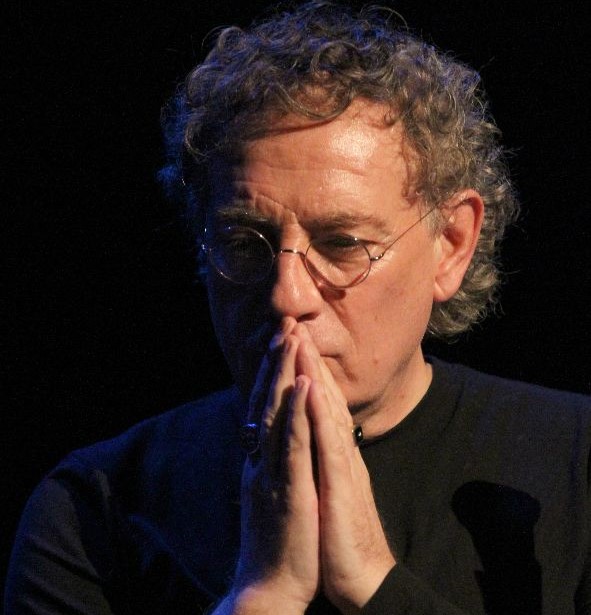
Juan Carlos Mestre (Villafranca del Bierzo, León, Spain, 1957), poet and graphic artist, is the author of numerous books of poetry and essays, including Antífona del Otoño en el Valle del Bierzo (Premio Adonáis, 1985), La poesía ha caído en desgracia (Premio Jaime Gil de Biedma, 1992) and La tumba de Keats (Premio Jaén de Poesía, 1999). In 1987 during a stay of several years in Chile he published Las páginas del fuego.
His poetry has appeared in such anthologies as Historia Natural de la Felicidad (Fondo de Cultura Económica, 2014) and La hora izquierda (Ya lo dijo Casimiro Parker, 2019). His book La casa roja received the National Poetry Prize 2009, and with his poetry collection La bicicleta del panadero he won the Critics’ Prize 2012. In 2018 he published Museo de la clase obrera, followed in 2019 by 200 gramos de patacas tristes, his first book written in the Gallego language.
In 2017 he was awarded the Premio de las Letras de Castilla y León in recognition for the body of his work, the Annual Cheng Ziáng Prize of the China Writers Association, and the “Homero” European Medal for Poetry and Art.
*****
Juan Carlos Mestre: Five Poems
MESSENGER OF THE STARS
God for those who sing in the bird.
God for those with seven lips.
xxxxxxxxxxxxxxxxxJuan Eduardo Cirlot
And nevertheless I, Galileo Galilei, musician by vocation, have heard the flies of eternity buzz round whatever can still be counted on your fingers. I have reasons to think the soul is a lead ball oscillating in fear like a pendulum’s shadow. Though I had not dreamed of them I had motives. I imagined the age of the hexagon, I heard its vibrations behind Homer’s eyes. I know the formula for snow. I have fed a lamp in every basement of its geometry. I Galilei, kneeling before the stars on Merlin’s hat, recant having delved so far into reality I discovered the shroud meant for the serpents’ bride. I leave to the farmhand of mathematics the hypothesis of my unique assets. I disown the Etruscan coals where the smile of all who still can’t hear lights up its kingdom. I have sown my falsehood in the college of death. There are no excuses. To my mother, Giulis Ammannati di Pescia, I leave the voice that curses and the gesture of the tower of Pisa.
TRIBE
Poets, prostitutes, beggars, those familar with the arts of dawn who know useless things that save, the line of the abyss, the lines of the hand. Charity and wisdom, one and the same almsgiving, one and the same maze of spiders.
THE LETTER
The story of someone who’s waiting for a letter. The postman has gone by tearing out a trail of ink down the streets. The hour of the impatient one who looks at the light glinting on a saber’s blade. Horses with wounded wings. Cities that burn alongside the green epidemic of chloroform and death. Someone counting waves with the obstinacy of a boatman at high tide. The watch’s minute hands obedient to night. The southeast wind and birds migrating to far off deltas. Someone who sees his own footsteps and imagines the shape of the other relentlessly pursuing him. Time’s trumpets in the loneliness of islands. The certainty of someone who waits for the letter and a ghost visits him.
GIORDANO BRUNO
Before you spit in my mouth, before everything that’s worth very little in the midst of Rome’s nature: the truth that before birth was already the neighbor of love, the sphere where, free from any position in space, no star is subject to death. Before you spit in my mouth and the girl with brown hair in the telephone booth calls her winter lover and both change clothes to go to the supper of ashes. A day like today, the 17th of February 1600, where there can be no dissolving the epidemic of mankind’s instincts. Since both annihilation and the mountain of embraces that please Aristotle’s pupils are impossible, the snow’s lie falls on the small stone hotel of the perfect idea. Here there is no absolute up or down, just the corridor of a brothel where Mafiosi lie in wait for the heads that are passing through. They believe because they hope. They will arrive before me and the sweepers of the sea will sound three times the rattle of what follows its own course. Even though they will never hear me, this man and this woman in their death agony offer instructions to runaway horses, to swivelling mares. And from this very fact, their being there, understanding each other without light, comes the sign of what is torn from the tree of great weariness. Lord, it doesn’t matter how dark the night may be, the wood has begun to burn and love which gives and takes away everything has slipped another coin into the crack in the conversation. Already I barely exist. No longer I, Giordano Bruno, Filippo of Nola, where the bells that gaze at the candle rejoice in the bus that goes to the Campo de Fiori. Now I know this. The prince’s majordomo has moved the armillary sphere and the orphan looks for his own eyes on a desert island. I have not named you, music, have not summoned you, unused voices, kicking against what is reasonable. But these two lovers tied together by the conflict of possession, forever ablaze before what is about to disappear on the banks of the Tiber, are now the only words left to the world. The last words. Lord of all that is theirs, Lord of all that is mine, before you spit in my mouth.
LAST WORDS
The law disappears the world disappears shacks collapse diamonds become liquids lips lower to touch plaster bells murderers sip froth and burn orders sources of streams heads with straight hair burn the sick give up certainty sleep apples stop ripening I don’t know if I’ve made myself clear spring on a stretcher a stick there’s no answer the bus changes its route builders go to a baptism prisons disappear buckets in hospitals death and its names
*****
Peter Boyle is an award-winning Australian poet and translator of poetry. He has eleven books of poetry published and nine books as a translator of poetry from Spanish. His most recent collection is Companions, Ancestors, Inscriptions (Vagabond Press, 2024). His translations include Anima (Shearsman, 2011), Of Such a Nature/Indole (The University of Alabama Press, 2018) and De últimas horas/Of Last Hours (Rialta Ediciones, 2023) by Cuban poet José Kozer, The Trees: Selected Poems of Eugenio Montejo (Salt Publishing, 2004) and Three Poets: Olga Orozco, Marosa Di Giorgio and Jorge Palma (Vagabond Press, 2017). His translations of Pierre Reverdy, René Char, Max Jacob, Yves Bonnefoy and Guillevic have appeared in journals and anthologies in the US and the UK. In 2013 he was awarded the New South Wales Premier’s Award for Literary Translation. He holds a Doctorate of Creative Arts from the University of Western Sydney. Peter lives in Sydney, Australia.
 The High Window
Amazing. Brilliant poetic translations. The Letter in particular.
LikeLike