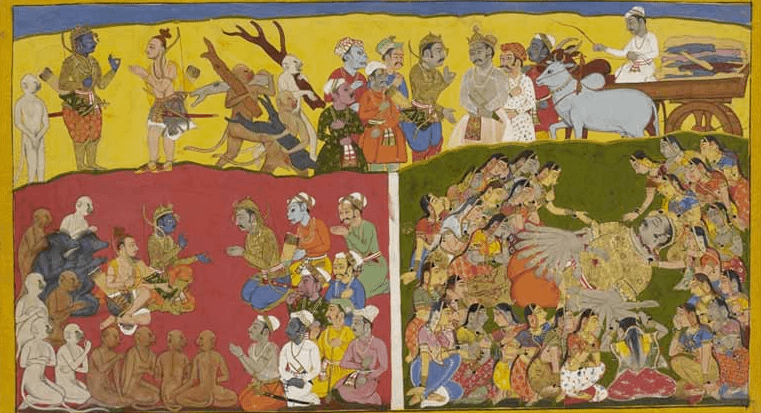
The funeral rites of Ravana, a character from the Hindu epic Ramayana
*****
Louis Hunt is a retired professor of political theory from James Madison College, Michigan State University. In addition to his work as a political theorist, he has studied Sanskrit and classical Tibetan. In Fall 2008, he lectured on politics and studied classical Tibetan at the Central Institute for Higher Tibetan Studies in Sarnath, India. He has published poems and translations from Sanskrit in The Rotary Dial, Autumn Sky, The Road Not Taken, Snakeskin, Lighten Up Online, Metamorphoses, Ezra, The Brazen Head and Interpret. He is currently working on a volume of translations from the Sanskrit of Kalidasa, Bhartrihari and Nilakantha Dikshita.
*****
Shantivilasa, ‘The Diversions of Peace’, by Nilakantha Dikshita
Nilakantha Dikshita was a prolific 17th-century poet and scholar who lived in Madurai in what is now the Indian state of Tamil Nadu. The Shantivilasa is a collection of 51 epigrammatic poems written from the standpoint of an old man reflecting on the course of his life and his anticipation of death. The poems are all written in the same Sanskrit meter, the Mandakranta (“slow stepping”), which consists of four lines of 17 syllables each. Sanskrit meter, like Greek and Latin, depends on the balance between short and long syllables rather than the patterns of stressed and unstressed syllables familiar from English. I have not attempted to reproduce these complex patterns in my translations. (The Mandakranta meter, for example, begins with four long syllables followed by five short syllables, a pattern that is close to phonologically impossible in English.) I have chosen instead to employ a loose iambic meter which attempts to reproduce the phrasing of the poems. My line breaks generally coincide with metrical pauses in the original Sanskrit. I have, with one exception, avoided end rhyme, since it is not a feature of classical Sanskrit poetry. Nilikantha’s style marked a deliberate break with the ornate elaboration of late classical Sanskrit poetry and I have tried to reflect this spareness in my translations.
NB: The Sanskrit text of the poems is taken from Pierre-Sylvain Filliozat, Oeuvres Poétiques de Nilakantha Diksita, Institut Français D’Indologie, Pondichéry, 1967. [LH].
*****
Nilakantha Dikshita: Eight poems from Shantivilasa
When young, I sat at my master’s feet,
seeking knowledge of the highest truth.
Now I squander all my learning
telling nursery tales to drowsy kings.
Alas, how much has changed!
*
आ कौमाराद्गुरुचरणशुश्रूषया ब्रह्मविद्या-
स्वास्थायास्थामहह महतीमर्जितं कौशलं यत् ।
निद्राहेतोर्निश निशि कथाः शृण्वतां पार्थिवानां
कालक्षेपौपयिकमिदमप्याः कथं पर्यणंसीत् ॥
***
Shade, water, clothes, food, transport, light,
none of these can be easily had where we are going.
This path that every creature must take is long
and the journey commences with a forgotten rite
that our body’s hunger keeps us from knowing.
*
छाया तोयं वसनमशनं वाहनं दीपिका वा
केतुं यस्मिन्किल न सुलभं किंचिदप्येषु मर्त्यैः ।
तस्मिन् दूरे पथि तनुभृतां सर्वथैवाभिगम्ये
प्रस्थानार्हं कमपि तु विधि घस्मरा न स्मरामः ॥
***
I hear the tumultuous clamor of death’s entourage,
slowly, slowly time’s noose tightens around my neck,
my life’s breath, eager to go, takes its leave of me,
but my mind still clings to the things of this world.
*
आकर्ण्यन्ते तपनतनयग्रामसंलापघोषा
मन्दं मन्दं हसति निहितः कालपाशोऽपि कण्ठे ।
आपृच्छ्यन्ते कृतजिगमिषासंभ्रमाः प्राणवाता
नैवेदानीमपि विषयवैमुख्यमभ्येति चेतः ॥
***
By crooked ways, in hidden nooks and crannies,
I found and squandered a fortune,
but gained only this ponderous body.
As I grew older, I listened to others’ advice,
but all I have to show for it is my ignorance,
dark and impenetrable as a moonless night.
*
नानोपायैदिशि दिशि धनान्यर्जयित्वा व्ययित्वा
सम्यक् संपादितमिदमहो’ स्थौल्यमेकं शरीरे ।
श्रुत्वा श्रुत्वा बहुजनमुखादायुषैतावतापि
प्राप्तं दर्शावधितिमिरवगाढमज्ञानमेकम् ॥
***
My wife, children, dear friends, kin and servants
are reluctant to part from me even in their dreams,
but when Death’s messengers come crowding in,
not one of them, Shiva, is willing to follow me there.
*
दाराः पुत्राः परमसुहृदो बान्धवाः किंकरा वा
स्वप्नावस्थास्वपि च विरहं ये मया न क्षमन्ते ।
अत्यासन्ने’ तपनतनयस्याज्ञया दूतवर्गे
तेष्वेकोऽपि स्मरहर न मे गन्तुमन्वस्ति जन्तुः ॥
***
The servants of death will never find me in my hiding place.
If they find me, they will never conquer my arrogance.
If they assault me, I will have the king destroy them.
This is my inner citadel: I never think about death.
*
केक्षन्ते मां कचन शयितं किंकरा दण्डपाणे-
रीक्षन्तां वा तदपि मयि किं कुर्युरुद्दामवृत्ते ।
कुर्युः किंचित्प्रसभमपि वा घातयिष्यामि राज्ञे-
त्यन्तधैर्यं परमिह वहन्नन्तकं न स्मरामि ॥
***
Flattery of the king’s servants
is my spiritual guide,
the approach to the king’s gates
my entrance to the ascetics’ forest,
catching sight of the king my witness
to the presence of the supreme Lord,
and dying in the king’s palace
the only liberation for a man like me.
*
यत्तीर्थानामनमथ यत्पूजनं देवताना-
मिष्टापूर्तव्यसनमपि यद्यच्च दाक्ष्यं कलासु ।
अर्थप्राप्त्यौपयिकमखिलं जायते मादृशां त-
ते चाप्यर्थी धरणिशरणा भूमिभृत्सात्कृता वा ॥
***
The fire in the pit of my stomach has dwindled,
desire no longer exercises its proper function,
my senses run wild like horses in every direction
until one by one they fall exhausted.
Fate alone has vanquished these enemies,
only my mind refuses to submit.
What should I do? Where can I go?
*
शान्तो वह्निर्जठरपिठरे संस्थिता कामवार्ता
धावं धावं दिशि दिशि शनैरिन्द्रियाश्वा निपेतुः ।
एवं दैवादुपरममगादेष मे वैरिवर्ग –
चेतस्त्वेकं न वशमयते किं करोमि क यामि ॥
 The High Window