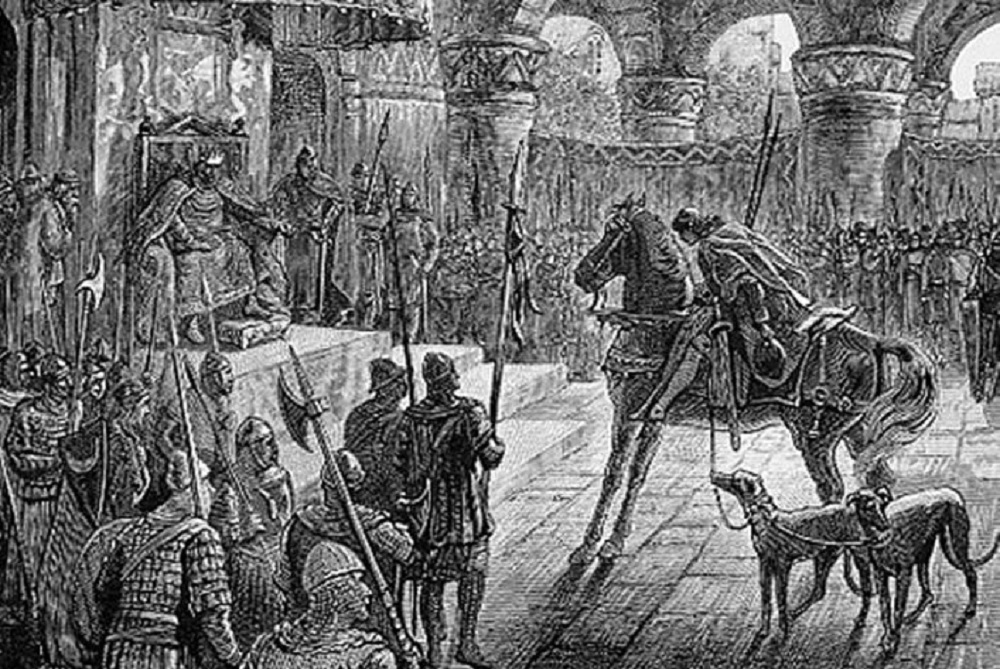
Culhwch at the Court of King Arthur
*****
Liam Guilar lives in Australia. His most recent poetry books are A Presentment of Englishry(2019) and A Man of Heart (2023), both published by Shearsman books. Both are part of an ongoing attempt to retell three stories from a 12th century poem. Like ‘The Punishments’ which previously appeared in The High Window, this will be part of the third and final book in the sequence. His website is http://www.liamguilar.com
*****
The translation is from medieval Welsh to English and from prose to verse. The edition I’m using is Culhwch and Olwen: An edition and study of the oldest Arthurian Tale, edited by Rachel Bromwich and D. Simon Evans, University of Wales Press, 1992.
The editors date the story to the end of the 11th Century although the two surviving manuscripts are from the 14th. If you think of writing as performance, then this is one of the great performances in European literature. Imagine a condensed Tristram Shandy. Within one tale the anonymous storyteller exploits a range of styles, varying pace and treatment all the way from understatement to exuberant nonsense. [LG]
*****
The Extracts
One and Two
The story begins as a recognisable folk tale. Culhwch’s mother, dying, attempts to protect her son. When her plan inevitably fails, her husband literally ‘gets’ another queen by invading a neighbour’s kingdom, killing him and abducting his widow. Enter the stepmother. When Culhwch turns down her daughter as a potential bride, she retaliates by putting a curse on him.
Three
Following his father’s advice, Culhwch sets off for Arthur’s court to seek his help in the search for Olwen. The prose becomes exuberant as the story stops and the story teller launches into a detailed description of Culhwch and his horse.
Four and Five
Arriving at Arthur’s gate, Culhwch encounters the porter, Glewlwyt Gauaeluawr, whose name means ‘Great Grey Mighty Grasp’. Appropriately, the porter’s description of his deputies abruptly opens a door on to a different reality. His conversations with both Culhwch and Arthur introduce the storyteller’s delight in made up names for people and places, and set the tone for the two great lists which will follow.
Six and Seven
Arthur promises to help Culhwch. After some difficulty they find Olwen. The storyteller thought her name meant ‘white track’. Her appearance is another excuse for the storyteller to show off. Her advice sets up the rest of the story but ‘Whatever he asks of you, promise you’ll get it’ doesn’t prepare Culhwch, or the reader, for her father’s forty demands or the fact that every one of them sounds impossible.
For anyone interested in what happens next, and what I’ve left out, there are fine prose translations in modern versions of The Mabinogion. Sioned Davis’ is probably the best. However, for anyone who wants a sense of the strangeness of the original, I’d recommend the ‘classic’ translation by Gwyn Jones and Thomas Jones which is where I first encountered this story many decades ago.
*****
Liam Guilar: Seven extracts from Culhwch ac Olwen
- The mother’s request
Dying, she called her husband to her side.
I know that you will want another wife,
but these days queens dispense the gifts.
It is wrong for you to harm your son.
So all I ask is you won’t seek another bride
until you see a brier growing on my grave.
He agreed. She then sent for her priest,
whispering; see that my grave is kept clean.
He said he would and then she died.
Each day, the king dispatched a serving lad
to see if anything was growing on her grave.
After seven years the priest forgot his task
and freed the king to seek another queen.
- The stepmother’s curse
‘What reason husband, do you have
to hide your son from me?’ ’I will not,’
said the king and sent for him.’
‘Well, boy,’ she said, ‘it’s good for you
to seek a wife. I have a daughter
fit for any noble in the world.
‘I am not old enough to seek a wife.’
‘Then I will swear a destiny on you.
Your side won’t strike against a woman’s
unless you get Olwen, daughter of
Ysbaddaden Chief Giant.’ The boy
coloured, and every part of him
was filled with love for this maiden
he’d never seen. ‘What ails you son,’
his father asked, ‘why do you blush?’
‘My stepmother has sworn I’ll never have a wife
except for Olwen merch Ysbaddaden Pencawr.’
‘That’s easy, son. Arthur is your cousin. Go to him.
Have him trim your hair then ask this as your gift.’
- Culhwch rides to Arthur’s court
Off went the boy on a fine looking steed:
grey-headed, shell-hoofed, four winters old.
A tubular gold bit in its mouth,
and under the lad a golden saddle.
In his hand two whetted silver spears,
a battle axe, its blade from edge to edge
the forearm’s length of a full grown man,
sharp enough to draw blood from the wind,
swifter than the swiftest dew drop falls
from stalk to the ground in the month of June
when the dew is heaviest.
A gold-hilted sword on his thigh, the blade
gold inlaid. A gold chased shield on his back,
its ivory boss the colour of lightning.
A purple cloak was on him.
At each corner an apple of red gold,
each apple worth a hundred cows.
Two white breasted brindled greyhounds before him,
each with a gold collar from shoulder to ear
and the one that was on the right would be on the left
and the one on the left would be on the right
like two swift terns, frolicking about him.
Four clods of earth were struck by the steed’s hooves,
like four swallows in the air about him,
sometimes in front, sometimes behind,
but never a single hair stirred on his head
so sure and light footed his steed’s canter
on his ride to the gates of Arthur’s court.
- The Gate Keeper
The boy asked: ‘Is there a porter?’
‘There is, and may your head not be your own for asking.
I am Arthur’s porter on the 1st of January,
for the rest of the year my deputies are Goodhearer,
Littlemeatman, Slowstep, and Penpingpong,
who goes upon his head to save his feet,
neither earthwards nor heavenwards,
but like a rolling stone on the floor of the court.
‘Open the gate.’
‘I will not.’
‘Why not?’
‘Knife has gone to meat, drink into horn
and there’s a throng in Arthur’s hall.
None may enter except the son of a rightful king
or a working man who brings a necessary craft.
There is food for your dogs, and corn for your horse.
For you, hot peppered chops, much wine and entertaining songs.
Food for fifty men will come to you in the hospice,
where travellers from afar eat with those who have no craft to offer.
It will be no worse for you there than for Arthur in his court.
A woman to sleep with and pleasant songs before you.
Tomorrow, before the third hour, when the gate is opened,
you will be first at the opening and you may take
whatever place you choose in Arthur’s court
from the highest to the lowest.
‘I will do none of that.
If you open the gate: good.
If not, I will shame your lord
and bring ill repute on you.
I will give three shouts before these gates
no less audible from Land’s End,
to the depths of Dinol in the north,
to the Ridge of Coldness in Ireland.
If there are pregnant women in the court,
their pregnancies will fail
those who are not pregnant,
their wombs will be a burden to them
and they will never have children from this day forth.’
‘Scream as much as you like about the laws of Arthur’s court,
you will not enter until I have spoken to him first.’
- The porter talks to Arthur
Arthur asked him, ’Have you news from the gate?’
‘I have.
Two thirds of my life has gone
and two thirds of yours.
I was at Caer Se and Asse,
in Sach and Salach, Lotor and FFotor,
India the great and India the lesser.
I was in the battle of the two Ynyrs,
when twelve hostages were taken from Norway.
I was in Europe, Africa, and Corsica,
in Caer Brythwch and Bruthnach and Nerthach.
I was there when you slaughtered
the warband of Gleis mab Merin,
and when you killed Mil Du mab Ducum.
I was there when you conquered Greece.
I was in Caer Oeth and Anoeth
and in Caer Nefenhyr Nawdant.
Fair kingly men we saw there
but in all my life I’ve never seen
a better looking man
than the one outside your gate.’
‘Well if you came in walking: go out running.
And an injunction on the man who sees the light
with both eyes open and then shuts them again.
Serve him wine from golden drinking horns
feed him with hot peppered chops
‘til he’s had his fill of food and drink.
It is shameful to leave in the wind and rain
such a man as you describe.’
‘By the hand of my friend,’
said Cai, ‘if you were to take my advice,
the laws of the court would not be broken for him.’
‘Not so fair Cai,’ replied Arthur.
‘We are noblemen so long as others seek us out.
The greater the gifts we bestow,
the greater our nobility, honour and fame.’
- Olwen
She came with a fine silk robe
of flaming red around her
and at her throat a torque of gold
studded with pearls and garnets.
The flowers of the broom
are not as yellow as her hair.
Whiter was her skin than the foam of a wave
on the clearest day of brightest sunshine.
Whiter were her palms and fingers
than the shoots of the marsh trefoil
thrusting through fine gravel
by the clearest spring.
Neither the eye of the mewed hawk
nor the eye of the trice mewed falcon
was brighter than hers.
No breast of a white swan was whiter,
and her cheeks were redder than the reddest foxglove.
Everyone who saw her was filled with love for her.
Wherever she went, four white trefoils
flowered as she passed,
and for that reason she was called Olwen.
xxx7. Culhwch finally meets Olwen
‘Maiden it is you that I have loved.
Come away with me.’
‘That I will not,’ she replied.
‘lest sin be imputed to us both.
My father made me promise
I would not leave without consulting him,
for he will die when I go with a man.
I do have some advice.
Go ask him for my hand.
However much he asks,
agree to his demands
and I will be your wife.
But if he smells any doubt,
then me you will not have,
and you’ll be lucky
to escape from him alive.’
*****
 The High Window