*****
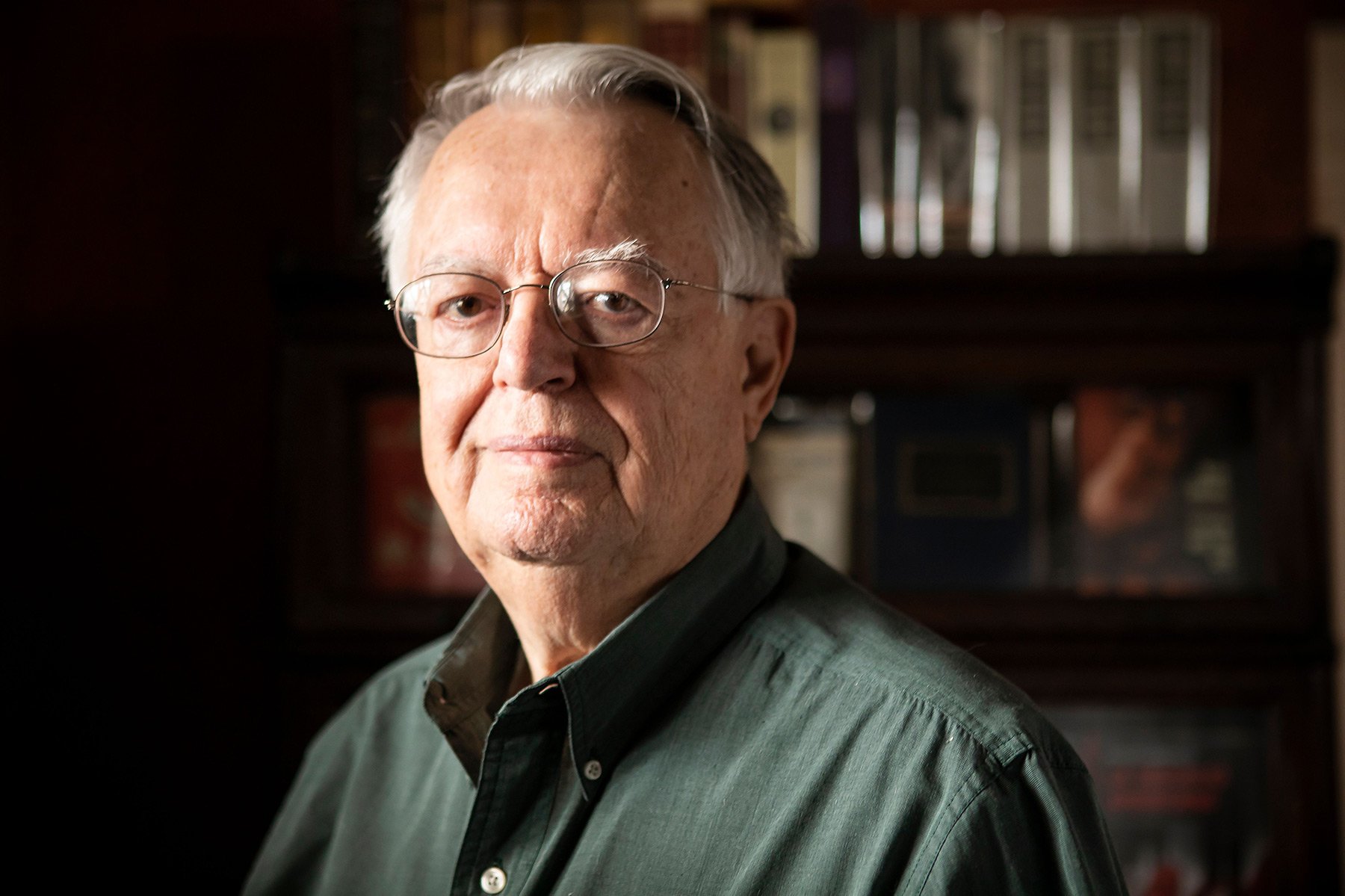
William Heath has published three poetry books: The Walking Man, Steel Valley Elegy, and Going Places; two chapbooks, Night Moves in Ohio and Leaving Seville; three novels: The Children Bob Moses Led (winner of the Hackney Award), Devil Dancer, and Blacksnake’s Path; a work of history, William Wells and the Struggle for the Old Northwest (winner of two Spur Awards and the Oliver Hazard Perry Award); and a collection of interviews, Conversations with Robert Stone. He lives in Annapolis. www.williamheathbooks.com
******
INTRODUCTION
I began writing poetry when I was a young Instructor at Kenyon College, where, because of the Kenyon Review, I met lots of important writers. Paul Blackburn for one encouraged my poetry and also suggested I should go to Barcelona, which I did as a Fulbright Professor and where I met my wife, Roser Caminals, who is from Barcelona. “Placa Reial” (Going Places) is one of my favorite spots in the city. “The Hustler” (The Walking Man) is loosely inspired by the Paul Newman film, but it is also, like many of my better poems, a meditation on the human condition. “An Inside Job” (Steel Valley Elegy) is one of my autobiographical poems about growing up near the mobbed-up city of Youngstown. “A New World” will come out in the fall as part of a chapbook entitled Inventing the Americas (Finishing Line Press). The other poems will appear in the fall in my fourth full-length poetry book, Alms for Oblivion (Kelsay Books 2024).
After a decade of writing poetry (the best are collected in The Walking Man) I turned my attention to writing fiction, literary criticism, and history for most of my academic career, publishing an award-winning novel about the civil rights movement, The Children Bob Moses Led, and an award-winning history book about the early history of Ohio, William Wells and the Struggle for the Old Northwest.
After I retired as a Professor Emeritus from Mt. St. Mary’s University, I returned to my first love. The results are found in two poetry books: Steel Valley Elegy and Going Places, and two chapbooks: Night Moves in Ohio and Leaving Seville. If you wish to know about my work and my assumptions about writing, see my website: www.williamheathbooks.com and if you have any questions, don’t hesitate to ask.
*****
William Heath: Eight Poems
for Paul Blackburn (1926-1971)
The palm trees are still there, Paul,
people of all ages pack the stone benches
by the fountain and in the evenings stroll
across the square under the spiky, vaguely
threatening wrought-iron streetlamps
designed by a young Gaudí. Couples
still carry babies in their arms
and long-legged women of the kind
you kept your eye on can be seen,
nowadays from all parts of the world.
Plaça Reial is an enclosed surprise at
the heart of the old city, an arcaded square
accessed by alleys adjacent to the Ramblas,
its high-shuttered apartments on all sides
contain a Parisian flavor. Like Washington Square
in the seventies, it was the den of drug dealers,
prostitutes, pickpockets, and purse snatchers.
A seedy ambiance adds spice to its charm,
but now the word is Barcelona Posa’t Guapa
and the facades are freshly restored.
It’s no secret from the tourist hordes,
tables from many cafes fill the arcades
and spread into the square. Your favorite bar,
the Glorieta, is long gone, Paul, along with
the organized waddle of the waiter you evoked
in “The Touch” who remembers you after
many years and taps your shoulder.
When he dies you realize you never
knew his name and that we don’t need
to know people’s names to love them.
(from Going Places, Kelsay Books, 2023)
BLUE WATER HOUSE
1
My hands gripping her shoulders,
Roser leads me across the hot
sand dunes of the Delaware Bay.
The beach has gentle waves,
unlike the riptides of the Atlantic
a few miles away. We watch
the ferry bound for Cape May
sail away to return later, only
without sails, just a white ship
shrinking and then fading
from sight over the horizon.
2
I need Roser’s support again
to wade across the sliding sands,
seaweed, and pebbles on the shore.
When the water is waist-high
I swim a few strokes, or, better yet,
lie on my back and float, eyes shut
against the burning sun. Pounds
I’ve gained lately come in handy,
a mere flutter of my hands keeps
my belly above water, so restful
if I fell asleep I’d only drift back
to shore and awake at the soft
touch of sand and smooth pebbles.
3
Lewes, Delaware, is a summer secret
kept by a happy few. Our favorite place
is the Blue Water House, a short walk
to the beach. We stay in the Hemingway
suite, a mini-museum displaying
photos of Papa, a desk featuring
an Underwood with its clickity-
clack keys and carriage return.
The main motif is African safari:
imitation heads of zebras, lions,
elephants line the walls, our bed
is of polished logs with leopard-
skin-patterned sheets. On the ceiling
are paddles, a tiger hide, assorted hats,
but, thankfully, no hunting rifles.
MR. BEEGHY’S DOUBTS
Mr. Beeghly has his doubts
whether I am a suitable playmate
for his son and my friend Joel.
He calls me a Johnny Come Lately
and a Fly By Nighter, although I
only break into their house once
to retrieve a basketball.
xxxxxxxxxxxxxxxxxxxxxxxIt isn’t
hard: I ascend the television pole
on the side of the house near
an open second-story window,
then it’s down the stairs,
through living room and kitchen
to the garage where the pebbly
surfaced sphere of my desire
is waiting for me.
xxxxxxxxxxxxxxxxxYou see
they have the best backboard
and rim in the neighborhood
fastened to their two-car garage.
I am guilty, I know, but feel
completely innocent. Isn’t
basketball my avocation, don’t I
answer its call every day?
And yes I am known to rob
their orchard of apples, plums,
and pears when I’m hungry,
to pick grapes from their arbor,
and ride Joel’s pony, but only
with his permission.
xxxxxxxxxxxxxxxxxxxxAnd yes
I teach Joel to swing out on
tree vines before splashing
into Lee Run Creek in spite of
repeated warnings the water
is shallow, we could break
a leg or our necks on the rocks.
Finally, Mr. Beeghly chops
off the offending vines, but
of course we simply seek
others further downstream.
BREAD
The best thing in
the world to break
is bread, wheat fresh
from the fields, fire
preferably of wood,
squeeze the dough
in your fingers until
it forms a shapely
lump, place it in
a heated iron oven
and watch it swell
in a sudden pregnancy
and within an hour
emerge as a plump
baby, complete if
you look closely with
a navel of sorts
and a golden skin
with a crisp crunch
outside, a warm treat for
the tongue inside plus
a lingering aftertaste—
this is the gift of bread.
THICK MILKSHAKES
for Jim Vincent
Jim tells his dad that it looks like
he isn’t going to last much longer
and asks if he has anything he
wants to say, any advice to pass on:
buy IBM stock, brush your teeth,
whatever. At first his dad shakes
his head, he has nothing special
he wants to say, but then he says,
“There is one thing—milkshakes.
I have never liked thick milkshakes
where the ice cream jams the straw;
here at the hospital they make
them thin, they go right up
the straw, that’s the way they
made them when I was a boy.
I’ve never liked thick milkshakes.”
After his dad dies Jim’s mother
admits that she wishes he
had said something to her,
told her she’d been a good wife,
that he loved her, but he died
without saying anything like that.
I ask Jim if he said anything
to him. “He did,” Jim answers,
“he told me he never liked
thick milkshakes.”
SARAH’S HOUSE OF SPIRITS
Sarah Winchester marries the son
of the man who invents the Winchester
repeater, the Gun that Won the West,
a medium tells her that unless she builds
more rooms to her house to host and
appease the spirits of thousands killed
by the notorious rifle, she will die—
so for thirty-eight years she adds room
after room, door after door, endless corridors,
stained glass spider-web windows, twisted
stairways, parquet floors of mahogany,
teak, ash, oak, and other choice woods,
silver-plated chandeliers, secret
passages to elude pursuing ghosts.
Each night she visits the Séance Room
to learn what next needs to be done.
This calls for continual renovation
as the house expands to five-hundred
rooms, shrinks to one-hundred-and-sixty.
The resulting maze has an upside down
column that doesn’t touch the ceiling,
chimneys that never reach the roof.
Windows in the Grand Ballroom feature
obscure Shakespeare quotes: “Wide
unclasp the tables of their thoughts,”
“These same thoughts people this
little world.” Gnomic messages inciting
her obsessions? No one knows
The San Francisco earthquake of 1906
severely damages the house, Sarah
is rescued from her wrecked bedroom,
she sees the quake as a sign to change
her ways, thirty front rooms are sealed.
An eight-story tower falls, other turrets,
towers, cupolas, and balconies remain.
The number thirteen figures prominently
in her extravagant designs. Thirteen
the number of window panes, ceiling panels,
stairway steps. Among flowers, fountains,
statues, and exotic trees highlighting
her resplendent gardens, thirteen palm trees
lining the driveway die of old age.
GHOSTS
1
You have to admit the dead
are reluctant to talk,
yet we want them
to communicate so badly
we claim to hear voices,
see them in our sleep,
lurking in the penumbra
of a shadow we glimpse
a fleeting outline, not
enough to swear by,
or put any faith in,
but we do anyway,
that’s how needy
we are of ghosts,
why we refuse to ever
let them leave.
2
The fleshless dead
come back to us
as ghosts, a presence
felt but seldom seen,
vaguely a fleeting
image in the mind.
We see faces most
clearly in dreams,
eyes hone into us
but lips are sealed.
We never know if
they want to talk,
offer advice, send
love, or, what we
fear most, a curse.
ON THE ULTIMATE PRIMACY OF IMAGES
He talks about the ultimate
primacy of images, how we
must recognize the new
literacy of children. They
cannot read the little books
but understand cartoons.
Ask the art department
to interpret moving images
and they will have nothing
to tell you. Subliminal
commercials speak on levels
we are unaware of.
Metamorphosis rules,
nothing static, change the norm,
show how Harpo, not Karl,
was the most radical Marx,
depicting a world coming apart
at the seams, decomposing
before our eyes. His eyes
shine as he speaks, smiling
and predicting our image-
reading capacity will grow
enormously. In the West
no longer will knowledge
mean print. Montaigne’s
nothing human is alien to me
will replace Pascal’s the good
is only what serves God.
Montaigne didn’t say everything
human is pleasing to me,
and the speaker’s smile has
the gleeful intensity of a born-
again Christian. He is a new car
with twice the horsepower
but half the windshield, no rear-
view mirror to speak of.
Sitting in the back of
an Italian Renaissance salon,
frescos on the vaulted ceiling—
now a lecture hall in Rome hosting
an American culture conference—
my takeaway: I look forward
to the past, regret the future.
 The High Window