*****
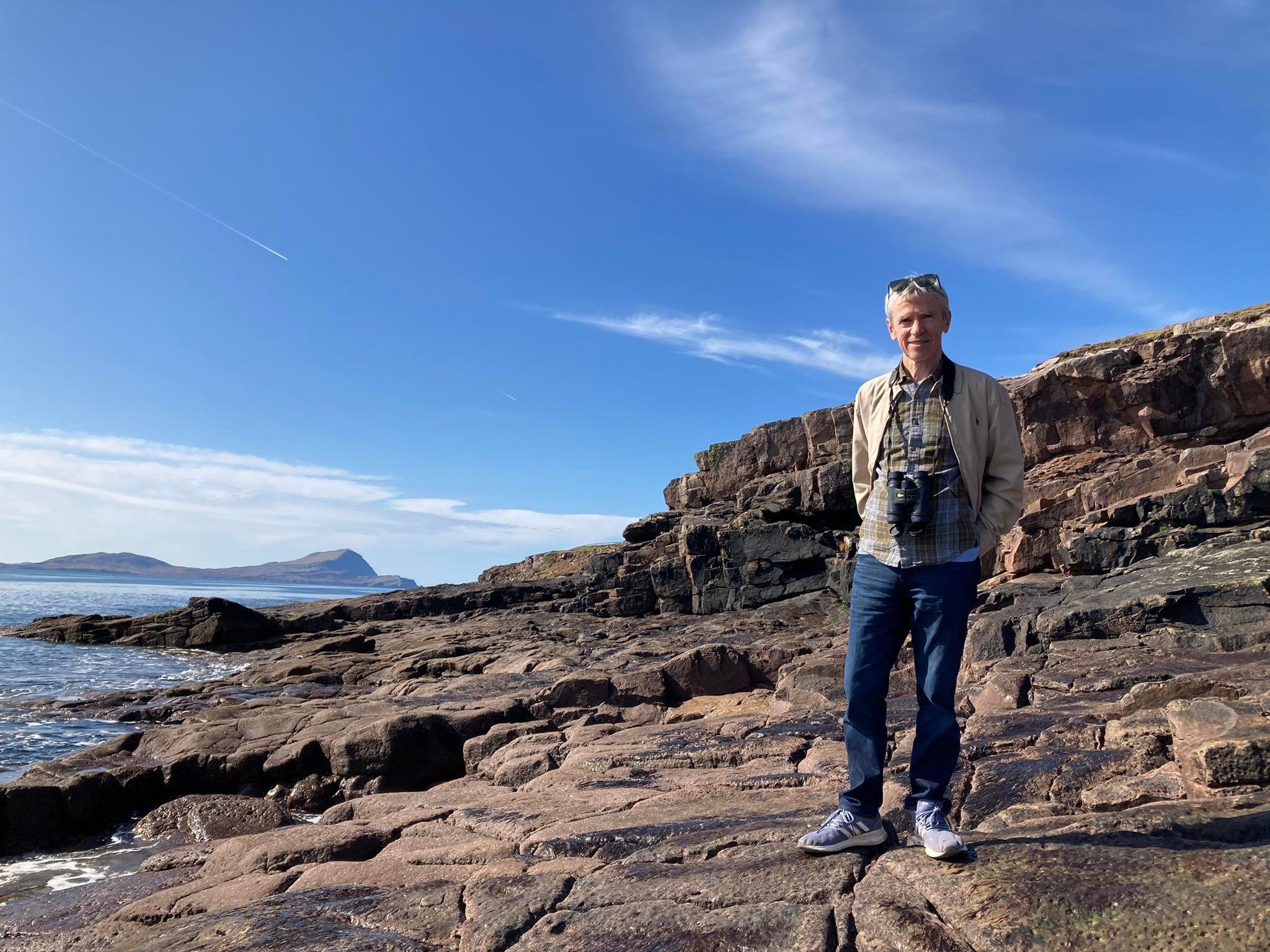
Seán Lysaght is the author of several collections of poems with Gallery Press, including Selected Poems (2010) and. most recently, New Leaf (2022). He has also written prose about landscape and wildlife in the west of Ireland, including Eagle Country (2018) and Wild Nephin (2020). He lives in Westport, County Mayo. You will find a selection of Seán‘s books here.
*****
Introduction
This sequence was written at the end of winter, during a two-week residency in Mulranny, on the west Mayo coast. At that time of year, while there is little growth and everything seems worn down by winter’s work, light, space and distance can prevail, especially on brighter days. This was particularly the case in a house of generous proportions on the shore of Clew Bay. Given that sense of emptying out, it can be difficult to articulate feeling in language – indeed the coordinates of that time had more to do with the visual, contemplated in silence, than with any other medium. It was into that stillness that I ventured to write ‘The Outermost House’, borrowing my title from the book of that name by Henry Beston, which celebrates his two-year stay beside the sea at Cape Cod in the 1920s.
*****
Seán Lysaght: Poem

THE OUTERMOST HOUSE
I
Sunlight, the glitter of sea,
The dactylic morning we’ve dreamed about
Keeping distance over miles of water
And a harbour littered with symbols.
A deep surge boiling round
The cornerstones of the pier
As the swell rises and subsides.
Rough sand in the narrow channel
Where I dug for sand-eels once
And they came quicksilver to the blade.
Beached kayaks the colour of summer
For storied disputes and epic rage –
All began when boys were told to
‘Go down to the beach and play.’
We’ll be content with ceremony
In the yoga room. Our teacher
Strikes the gongs while we
Lie on the floor sleeved in privilege.
II
You can watch the coast from here
And see others walking to the pier
Past broken traffic cones,
Wading birds, and a mustard-coloured
Lichen on the capstans. In this reckoning
There’s also a span of desire
Dreaming in the sand dunes in July,
Which now stays warm indoors.
Right here, where sunlight
Pools on the desk, any marks
Like these mean, in addition,
That the day is kept behind glass
To get the measure of this script
With artwork, books, and beach drift.
III
A third person between us
Camped out one night of trespass
To face up to a belief in hauntings
On a headland to the south –
And found none. This was the weather,
Hard and clear, a last shift
Of winter doing the spring cleaning,
With love as quiet as a catkin.
But first, to strike camp that morning
In a secular light of lark song,
With nothing to share, nothing to fear
From any of the good people.
It was not they who saw him
And put a padlock on the gate.
IV
This house was lines on paper once,
A tiled floor with long windows,
Three steps down to a lounge,
A chimney shaft of warm brickwork,
A span of deal ceiling,
A mezzanine high up
Railed like the deck of a ship
With berths where we don’t go.
The architect’s marks were a start,
A guide for builders, a space
For joking tradesmen twenty years ago
Before it opened to the flow of life,
And still kept an open mind
Through airlift and light.
V
Summer flowers can start in a cold
Frame, to protect from frost
And let sunlight in, just as
This time nourishes a quiet seed
With boundaries of sawn wood,
Brick and fitted glass. All disturbance
Is withheld, other than the sounds
Of a high wind overhead.
There’s no impulse, either, to leave
And explore the shore, because the fittings
Leave nothing to be desired, given
A sense that here is a calm entrance,
Her shape passing ahead of her shadow
As she steps down to the baby grand.
VI
If all art is dated,
Easily consigned to its period
As a series of marks made with a nib
Or a brush, tapping at posterity,
Occasionally, a gleam
Of purpose still endures,
Like a beach scene by Deirdre Walsh
With a banked brightness of shells
Set in cream at its utmost point
Where the background sea is very dark,
And the sky toned like a louring hill.
I could take you down to the causeway
And show you where she stood
As space flared from her perspective.
VII
Nostalgia will happen in time,
When the hillside is covered in flats
And the last fisherman of the bay
Fades in photographs behind the bar.
Now there are images to mark
As bushes and trees do their work,
Sprawling close to roads and gardens.
Someday, for sure, when everything
Is tidied in, and kitsch presides
Over all attempts at imagining
What it was like here once,
Brent geese will fly across the memory
Of two distant men cutting
Wrack with a sickle, to make a morning.
VIII
Camille Souter died today.
The Yarrow is my favourite of hers,
A spare bouquet of white flowers on dark stalks
Set in the glaze of a blue vase.
Around the explicit bright petals,
Objects and light are muted and soft:
An ochre table-cloth, a door’s blue panels.
Delighting care worked every surface.
Ochres and pinks spread
And blend into each other.
Blues from the wainscot and vase
Encroach on the bare wall,
The yellow of the door frame
The same, while a warm blush
Pulses through every brush.
Then a door latch lifts to wonder.
IX
I go out there every day,
Expecting to find him at the edge
Of the tide, either rising or falling,
Whether my feet step back
From a fullness, or I study the shore-
Glaze where water drains off.
All the wader calls echo
Attention in an old thumbed book,
A whole bay is busy with the knowledge
That he tried to attach to those
Wild generations, and failed to consign.
Just as now, at the waves’ collapse,
When I turn, the sand is marked
By someone approaching, and then going past.
 The High Window