
*****
About the Poet
Poet, writer and translator Khairi Hamdan was born in 1962 in the city of Dier Sharaf, on the West Bank of the Jordan River. In 1967, his family emigrated to Jordan, where he lived until 1982. Since then, Khairi Hamdan has lived and worked in Bulgaria. He is the author of a number of books published in Bulgarian and Arabic, most recently the novel Chestnut Gardens and the poetry collection The Water Lilies of Memory. Hamdan translates poetry and prose between Arabic and Bulgarian and has been awarded several international honors for his translations, as well as for his original work.
About the Translator
Katerina Stoykova is the author of several award-winning poetry books and the Senior Editor of Accents Publishing, where she has selected, edited, and published close to 80 poetry collections. Katerina acted in the lead roles in the independent feature films Proud Citizen and Fort Maria, both directed by Thom Southerland. She splits her time between the coast of the Black Sea and the rolling hills of Kentucky. Katerina writes, lives and thinks in two languages.
*****
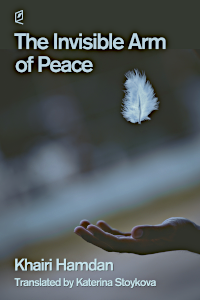
The poems selected below are all taken from Khairi Hamdan’s The Invisible Arm of Peace, translated by Katerina Stoykova. They are published by Accents Publishing, Lexington, Kentucky, 2022. ISBN 9781936628933. Copies can be obtained by following the link.
*****
Introduction
I met Khairi Hamdan at a literary event in Bulgaria, where he is a well known poet, writer and translator. He has had an unusual life. Khairi was born in the city of Dier Sharaf on the West Bank of the Jordan River, but he grew up in Jordan after his family emigrated there in 1967. In 1982, he moved to Sofia to attend university and to study engineering, and in Bulgaria he found another country to call his own. He married a Bulgarian woman, became a father of three daughters, and mastered Bulgarian, one of the languages in which he now writes poetry and prose. I have read a number of Khairi’s poetry books in Bulgarian, and I have selected a few of my favorite poems to present to the English-speaking reader. In these poems you will find the sand of the Sahara Desert, the Bedouin, the Dervish, and unmediated conversations with God. You will encounter destroyed temples, refugee camps, border patrol, children with nontraditional names. You will also find lyrical poetry of intimate tenderness and the unrelenting drive to be a better human being. I hope you enjoy seeing the world through Khairi Hamdan’s eyes, for it is rich and compassionate, and our world is a better place for having Khairi Hamdan’s poetry in it.
Katerina Stoykova
*****
Khairi Hamdan: Eight Poems
Khairi Hamdan: Eight Poems
SUFFERING SUITS THE HUMAN RACE
Bitter sugar, unconsumed, lacking passion,
begets a sweet memory of a former storm
at the bottom of a coffee cup.
Handwritten on a colorful booklet
are two travelers’ names:
she—local, he—a foreigner who arrived
some time ago on a wandering boat
and stayed until the next promise.
The foam eats up the ink, the first letters survive,
a brief poem and a place to reunite.
Next year—same time, same pier.
Salt asserts its nature
in the wound, merciful and raw.
The flesh belongs to another.
That summer God descended,
caressed us with the comb of death,
sedated his faithful prophets.
Suffering suits people.
GREEN AS NEVER BEFORE
Suddenly I’m overcome with desire to soar,
to thumb through others’ notebooks,
to sense the cool dawn, the bitter wine.
And as I was freely and timidly plummeting,
I tore an autumn leaf off a proud fig.
Unceasing desire to embrace your shadow
that just passed through,
covered with a light shirt and a shawl,
and on your face—traces of grass.
A tired yellow walnut tree flew by.
I picked a flying fig leaf
during a time of rest and absence,
yet my heart—green, green as never before.
***
I can pass through a needle’s eye,
beyond a lonely cloud—
a guard inside the sky’s ulcer.
I can pass through your slumber,
to touch your day, your dream.
But I could hardly touch
the roof of the pain you sow
everywhere around me.
The world needs no more
bandages for boxing, for horses,
for new sexual positions,
for Olympic games.
No need for undue efforts
for excessive passions.
***
I don’t want the wind
to lift me up,
I simply crave wings.
I don’t want honey in my cup,
I simply desire the bees not to lose direction
but to return to their hives.
I don’t want fireplace and hearth.
I covet abundance of sun
to brighten the heart,
the pigeons before the church,
the vagabond by the frozen fountain
and my mother’s grave.
HASN’T ARRIVED
The train hasn’t arrived.
It derailed in an unidentified direction
and resumed its travel towards the blueness.
Farmers, artists, lawyers and doctors ride,
run away from their daily lives, protest lies,
rivalry, fame and unrequited love.
The train will not arrive, the station manager announces,
don’t wait for puffing wagons, noisy greetings, vanity!
The reasons for the engineer’s revolt are countless—
loneliness, low pay, frayed nerves,
lack of spare parts, search for alternative space,
banquet in first class, wedding in second,
birthdays of two travelers without seats,
improvised court, unpostponable case, urgent surgery.
Dear citizens, don’t wait for the slow train,
originally expected a bit after midnight!
The runaway train seeks an alternate destination,
seeks a desolate station where painful confessions
and premature forgiveness are sanctioned.
THERE ARE NO RANDOM CHRYSALISES
We’ve met repeatedly, randomly
by a railroad,
at a cross examination
in a Latin-American
or Middle eastern prison cell.
We recognize each other.
You always appear elegant,
no makeup,
fleeting and majestic.
You measure precisely
only the weak tones of the heart.
You lead me to the well
harboring poets.
There they bathe
under the same denominator.
Again and again you state
that poets always perish
during spring,
turn into chrysalises,
and later take flight
as free butterflies.
SOUTH OF EVERYTHING
It’s South everywhere—
boredom, delights,
desperate prostitutes,
bitten lips, tattooed mornings,
lack of dreams, only rancid fish.
South of the world banks,
of the border police,
of the punctured paper boats
and rusty trains—
a crowd of kids
without traditional names,
or addresses.
They kick the skull of faith.
South of everything—
another cemetery
sprouting in the place of
a just-demolished temple.
GO TO SLEEP!
Go to sleep!
The city nods off,
suffocates inside its own slumber,
wakes in wee hours
before sunrise,
as the moon smokes its last cigarette.
The city nods off,
as I lower the blinds
before the late news
announcing the demise
of another dream
supported by the government coffer,
guzzled at the crossroads
between east and west
on the shore of a forsaken ocean.
Sleep, my city!
A journey awaits you,
a serenade awaits you,
a relentless roar.
 The High Window