Morgenstern’s Magic:
a bilingual selection of poems by Christian Morgenstern
translated by Timothy Adès
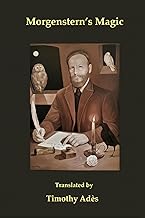
Christian Morgenstern (1871-1914) is best known as a nonsense poet, above all for his Gallows Songs and the two characters, Korf and Palmström. These works have always been very popular, appearing in numerous editions, much quoted, and set to music. He could be serious too: he was an essayist, and an acclaimed translator, especially from Norwegian and French. Health problems kept him constantly on the move,: this brought him many contacts and interesting encounters. His mystical side is less well known, especially to English readers.
Timothy Adès, born 1941, is a rhyming translator-poet. He has published several books from French, two from Spanish, and has awards for work from those two languages. He has rewritten all Shakespeare’s 154 Sonnets without using letter E. He can be found on Facebook and YouTube, and on his website which is www.timothyades.com . He keeps as close to the original text as he can, but most of all, tries to convey the spirit of the original.
Many of these poems by Morgenstern have inspired videos on YouTube, often more than once. There is so much to enjoy, from great classical singers through folk and jazz to talented children, creative visuals, and some very effective readings. As an exciting innovation in publishing, and a great enrichment of this volume, we offer you a selected list, to be found at the end.
NB: You can hear the poems being read in the original by clicking on the German titles.
*****
Christian Morgenstern: Five Poems from Morgenster’s Magic
translated by Timothy Adès
THE TWO PARALLELS
There once went forth two parallels
into the infinite:
a quite substantial pair of souls,
well-founded, bolt upright.
They wished not to be parted
till in blest earth they lay:
that was the pride they nurtured,
that was their secret stay.
But roaming in concomitance
twelve light-years on the trot,
did it make any earthly sense?
The lonely pair thought not.
Whether they still were parallel
they simply didn’t know –
they moved through light perpetual,
twin souls in stately flow.
Eternal light imbued them,
they were but one therein.
Eternity consumed them:
seraphs, they might have been.
*
Es gingen zwei Parallelen
ins Endlose hinaus,
zwei kerzengerade Seelen
und aus solidem Haus.
Sie wollten sich nicht schneiden
bis an ihr seliges Grab:
Das war nun einmal der beiden
geheimer Stolz und Stab.
Doch als sie zehn Lichtjahre
gewandert neben sich hin,
da wards dem einsamen Paare
nicht irdisch mehr zu Sinn.
Warn sie noch Parallelen?
Sie wußtens selber nicht, –
sie flossen nur wie zwei Seelen
zusammen durch ewiges Licht.
Das ewige Licht durchdrang sie,
da wurden sie eins in ihm;
die Ewigkeit verschlang sie
als wie zwei Seraphim.
***
NO PEACE IN PUNCTUATION LAND
No peace in Punctuation Land!
That golden splendour’s not to hand.
Full Stop and Comma make it known:
‘The Semicolon is a drone.’
What’s formed, so fast as to intrigue?
The Anti-Semicolon League.
One group stays mum and won’t embark:
As always, it’s the Question-Mark!
The Semicolons raise a racket,
Which earns them, fore and aft, a bracket,
And then these captive entities
Are placed between parethenses.
The Minus Sign comes up and – Boom!
Its lethal action seals their doom.
Each Question-Mark just shakes its head,
Going off home, to see these dead.
But – oh dear me! Another clash:
The Comma’s grappled by the Dash,
Who stabs its throat and runs it through.
The Comma, likewise, also, too,
Itself intent on murderous harm,
Falls prone, in Semicolon form.
Stunned, to the graves the mourners roll on,
Bearing both kinds of Semicolon.
The other Dashes, black, and cowed
To silence, sneak behind the crowd.
The Exclamation-Mark holds forth;
The Colon adds its tuppence worth.
Hint of a comma, there is not.
They all trudge home, Dash, Dot, Dash, Dot.
*
Im Reich der Interpunktionen
nicht fürder goldner Friede prunkt:
Die Semikolons werden Drohnen
genannt von Beistrich und von Punkt.
Es bildet sich zur selben Stund
ein Antisemikolonbund.
Die einzigen, die stumm entweichen
(wie immer), sind die Fragezeichen.
Die Semikolons, die sehr jammern,
umstellt man mit geschwungnen Klammern
und setzt die so gefangnen Wesen
noch obendrein in Parenthesen.
Das Minuszeichen naht, und – schwapp!
da zieht es sie vom Leben ab.
Kopfschüttelnd blicken auf die Leichen
die heimgekehrten Fragezeichen.
Doch, wehe! neuer Kampf sich schürzt:
Gedankenstrich auf Komma stürzt –
und fährt ihm schneidend durch den Hals,
bis dieser gleich – und ebenfalls
(wie jener mörderisch bezweckt)
als Strichpunkt das Gefild bedeckt!
Stumm trägt man auf den Totengarten
die Semikolons beider Arten
Was übrig von Gedankenstrichen,
kommt schwarz und schweigsam nachgeschlichen.
Das Ausrufszeichen hält die Predigt;
das Kolon dient ihm als Adjunkt.
Dann, jeder Kommaform entledigt,
stapft heimwärts man, Strich, Punkt, Strich, Punkt.
***
THE KORF CLOCK
Korf invents a clock. He’s reckoned
that one minute- and one second-
hand are not enough. So there,
he’s installed another pair.
One points forward, one points back:
when it’s three, it’s nine o’clock,
when it’s two o’clock, it’s ten.
Only take a look, and then
Time won’t bother you again.
Yes, this clock that’s made by Korf
with its Janus-like gyrating
does what he was thinking of:
Time is self-invalidating.
*
Korf erfindet eine Uhr,
die mit zwei Paar Zeigern kreist
und damit nach vorn nicht nur,
sondern auch nach rückwärts weist.
Zeigt sie zwei, somit auch zehn;
zeigt sie drei, somit auch neun;
und man braucht nur hinzusehn,
um die Zeit nicht mehr zu scheun.
Denn auf dieser Uhr von Korfen,
mit dem janushaften Lauf,
(dazu ward sie so entworfen):
hebt die Zeit sich selber auf.
***
PALMSTRÖM’S CLOCK
Palmström’s clock’s a pure nonsuch
With a soft reactive touch.
All who ask are well received.
Strange manoeuvres are achieved,
Movements that one may suggest,
Backwards, forwards, by request,
Just one hour, or two, or three,
As one feels, accordingly.
It’s a clock that overrules
Chronometric principles:
A machine that stands apart,
A machine that has a heart.
*
Palmströms Uhr ist andrer Art,
reagiert mimosisch zart.
Wer sie bittet, wird empfangen.
Oft schon ist sie so gegangen,
wie man herzlich sie gebeten,
ist zurück – und vorgetreten,
eine Stunde, zwei, drei Stunden,
je nachdem sie mitempfunden.
Selbst als Uhr, mit ihren Zeiten,
will sie nicht Prinzipien reiten:
Zwar ein Werk, wie allerwärts,
doch zugleich ein Werk – mit Herz.
***
COMPARISON
Like a branch in the wind Palmström sways…
Korf asks him why… Palmström says:
‘A beautiful thought, as sweet and swift
as a bird, landed lightly,
loaded me slightly.’
So, like a branch in the wind he sways,
swinging still from the welcome gift.
*
Palmström schwankt als wie ein Zweig im Wind…
Als ihn Korf befragt, warum er schwanke,
meint er: weil ein lieblicher Gedanke,
wie ein Vogel, zärtlich und geschwind,
auf ein kleines ihn belastet habe –
schwanke er als wie ein Zweig im Wind,
schwingend noch von der willkommnen Gabe…
 United kingdom
United States
 The High Window