
*****
Wendy Klein, a retired psychotherapist, born in New York and brought up in California left the U.S. in 1964, and has since lived in Sweden, France, Germany, and England. Despite having 4 daughters and 14 grandchildren, she has published 4 collections: Cuba in the Blood (2009) and Anything in Turquoise (2013) from Cinnamon Press, and Mood Indigo (2016), from Oversteps Books, Out of the Blue, Selected Poems (2019) from the High Window Press, and one pamphlet, Let Battle Commence, based on her great grandfather’s letters home while serving as an officer in the U.S. Civil War (Dempsey & Windle, 2020).
*****
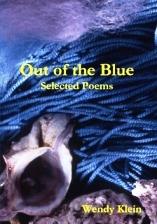
Copies of Wendy Klein’s Out of the Blue, Selected Poems are available from this website and can be purchased by following the link.
*****
Introduction
First off, many thanks to David for offering me this slot, although I was initially worried about the fact that I am no longer ‘officially’ American, having renounced my citizenship eleven years ago. Indeed, I believe the single most significant influence on my work is a sense of belonging nowhere, a pervasive disjuncture. I think I started leaving America, the United States, from the moment I realized there were other places I might go, other places I might live. The assassination of John F. Kennedy, and a failing marriage to a classical musician dissatisfied with his career in the US, plus the escalation of the Vietnam war provided concrete reasons for leaving in 1964. The first destination was Sweden, though Sweden was never home, or France where I lived next, and even less so Germany, where I lived for nearly 7 years. Now in the UK for more than 50 years, I am still not sure it is home, though it is as close as. Since I began writing seriously here, I write outwards from this place/this permanency, eternally surprised at the way my voice comes out looking back at America with a critical eye, but strangely American at once. In the UK I was taught about form by some of the best teachers in the trade, but in the end I opted, perhaps lazily, for a looser free verse, aiming to be accessible in language and style, unpretentious. I hope I have achieved this.
It has been difficult to select poems that I feel are representative/typical of my work, since I have prided myself in being something of a chameleon, a family label originating with my Jewish grandmother who loved labelling, often rudely. Her sharp tongue was a poor cover-up for a lifetime spent grieving for my mother who died at 35, her younger sister at 42. As my replacement mother for 5 years following my mother’s death she wanders in and out of my poems with relentless love and reproach. Indeed, family is never far away from my writing, my daydreaming father from a wealthy non-Jewish family with U.S. Civil War origins, his left-wing politics, his hatred of war, his pervasive sense of inadequacy – all there in my poetry. Then there is my grandfather, a loving tyrant, both informing and confusing me about being Jewish, and always disappointed that I did not turn into my dead mother. I have had to include the poem ‘California Day’ about her death caused by an attempted illegal abortion. My caring stepmother, Ruby, sometimes turns up, too, but has had to be sidelined here, as well as my lovely grandchildren. Travel has featured in my work; the excitement of new places and writing about them a welcome distraction from the closet full of family skeletons, though everywhere I went seemed to lead back to family business, but I think the choices I have made here cover the territory adequately. Huge thanks again to David who reviewed my first book, ‘Cuba in the Blood’ for Acumen poetry journal in 2009, which made me believe, for a moment, I might really be a poet, and for publishing my ‘Selected’, Out of the Blue in 2019.
*****
WAR DANCE
after Mark Turcotte
Back when I used to be American
I’m playing cowboys and Indians with Doug
and Larry, but Doug says
I can’t be a cowboy cause I’m a girl,
and before I can ask, he says
I can’t be a cowgirl either
cause there aren’t any in his game,
so I look around in the garden shed
for Daddy’s axe
thinking about a tomahawk —
see it splitting Doug’s fat, stupid head
wide open, but he hands me
a pigeon feather,
and I try to stick it up his nose,
sharp end first,
but Larry says maybe,
I could be an Indian,
and boy am I ready — strip off my blouse,
fetch my secret face paints
think I hear my tribe start to chant,
hum along
to a dance beat,
get ready
for war.
(First published in Prole)
RED WEDDING DRESS
We’d got six red dresses to try,
flouncing on their hangers – so many
shades of red, but all loose-fitting
to hide your just-rising bump.
I was zipping you up the back
when a tannoy crackled on,
and a sales girl shrieked
as a breathless voice announced,
the president’s been shot…
You weren’t listening –
too busy pulling in your tummy
as hard as you could,
frowning at your silhouette
in the mirror, shaking your head.
Hey, I shouted, the President –
he’s been shot – in Dallas!
You gave me this dopey look,
repeated it – like a question:
In Dallas? I wanted to shake you
as the tannoy grumbled on:
They’re taking him to hospital,
but you were still gawping at the mirror.
This one won’t do, you said, grabbing
the next – floaty, with a dropped waist,
and as the world you’d signed up for
juddered and changed, you smiled
at your reflection – gave a little twirl
of your skirt – blood red and swishy.
(First published in Acumen)
CHICKEN SOUP FOR PESACH
My grandmother never kept hens.
When she asked her Kosher butcher
for a boiling fowl, she didn’t see
a tired bird, done with laying,
but a rich broth, laced green with
celery, with parsley, later dotted
with Matzoh balls so light they wafted
rather than floating. So today
when I take a knife and poultry shears to
a free-range, organic super-market bird
stripped of giblets, but killed, I’m assured,
in her contented prime, I feel
my grandmother’s breath in my ear,
muttering about the ludicrous price;
that dead is dead; that soup should not
happen to a pullet, that young meat
is for the grill or the frying pan,
asking again what happened to boiling birds,
insisting that spring chickens are meant
for better things, and I wonder whether
she is thinking of my mother, dead at 35,
her sister at 42, herself dead by my age,
or the death reserved for tough old birds like us
still making chicken soup for Pesach.
Previously unpublished)
THE LETTERS BETWEEEN US
i.m. Samuel Heyert (1879-1962)
How he yearned to teach me the alphabets that shaped him, landed him between
the Byzantine curls of Cyrillic, its traps and surprises: the tantalising A, M, T,
so like English, the hooded back-to-front ‘b’, a footstool beneath its seraphed
canopy, and the sternness of prayer book Hebrew.
From his Siddur, he traced squat Chet, the inquisitive curve of Lamed, severe
Dalet , using his forefinger as Yod, read backwards across the page, tapped each
word, spoke it, lingering over the ghetto gutturals as he tried and failed to climb
out of his past: the shtetl, the steerage, the black-gabardine chanting.
And I was a dull pupil, forever reproached in the letters he fired at me through
all my growing away, envelopes addressed in poles and pikes: i’s dotted with
emphatic bursts, strident t’s, the twin-spiked ‘W’ of my name, the Y’s tail
so straight its spine must have ached from the jab of his Parker 51.
It was grandmother’s postscripts: the perfect curves of the fifth-grade school
leaver, her model penmanship, that soothed me, delivered her smells to me off
the page –a blending of moth balls and face powder; the comfort of misspellings
and undisguised devotion.
What would they think of my draughtsman’s pencil, my sturdy blue life-line,
its clumsiness, its smudges; its hope that something fresh will emerge; can be rubbed out if not; the way I shape my letters, sloped back with resistance, rearward leaning, forward lurching – left-handed writing in a right-handed person.
How, snagged in the Velcro teeth of memory, it becomes more illegible, how
I use it to conjure him, wonder if what I’d read as pedantry, was only pastiche –
the reproach, a wildcard love – whether we ever quite climb out of our pasts:
the shtetl, the steerage, the black-gabardine chanting.
(From Cuba in the Blood)
CALIFORNIA DAY
i.m. LHT, 1 June 1942
It’s typical L.A. just how you fell in love with it —
a lifetime away from snow and slush, remembered
brownstones. The house is a single-storey sprawl;
ranch-style Spanish with reliable roof tiles in red.
There’s no place for fear in this balmy afternoon –
Gracie has sung the praises of the doctor,
and you giggle with your sister, plan chocolate sodas
for after, remind her, remind yourself, of the hundred and one
good reasons not to have it: the first one still so young,
the war still on, no money, no jobs. You’ve been told
it’s a simple procedure, over in no time, but you’re scared
of the pain, insist on ether. I imagine you poised
between thirty and forty, the high board of your life;
your arms pressed to your sides, waiting to black out
and when they tell me years later, I try to picture
the second before you made the dive; to guess
whether you spared a thought to who’d comfort
your sister who drove you there and waited;
or your parents miles away, not knowing,
and who would hold your first-born,
if you failed to surface again.
(From Anything in Turquoise)
LUTE
Look at the shape of it – like a teardrop,
the depth, the back that’s called a shell,
the strings that are made of sheep’s gut.
Close cousin to the guitar, the lute
has a lighter sound. Once upon a time
it was the instrument; even the queen
had one, could play it. What if my father
had owned one, could play it, had brought it
to his high school English class, held it,
leaning against his desk like a rock star,
explained how it was hand-crafted
way over 400 years ago in France?
What if some tough kid had asked,
Is that what guitars looked like
in the olden days, and my father
had answered yes, and teased a pop tune
out of the sheep gut strings, and the kids
had thumped their desks and sung along?
Would we have stayed on another year?
Avoided the next new school, the next house,
the next neighbours, no friends? Instead
he tells a story of the lute player’s daughter
who preferred playing a tin pipe she’d bought
for tuppence in the market, said how she liked
music made of breath, not formed from fingers,
and the tough kid blew a raspberry, and my father
groaned, and the bell rang for lunch.
(2nd Prize winner, Poetry Space Competition, 2022)
MY GRANDMOTHER AS SCARLETT O’HARA
Sallie Lightfoot Tarleton (1821-189-)
I try to imagine you at Tara, Sallie Lightfoot,
on your knees in a field of turnips (or was it
potatoes?), like Vivien Leigh playing Scarlett,
raging against Sherman’s evil work,
vowing, God as her witness, never to go hungry
again: hair wild, unaccustomed apron
grimy with grease or blood – kitchen dirt.
So much behind you, Southern Belle: music,
dancing, fine wine, spirited horses, good books,
gentleman callers on the front veranda —
you, catching my great-grandfather’s eye:
young Robert Tarleton, just down
from Princeton, plunged head-first
into the politics of secession, ready
to fight for his land, your land, the glory —
your way of life, already receding.
And though the turnips were real enough,
the hunger, the poverty (your bridesmaids
in homespun muslin, hand-woven
on the plantation, your wedding gown
passed down through sisters and cousin-brides),
my Tara image gives way to a sorrowing woman,
early-widowed. You never put on colours
after mourning your husband,
the genteel past, the South you knew
and loved. Near death on a 4th of July
you railed at the nurse who brought
a small American flag into the room,
your voice as strong as ever:
Take that flag out of this room.
(From Let Battle Commence)
RENOUNCING
Seven of us told to line up, a ‘safe’ distance
from the glass cage separating us from reception.
Are you here for renunciations?
They don’t have the list of names yet
so we don’t exist, shuffle in the shadow
of the embassy.
Are we dangerous?
A uniformed official asks for passports: which one,
I stammer, and hand over both.
Are you here for renunciation?
An Orthodox Jew, white-bearded,
towering above us in his Shtreimel,
stands next to a daughter, granddaughter,
or youthful wife. Stocky in too many clothes
for the first warm day this spring, she studies
the ground through dark-rimmed spectacles,
her eyes short-sighted from close reading
Hebrew without vowels.
A honey-haired woman, American, to judge
from her accent, averts her eyes, her mouth
crooked with embarrassment, her daughter
bold-eyed beside her; her father with matching
eyes and a name that might have made the Haj.
What are their stories?
A man in his forties, tailored by Saville, his speech
Magdalen, Balliol — brown hair clipped, has a slow smile
for each of us.
A woman, too muscular for her pinched face,
hovers, supported by her lawyer who’s not
allowed in, but offers crisp comfort, a pat
on her client’s stout arm, observes her hand
white-knuckled on a battered brief case.
What are their stories?
We’re allowed in, stripped of buckles, boots
anything electronic.
Are we dangerous?
He gives us each a number, ushers us into a room
large enough to hold a small army, leaves us to take
seats as distant from one another as we can manage –
to wait in front of television screens that broadcast
the news without any sound.
Are we in danger?
I am called, and it is over so fast I hardly know
it has happened.
Look at the flag
And when I do, the stars and stripes, the gold fringe –
look tired.
Do you renounce…?
I think: your word not mine, shutting out
the face of my great-grandmother, wet
with tears of gratitude as she kisses the ground
at Ellis Island, as I sign that part of me away.
(First Published in Jewish Renaissance)
 The High Window
lovely introduction by Wendy Klein – and powerful poems. Thank you
Sarianne
LikeLike