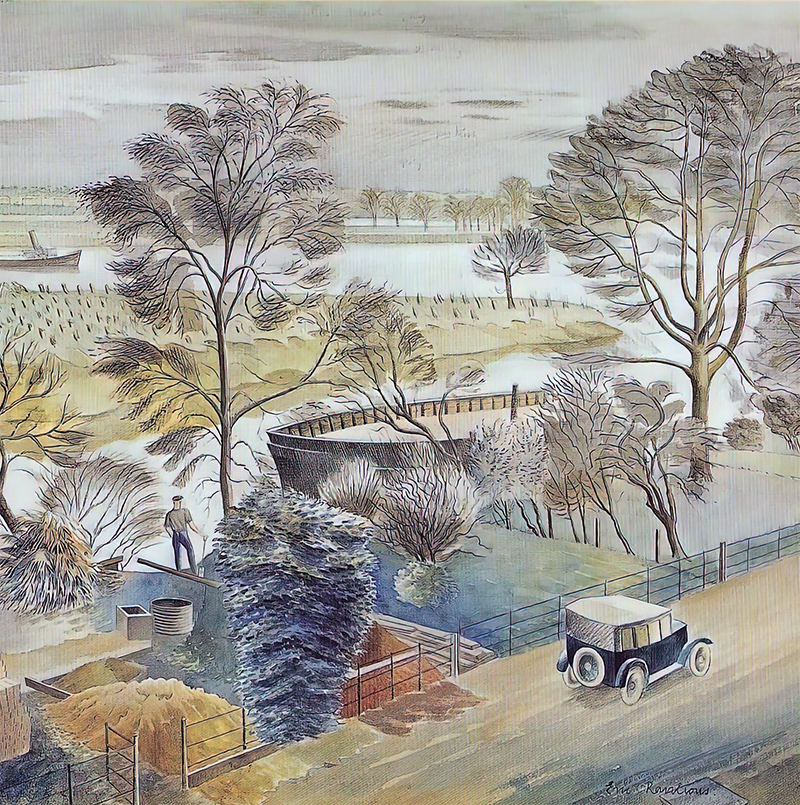
Eric Ravilious: ‘The River Thames at Hammersmith’, 1933.
*****
Alan Jenkins was born in 1955, in London, where he has lived for most of his life. Until 2020 he was Deputy editor and Poetry editor at the Times Literary Supplement, and he has taught in England, France and the United States. His volumes of poetry include the Forward Prize-winning Harm (1994), A Shorter Life (2005), and Revenants (2013) as well as several chapbooks.
His latest collection is The Ghost Net which was reviewed in The High Window: July 17, 2023.
*****
Alan Jenkins: Eight Poems

INHERITANCE
Herringbone and fern, this coat
Materialized out of grouse-moor,
The ground my self-made great-grandfather treads
Ten years before the First World War;
Shotgun cartridges, tobacco-shreds
And dry-flies in the pocket of his coat,
And the slender hip-flask,
Silver in its leather sleeve,
Tarnished now from trying to relieve
My grandfather’s thirst, take off his fear
Of rats and snipers and the feeble cheer
That goes up as they go over. Last-nip flask.
On the way to art-school dances
Or a Left Book Club lecture (Spain)
My father glances at his gold-plated watch
And slips the flask, half-full of scotch,
Back in the pocket of his coat. At Alamein
It stops a shrapnel-shard as he advances
And he comes home, when the war is ended,
To a place where quiet lives are led
(Grandfather, father both long dead,
Grouse-moor and money all long gone);
A wife and child are all he gambles on
But some things, like the fence, are never mended.
And he gives me, not yet twenty,
The flask, that I will later lose,
The coat and watch, that I will wear and use
To seem a man in the world I have not fought for,
Worked for, even spared much thought for.
This is my inheritance. It is plenty.
ORPHEUS
What is life to me without thee?
xxxxxxxxxxxxxxxxxxxxxxxxxxxxxxMuch the same,
except that I can’t hear the great aria
sung by Kathleen Ferrier
and not be filled with longing and with shame,
so uncannily her portrait on the CD cover
resembles you; so uncannily her 1950s perm
brings you back to me, that first day of term,
waving me on to school. I missed you like a lover
and would have clawed through concrete and earth
to be at home with you, who had to let me go,
who gave me such a sense of my own worth
that I sing with her, as if Orpheus was my name…
What is left if thou art dead?
xxxxxxxxxxxxxxxxxxxxxxxxxxxMy attic flat,
the cat you took such pleasure in, who wonders why
I sit so late, and drink, and do not go to bed
to sleep an hour or so then wake
and soak the clammy pillow for your sake,
who comforts me with purring in her sleep,
the gentle sleep she offers like a gift;
who does not as I do turn over in her head
the knowledge that you died between the night and morning shift,
that as you felt yourself slip
you heaved up the black bitter years that would dry
on your cold dead lips; she does not know that.
Thy dear lord am I so faithful?
xxxxxxxxxxxxxxxxxxxxxxxxxxxxNo more or less
than when I bundled you into a wheelchair
in a stained pink hospital quilt
and the dazed smiles of women stranded in the regimen
of sleep and pills, your new friends, were rooting for us
as we struggled to that suburban high street where
you sat for your last wash and perm;
and we came back to their wondering chorus
of ‘Ooh, lovely, dear’, and you were young again,
touching your new hair, and I was without guilt
and loved you as on that first day of term,
as if I had won you back by this huge success.
DAY RETURN (THE FOUR STUDENTS)
That left-over halt… It’s where, years ago,
Four of us at the end of our student days
Got out and walked for hours in midsummer heat
Down lanes and bridle paths and unmarked ways
Through waist-high grasses, warmth-holding wheat;
Or let the river lead us, full and slow,
Past stands of willow, clumps of oak and beech
And their reflections that one dazzling swan
Sailed across – above that wide green reach,
Cloudless blue. To think: only one-third gone
Of life! Two boys, two girls, still owed a living each;
Two of us in love, all four the most free
We’d ever be, with nothing more in mind
Than the next pub and no-one more inclined
To wonder what was waiting than the other three.
Did I even think of what I hoped to find,
Back then? Cocksure, twenty-one and walking
Towards my smiling future with no fear
Except of things I didn’t want, and no idea
I’d talked it to death – while death was stalking
One of us, in fact: though we could not know.
He’s gone now. I stood still, while the others
Went purposefully onwards from that hot July,
Two as wives (then one a widow), mothers…
This time the river’s just as sluggish-high,
The fields and farmhouses in their stands of trees
Are as perfect as that day; but now Too late,
They say, for you to taste seclusion, ease,
The beauty you see here. From the crossing-gate
We have, to one who knows he too will die,
The look of permanence, of hallowed ground
You cherish since you’ve grasped it will remain
Almost the same when you are not around
To gaze at it. And this new kind of pain
Goes with you as you sit in the London train,
As you walk from your station up the hill
Past playground, car-park, pub…Not many lights
Left on at this hour. Some, sleepless still,
Pace their rooms, their minds full of other nights;
One smokes, arms folded on a windowsill;
One tinkers on the internet; one reads.
In piss-smelling tunnels, wire-fenced alleyways,
On paving stones that sprout stubborn weeds
The streetlamps’ slick repeated orange blaze
Points the way home. I know where it leads.
MOTHER, SUMMER, I
On weekday afternoons as still and hot as this
We used to have ‘the Common’ to ourselves;
I ran ahead of her down the shadowy walks
Through birch and bracken, mounds of new-mown stalks
To where the small pavilion’s tiled roof shelves
And the blank scoreboard waits for Sunday
That brings men in white, their sandwich-making wives,
Their faint cries from the outfield, hit and miss –
Then ran back when she called. I was afraid to stray
Too far into the shrubbery, beyond our lives…
Today the temperature is touching ninety
So everyone young or brave enough is here,
Slumped in deckchairs to watch the cricket
Or picnicking, out of sight of the wicket,
In the shade of horse-chestnuts, and with a cheer
Releasing toddlers who stagger drunkenly
Around and fall face-down on the grass;
But one or two like me have come instead
To be with tombstone-angels and their dead,
To clear the weeds from portraits under glass,
From ‘Dearly loved and sadly missed’ and ‘Always
In our Thoughts’ – except that you have none
Of those, just a yew tree and a bench and one
Rose flowering from a dusty bush. These days
Of unnatural heat that would have wilted you
Have not wilted that, so I skirt ‘Dearest Mum’
To sniff the scent, but it’s then the hot tears come:
To think of all I could have given, but withheld!
The afternoons, the trips that would have spelled
Such happiness, when instead I jilted you;
The picture that, although you never said,
You longed to show off in the little local store:
A family group, with granny – you… Instead
There’s only us. I get up, stiff and sore.
The sun has gone behind the darkening trees.
The gates are closing. Cars queue silently.
Is it the thought of another solitary evening
That slows my steps to a standstill, or these
Twin dead-weights: to be, yet again, leaving;
To know what you’d have wanted, now, for me?
from SALT-WATER DAYS
Where were they, the tall ships of salt-water days? – In irons
In a stench of mud and fish-heads, the stews-like environs
I knew so well, I heard the calls of South London sirens:
‘Now listen, all you modern tars what draw the mid-day potion,
Good kids, no doubt, in harbour bars, but blimey, on the ocean:
When stormy winds begin to blow the ship is in great motion. . .
This rocky mid-life passage finds you unprepared,
So many of your shipmates gone, while you’ve been spared –
But not for long, while what’s to come leaves you shit-scared!
Years ago it would have been the syphilis that got you,
Or opium, or drink – something that would rot you
From the inside out; or a husband would have shot you…
What’s happening is not exactly what you’d hoped or planned.
Look at you – unprized laureate of the prostate gland!
Bid farewell to the shipmates you have lost, to the strand
Where they gather, and set sail – for those fortunate isles
Where the only commuting is in nautical miles,
Where the men are men and the women are all smiles;
For the harbour that awaits you, the words that you must write
In love, in hope, in grief, in gratitude, and in despite,
In a fire of self-forgetting, in the watches of the night.’
FEEDER
Basking in the Mayfair afternoon,
the Killer Whale, the male.
Undersea light
filters through the fronds
of sea-grass – urban ferns
and hanging-basket leafage.
And he has come to feed.
Silent, he lunches
on small fry and crustaceans
which he crunches, on gilts and bonds,
on something by Jeff Koons
and the woman’s cleavage.
There is a need
for gradual overpowering
in his hands, which prod her
here and there, feeling
for the soft spots,
the intimate recesses where
he can deliver hurt –
there is a need for devouring
in his playful excesses,
sea-spurt and sea-squirt!
Such vagaries of appetite,
and only the ocean
with its teeming zones
to nourish him…
Why her stunned face,
why that commotion
in the shallows, that wave
of indignation on the shore? –
Unrest among the bottom-feeders,
clicking of iPhones,
writing of leaders.
You can’t fuck with someone’s head
in peace, in public, any more.
It’s outrageous. It’s a bore.
from RIVER
The young men of a rowing eight,
Twice my height and half my weight,
Go flashing past, their fluent oars
Send ripples spreading to both shores. . .
Blackfriars
Late afternoons, late ‘60s
I hurried past
Stamford Street’s
grey-brown brick
soot-dark fanlights
in school uniform
Merchant Navy battledress
officer’s peaked cap
starched white
by my mother
shoes buffed to
flawless black shine
by my fatherxxxThis once
slouching past me
back to his lodgings
Arthur Rimbaud
no more than a boy
ice-blue eyes caught mine
Putney
Duke’s Head, Putney,
tall French windows open
to the river, slow-running,
rowing fours and eights;
gentle Gavin Ewart
sipping at his pint,
telling me this was
‘The home of English
liberty’ – 1647,
Putney Debates. . . I
pointed out a ladies’ four
as they flashed past,
thighs flexed, breasts lifted
and ‘I may’, he said, eyes wide
voice full of cunning
‘be getting on a bit
but I can see they’re girls –
I haven’t died!’
Mortlake
Flotsam washed up
on towpath and foreshore
by a spring tide,
the splayed-wing
semaphore
of cormorants in beeches
the sudden plunge
as a barge, black-eyed,
chugs upstream:
at home in these
thickly-leaved
suburban reaches
Mortlake, Richmond, Kew
among scents of
woodsmoke, river-gunge
I still dream
some thing beyond
things my father knew
Isleworth (Heron Island)
They’ve seen better days
their tatty morning suits
silver hair en brosse
distinguished
wedding guests
great-uncles, still elegant
they gather on this lawn
that shines like metal,
mirror they disdain
to look into, their gaze
fixed on far-off events
that once concerned them
until some stir
below the surface
snags their attention
and with jaw-dropping
accuracy, with distaste
they skewer two canapés
HAMPSTEAD
‘The Cresta run
from Hampstead to Belsize Park
is long and wet and dark.
There’s whisky at the end,
and music, food and fun.
There are things unsaid, undone
on that slippery slope
that can give a person hope.
Something in you wants a friend
when night falls, rain falls
and the pretenders pretend.
Something in you calls
from that far room
as she called out from Hampstead
to a marvellous boy dying in bed –
outside, going about its business, Rome.’
Where was it she lived, back then?
Pilgrim’s Lane, or Gayton Road?
I walked from Hampstead tube –
in those days before Uber,
before iPhones, before we all went cashless –
down the hill towards Chalk Farm,
summoned to Sunday lunch (domestic bliss!)
by a woman I barely knew. . . Back then
I was a chancer, so I chanced my arm.
And did I write that stuff
later, in the evening, off the cuff?
In those days, music, whisky, food
and what I call ‘fun’ were enough
to make a life, my life, and poems, brewed
for months or minutes, flowed
or spurted, ‘fountained’, even – from my pen.
And what about that ‘marvellous boy’?
That was Chatterton, poet under a curse,
though clearly, I meant Keats.
Did I really dare, in any way
compare myself to him?
And of whose ‘far room’ was I thinking
as I walked the streets
and hills and vales of Hampstead?
Not mine – and not hers,
which I’d never seen till that day;
a warm room where we went on drinking
after her other guests had gone,
and the sofa served for a bed
when, seemingly on a whim,
she somehow had nothing on. . .
Ah the days, the nights, and so much joy. . .
*****
Note: The italicized lines in ‘Orpheus’ are from the English version of Orpheus’ heartbreaking aria in Gluck’s Orfeo ed Euridice (Orpheus’s lament on having won his love back from the dead, only to lose her again, this time for good). Kathleen Ferrier’s incomparable rendition is widely available on YouTube. ‘Day Return (The Four Students)’ bears a close, if loose, relationship to Thomas Hardy’s ‘The Five Students’. (I had no conscious memory of his poem when writing mine. Perhaps, as Freud said, we never forget anything, and there are no accidents.) I consciously borrowed the title of ‘Mother, Summer, I’ from a poem by Philip Larkin – a poem he never published, so maybe my impertinence can be forgiven.
Those two, Hardy and Larkin, stand at the pinnacle of one kind of English lyric poetry that I love, and think of myself writing ‘in the line of’; some of my poems, though, are much more Frenchified, and draw nourishment from the late nineteenth-century poets Verlaine christened les poètes maudits (literally, the accursed or wretched poets). In some poems I try to bring these strands, these musics, together; in others, I am more beholden to one or the other. In ‘Hampstead’ I acknowledge this with a reference to Thomas Chatterton, who could be said to have been the original poète maudit. Not that I really think I’ve been cursed, far from it – as that poem also tries to suggest.
*****
 The High Window
So good to see A J back in action !
LikeLike
Yes, I too remembered the Five Students. I loved this poem, and the poems about your mother, and so admired your mastery of form and your evocation of a world that is gone. Yes, Hardy and Larkin are the true line of english poetry. I wil go on reading you.
LikeLike