*****
The editor of The High Window is grateful to the poet, Alan Jenkins, and Rory Waterman, at New Walk Editions, for permisssion to reprint two poems from The Ghost Net.
*****
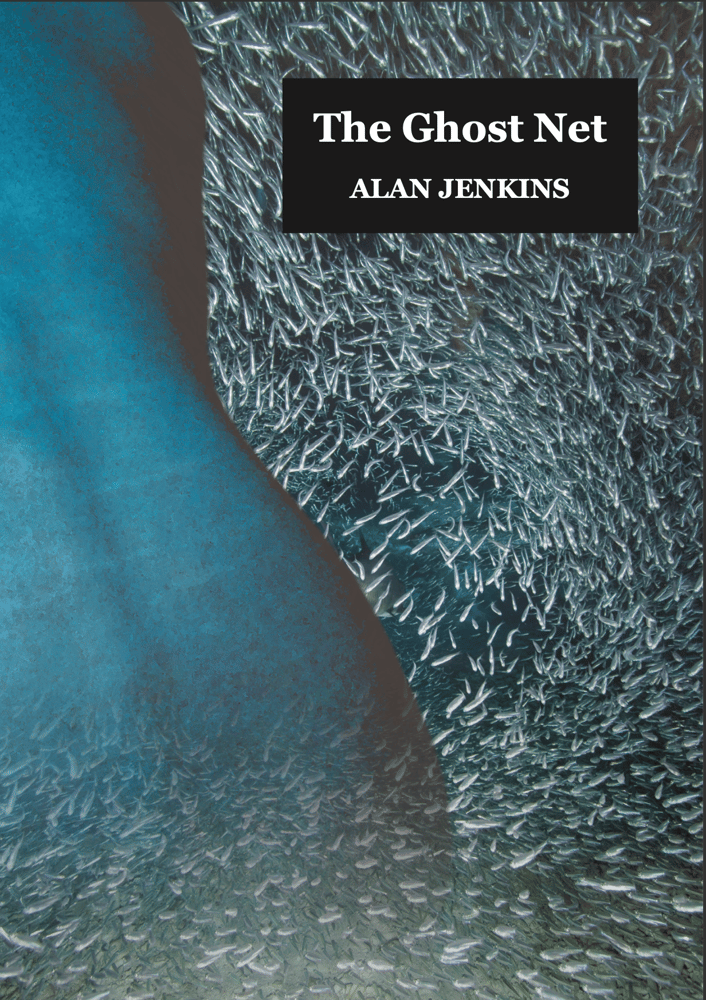
The Ghost Net by Alan Jenkins. £12. New Walk Editions. ISBN: 9781739281205 Reviewed by David Cooke
The publisher’s blurb for Alan Jenkins’ The Ghost Net informs us that this is his ‘eighth full collection of original poems and his first for a decade’. Since publishing five acclaimed collections with Chatto & Windus, between 1988 and 2005, and, in 2001, A Short History of Snakes, his selected poems with Grove Press, New York, it has been increasingly difficult to keep track of work that has been published by various small presses. One is grateful, therefore, to New Walk Editions for making available this memorable addition to the poet’s oeuvre which shows him writing at the height of his powers. Elegiac in tone, it is dedicated to the memory of two friends, one of whom, Marie Colvin, is a significant presence. An American-born foreign correspondent, who worked for The Sunday Times, she was killed in a rocket attack on Homs, Syria, in 2012, and was clearly an important figure in the poet’s life.
As in much of his previous work, Jenkins is haunted by memories, turning them over obsessively and never quite managing to lay them to rest. This process, or its failure, is encapsulated in the collection’s enigmatic title. A ‘ghost net’ is an abandoned fishing net, of which it is estimated that some 50, 000 tonnes are generated each year. Eerily submerged beneath the surface of the oceans, they inflict significant damage on the environment and continue to entrap fish which can never be brought to the surface or be disposed of for any useful purpose.
‘A Song of Maine’, the opening poem, sets the tone for much of what follows. It also hints at the presence of one of Jenkins’ literary ‘ghosts’: Robert Lowell. Here is its first stanza:
It seemed absurd,
To be flying up to Maine,
An ‘honoured guest’, the week I’d heard
That my life would never be the same again,
That the time had come to pay for every word
I’d let go in unkindness, or in haste,
Every chance I’d let go to waste,
Each drag, each drunken fuck,
Each drop of booze,
Each bit of undeserved good luck
I’d somehow refused to use;
The self-recrimination expressed in these lines is overtly ‘confessional’ and brings to mind some equally devastating lines from Lowell’s sonnet, ‘The Dolphin’:
I have sat and listened to too many
words of the collaborating muse,
and plotted perhaps too freely with my life,
not avoiding injury to others,
not avoiding injury to myself—
…
my eyes have seen what my hand did.
However, it may also be worth mentioning at the outset another influence that has shaped Jenkins’ literary persona: the 19th Century French poets from Baudelaire onwards. ‘A Song of Maine’ might be seen as a prologue to this collection in the way that ‘Au Lecteur’ is to Les Fleurs du Mal. The French poet universalises his theme but there is a similar sense of self-flagellation:
La sottise, l’erreur, le péché, la lésine
Occupent nos esprits et travaillent nos corps,
Et nous alimentons nos aimables remords,
Comme les mendiants nourrissent leur vermine.
(‘Stupidity, error, sin, and meanness possess our minds and work on our bodies, and we feed our fond remorse as beggars nourish their lice.’ Translation adapted from Francis Scarfe: Baudelaire: Selected Verse. Penguin. 1961.)
Since his teenage years, Jenkins has immersed himself in this poetry, translating it, adapting it and, in the process, assimilating his own poetics to that of les poètes maudits. Moreover, throughout The Ghost Net – to a great extent because of his own family history – Jenkins is haunted by seafaring and seafarers, just as Baudelaire and Rimbaud used the image of ‘the voyage’ as an allegory for life or, as Mallarmé did in ‘Brise Marine’, as an escape from the ennui of daily existence. In ‘To the Lighthouse: Finistère’, Jenkins addresses the less widely known Tristan Corbière, who, like Rimbaud, was prodigiously talented, but died young:
Tristan! You were history. I was high and dry.
Our fathers would have sent us
both to sea, the carrière
ouverte aux talents – instead you hauled a dinghy inside
your family’s summer home-from-home
to sleep in, while I spent forty years
on a berth sheltered from
the brown swirling current of careers.
However, in spite of such influences, Jenkins is still very much an English poet. The Ghost Net is replete with references to the British naval tradition and the many books and films it has spawned: Conrad, Marryat, Monsarrat, O’Brian. Moreover, reading his poem ‘B&B’, one sees, also, that he is a worthy heir to the legacy of Philip Larkin. Except perhaps for the late Derek Mahon, there have been few poets since Larkin, who have been so wedded to the traditional metrics of English verse and who can handle them with such ease.
I knew the path, the promenade, the lanes,
The park where a stone Victoria frowned
At lichen-covered benches, salt insistent rains
(I could have lost myself, I could have drowned),
The rust-streaked wet clay of the undercliff;
Heaps of rotted feathers, stinking bladderwrack,
Gull-shit and tar-stains, and the intimate whiff
In broken shells. Why had I come back?
In the course of this poem’s eight capacious stanzas, Jenkins charts, with his own brand of bruised eloquence, the frustrations of adolescent love set against the backdrop of a seaside resort, the decline of which mirrors that of the country. It’s a virtuoso performance in which the rhythms are sure-footed and the rhymes unobtrusively pitch-perfect. Three of the stanzas start with the phrase: ‘I knew the path …’, which is then repeated elsewhere in the collection, emphasising the obsessive nature of these memories and thereby enhancing the overall unity of the collection. In fact, we note it again, with a change in the tense from past to present, in ‘Look Out’, the poem which immediately follows. Here, the poet’s awareness of lost opportunities is emphasised by the sloshing rhythm of the waves: ’Same old riff: // What if What if What if What if …’. Reminiscing again on an early sexual encounter, he sneaks in a playful reference to Marcel and Gilberte in Proust’s À l’ombre des jeunes filles en fleurs: ‘Do you want to wrestle’. However, as might have been expected, he again concludes forlornly: ‘She is not there.’
Throughout The Ghost Net, Jenkins gives ample evidence of his skill in handling traditional metres, including terza rima, which is notoriously difficult in English, given its lack of words that truly rhyme. However, beyond those particular challenges, he has a predilection for ambitious sequences, such as ‘Salt-Water Days’, a sea-faring fantasy in which he alternates rhyming tercets of 12-15 syllables with octosyllabic stanzas reminiscent of Rimbaud’s ‘Le Coeur Volé’, which, for good measure, he translates and incorporates:
My sad heart slobbers on the poop,
My heart all black-tobacco-blue;
They chuck at it their gobs of gloop –
My sad heart slobbering on the poop
Under the piss-taking of this crew
Who laugh themselves to death it’s true…
In a sequence where fantasy and autobiographical detail get blurred, he has plenty of scope to remember some of the ‘characters’ who taught him in the London nautical school which, we learn from his Notes, he attended for a few years:
That long-dead master-mariner? So hugely eared
He could have gull-winged down the rope-hung corridor,
Who growled his orders through a nicotine-striated beard …
In ‘Night Sail’, another sequence, written in terza rima and dedicated to Marie Colvin, he demonstrates his Byronic facility with rhymes: ‘grandfather Herrick’s / derricks, ‘super tanker / Casa Blanca’, ‘Zuwarra / Samara / John O’Hara’. More serious though is the contrast he draws between himself, the armchair traveller, and the daily risks which Colvin took in the course of her job and which, in the end, killed her: ‘the old fear, / of falling short, of being found out, of the yellow streak // that runs through me …’.
Moving beyond the death of Colvin, he returns, in ‘At Richmond’, to his suburban upbringing as a bookish youth. It’s a touching poem interspersed with portraits of the ‘purse-lipped cantankerous’ old gay man who ran a bookshop and the ‘legendary’ Peter Green whom he was too shy to address. The elegiac mood then deepens in ‘Salvage,’ a sequence of seven sonnets dedicated to the memory of his father. In these poems, a larger-than-life character has been reduced to a few medals, books and items of clothing, although of course his memories remain of days spent fishing or of being taught to swim. In ‘Clipper’, the poem which brings this sequence to a close, the model ship so painstakingly constructed by his father has slowly disintegrated through neglect and the passage of time:
No one has dropped her, or dropped anything on her.
No-one has come near her. But forty years
Have done their work, as patient as he was,
Undoing all his craft.
Reading The Ghost Net has been an exhilarating and moving experience. Witty, scurrilous, poignant, it creates the impression of a life lived and honestly appraised. It is, by many nautical miles, the best new book of verse I have read in a long time.
*
NB: A copy of The Ghost Net can be purchased here
*
Alan Jenkins was born in 1955, in London, where he has lived for most of his life. Until 2020 he was Deputy editor and Poetry editor at the Times Literary Supplement, and he has taught in England, France and the United States. His volumes of poetry include the Forward Prize-winning Harm (1994), A Shorter Life (2005), and Revenants (2013) as well as several chapbooks
David Cooke is the editor of The High Window. His Collected Poems has recently been published by Littoral Press.
*****
Alan Jenkins: Two Poems from The Ghost Net

(Photograph © Charles Hopkinson)
B&B
I knew the path, the promenade, the lanes,
The park where a stone Victoria frowned
At lichen-covered benches, salt insistent rains
(I could have lost myself, I could have drowned),
The rust-streaked wet clay of the undercliff;
Heaps of rotted feathers, stinking bladderwrack,
Gull-shit and tar-stains, and the intimate whiff
In broken shells. Why had I come back?
I knew the path they called the Coastal Walk –
A sheer drop to hissing shingle, and the slosh
Of foaming breakers, spindrift, backwash,
The jagged rocks and eddies under talk
Of what we’d eat (some pricey fish-based gunk);
Farther out, the sliced-off, rust-gripped hulls
Of wrecked merchantmen, and wind-flung gulls –
Drowned sailor-souls. . . Every evening, sunk
In silence, clenched tight as mussels and half-pissed,
We took unsteady steps down to the ‘beach’
(How her muscles clenched tight on you!): through mist,
A harbour-pastoral of masts just out of reach;
Lamps festooned the ‘Captain’s Cabin’, nets, so much
Old rope – and there it started, nights of Please,
It’s not a good time. Of Look but don’t touch,
Of your look that brought me to my knees!
(In cooling bathwater, in a stench of fish
And mildew, I groped for the sliver of soap
That slid from the B&B’s scallop-shell dish –
Grey suds slopped overboard. . . And did I hope
To see you now, pale skin, pale pubic blur
As you peeled off your one-piece? Could she tell –
How much you’d miss the feel of scallop-shell
Slippiness inside; that you’d be back for her?)
I knew the path across sand-dunes and rocks
To a concrete pillbox: piss-and-damp-mould smell,
Charred driftwood, condoms like the ghosts of cocks;
Outside, the washing of the channel swell
Through winding culverts to a weed-fringed pool
Where sea-anemone and scuttling crab
Shrank from my groping fingers and a school
Of gobies darted, when I knelt once to grab –
Only a white sea-smoothed pebble in my hand,
The crab had vanished in a cloudy swirl.
A brisk rub-down, the towel stiff with sand
And salt – aged nine, I watched a little girl,
Wet cotton clinging to her sun-browned skin
As she ran shrieking in the shallows’ sudsy foam,
Ran shrieking back: I’m going in! –
A last-swim sadness, last day before home. . .
Don’t touch, don’t touch: the tightly puckered bud,
The fronds that wave like underwater hair,
The yellow froth that comes in with the flood,
The pale gooseflesh in salt astringent air. . .
I’d never find our windbreak that was hung
With leathery strands of sea-kelp, or peer
Through stinging lashes at wet cloth where it clung
To you when you climbed ahead of me up here –
The narrow track, zig-zag that clings to chalk;
Above me, slate-grey sky, a flapping flag
Torn from an old Red Ensign, and the squawk
Of gulls that bobbed around that fraying rag,
Its empire shrunk to this, a cliff, a path
That led me winding back where I’d come from –
A mildewed B&B, a bar, a bath –
Through spray the wind whipped up above the prom.
SMOKE
All autumn, the chafe and jar
of nuclear war
xxxxxxxxxxxxxxxxxxxxRobert Lowell, ‘Fall 1961’
My father, who’d had
about as much as he could take
by ’44, and still woke
swearing at flies
and soaked in sweat,
read the Telegraph
in dread and disbelief
over his first cigarette,
narrowing his eyes
against the scroll of smoke. . .
Only half-awake,
dreaming a bitter,
penitential cup
of coffee, we squint
at a screen instead of print,
swipe through
and see plump child-men
jerked by the strings
of Twitter,
their sad posturings
that could turn us to smoke
before we can even laugh.
A father’s no shield
for his child – nor
a husband for his wife. . .
Nothing now is a joke,
nothing is so mad or bad
it cannot happen.
To that ‘well-meaning guy’
outside a club in Paddington
who saw her lighting up
and told her she should stop,
Marie just said:
‘I promise you,
this isn’t how I’ll die.’
 The High Window
Reblogged this on The Wombwell Rainbow.
LikeLike