*****
The Translations of Seamus Heaney, Faber & Faber, 2022, £30.00 hardback. ISBN: 9780571342525. Reviewed by Sam Milne

This volume collects all the translations of Seamus Heaney. It comprises one hundred and one texts from fourteen languages, an extensive and very useful Introduction by the editor Marco Sonzogni, an extensive Commentary (arranged by decade) providing information on the source texts, a publication history of the translations, and an account of each poem’s background. Heaney’s model throughout, we are informed, was Robert Lowell’s Imitations (and he began translating at the outset of his poetic career, continuing right to the end) and Heaney’s achievement I think is equal to that of Derek Mahon’s Adaptations, a volume also influenced by Lowell (see my review of Adaptations in the March 1, 2023 issue of The High Window). The volume is synoptic, providing a window into Heaney’s personal poetic preferences.
Any reader these days is inundated by the power of business, fashion, celebrity and social media to the point where the voice of the poet especially is drowned out. Society can make a use of nearly everything, it seems, but not the poet. Seamus Heaney seemed to buck this trend. I have heard it argued that publicists were responsible for his fame. This is utter nonsense—a groundless prejudice. His poetry is its own testimony. It is a poetry of hope, a poetry of love, and I think that it is these features, among others, which attract readers to his work. His poetry uplifts the spirit, and his work often seems far removed from the bitterness, the cynicism, of the age. He writes about our fallibility, our vulnerability—and these qualities are evident in these translations.
There is a classical restraint to Heaney’s work which shields it from modernist hysteria, and it is no surprise, therefore, that classical poets feature centrally in his translations. We have selections from Horace’s Odes, Ovid’s Metamorphoses, all of Virgil’s ninth Eclogue and Book VI of the Aeneid, and the whole texts of Sophocles’ plays Philoctetes and Antigone. Heaney calls this classical hinterland ‘ancient ground’, basing his poetry on this solid millennia-deep tradition. For him this heritage is the nexus where ‘the land of the living and the land of the dead become pervious to each other’ (translating lines from Sorley MacLean’s Scottish Gaelic poem ‘Hallaig’). Heaney’s style in these translations is as it is in his own poetry, embodying what Ezra Pound called ‘the radiant world where one thought cuts through another with a clean edge—a world of moving energies’, and to my mind there is no sharp contrast between Heaney’s poetry and his translations—they are simply two sides of the same coin. There is also a constant seriousness and honesty about Heaney’s work which one admires—the poetry is rarely opaque, and there is always a steady human sympathy running through it.
Heaney’s poetry reveals the beauty of consciousness, the surge of being alive, showing ‘the strangeness and wonder lying just below the surface even in the commonest things of daily life’ (as Bertrand Russell once described the joys of philosophy). This is noticeable in his selection from the work of the Dutch poet J.C Bloem, for instance. Like Heaney himself, Bloem’s poetry stresses the beauty of the everyday and the commonplace, praising life’s diversity and richness (its colours, sounds, and scents) much as Rilke did earlier in his verse (several of Rilke’s poems are included in the volume). Bloem demonstrates that same ‘at-homeness-in-language’ Marco Sonzogni commends in Heaney’s work:
Sheer, bright-shining spring, spring as it used to be,
Cold in the morning, but as broad daylight
Swings on, the everlasting sky is a marvel to survivors.
In a pearly clarity that bathes the fields
Things as they were come back; slow horses
Plough the fallow, war rumbles away
In the near distance.
Bloem is describing the agonies of Nazi occupation of Holland in World War Two, and this praise of resistance is of a piece with Heaney’s translations of Eastern European poets (Jan Kolchanowski, Ozef Kalda, Ana Blandiana, and Marin Sorescu) living under communist rule in the nineteen sixties and seventies. This theme, I believe, had affinities for Heaney in the time of the Northern Irish ‘Troubles’( a time when there was much ‘need for coherence’ as he called it, attempting to find some unity in a fragmented world, calling for reconciliation, not division). He is quoted in the Commentary to the volume as saying he admired these poets’ ‘human fortitude and faith’. The intention here then, as I see it, is to reach beyond cold, impersonal abstractions, everything that destroys the spontaneity of life, to grasp life’s minutiae. This I think was one of the driving forces behind Heaney’s poetry, and it is an aspect much to the fore here in this collection. There is an ease, a clarity, to his style which exhilarates, evidencing a sane and clear-headed poet—and this too I think attracts readers. It is a quality perhaps not too readily accepted in scholarly quarters. His is not a poetry for the chosen few, but for all—his work does not rely upon an ‘expert’ listener as it were. This is what makes him, I think, a representative poet of the age, as Tennyson was in Victorian times.
One of the poets translated here is Joseph Brodsky. Heaney is attracted to his work, I think, because of Brodsky’s belief that ‘By failing to read or listen to poets, society dooms itself to inferior modes of articulation’. Heaney clearly shares this view, and must have been pleased that his own work did not fail in this regard. Affinities, resonances, are obviously important to him in his selection of poems—Sorley Maclean’s ‘Hallaig’ (mentioned earlier) is clearly chosen for the accord between Scottish and Irish Gaelic; Beowulf (the whole of it) and other Anglo-Saxon poems are chosen as they provide perspectives on the origins of the English language. This rich heritage can then be explored creatively through the act of translation (as Pound had proved earlier in his version of The Seafarer).
The Scottish poets Robert Henryson (all of the The Testament of Cresseid, and his Seven Fables) and Arthur Johnston, are chosen because of the Celtic connection between Lowland Scots (Lallans) and Ulster Scots. Henryson was also selected by Heaney (we are told in the end-notes) because of the Scotsman’s ‘sober and playful’ style, a quality which clearly chimed with Heaney’s own temperament. The sacred element in Heaney’s poetics is represented by a selection from the poems of St John of the Cross, a poem by St Brigid, a poem by St Colmcille, and Caedmon’s Hymn (amongst some anonymous hymns by Irish monks and scribes). Established Irish Gaelic poets such as Nuala Ní Dhomhnaill and Cathal Ó Searcaigh feature significantly in the volume and (as with the myths of Ovid) the myths of Old Irish literature, especially the lengthy (and anonymous) tale of Sweeney Astray—one of the highlights of the collection. Myth was always important for Heaney, as it was for Yeats, and one feels that the exercise of translating the early Celtic myths filtered through into his own work. His ‘sense of place’ (his own phrase) was always important to him, and it is evinced felicitously in his excellent translations of poems by Eugène Guillevic (see especially ‘A Herbal’) and Giovanni Pascoli (see especially his long poem ‘The Last Walk’). Heaney goes on record (in an interview quoted in the Commentary) as saying that these poems ‘evoked a childhood spent in a natural world that had some affinities with his own boyhood experiences.’
For Heaney translation was always, we are told, what he called ‘a self-referential quality’—he translates the poets he likes but he also translates the poets he seems to have little in common with, exploring creative possibilities that lie outside his own experience—what he calls ‘prisms of a kaleidoscope.’ By translating poems that run counter to his own nature then (such as those by Baudelaire, Pushkin and Cavafy, for instance) he learns something new, it seems, something perhaps he can build on in his own work.
Translation is always a necessary exercise for the serious poet: it is not merely a question of practice, it establishes a means of bridging one discipline with another, the original work with the assumed. I don’t think it is necessary (or even helpful) to separate the poetry from the translations, as if the former somehow were the genuine article only. It needn’t be a comparative exercise. Heaney sets up a dialogue, as it were, between the poems and the translations, emphasising the fact that it makes no sense for a poet to ignore other poets, living or dead. On this basis translation clearly was of central importance to Heaney in his writing life, his style as unique here as in his own work. As in his poetry his translations instantiate that ‘balance between pain and praise’ Brendan Kennelly discovers in his poems. Here we encounter the same style, the same voice, we recognise as unique, singular and universal—evidencing the same relentless labour of craft we associate with his best work.
There are plenty of fashionable frauds in the poetry world, but Seamus Heaney was never one of them. Steering clear of trivialities, seeking human truths, in an age of mediocre and dull poetry, he was always one poet we could turn to for rejuvenation, someone who knew we still need to care for poetry. With his deep, resonant voice (a voice far removed from the dry, thin tones of much contemporary verse) he demonstrated that words still matter, that poetry should remain a central core of human endeavour at the highest level, and not just an excuse for idle chatter. These translations, or versions, add to the overall quality of his work. It is a book every poetry lover should buy.
Sam Milne is a Trustee of Agenda and a regular contributor to the magazine. He is an Aberdonian living in Surrey. He has just finished writing a play on the Scottish communist, John Maclean, and has recently completed a translation of The Iliad in Scots, which is to be published next year.
*****
Home by John Murphy. £10.00. The Lake Press. Available: http://www.thelakepoetry.co.uk/shop/ Reviewed by David Mark Williams
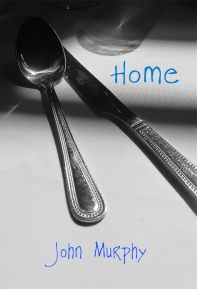
John Murphy is best known for being the editor of The Lake poetry webzine. On the evidence of this collection he deserves to be better known as a poet.
Home is divided into three sections, entitled respectively ‘Words’, ‘Home’ and ‘Away’. ‘Words’ is devoted to poems exclusively about the writing process; ‘Home’ focuses on family history; while ‘Away’ is a miscellany but includes quite a few poems that fit the description of spoken word in the performance sense.
That all the poems in ‘Words’ are self-reflexive risks the criticism of indulgence but Murphy handles the subject matter with a lightness of touch that draws the reader in and while there is humour there is depth too. An example of this is the self-satirising, ‘There is no connection between the Word and the Thing it Represents’, which has an echo of a Wallace Stevens’ title about it. Murphy’s style, however, is much more demotic than Stevens’ characteristic frothed finessing, though not without a rhetorical power of its own. The poem begins by focusing on the act of writing itself but through a subtle sleight of hand a recognisable material world emerges:
The pen’s imperfections chasing
images of sunlight through raindrops,
exploding into colours on drooped
flower heads and glistening lawns
In drawing attention to the fact that words merely signify, Murphy paradoxically exemplifies the power words have to work on us and see the world afresh.
The ‘Home’ section is the shortest of the three, comprising only five poems but they are the core of the collection. Clearly autobiographical, they bear comparison with the best of Larkin. To discover that the title poem was shortlisted for the Bridport Prize comes as no surprise as it is very fine indeed. It recreates an intimate act of care, the poet shaving his father’s face, the father being now ‘stroke-racked’. ‘Home’ is poignant, unsentimental and incisively delineated. The process of shaving is described in precise detail that is charged with poetic intensity but firmly grounded in everyday language. For instance, Murphy settles on the homely ‘white dollop’ to describe the shaving gel in use. It’s a register that some writers might have not entertained, perceiving it as not “poetic” enough but here it is demonstrative of Murphy’s boldness of style. A similar poem, ‘The Memory Seat’, is also well observed and crafted. The subject matter is the restoration of a bench in a cemetery. The language is plain but vigorous, and like ‘Home’ meticulous in its detail: ‘I stir the wood preserver, dip the brush // stipple bristles to cracks and splits, / smooth strokes along lengths of slats’. From this foundation Murphy achieves a lyricism that never becomes overwrought. The poem ends with these deftly controlled lines:
I stand upright, arch my aching back,
listen to sparrows quarrelling in the privet.
One flies off, then another and another,
little waves, speckled curves on the blue.
Unlike ‘Home’, not all the poems in ‘Away’ may be assumed to be autobiographical. ‘Blueshift’, for instance, reads more like fiction. This is largely due to being written in the third person but there is also an implied narrative, focused on a couple who seem to be estranged and exist in a sort of 1950s time warp. The images evoked are vivid and sometimes unsettling. The poem closes with the couple contemplating a ‘black cherry cheesecake / silently revelling in its gooey tartness and smiles’.
As I have already noted, performance poems dominate this section. They perhaps do not shine quite as much on the page as some of the more ‘literary’ poems included but they would certainly have impact at a poetry reading as ‘crowd pleasers’. Such poetry does incur a snobbish reaction sometimes from certain quarters. A negative response might be warranted where what is on offer is shallow and ineptly written but Murphy’s poems in this mode are invested with a keen intelligence and bravura execution. The prose poem ‘Find a Star to Hang Dreams From’ bears comparison with Ginsberg. It demands to be read aloud to fully realise its propulsive energy.
While most of the poems in Home are free verse, Murphy demonstrates that he can tackle fixed forms very adroitly too. The only sonnet in Home, ‘Arrythmia’, attests to this. The Shakespearean form is adopted but with a Petrarchan twist, the first eight lines being enjambed into one sentence, disrupting the expectation of self-contained quatrains. This gives the volta of the ninth line all the more impact as the focus moves from the physiological to the act of creating a poem: “This morning fourteen lines seemed out of reach”. The closing couplet weaves both aspects together, with a hint of wordplay perhaps in the last word:
Yet as I catch my breath the heart unjams
and slows into its regular iambs
This is a collection that will repay going back to regularly. It offers not only a window on the world but also a robust poetry of ideas. Murphy provides the best commentary on his work with the following lines: “ a poem starts to open / its tightly packed bud of thought”. It is certainly true that there is much in Home to engage the mind. On the strength of this collection alone, Murphy has shown that he is a versatile and accomplished poet.
David Mark Williams has won numerous prizes for his poetry in the UK and New Zealand, most recently second prize in the Roger McGough Poetry Prize 2021. He also writes short fiction which has been published in anthologies from Liquorice Fish Books and included in The Cinnamon Review of Short Fiction. His first full length collection of poetry, The Odd Sock Exchange, was published by Cinnamon Press in 2015 followed by Papaya Fantasia, Hedgehog Press in 2018.
 The High Window
Reblogged this on The Wombwell Rainbow.
LikeLike