
*****
Edward Alport • Abeer Ameer • Marie-Andrée Auclair • Michael Bartholomew-Biggs • Louise C. Callaghan • Nick Cooke • Derek Coyle • Tony Curtis • Kathryn Daszkiewicz • Gary Day • Claire Dyer • Susan Evans • Mike Farren • Rosie Jackson • Jenny Lewis • Konstandinos Mahoney • Martin Malone • Ray Malone • Sam Milne • John Mole • Kate Noakes • Michael Penny • Fiona Pitt-Kethley • Bethany W. Pope • Dilys Rose • Miles Salter • Ernesto P. Santiago • Sue Spiers • Paul Stephenson • Teodora Sukareva • Laura Theis • Sue Wallace-Shaddad • Julie Webb • John Wheway
*****
*****
Edward Alport: Two Poems
PEOPLE STANDING AROUND
The wind has whipped up
pale fantasies out of sand,
plastic bags and anything discarded
or disregarded that comes to hand.
They seem insubstantial
but far too far away to touch;
pale shapes of people standing round.
The wind has whipped the landscape
into giving up the figures.
They are standing with nothing to do
and far too much time to do it.
They may be monks, mendicants.
They may be priests to meditate
between the sand and wind, standing round
or hurrying from A to B before the wind dies down.
THE MEMORY TOWER
I have built a tower of thoughts.
I cut out dreams but they still
follow me around like dogs,
and the sleeper cannot mourn their passing.
I welcomed alien thoughts that held promises,
and the inscrutable thoughts of sphinxes.
My memories dwelt too long
on the beautiful love of witches,
leaving their huts on chicken legs
to find their destiny
in the soup of time.
Around the dancing floor, stags and badgers
watched the dancer in her throes.
There is no silence, and the whales
blame the medium for their deafness.
All across the green riads, the fishermen roam,
looking for scapegoats
as decorations for the dinner table.
Edward Alport is a retired teacher and proud Essex Boy. He currently occupies his time as a poet, writer and gardener. He has had poetry, articles and stories published various webzines and magazines and performed on BBC Radio and Edinburgh Fringe. He used to post snarky micropoems on Twitter as @cross_mouse.
*****
Abeer Ameer: Three Poems
PORTRAIT OF THE POET TRAVELLING BACK IN TIME TO ADDRESS HER FEAR OF PUBLIC SPEAKING
Back to 3rd June 1990. She’s thirteen and just found out
that she must present her literature coursework, read two excerpts.
She has relived these quakes many times. She glances at the class door.
Mr Goodyear stands between her and the exit. A-grade-Jennifer-May
has, of course, performed a moving rendition of Hamlet’s soliloquy.
Mr Goodyear’s praise and applause is followed by an unbearable pause.
His frowning grey eyebrows frame his glare. The poet-to-be is next.
She stands and stutters as she tries to read the piece
chosen only minutes ago. Something about potato waffles.
She wears a brown blazer, beige shirt, her blue and yellow tie
tightens around her throat with each word.
Her mouth so dry she can’t swallow. Her pounding heart
shifts her centre of gravity. She shrinks, her glasses steam up
in their thick black plastic frames. She’s rehearsed these lines
in her future mind many times in a bid to correct this moment.
Her classmates mirror her awkwardness, shifting in their seats.
She daren’t look up at Mr Goodyear; examiner, executioner,
who repeats the same words each time: It’s all wrong,
He’s in a flap, irate.
It’s all wrong. All the wrong notes. You’re reading the wrong notes.
There is a pause. A time-travel glitch.
It’s Christmas 1971. Mr Goodyear’s gaze is fixed. His eyes twitch.
His mouth agape like a codfish. Mr Goodyear has morphed
into the composer André Previn.
She hears a roll on the timpani, flutes and violins, a full orchestra.
Grieg’s Piano Concerto in A minor takes over.
The poet stands tall, taller than she’s ever been,
strides straight towards Mr Goodyear
and lifts him by his blazer collar.
She’s calm, both her hands are fists. It happens so fast,
all her strength summoned. These fateful twists
are out of her of control. She has no idea how
but she’s channelling the spirit of Eric Morecambe.
I’m reading all the right notes. But not necessarily in the right order.
I’ll give you that, Sunshine. I’ll give you that.
She slaps Mr Goodyear’s cheeks,
jiggles her thick black frames up and down,
and tap dances backwards out of the classroom.
IT’S RAINING THIS DAY IN FEBRUARY 1991
The Gulf War
has taken a turn in Basra
on the Highway of Death.
It’s the final stretch
in desert lands far away.
Late to morning assembly again
she tiptoes in as the girls in her school
sing of treading the verge of Jordan.
She sees her friends, middle of row
in the corner of her eye and knows very well
they’ll giggle and sigh at the name Jordan,
New Kids on the Block never far
from their year 9 minds.
The teachers’ glares burn a rash in her neck.
Here she is, late again
to morning assembly,
the hymn singing, the prayers
and litanies.
There is something amiss
but she can’t put her finger on it.
And for years to come she’ll dismiss
the nagging in her head,
the rash on her neck reminding her
she’s not really from here.
She’ll wonder whether her kind
is included in these prayers.
FOOTWEAR
Another aftermath scene.
There are shoes
strewn. One in particular
catches the eye of the onlooker.
It is on its side amidst shattered glass
and broken chairs.
A black rubble canvas.
This shoe is splattered red.
Sometimes there is Velcro.
Other times, it’s an effortless slip-on.
If there is a lace,
it’s perfectly tied.
The shoe always moves
in its emptiness.
Its stillness.
Abeer Ameer is a poet of Iraqi heritage who lives in Cardiff, Wales. Her poems have appeared widely in journals including Acumen, Atrium, The High Window, The Rialto, Magma, The Poetry Review, Under the Radar and Poetry Wales. Her debut poetry collection, Inhale/Exile (Seren 2021) was shortlisted for Wales Book of the Year in 2022. She is currently working on her second collection of poems.
*****
Marie-Andrée Auclair: Three Poems
EASY BOXES
She is slow to discover the size of the box
that people build for her
where she lives, trapped
by their gleanings and imaginings
as much as if by boards and nails.
She loves her three cats, which condemns her
to receive birthday cards with cats
Christmas cards with cats
even get-well cards with cats,
friends reducing her to one interest
or being uncurious.
Not you, you don’t drink instant coffee,
one exclaims; I always picture you
with an espresso machine.
Right, no counter clutter for her!
She always forgets to buy milk
sits at Starbucks instead.
They want to know her and own her,
easy and tidy, so they’ll be familiar
the lay of their own land and feel safe.
She wants that too, to see the boxes
where she crams people. A behaviour once,
twice, and a pattern gives a head start
to her assumptions.
Until someone protests.
Don’t jam me in a box.
Give me space.
I’ll surprise you.
She re-examines her boxes
punches holes in them,
makes space for the unexpected
for the grace of love alive.
DOWN TO EARTH
A steel wire slices thought a raw chunk of clay
holding on to its secrets.
You dreamed a bowl, safe from gravity, without mass
perfect and immune to breakage.
Heels of palms, fingers knead knob of grey clay
until pliable, round and uncertain like an infant’s head.
The dream bowl lands into a world of laws.
Foot on pedal controls speed of rotation,
clay centred on tray glistening
ready to be grown into the shape of a bowl.
Hands hug it tight and thumbs dig in, hands open
sides wobble, stoop and fold floppy onto themselves.
Try again until clay forgives fumbling fingers
complies with hands, becomes your bowl.
This is the story of a bowl.
Fired and glazed, object of beauty or practical
breakage is its inherent risk. The bowl you made
demands care, it holds more than it contains.
UNSEEN
I trust them
those I have never seen.
I forget them, strong and mute
while my skin
blushes and shivers
muscles
swell and throb
viscera
rumble and sigh
and throat spreads protean songs
I forget
these unassuming supporters
who hold my shape
give me freedom
my bones I see
only as grey shadows
on X-rays,
who will outlive me
and remember my trace
in the patient earth.
Marie-Andrée Auclair’s poems have appeared in publications in Canada, where she lives, and other countries. For example, Bywords.ca (Canada); 34 Orchard (USA); The Frogmore Papers (UK), The Tokyo Poetry Journal (Japan) and The Broadkill Review (US). She enjoys photography, traveling and adding to her cooking repertoire after each trip.
*****
Michael Bartholomew-Biggs: Two Poems
TRYING TO FIND YOU
i.m. DW January 2024
That your door was double-locked was unexpected
clicking one more tumbler in a combination
of disquieting events: that you had left
your mobile phone turned off all day; that I’d no key
to fit the awkward bottom latch you seldom used.
That I couldn’t get inside your flat relieved me
of the dread of entering each room in which
you might be dead. And that a key could turn a lock
from outside let me hope you’d slipped out on some errand.
That your neighbour was a locksmith might have helped
except he wouldn’t let me in his flat or yours.
And English wasn’t his first language so he told me
clumsily about an ambulance last week
that took away “a fallen person on the stairs”.
That no one picks up telephones in hospitals
or mortuaries at night should have been obvious
but I observed myself act out the part of someone
listening to futile ringtones while expecting
that the next call would provide an explanation
(otherwise the audience would soon get bored).
Not so. I’d have to go outside to look for clues.
But then to bring them back indoors I’d need a passcode
that you would have told me if I’d thought to ask.
LONG ARM OF THE LAW
One day my father pointed out
a shabby café by the river
where, a dozen years ago,
a weary multi-murderer
was apprehended without fuss –
and possibly with some relief
at letting someone else take care
of what would happen to him next.
My Dad added that he’d often
used that café and was there
the day before it had become
a footnote in forensic folklore.
Afterwards he always fancied
he could sense the empty presence
of a hunted man whose meal
would be the last he’d have to pay for.
I heard the story only once
but can’t forget Dad might have touched
the same formica table top
and greasy rexine-covered chair
as that guiltiest of parties
(surname still notorious)
or the constable who caught him
(and who cares what he was called?)
The riverside is smarter now;
arrests like that would not occur
in the daintiest of tea rooms.
Respectability excludes
the rougher sort of customer
and well-off, well-bred lawlessness
can slide inside quite easily
where local bobbies never look.
Michael Bartholomew-Biggs is a retired mathematician but remains an active poet. He is also poetry editor of the online magazine London Grip. He has published four chapbooks and six full collections – most recently Poems in the Case (Shoestring 2018) which buries a poetry collection inside the framework of a murder mystery and Identified Flying Objects (Shoestring 2024) which (with help from the prophet Ezekiel) reflects on the regrettable human tendency to ignore well-founded warnings.
*****
Louise C. Callaghan: Two Poems
ANNE LE MARQUAND HARTIGAN
1931-2022
Early that morning
lying in her bed
tired and beginning
to weaken,
she said, I think
I am going to die –
and although at home,
I want to go home
were her last words.
Anne dying, is
like a flower:
A rose, full-blown.
*
My father’s sister married
her mother’s brother.
We’d worked it out:
My aunt, married to
her Uncle Nick.
The only one I’d met
was Nick’s sister,
her Auntie Dan,
I was about six –
a tall, gaunt woman
who smoked a pipe.
When I first met Anne,
she was wearing a
Persian lamb astrakhan.
A LONE DAFFODILL
Bee! I am expecting you!
E. Dickinson
That year it survived great upheaval
in the front flowerbed. A small bulb,
buried beneath iron scaffolding
and trampling builders’ boots.
All through winter in the dark clay
among bands of blue electric cable.
It glows now, more Emily Dickinson
than a Herrick, on life’s brevity –
a yellow head nodding in full sun.
Between passion and restraint, it
calls, invitingly. And let the days
last, I reply, the longer golden hours.
Louise C. Callaghan lives in Dun Laoghaire, County Dublin. She is the author of five books of poetry – and is currently preparing a New & Selected Poems for her publisher, Salmon Poetry.
*****
Nick Cooke: Poem
LITTLE’S CHANGED, MRS WHARTON
We mean one thing, but use another phrase –
A subtext you will need time to decode.
You’ll have to learn our hieroglyphic ways.
‘I realise it’s deemed correct these days,’
We’d say of conduct likely to corrode.
We mean one thing, but use another phrase.
‘I’m not quite sure I follow,’ someone says –
Their addressee is not quite à la mode.
You’ll have to learn our hieroglyphic ways.
‘I gather this is quite the latest craze,’
Would signify the kiss of death’s bestowed.
We mean one thing, but use another phrase.
The target of ‘I saw much I can praise’
Is left to grope down meaning’s darkened road.
You’ll have to learn our hieroglyphic ways.
‘I trust it’s just a stage, a passing phase’:
The would-be prince will always be a toad.
We mean one thing, but use another phrase.
You’ll have to learn our hieroglyphic ways.
* “In reality they all lived in a kind of hieroglyphic world, where the real thing was never said or done or even thought, but only represented by a set of arbitrary signs.”
– Edith Wharton, The Age of Innocence
Nick Cooke has had around seventy-five poems published, in a variety of outlets, including the inaugural issue of The High Window, Acumen, Agenda, Dream Catcher and London Grip. In 2016 his poem ‘Tanis’ won a Wax Poetry and Art contest. In addition, he has published around thirty-five poetry reviews and literary articles, as well as several short stories.
*****
Derek Coyle: Three Poems
TWO WAITERS
I
Reading John Ashbery
in Costa Coffee Carlow
is not the same since you left, lad.
I miss your mop
of curly brown hair,
your stubble,
that smile.
There’s no point in lying. Instead,
I have to imagine you –
a figure in a Matisse painting.
‘Music’, let’s say,
your love of the guitar,
only it would be
‘Sweet Child of Mine’
played on an acoustic Martin.
With you wearing
only a red bandana,
the guitar hiding your modesty.
Maybe, or maybe not.
There’s no point in lying.
II
And then there’s the guy
who worked in La Strada
on Tullow Street, years ago.
His Spanish-black hair,
let’s imagine, brown eyes, sallow skin.
I’ve thought of him often,
serving up a cappuccino after dinner,
reading Miłosz, reading Longley.
I see him in a wine-dark,
maybe burgundy T-shirt,
a blue apron – he’s working
after all. Still, I prefer
to see him now in a Matisse,
‘Interior with Phonograph’.
Some sun-bright Sunday
in the south of France,
Sonny Rollins at the Village Vanguard,
‘Softly, as in a Morning Sunrise’.
Me, eating one of those rosy apples,
or the succulent pip
of the pomegranate, and him
lying back, a Matisse nude,
all sinuous lines, his leg
suggesting an amphora, Roman wine,
the fruit of the grape, the fruit of the vine.
NARCISSI
(i.m. James Schuyler)
The daffodils are here again.
I know they are not tulips,
Jimmy, but I think you’d enjoy them,
their yellow heads, this promise of spring.
You’d know their Latin names.
And my heathers and other shrubs.
I’m a disaster in the garden,
but I enjoy poetry.
I hope you appreciate
my African art. Here purple hazes
into azurite blue, and human heads
emerge from geometric shapes –
Venn diagrams, a trick of the eye.
There is a basic maths that underlies
it all – symmetry and proportion –
like a well-judged line,
a splendid composition. We call in
Mahoumd Darwish from the Shades
– where he fights off Yeats –
to sit with us at our table.
He’s been wandering in a place of snow,
in search of Salim Barakat
– let him sit to our dinner.
Cumin-flavoured potato, turmeric
and coriander, carrot, green bean,
slow-cooked chicken, succulent
and moist – this bottle of Shiraz,
a stored summer, its proud, exalted scent.
Yehuda Amichai reads his poem,
the one where the inner walls
of a house are exposed, standing,
but shaken – his symbol for the exposure
of middle age, an image of Al-Mawasi now.
Dust and ruin, where children starve,
who will never know what it is
to be inside – a comfy armchair, wine, poetry.
Where is the equation that can account for this?
IN NOUVELLE-AQUITAINE
(i.m. Seamus Heaney)
You might be surprised to discover
I see you in that summer that never ends.
Not in Anahorish, Toome, or Castledawson,
much as they were on your mind,
even in the south of France.
You are writing in that barn, big-arched,
double-doored, your vowels and consonants in combat
with the twitter of restless swallows.
You dodge them with a smile as they drop their natural bombs.
The children chase bewildered ducks.
Marie and her sister Helen this July
doze in the sun, a dream of Biarritz.
Breakfast calls for fresh-baked fougasse, sculpted,
a grain of wheat you’d recognise. Pears, apricots,
cherries, figs, abundant as the merlot, the grenache.
The locals wear Basque berets,
here where borders only exist
on a map, or the narrow mind
of the type you find everywhere.
You stroll the markets of Peyrehorade,
sniffing out the freshest fruit,
your incredible knack for what might sustain
a body. Haggling with the skill of a Derry farmer,
the locals, amused by your strangely accented
English, dance a gavotte to your music,
the way they open to your smile.
We miss you, Seamus, and wish you were here.
Derek Coyle’s Reading John Ashbery in Costa Coffee Carlow (2019) was shortlisted for the Shine Strong 2020 award for best first collection. Sipping Martinis under Mount Leinster (2024) is published in a dual language edition in Tranas, Sweden. His poems have appeared in The Irish Times, Irish Pages, The Stinging Fly, Poetry Salzburg Review, The Texas Literary Review, The Honest Ulsterman, Orbis, Skylight 47, Assaracus, The High Window and The Stony Thursday Book. He lectures in Carlow College/St Patrick’s, Ireland.
*****
Tony Curtis: Poem
GOING INTO EVENING
Two black-as-night cattle
grazing, disregard the Sunday walkers
as they hold to the path, skirt the river
and wind around the remains of the castle.
The winter trees are skeletal
and so we see it all – the big sky,
the Norman keep, the swollen river
and the stretched, grey sky where,
look, there and there
and again, over the wood
a hungry buzzard is chased away
by the crows in concert.
The light is fading,
we are just past the shortest day,
on the cusp of a new year,
my seventy-ninth. Who knows,
before the last of it goes,
things may become clear.
Tony Curtis was Wales’s first Professor of Poetry. He developed and directed the Writing Masters at the University of South Wales (Glamorgan). His eleventh collection Leaving the Hills will be published in 2024 by Seren who published his first novel Darkness in the City of Light, which was shortlisted for the Paul Torday Prize by the Society of Authors this year. www. tonycurtispoet.com
*****
Kathryn Daszkiewicz: a poetic sequence
THE LENGTH OF TIME IT TAKES TO SEE THE LIGHT
(i) Fresher (1979)
The only ones I notice at the time
wink in the sun from the towers of the Civic Hall.
I do not ask: Why owls?
Information’s shelf bound
and inaccessible on Sundays
when the library’s closed
while wisdom’s somewhere
at a mythic distance
catching the fickle light.
(ii) Window (2021)
The colours are jaded, flashing dulled
to grey. Between two owls – one tawn,
one flaking white: the Golden Fleece.
It hangs, serene, against still vibrant blue.
A battered, fading, stained glass coat of arms.
I pay the fifteen pounds
and wrap it in a blanket, in the boot
and wonder if some forty years ago
I walked the pavement underneath the sill
of whatever grand stone building it adorned
in the city that unmade me.
(iii) Leeds Owl Trail (2023)
Gold numbers mark out owls,
the Civic ringed in red, black for the wider trail.
I scan the fold-out leaflet: so many knowing eyes
whose feathery presences I didn’t sense till now.
Perched in a circlet guarding a grand door;
under acanthus leaves on the museum;
a huddle of birds hacked from the old Saint Anne’s
when the cathedral made way for a road.
The War Memorial owls with angel wings.
Those peeping from the Yorkshire Penny Bank.
On library railings – moon faces and eyes
so weathered as to make a motley flock.
Elegant, slim – Art Deco silver owls
gracing the Fountain House’s metal gates;
fluffed and rotund in the Wall Street of the North
all mossed and blackened into camouflage.
I must have blanked the Bourse owls countless times
walking from Briggate round to Bistro Five
or from the station up to Charlie Mo.
But they don’t face the road – their architrave’s
set back and to the right. They sit among
improbable foliage and other birds
both too exotic for this urban clime.
Silent survivors of those wrecking balls
that swung like pendula in postwar years
and blitzed Victorian grandeur into dust.
In a shop window on a tarot pack
a barn owl swoops across a huge blood moon
an avian Queen of Swords.
The past is looming. I must rise to it.
(iv) Cleowan
I struggled in a land of ash (æ) and thorn (ð)
and wynn (þ) – I loved the texts but nothing
would translate. I took the pills prescribed
bright blue and orange. Their vibrancy sapped mine.
Demons, though lying low – were coiled
in the recesses of my mind .
Unloosed from the thread of myself
I had no way to find and face them down.
Then I unearth the Anglo-Saxon root
of our word clue – meaning a ball of thread.
It tautens: pulls me back into that place –
its convolutions
not unlike the brain,
into the labyrinth
and the great I am
not.
(v) Upper Room (2023)
He says I don’t do labels.
The flame of a single candle dances.
Masks peer from the walls
while tribal artefacts
and smooth, grey patterned stones
radiate otherness.
It’s so unlike that room with metal chairs
and the stark cabinet where I was filed
shrunk to three letters of an acronym
which was not then disclosed
but vaguely termed an irrational turn of mind
that I must learn to live with.
Now, as I lean into the friendly sofa
we talk of Jung and journeying
to find the hidden self.
The layers of perceived reality
and where I spend my time.
The tensions that are crucial,
and what make me.
Outside the churchyard yew is dense
as any folktale hedge left to go wild
after a witch’s curse. I watch as small birds
dive, fearless, into blue green foliage
emerging quite unscathed then drawn again
into the spindly dark.
(vi) The Fleece
A ritual in Anatolia
required a sheepskin pouch
which Hittites placed
beneath a male yew tree
whose falling grains
of gold dust pollen
spun it into myth.
Bag full of emptiness;
only imagination gave it flight.
(vii) The Length of Time it Takes to See the Light
Between the owls and right above the fleece
a rectangle of night has kept its blues –
a sky that does not presage what’s to come
but what is past is thrown into relief
by three small yellow stars.
(viii) Once They Were Heroes
Jason, like the newly dead
who stepped as shadows
onto a waiting boat, was rowed
across uncharted oceans
(the dying consort
of an earth goddess
now sidelined like
the woman with the thread)
emerging later from
a dragon’s mouth
clutching a fleece
the colour of ripe corn.
While deep inside
the belly of the maze,
Theseus took on
the essence of the brute.
(ix) On the Shoulder of the Warrior
Until, like the owl,
you can twist your head
so far backward
as to take the past in whole –
its mess of blood and bone –
will it take on a palatable shape
and what must be discarded
is made plain.
Softness
is only feather deep;
there is so much below
to be unsheathed.
Kathryn Daszkiewicz now livs in Lincolnshire but was raised in the north east and studied English Literature at Leeds University. She has four collections with Shoestring Press: In the Dangerous Cloakroom (2006), Taking Flight (2012), A Book of Follies (2017) and Coldharbour (2022). Her work is influenced by a fascination with the natural world, especially birds, and an enduring preoccupation with mythology.
*****
Gary Day: Four Poems
REUNION
It was still love,
But something was lost;
That easy way of being together
They once had. Now all words
Cast a shadow, all touch is slightly
Awkward, spontaneity gone.
It was still love,
For something was gained;
An understanding of actions,
An acceptance of flaws; yet how
They longed to trade this experience
For the innocence of before.
THE WORK OF HANDS
And once the father frowned
As the boy struggled to fasten
The drawbridge on his fort.
‘He’ll never be any good
With his hands’ he declared,
As if the boy wasn’t there.
And once he beat the boy
For palming a Dinky toy
His mother refused to buy.
She prised it from his shell-
Like hand, angry he’d made
Someone called Jesus very sad.
And once the father crafted
The boy a fancy hat; a bowler
Become octopus, brim sawn off,
Eyes painted on the crown,
A cut-up hose for tentacles,
Good enough to win a prize.
And would his father still tut
That even now his son cannot
Join or nail or hang; only ponder
How the work of days and hands are many,
Love pouring through them and from them,
In ways a lifetime cannot fathom.
SUNLIGHT
He could be a figure
In one of his own paintings;
A tall man in a fedora hat, leafing
Through the pages of the NYT
Under elms in Central Park.
Sun guides his brush to Sunday streets,
Gas stations on empty roads, blonde
Grass sashaying to a noon house,
Then onto the electric city with its medley
Of tics and visionary moments:
Boredom made numinous
At a midnight diner, a sudden gust
Fluttering a nursemaid’s mantle; the flickering
Symmetry of a lifted curtain and the wind-stirred
Dress of a woman basking on a step;
Light measures the distance between strangers,
Leaves whatever dreams of love they have intact;
Is an annunciation on walls, a golden geometry
Missed by occupants who look out of windows,
Mesmerised by worlds bigger than their own.
He lays aside the paper and returns home,
Where Jo opens a can of beans. There’s the usual
Bickering, this time without blows, and then it’s back
To the calm of the canvas with its characters
Contemplating, in colour, the pallor of their lives.
A HISTORY OF LANGUAGE IN NINE FRAGMENTS
The first articulation created
The possibility of silence, and broke
Forever with earth’s natural music.
Shapes on stone lightened
Into letters that were yoked together
And herded into books.
Candle flames trembled
At the Word of the Lord while saints
Blazed in stained glass windows.
An island people stood amazed
At the strangely clad creatures
Babbling and gesticulating on their shore.
When the King lost his head,
English turned artisan; plain
And simple, like truth itself.
Self is tangled in figures, metaphors
And tropes. Each attempt to break free
A new conceit, a deeper enmeshing.
‘The will of the people’
‘There is no “I” in team.’
‘Because you’re worth it.’
Thoughts are bytes, thinking is binary.
The heart’s poetry only
So much data.
A wind once inspired flesh to speak in tongues.
The dying down of a breeze is one
Of the earliest meanings of silence.
Gary Day is a retired English teacher and the author of several books including Class, Literary Criticism : A New History and The Story of Drama. His poems have appeared in Acumen and Beyond Words. His poem ‘Anne Bronte’s Grave’ was shortlisted and highly commended in the Artemesia 2024 Poetry Competition. ‘About Daffodils’ was shortlisted for Vole Poetry Competition 2024 and published in Vole’s Autumn Anthology, Autumn Makes Me Sing, 2024.
*****
Claire Dyer: Three Poems
THE HEART OF THE MATTER
In the changing room of the department store
I am trying on new hearts. Better here than online,
the assistant says. It’s always best to double-check
the size. The hearts aren’t substitutes for the one
behind my ribs, but for those I wear on my sleeve,
carry in my hands, hold in my mouth when
I can’t find the words. They are replacements for
the broken hearts, the right place hearts,
the heart of the matter; the ones I cross,
and change, and follow and learn by, steal, set,
win, lose, mean things from the bottom of, keep
close to; those that are warm, cold, taken to, tugged at,
soft, feathery, heavy, hard, half, whole, laid bare,
made of gold. The ones that race, and slow,
that skip a beat, are poured from. What happened
to your old hearts? she asks, picking a damson-
coloured one from the shelf and holding it
to the light. How can I tell her about the damage,
the sheer weight I’ve asked them all
to bear: the first loves, last; the deaths, life’s
wonderments, the hopes pitched against
the dark roads of the night? At last we find
the perfect ones. I pay for them and slip them on
before returning to the carpark, driving home,
where I tell you these are the hearts that will
see me through the difficult days to come.
WHAT I SAID
at the end. I’d practised.
In my head after leaving
you on sparrow watch.
The bird feeder outside your window.
Your carers’ care a constant.
And then, that day.
Everything ready but me.
What I’d planned to say –
practised – stalled behind
our differences. And silences.
But this was the now,
the never of it: they –
the carers – in the garden
unexpectedly cutting back
the laurel. Jackie on her way.
So, I held your hand.
Said it all. Yes, everything.
And later, when you went,
wondered if you’d heard.
Believed one word. Still do.
SISSINGHURST AGAIN
This time after you – a drawing in
of summer: rosehips, dahlias, hydrangeas
on the turn; solace from asters, anemones
and phlox, and, in the herb garden,
walking amongst feverfew, tarragon,
rosemary, mint; crushing double camomile
between my fingers, the scent rising, rising.
The times during you – it was always
high summer: rosa mullinganii, white irises,
Japanese anemones, lime trees in full leaf,
cottage garden ablaze, moat water green
and quiet, the Tower stairs cool, what sun
there was lighting fires in the coloured glass
until all was rainbow, rainbow, rainbow.
Claire Dyer is from Reading, Berkshire. Her poetry collections are published by Two Rivers Press, her novels by Quercus, The Dome Press, Matador and Pegasus. She teaches creative writing and runs Fresh Eyes, an editorial and critiquing service. She is the SWWJ’s Poetry Consultant, TRP’s Reviews Co-ordinator, a Voluntary Archivist at Reading University, has an MA in Creative Writing and is represented by Broo Doherty at DHH Literary Agency. Her website is: www.clairedyer.com
*****
Susan Evans: Poem
ESPRESSO
Of all the things I might have needed
from you; I never did need an espresso machine
I bought one off you to help you out
You bought expensive olive oil & protein
Wished we’d been more on the same page
I did appreciate your domesticity & kitchen disco
But it’s a no to sex before monogamy;
a standard I just can’t let go
& If getting laid is all you care about
there are plenty of free apps
No need to lead a bereaved woman on;
future-faking to get women attached
Can you not do better than that…?
Susan Evans is an award-winning performance artist, author and activist. She is widely published in a variety of magazines and anthologies; in print and online. A Londoner who mostly lives and writes in her spiritual home of Brighton.
*****
Mike Farren: Three Poems
AN UNDERCLIFFE GRAVE
After Philip Larkin
Nestled in a crooked right arm
the stone girl sleeps eternally;
the mother, wreathed in drapery,
watches the baby by her breast.
Her body is a shield from harm
so nothing can disturb that rest.
Seen from the graveyard’s avenue
as white, among a field of grey,
gleaming on a summer’s day,
it seems life is defying death
and gazing to the distant view
of Dales to catch a clear, pure breath.
I look around the pedestal:
a dozen or more of the dead
who lie beneath this marble bed
are listed, with their living span
and when death brought about their fall
and their relation to the man
bereft twice, by loss of a wife
and by that of their infant child.
Although appearing reconciled
with fate enough to wed again,
that double death haunted his life:
their monument portrays his pain.
Perhaps he thought that grave would stand
forever on this Bradford hill
as testament to beauty, still
outlasting death, solid and strong
enough to touch with living hand
and feel that love could last so long.
But even stone will wear away
left open to the northern skies
and anyone who casts their eyes
where child and mother lie together
sees not what sculptor first portrayed
but a parody fashioned by the weather.
What almost-truth their common fate
reveals, I hesitate to guess.
This melted marble shapelessness,
eroded by the acid rain
preserves no individual traits
of love: just its idea remains.
BRADFORD. SUMMER 1976
The grass is white,
bleached like a Polaroid in too much light.
It catches fire without warning.
We beat it out with bats
and Tommo’s shirt we’re using for a wicket.
I have forgotten rain;
I have forgotten that I’d left the other kids
behind; forgotten Donald Neilson
and Mark Rowntree came from here;
forgotten Ripper murders – everything
except the cricket bat,
the tennis ball, the Top Field and the shirt
I don’t try to stop them burying
in long grass, chucking dog shit on the top,
when Tommo leaves for tea.
All evening at home,
above canned sitcom laughter, I expect
the hammering at the door, the figure
looming dark in frosted glass, the finger
pointed at me. It never comes. Unlike the rain.
from THE VANITY OF SMALL DIFFERENCES
After the tapestries by Grayson Perry,
https://artscouncilcollection.org.uk/exhibition/grayson-perry-vanity-small-differences
4. THE ANNUNCIATION OF THE VIRGIN DEAL
Something comes out of nothing. Whatever
you believe, it always comes back to this:
the infant from the Virgin’s nothing womb;
all existence from the Big Bang’s nothing;
the soil-clogged organic produce
from the nothing earth; and unimagined
wealth from the nothing family and the nothing
code that rules the world without actually
existing. The world waits for this something /
nothing patiently: it’s all it can do,
as the moment out of time will not
be rushed. So you check your phone;
blow raspberries in the baby’s ear; listen
for the bubbling of the coffee percolator
on the Aga; see in the convex mirror
the colleague who is almost a friend
transfigure, grow wings and point
an angel finger toward your destiny.
Mike Farren’s poems have appeared in journals such as Stand, 14 Magazine and The Interpreter’s House. He has won several competitions, including Poem of the North (2018 – ‘canto’ winner), the Ilkley Literature Festival Poetry Competition (2020) and the Red Shed Competition (2023). His pamphlets are Pierrot and his Mother (Templar), All of the Moons (Yaffle) and Smithereens (4Word). He is part of Yaffle Publishing team and one of the hosts of Shipley’s ‘Rhubarb’ open mic.
*****
Rosie Jackson: Four Poems
LISTENING TO KARL JENKINS AT BREAKFAST
And thinking that a year ago I was floating out of my body
and what a wonder it is to be tethered anew,
to watch light spread over the sea in gold and grey strata,
to know a body can resurrect into wanting to live again.
Now Jubilate has given way to Requiem: Dies Irae,
we know all about that, God-the-Destroyer
more in evidence than Creator or Sustainer,
the world’s wounds are ample testimony.
Then the music’s interrupted by a plea from War Child,
which reminds me I haven’t yet donated
to Julia’s Just-Giving fund for kids displaced from Ukraine,
she swam in rough seas round Burgh Island.
And how we are all on an anvil, Old English anfilte,
meaning beat. How love is a hammer blow, striking away
everything that is not itself. How we are here
to be removed from ourselves, to see what remains.
HEARING THINGS
Your cells are bewildered. For half a century
they’ve exchanged love for water and air.
Now they’re in panic mode. There will be no more feasts.
Your stomach has closed its doors. But your bowels go on
emptying themselves. They always were the dunce of the class.
And while your tired blood pumps you back into evermore,
memories jostle, unsure which should go first.
The good ones are noble, offer to sacrifice themselves:
May blossom, mountain climbs, a sweet marriage.
Traumas are more tenacious, want to leave nothing unhealed.
Can you feel this touch, this breath on your face?
Are you hearing things? Footsteps, music, rain on glass,
your own poems being read to you? You did well, they say.
You did exactly what you came to do.
THIS ORDINARY DAY
Pain is such a bad conversationalist.
Deflects polite enquiries about where it comes from,
how long it intends to stay. Resorts to crude
monosyllables: I’m here, I’m here, I’m here.
I try to dignify it with different names:
suffering – too general, torture – too political,
affliction – operatic. No, pain it is – fixed, focussed,
chronic, inarticulate fuck-you pain,
a dart that knows its eye, a stone thrown
into the middle of the forehead. It makes me long
to be a juggler, a man who can throw pain in the air,
catch it again without resentment or fear.
How deftly he shifts from one palm to another,
sings, laughs, stands on one leg, the pain tossed high
towards blue, a vastness of sky it can only crawl
across, like one of those flies, fat and black,
that sits on the frame of a Renaissance painting
in a trompe l’oeil effect. What concentration it takes
to see beyond it – the room, grapes, people,
this ordinary day waiting to be lived.
NO LONGER HEARSAY
for Sue
Knowing she has one foot in eternity
has not changed her. She’s fixing leaks
in her house, having friends to visit.
She ruffles the tufts of her cropped hair,
already thinning, falling, smiles wryly.
What is it makes her more beautiful now,
stuffed as she is with chemicals and pain?
She looks radiant, the light that will
harvest her no longer hearsay,
but starting to move in, to wipe away
the shadow of her provisional life.
And through our nine-hour time difference,
I wonder at the mystery of our being alive
at the same time, incarnating the same year,
the odds against our long ago meeting.
How she lent me her vintage lace
wedding dress. Those long walks we did
in Dorset – that climb at Chapman’s pool,
steps that seemed never to end –
then the view on arrival –
blue sweep of bay, perfect skylark coast,
nowhere else on earth worth getting to.
Rosie Jackson lives in Teignmouth, Devon. Widely published and recipient of many awards, she was short-listed in the Mslexia Competition 2025, Commended in the Troubadour Competition 2024 and the National 2022. Her most recent collection is Love Leans over the Table (Two Rivers Press, 2023). A Hawthornden Fellow in 2017 and nominated for the Pushcart Prize 2021, other works include Light Makes it Easy (2022), Two Girls and a Beehive: Poems about Stanley Spencer and Hilda Carline (written with Graham Burchell, Two Rivers Press, 2020) and The Glass Mother: A Memoir (2016).
*****
Jenny Lewis: Three Poems
I CALL IT MY BAD LEG
I call it my bad leg, as if it were some kind of criminal,
but what did it ever do wrong apart from housing bones
turned papery as wasps’ nests, and that was really my
fault, or that of my mother or grandmother, great aunts
or whoever’s bones I’ve been using all these years to get
from one place to another. Honeycombed and brittle
as the dry sponges I used to bring from Greece to give
to my father-in-law, they’d be far more useful outside
in the open, making homes for insects – beetles or bees;
if bees, they might fill the holes with honey, sweetness
from which comes forth strength as the lion on the green tin
of Tate and Lyle syrup showed me when as a small child
who had just learned to read I stood on a chair to look
closer, running my finger round the closed lid to taste
ambrosia. So I must learn to forgive my bones, to live
with them as they are, ramshackle. I sometimes imagine
them going home at night, feeling deflated, to an empty
fridge in a cold, north-facing flat in a run-down district
at the end of the Piccadilly line after a gruelling journey
in a carriage that was standing room only, which made
them rattle each time it stopped and started. At home
they may find other bones, who’ve just dropped round
to see how mine are feeling and have been waiting ages
in the corridor where the light bulb has blown and they
have had to feel their way up to the twenty-sixth floor
to offer sympathy. No need say my bones, longing to be
left alone, but now they’ve come, the other bones insist
on being kind. Onwards and upwards, they say, if there’s
anything I can do – let me know. My bones hate the drudge
of hurting, aching, hate the fact that they’ll have to go
through it all again tomorrow. I’m fine, they say, holding
onto a smile that’s turning into a grimace, while the other
bones say Don’t worry, no honestly, I’ll see myself out.
PHYSIOTHERAPIST
Try again you say in your soft voice,
as though my body was normal,
undamaged: and I feel tears rising
as you turn my hips to face you, not
because you are male and that under
my T-shirt is my skin, but because
I am a child again, wanting
my mother who has been dead
for fifty years. I am a child raising
my face to hers, wanting to be lifted
up into the warmth of her body,
lifted up into the smell
of her Elizabeth Arden face powder,
into the comfort of her cushiony chest
to where I can feel her heart beating.
I try again, knowing
that putting the weight on my left leg
will make the pain unbearable.
I try again, feeling my mother is there
even in your alpha maleness.
PHYSIOTHERAPIST 2
Try again, you say. And once more I feel
the fierce ripple of scar tissue, like fire
running along the edge of paper against
the muscles in my thigh. Now I can even
name them, Vastus, Iliacus, Gracilius
Sartorius – like actors in a Roman play,
ready to step forward at a moment’s notice
and face the crowd; lifting sideways, lifting
upwards, flexing, extending, and always
the bad dream that you are in the arena
all eyes in the amphitheatre are on you.
You try to move, but nothing happens.
Jenny Lewis is a poet and playwright who teaches poetry at Oxford University. She has had seven plays and poetry cycles performed at major theatres and published five collections including Gilgamesh Retold (Carcanet, 2018) which was a New Statesman Book of the Year and Carcanet’s first audiobook. Her recent work includes From Base Materials (Carcanet, 2024), and a sequence of ecological poems for Mandala Theatre Company’s Seed Guardians, written and directed by Yasmin Sidhwa which won a Joseph Rowntree Foundation Award.
*****
Konstandinos Mahoney: Two Poems
BREAKING BREAD
Just off the boat, a man, short black hair, denim
jeans and jacket, a boy on each hand, heads shaved,
wide amber eyes, walks in off busy Athinas Street.
In accented English he orders three gyros, pays
six euros, finds a table, moves an ashtray filled
with chips, ash, dog-ends, pumps sanitizer onto
the boys’ open palms. Gingerly they rub their hands,
the way he does, chew their pita cones thoughtfully,
the way he does, finish at the same time. He pulls
flimsy paper napkins from a dispenser. In unison
they wipe lips and fingers. Back out on the street
boy on each hand, he pauses, sets off to the right,
stops, turns back, disappears.
APHAIA STREET
A cathedral spire scratches a grey northern sky.
The scars on her arms are obscured by clouds.
She leaves behind an indifferent town, truant mother
absent father, a girl trembling in a mirror
flies south, finds an island, a job in a bar
rents an upstairs room from Kuria Maria
learns to say kali mera, discovers her street
is named after a goddess.
In a shuttered room off the courtyard
Kuria Maria’s husband lies dying.
When they carry him out, feet first
the building gasps, a punctured heart sighs.
Next morning the sun illuminates
a courtyard cascade of red bougainvillea.
Kuria Maria deep fries honey doughnut balls
takes them up to the foreign girl.
Spoonfuls of sweetness, blue and brown eyes speak,
in broken English they exchange lives.
From the harbour, a long low moan –
a homecoming ferry horn.
Konstandinos (Dino) Mahoney lives between the Greek island of Aegina, and London. He won publication of his second collection, The Great Comet of 1996 Fortells, in the Live Canon Collection Competition 2021. His first collection, Tutti Frutti, was a winner of the Sentinel Poetry Book Competition 2019. He won the 2017 Poetry Society Stanza Competition. He is Stanza Rep for Barnes and Chiswick. He has recently published poems in, Under the Radar and Poetry Wales Website. His website is dinomahoney.co.uk
*****
Martin Malone: Poem
NO FUN
The Lomax 16/12/1999
There are five people in this room I do not want to be with
and three of them are in my band. The drummer is having
one of his ‘far-out’ nights, the guitarist white with rage
at our new bass player, who’s behaving like an asshole,
and my dog’s backstage, barking at himself in the mirror
I broke an hour ago. I should have changed these strings
for they’ll not stay in tune, this guitar needs a setup.
and my ex is here with a new man. That French girl’s
not showed up either, nor her mate. And, man, am I tired:
of here, of now and of being some place emotional age
has an upper limit of eighteen-years-and-six-months.
So, just do the gig, get through tonight and call it a day.
Who needs this anyway? Let’s go tear the fucking roof off:
make them pay, make them pay, make them pay.
Martin Malone now divides his time between Donegal, Aberdeenshire and France. He has published four poetry collections: The Waiting Hillside (Templar, 2011), Cur (Shoestring, 2015), The Unreturning (Shoestring 2019), Gardenstown (Broken Sleep Books 2024) and a Selected Poems 2005 – 2020: Larksong Static (Hedgehog 2020). He’s also published 4 pamphlets: 17 Landscapes (Bluegate Books), Prodigals (The Black Light Engine Room), Mr. Willett’s Summertime (Poetry Salzburg), Shetland Lyrics (Hedgehog). He is an editor at Poetry Salzburg Review.
*****
Ray Malone: Four Poems
INTERVAL 217
she sleeps, to the sounds from beyond
the window, owes nothing to the night
but the ease of dreaming, the fall of order,
the unmooring of the day, as dust in the wind
adrift in the dark, far from the fear of it :
she sleeps, not knowing the other, as stones
in the sea’s shift, lulled, lie side by side,
deaf to the rub and rhythm of the tide,
dead to the absence everywhere, dead
to the sleepless something sleep denies :
she sleeps : in the streets beyond, the bound,
fast to the light, the measured step, but,
such as I, of a mind to find, to meet
the dream, and to slowly close the eye
INTERVAL 219
gather it all together, the nothing come to,
the hand empty as ever, held, how many times,
out to the rain of things, thoughts falling from the clouds,
to the strangers’ eyes, the everyday aversions, turn, or
drop of the head, down, to the echoing ground of
passing by: everything turns into something, the sky
writes scene after scene, of streets peopled with wonder,
walking from corner to corner, of the rooms within them,
reaching for the walls would free them, from measure,
from the tight containment of a mind, a mind made to be
there, true to the body it breathes, to be there, in the air
it shares with the word, with every word, that waits to be heard :
where the one poor penny drops into your hand, silently :
pause: everything turns into writing
INTERVAL 220
for a second, the crack appeared, then closed again,
a pause in your path, then the stillness, a proximity,
brief as a perfume passed in the street, in the empty street,
the street at night, and nothing but your step for presence :
you were on your way home, to the lonely mirror, lit
with dreams and the streetlights, and the light of others, side by side
in the numbered stream of being: then, of a sudden, no sound,
no step, no measure, no foot falling, no breath breathing in,
none breathed out, no thought forming in the sky, the night sky,
no pulse in pursuit of its prey, no mind of a mind to mind,
no time to be the time of, no tick of the tiniest insect,
no nearness, no nothing, but the moment’s approach :
as if, for a second, the ‘i’ of the infinite might open,
only for the path to appear again, firm underfoot
INTERVAL 225
enters left, pauses at the edge, casts a glance
out, from somewhere behind his eyes, a past,
hidden from him, written in some forgotten script,
a part he played, perhaps, rehearsed a hundredfold,
line by inscrutable line, a rhythm brought forth
from being there : he remembers a moment of fright,
a tongue so tied as to be hung forever, for all
to see, breathes in the appraising eyes, holds
to the pose, the repeated appearing, holds
his breath before the incoming tide, closing in
on time and the rising sounds to come :
and suddenly, lost for further words, he cries,
then lowers his own eyes to the dumb applause,
the silent roaring in of the insensate seas
Ray Malone is an Irish writer and artist living in Berlin, working on a series of projects exploring the lyric potential of minimal forms based on various musical and/or literary modes/models. Awarded Second Prize in the Gregory O’Donoghue International Poetry Competition 2024. His work has been published in numerous print/online journals in the US, UK and Ireland.
*****
Sam Milne: Four Poems
STONEHAVEN
This field has hoarded the sun all summer,
And there’s a new silk on the barley.
Like a trawler in a gale the field sways,
The beards heavier now, entire.
(In the grate, already, a fire roars, flowers.)
There has been a procession of clouds all day,
And the sea, in the distance, is heaving,
Waves glittering like scales. (In mahogany bars,
Washing the salt from their throats,
The fishermen will be telling their tales:
Their boats beached, safe from the sea’s jaws.)
The dusty drove road is turning to glair now,
And rain is replenishing the burn.
Beneath the solace of the sky, its simplicity,
Finding an easy, regular rhythm to his walk
The farmer turns home, a hen racing him to the door.
Soon the days of bitter gales will be here
Drenching the land, and the long nights,
Like the harvest, are in store.
PORTLETHEN VILLAGE, KINCARDINESHIRE
I
The open belfry; the pebble-dashed church;
The stained glass window with the North Sea behind it:
Come, And I Will Make You Fishers Of Men.
The oars and the spars upright,
Stuck in the pebbles,
Holding the nets to dry:
Fish scales glued by the sun.
My penny safe in my hand
(for the offertory)
I’d run uphill, adoring the land
(the ricks, the stooks)
And the fisherman
Missing one finger from his hand.
II
Among the Pinks and King Edwards,
Singing your favourite arias,
I remember you forking a row,
The sea lazy in the distance,
Sopping sacks on the ground
‘Tae keep the frost awa.’
There was a newness in everything
As I ran home from school
(School where all had to be proven,
Everything done by rule)
Past the barrier gate
I pretended was the Swiss Frontier
(I’d seen it in a film).
Mum had set the dinner table
As you stamped your boots of snow.
Birdsong showered everything.
There was nothing else to know.
Alford, Aberdeenshire
THE SNUG
‘November gales tear tiles frae fairmers’ roofs.
Roond fires douce fowk gaither ti waarm.
Sma burns that fill the Dee and the Don
burst their banks, flooding the fields and the fairms.
The North Sea hools in the crofters’ lums
miles inland. Nae suiner daes the sun keek oot
than it’s awa, sunk ahin braes for guid.
We live on its measly crumbs
but somehou get by. Forbes died this year,
a weel-liked chiel he was wha was kent bi aa—
a drouth on him he had that’s gaan foriver.
(A cauld air gaithers frae afar.)
But there’s ay some cloun ready ti blether
and tak your place at the bar.’
THE HIGHLAND CLEARANCES
Assynt
The wind is a singing voice down the dark glens
Where no ear hears, and where no echo lives.
The wind blows through the empty shielings,
Stirs the grass, and the odd drifting leaf of autumn.
All those singing voices gone into the chorus of the winds!
Lost on the mountain tops, or drowned in ditches.
Or singing the Gaelic still across the waves.
Note: ‘lums’ are chimneys and ‘braes’ are small hills. ‘Assynt’ is a mountainous region in Sutherland, in the Highlands
Sam Milne lives in Surrey. He was born in Aberdeen in 1953. For many years he was an Associate Editor at Agenda magazine. He publishes regularly in the Scots magazine Lallans, and has recently published excerpts from his Scots translations of the Iliad and of Sophocles’ Antigone. He has just finished writing a play about Thomas Aikenhead, the last person to be executed in Britain for blasphemy.
*****
John Mole: Three Poems
ON LISTENING TO BILLIE HOLIDAY
Falling behind the beat
engages her voice
in conversation to reveal
the counterpoint of speech
as it hesitates then shifts
ahead of itself
to catch up with a rhyme
that lies in wait
to remind the song
of what has always been there
though for one timely moment
holding back.
BLUES FOR BESSIE
Bending the notes
not out of shape
but into an utterance
of heartbreak.
They remind us
how you woke this morning,
packed your bags
and made a getaway.
Booking their passage
in the minor key
they travel with you
at a loss for words
until your voice
is ready to receive them
and those companionable blues
are given birth.
CHALUMEAU
for Paul Harris
Not to start on a note
but to sound the depths
before it rises, register
the gloss of ebony
like moonlight searching
for a lover’s face.
Only then the intimate
intense vibrato
of a single breath
to end in music
as the melody
begins its water song.
John Mole lives in St Albans and was for many years a teacher there. He has compiled and presented poetry programmes for BBC Radios 3 and 4, was poetry reviewer for Encounter and, with Peter Scupham, ran the Mandeville Press. His poetry has received the Gregory, Cholmondeley and Signal awards, and his most recent collection is Keeping in Step (Shoestring Press, 2023 ).
*****
Kate Noakes: Two Poems
THE TRACKWAY
Piled down millennia before
Venetians found the way
to hold up their city
against ingress and tide,
whole pine trunks were
driven into the bog
by ancestors unafraid
to dive in murk
and snorkel the cold.
The trackway was boarded
by logs lashed
with flax rope and
strips of birch bark.
This must have been the way
to somewhere important
if such work was done.
And yet, it ends mid-bog,
so rethink wayfaring for ritual
and see not a footpath,
but a carpet of wood
dyed with blood.
SPERM WHALES SURFACE IN THE BAY FOR A QUARTER OF AN HOUR
And when we’d finished using
every part of the whales,
we were left with the problem
of the bones.
Vertebrae picked clean
were ground into fertiliser,
but the jaws struck us as decorative
and turned perpendicular
made pleasing gothic arches.
Dozens of them have stood across the paths
of the seaside garden for a century.
And when weathered,
split and splintered,
they were patched with concrete
for a triumph of roses to climb,
background these days
for tourist photos and wedding poses
now we’ve finished using
every part of the whales.
Kate Noakes‘ most recent collection is Goldhawk Road (Two Rivers Press, 2023). A pamphlet, Chalking the Pavement, was published by Broken Sleep Books in 2024. Her website is www.boomslangpoetry.blogspot.com. Kate lives and writes in Bristol.
*****
Michael Penny: Two Poems
TALISMAN
The pine branches are fragrant and green,
cut arm-length and knotted together.
We are to hike a dark pine forest
of wet slippery rocks, on an uneven trail.
Our maps fail us and the path’s unmarked.
While we hope for signs, nothing guides us.
The real talisman is to keep going
from the temple that blessed
the pine offering we tourists bought
as a Buddhist practice, sincere with our coins.
The temple needs funding and welcomes
our borrowing their spirit, as we assure our safety
with this talisman, a hope almost
as ancient as the valley that encloses us.
HULA CLASS, QUEEN EMMA’S PALACE, HONOLULU
I am in the back of the class
so as not to disrupt the others
with my sincere clumsiness,
and I try, feet, arms, and hands
rarely cooperating; if one’s right
the others splay to unbalance.
In front of me, graceful motion,
controlled to the fraction of an inch
to respect a long history.
There’s elegance and truth
as the dancers solve an equation
of past, memory, and this moment.
And me, clumsy as a slanted fence,
watching, knowing I could never do
anything but admire and learn.
Michael Penny lives on an island near Vancouver, BC. He has published five books and has appeared previously in The High Window.
*****
Fiona Pitt-Kethley: Two Poems
MINING ORPHEUS
I find myself humming Gluck as I exit
from a flooded mine. I leave with sadness.
Regret not for a lover but another world,
the peace of darkness, glittering minerals,
the treasures of the earth that lie below.
Did Eurydice also suffer regret?
Was she even asked? Would she have preferred
a part-time deal there like Persephone?
Hades and his world have their own attractions.
Mineras, the music of the Spanish mines,
powerful Flamenco songs about the life,
tell of the blackened bread, the fear when lights
go out. The shortness of a miner’s life.
The woman waits by the mouth of the mine.
Her man will not return. No deals are made
to get him back from there. That’s it.
Her life must now become a sort of hell:
taking in washing, prostitution, begging.
The widow’s lot in past centuries.
Mines closed but modern “miners” visit them.
My mineral club encountered Cerberus,
a Rottweiler, guarding a quarry gate,
champing to get at us, held back by a huge chain.
No Charon ferried us to other shores.
A mine is flooded? Get your waders on…
Modern day tourists of the underworld,
a place we always leave with some regret.
THE JUDGMENTAL PLUMBER
He came dressed for a party to our house,
looked at a leaking pipe and sinks and said
the house looked like a crime scene.
Plumbers are the Gods of the Underworld.
Immune to cold they squat beside a sink,
open the doors, reveal a world of pipes,
where spiders build their webs from side to side.
To flush or not to flush? Our shit-blocked drains
are grist to plumbers’ mills. They poke their hands
where no one wants to go, scrape out the scum,
or, blast it forth with heavy chemicals.
Too posh to handle filth? Well, change your job.
No bloody tampons blocking office desks.
No Freudian ballcocks on your shopping list.
Too proud to plumb our depths? See what life brings.
Are there no blockages to come? No leaky valves?
Nothing to mop? No watery accidents?
Fiona Pitt-Kethley‘s most recent publications are a book of prose, Washing Amethysts in the Bidet and two poetry pamphlets: The Samson Crane (Dreich) and Ninja Virgin(Hedgehog Press).
*****
Bethany W. Pope: Poem
ST. KEVIN
The long, delicate claws of a dove
are thin to the point of translucence; their pink
scales are tender, their curved nails soft.
A dove will fly from your hand
with a dusty susurrus, accompanied
by the brown pollen of moths.
Once caught, they nestle into your palm,
the white down on their breasts
could almost tear on the ridged whorls
of your fingers. If they trust you,
they’ll close their ringed eyes
and, as they sleep, you’ll feel the weight
of sainthood. Kevin had his blackbird,
her eggs, and his prayers as his knees
first wailed, then died from his kneeling.
He had his outstretched, Christlike hands,
dragged down by the twin burdens
of agony and potential, the weight
of the nest. Yet he held them out for months,
as his treasures hatched, grew and learned to sing,
perpetually suspended. To hold a dove,
for a second, a minute, for the span
of a dream, is to carry on the privilege
of a longer, older story. We are here,
on this green swathe of earth, spinning
through a galaxy of death and nothingness,
merely to protect what is weak, to sustain what we have.
To hold a dove is to live with the agony of failure,
to let failure pulse through us: a song in our blood.
Bethany W. Pope has won many literary awards and published several novels and collections of poetry. Bethany currently lives and works in China.
*****
Dilys Rose: Four Poems
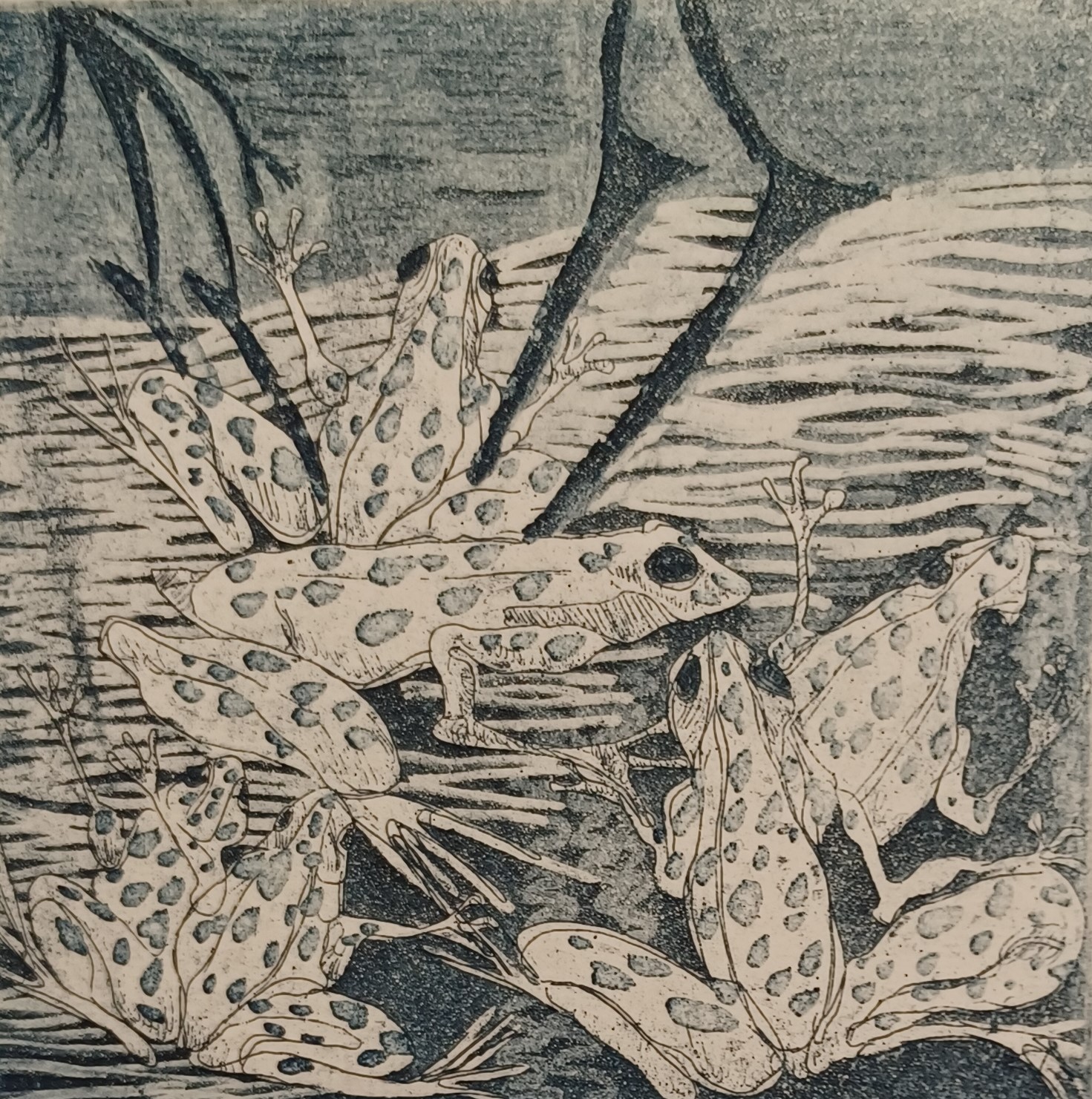
KNOT OF FROGS
Last year the pond was drained. Barrowloads
of gunge dredged up, bales of duckweed
skimmed off, armfuls of iris rooted out,
a new tarpaulin liner laid. The overhaul
left no clod unturned, no shrub unpruned.
But summer passed, and autumn. Winter
storms reclaimed, rewilded. It’s spring
again, and greening glistening banks
are swagged with frogspawn.
Mind when boys would spoon globs
into jam jars, and tote it home to gaze, rapt,
as full stops became commas, commas
grew legs, and flimsy tails dwindled until,
one day, when no one was looking, a knot
of frogs hopped it to who knows where?
Do boys still do this ̶ should they,
even if their spoils are not a jot to what
the newts and heron take?
Great water boatmen ̶ also partial
to a tadpole ̶ skiff the surface. Ploughing
through the mulch of last year’s leaves,
frogs, in their dozens, appear, scale
each other unceremoniously, pop
their blunt heads up and, within a ring
of resolute eyes, cordon off their brood.
Wherever I put myself, my shadow looms,
casts its murky net.
GHOST BICYCLE
At the clogged junction, the air reeks
of exhaust and impatience. Car radios
pump out drive-time tunes and, at the
traffic lights — all ten sets — the red men
and the green take it in turn to glow.
Everyone aches to get home, to ditch
the day. Feet itch to step on the gas.
A rush hour like any other. Nothing
special, nothing to alert the student
— pedalling at full tilt, gold ropes of hair
rippling in her wake, wondering what
to cook, keen to see the cat, her flatmates
— to take extra care. Did she know that,
turning left, lorries have a blind spot?
Did she know that, despite the driver’s
mirror checks, she on her blue bicycle
was, to him, invisible? At what’s become
a black spot, a chalk-white bicycle is chained
to the railings. The handlebar basket,
which once held bread, books, wine,
is now brimful of hardy perennials.
DARUMA DOLL
On an unfrequented shelf, I spot it:
the red head blunt as a boxing glove,
its one astonished eye I inked in years ago.
Gift from a daughter’s ex, after the break-up
—so messy, so prolonged—the dinky
good luck charm lost its pride of place
on the mantelpiece.
I used to love the swirls of black and gold,
the bold emblems of longevity: cranelike
brows, turtleish whiskers. And the lacquer
of legend—so bloody, so bizarre: how
meditation made Bodhidharma’s limbs
drop off, how things vermillion signified
the rituals of smallpox.
Perhaps I should have binned it when
that fella did the dirty on my girl but,
in time, the pain ebbed and she sprang
back, her appetite for ramen revived.
And so, monocular, Daruma Doll remains,
implacable proof of some half-finished,
half-forgotten goal.
PLAYTIME
They jostle towards the classroom door;
he dawdles at the rear. Shrieking, they
scatter across the playground, then,
drawn like magnets, converge.
Overlooked, he jouks into the gap between
the railings and a tree, turns his back upon
such runaway hilarity—the games of tig,
hopscotch, grandmother’s footsteps.
Blazer scraping bark, he rolls his eyes,
as if privy to some startling secret,
and shakes his head in thrilled disbelief,
and grins, as if he’s just fired off a killer quip,
and pores over the legend on frayed bunting
draping the railings, though he knows
the words by heart: All work and no play—
and squints at the sparse crown of leaves,
and begins to count them once, once again,
and waits, as ever, for the bell.
Dilys Rose lives in Edinburgh, and is a novelist, short story writer, poet and printmaker. She has published twelve books, most recently the short story collection, Sea Fret (Scotland Street Press, 2022) and the poetry pamphlet, Stone the Crows (Mariscat Press, 2020). She is currently working on a new collection of linked stories.
*****
Miles Salter: Poem
NIGHT CALLS
A callous year, that. In unhinged, broken
days, I searched for ways to die. In
my head, the car slammed against
a wall on the stretch near Castle Howard.
Top speed. That would have done it.
A mess for somebody, though,
clearing up ruined bone and glass.
Writing a note to the kids. Seems
silly now, selfish. But there you go;
I was off my head. In the centre of the night,
a voice would speak in Brighton, Peterborough,
Sunderland, Leeds. Lucy, Graham, Simon, Paula.
My story would unwind again, leaking identity
to strangers. Hello, it’s me. I didn’t mean
for it to go like this. Pauses. ‘Do you have
support? Have you had suicidal thoughts?’
You carry what won’t be changed, and alter
the rest. I hobbled through, grew strong again,
worked on my stride and stance, made
changes. Never told the kids. Years on,
past tempests look small.
Miles Salter is a writer and musician based in York. He likes Philip Larkin, early Bruce Springsteen albums and cheese.
*****
Ernesto P. Santiago: Poem
LOVE OF FATE
Of all my body parts,
my heart is perhaps the most
misused.
And it’s no wonder.
There are certain rules about
my heartbeats,
which often determine
whether I should
use it for love or for lust.
While a period ends
a sentence, my heart indicates
a smaller break.
Some lovers think of me
as a soft pause
within a sentence.
Ernesto P. Santiago for a long time had believed that poetry is his flowing (es)cape to a higher understanding of the wor(l)d. He spends all his free time between here and there, trying to learn something. He is too small for his ego. He is enough for himself. As a poet the shape of words interests him. He is fully confident in his identity with a Filipino heart.
*****
Sue Spiers: Two Poems
HEARING NOTHING BACK
The poet only speaks one way. He hears nothing back – W. S. Graham
I can speak into the ether,
write sonnets, sing in the shower.
If no one hears me and no one
reads my words,
like the fallen, unseen tree,
have I expressed myself?
The melody of vowels
and consonants: tricks of sonics,
the flicker of a poem’s heart
is a candle in a cell
whose prisoner has escaped.
Transmitting on a frequency
no receiver collects,
encryption without Rosetta’s
stone, glyphs without depth
or direction – pig noise.
Not even a Babel mistranslation.
Not silent but not heard.
In the conception,
there’s something I say
which may never reach
anyone’s ear or eye.
In the saying, no guarantee.
Why do I do it
to myself?
1974
The first I knew was mum reading out
Irene’s letter, then we looked for news.
Turkey invades Cyprus as a headline;
a bald statement absent of detail.
Arthur had to stay behind, no seat,
priority to ship out civilians, a skeleton
force kept to hold strategic positions
while Cypriots fought for their land.
Families had one day’s notice to leave,
transported like so much NAAFI cargo,
kids clinging to Hurricane webbing,
Brize Norton landing, stowed in a hangar.
Irene wrote of camp beds and blankets,
a makeshift latrine and army canteen
of lumpy mash, mushy peas and Spam,
queuing to sign up for family quarters.
Scabby Nicola left behind her tabby cat,
Theresa, Dad’s joke, Green lost Tiny Tears
I would have had to abandon books,
no Lego, no solitaire, no dominoes.
Mum sent mail to rank and serial numbers,
not knowing where to find friends
scrambled to temporary accommodation,
bunked in with relatives or staying put.
Salamis families were forced south,
taking over ransacked blue verandahs,
making do with army issue furniture –
strange belongings in a shell of home.
Sue Spiers was highly commended in the 2019 Yeovil poetry competition and awarded 3rd place in the Battered Moons competition. Poems have appeared in South, Stand and, Obsessed With Pipework and on-line at The High Window and Ink, Sweat and Tears. Sue is Treasurer for the Winchester Poetry Festival and reads regularly at Loose Muse in Winchester and Tongues & Grooves in Portsmouth. Her collection Jiggle Sac is available on Amazon and she Tweets @spiropoetry.
*****
Paul Stephenson: Two Poems
I DON’T KNOW IF IT WAS A TORTOISE
I just kind of assumed it was and sent Audrey a photo
by Whatsapp to which she replied almost instantly
as I waited for the others to board that she was out
and about in Epsom to pick up new glasses but her Paul
reckoned it could be a turtle, maybe even a terrapin.
I place no faith in my assertion it was a tortoise because
I’m familiar with tortoises only insofar as they’re what
people often keep as pets, but it might have been a turtle.
The point is, it was there. This thing. On the aeroplane.
Flailing about in a plastic container like a small fish tank
with removable lid. And earlier, at the departure gate,
flailing and waiting with me for the flight to be called.
Clearly the tortoise cum turtle cum terrapin creature
wouldn’t fit like a bag under the seat in front, which is
why it was being carried to the front to be dealt with
by cabin crew, upgraded to first class on an empty seat.
I told the man next to me about the tortoise, and his wife.
They were sitting in seats A and C but he budged up into B
when I showed up, and I did wonder if the A and C was
on purpose or if they were A and B but winging it for extra
elbow room. Anyhow, they were from Texas and worked
for Southwest so were au fait with working on airplanes
but had never in all the years had to deal with a tortoise.
Cats, small dogs, the occasional rodent, one massive spider.
And it got me thinking back to that long flight from Schiphol
to San Francisco on my way to an international conference
with Polish colleague Karolina. This massive plane but only
twenty-four rows of seats. How a member of the cabin crew
opened a door at the rear, and we all got this whiff of straw.
The plane half humans, half horses. Some race, somewhere.
ON THE FERRY TO THE SARONIC ISLANDS
which I saw written on the side of other ferries
as Sardonic Islands (itself kind of funny), the fizz
was very sweet despite assurances it was dry,
the mini bottles sealed in a silver foil I tried
opening using my house key and cutting
my wrist but not enough to bleed to death,
thank goodness, because it was meant to be
a holiday. Just a graze that bled, missing
a crucial vein, my wrist clumsily bandaged
with a napkin and blue elastic band, which
made me think about elasticities of demand
and microeconomics, then macroeconomics
and of our taxi driver who ran a franchise
of The Body Shop but since the crisis has been
driving and only charged us 11 euros, spends
half the year in Santorini where the minimum
fare is 36 euros, and how he joked on the way
down from Athens ‘Marriage many come there’,
said ‘the same people go later to Mykonos
to get divorce’. I can see him almost driving
off with our suitcases. In the days after debarking
we learnt from locals the problem of strays,
how everyone has to pack up and leave
because of Airbnb, spend six months elsewhere.
Paul Stephenson’s first collection Hard Drive was published by Carcanet in 2023. It was shortlisted for the Lambda Literary Award and Polari Book Prize. He previously published three pamphlets: Those People (Smith/Doorstop, 2015), The Days that Followed Paris (HappenStance, 2016), written after the Paris terrorist attacks, and Selfie with Waterlilies (Paper Swans Press, 2017). He has an MA in Creative Writing with Pedagogy (Poetry) from the Manchester Writing School. He co-edited the ‘Ownership’ issue of Magma and helps programme the Poetry in Aldeburgh festival. He lives between Cambridge and Brussels.
*****
Teodora Sukareva: Four Poems
BLESSED CHILD
A white expanse stretched before his eyes,
while music echoed close at hand.
The child within me whispered,
So this is heaven.
And blessed be that child—
for else, my chattering teeth and fingers,
clutching the little panic button tight,
would have deceived me so,
and made me believe
we lay in a magnetic resonance tomb.
SOMETIMES
Sometimes I wander
through a lacelike fog,
stepping on corpses of roses,
and the world feels so distant,
it cannot hear that I long to return.
Sometimes the night promises eternity,
while I search for the little gate
to home,
blindly, along a stretched tightrope.
Sometimes I sense the weight,
I could almost swear,
that the Earth leans
on my weary shoulders.
Thank goodness it’s only sometimes.
It’s good to be home.
A PROMISE
The heavens gathered
in my palms,
weeping,
while their hailstorms
made their way
between my bony fingers.
No words were needed,
no impossible embraces,
no false comforts.
Someone’s divine sorrow above
will slowly drown us all.
STRAY THOUGHTS
The tailed stray,
with a kind gaze and a damp snout,
gazed at the horizon before us,
and only God knew
what he was thinking.
I offered him my lunch,
he bit into the sandwich
and ran off, determined,
perhaps toward paradise,
and his path—
it turned out to be mine.
The scruffy dog,
with matted fur,
long since forgotten
what affection felt like,
slipped into the opposing thickets,
skillfully avoiding the cold stares
of all the estranged eyes.
And when he left his food
before his beloved,
nursing
their tiny pups,
only God knew
what I was thinking.
Teodora Sukareva (b. 1996) is a Bulgarian writer whose work explores themes of pain, self-discovery, and forgiveness. Her debut poetry collection, Confession in Metaphors (2023), marked a significant step in her literary journey. Her writing has been featured in Woman Today, LitDesign, Lunatic.bg, HighViewArt, and Phenomenal Literature.
*****
Laura Theis: Three Poems
FIVE CLUES FOR WORKING OUT WHICH BIRD YOU’VE BECOME
Even if no helpful bird baths present you
with a mirroring surface, don’t fret,
there are countless ways to find out
what you are:
If you feel constantly sleepy, if you
answer every question with an ominous ‘u-hu’
and everyone treats you like a dangerous queen,
you may have become an eagle owl…
If you find yourself overcome with a strange new echolalia,
unable to finish a conversation without repeating
what has just been said, you can be quite sure you’re
a mockingbird, parrot or mynah…
If you find yourself attracted to gold buttons
and eyeballs, you must be some sort of corvid – most likely
a magpie if you also find yourself riding the backs of deer
or strutting along with slow, self-absorbed steps…
If you like to drape yourself heavy
around the neck of a lost soul
you may be an albatross – or a swan if you do it
while also reciting the saddest song you’ve ever known…
But only if chosen to be a starling
will you gather with thousands of strangers at dusk
and use your peerless polka-dot wings to write
an ever-changing poem for the sky.
SPELLS FOR STORMY WEATHER
we are held together
just barely by hope tape and string
while at the same time
we are kept apart
by a red angry
once-in-a-century
storm with the name of
a hunter on the
look out for fragile things
we know gales cannot be bribed
or gentled with sacrifices
or gifts
wind travels
too fast hold on to anything
not even grudges or memory or loves
which is exactly the reason
we’re throwing handfuls of poetry into its path
of airy destruction
let it blow our carefully crafted efforts
into a scattered jumble of words that dance in flight
and never quite reach the ground
MY SISTER DREAMS SHE IS A GARDEN
my sister dreams she is a garden and running barefoot down her
winding paths I know not to step on the sharp stones
and where her early snowdrops grow
my sister dreams she is a garden and I am a snail
out in her dew until the sun burns the moisture away
so I must to burrow deeper in order to stay
my sister dreams she is a garden and
I’m the trunk of a birch tree that’s losing its leaves
and I’m its bare branches and I am its grief
my sister dreams she is a garden and I am a story
beloved by the snow I am what is lost to the silence
all that is covered and hidden below
Laura Theis writes in her second language. She has been widely published in journals and won variousl prizes. Her latest publications are Introduction to Cloud Care (Broken Sleep Books) and her forthcoming children’s debut Poems from A Witch’s Pocket (Emma Press).
*****
Sue Wallace-Shaddad: Poem
THE GAME OF CHESS
After Sofonisba Anguissola
Innocent of the future, the three sisters,
braided together like nut brown hair,
have delicate complexions set off
by starched ruffs, fine necklaces.
Each face promises its own story.
The elderly servant watching knows
they’ll face unexpected challenges.
She’s seen young women suffer
from promises made, not kept.
Cogs in the wheels of ambition,
where wealth and power decide,
will they survive the games of men?
Black squares are clear cut,
white ones yellowed. A wrong move
could end hopes and aspirations.
They would remember this game
in the sunshine under the oak tree.
A pawn might still become Queen.
Sue Wallace-Shaddad has three poetry pamphlets: Once There Was Colour (Palewell Press, September 2024), Sleeping Under Clouds (Clayhanger Press, 2023) and A City Waking Up (Dempsey and Windle, 2020). Her poems have also been published by London Grip, Second Light, The High Window, Poetry Scotland, The Ekphrastic Review, Fenland Poetry Journal, Ink Sweat & Tears and Finished Creatures among others. Secretary of Suffolk Poetry Society, Sue also writes poetry reviews, runs workshops and blogs for The Charles Causley Trust. https://suewallaceshaddad.wordpress.com
*****
Julie Webb: Four Poems
I NEVER BELIEVED IN GOD
though I did believe in Sunday school
though perhaps it was pastor Chris I believed in
with his smooth, round American cheeks
and his petite wife Denise.
I believed in their relentless cheerfulness
their bottles of root beer (so exotic)
their barbecues on the common
their bible verses and earnest prayers.
I believed in them until I didn’t
and I felt their disappointment keenly
when I when I failed to deliver
the required amount of belief.
For months I endured their pitying glances in the street,
their proffered prayers for my salvation
though I had never asked for any –
I was just a teenager having a difficult time,
a teenager who was looking for something
trying all the usual teenage things:
drinking, smoking, boyfriends,
going to concerts, playing records.
Pastor Chris said they would pray for my soul,
told me music was the work of the devil –
that I should take a hammer
and smash up the albums I’d saved so hard for,
but I put the record on the turntable
and carefully lowered the needle
I did it over and over and over.
Here’s something I can really believe in I said.
I AM NOT SURE WHICH IS WORSE A GHOSTING OR A REAL DEATH
because I know you’re out there somewhere
living your life – breathing, talking, eating,
not giving me a second chance
not letting me put things right.
They say it’s always the messenger that gets the bullet
but until that day I never really believed it.
When you pushed me again and again
for an explanation about something
and drunk, I told you what our old friend had said
about why she kept avoiding you.
I could see the hurt in your face
and instantly regretted it,
but I didn’t expect the blame –
that dropped between us like a fizzing firework
something too hot to touch,
too bright to look at.
I wanted to make things better
and I tried to
but you never gave me the chance.
IF THERE HAD’T BEEN A TIGER INSIDE ME
perhaps it would have been something
altogether more British –
a kingfisher, woodpecker
or a stag with a stunning set of antlers
but more likely it would have been
something peskier, like a rabbit.
When tiger moved in
she found my forest too dark and quiet,
the pine needles prickled her foot pads,
and the weather, she said,
was the worst thing ever,
always so grey and damp and chill.
She longed to be bounding
gracefully over hot savannah,
heat shimmering the distance,
the game giving her a good run for her money
rather than hiding out in the shadows
hoping not to get caught.
SMOKE
Is it the same smoke that haunted my grandmother
and followed her from house to house?
Smoke or dust motes,
we could never work out which,
but it was coming through the walls
or the window gaps, or was just there, hanging
in the air that she was trying to breathe.
The smoke, she thought, from a neighbour’s fire
(but they had central heating and so did she).
Smoke that no one else could see.
Mostly it was night time when it came –
just like my smoke – glimpsed from an eye corner
while at work at the kitchen sink or cooker,
but walk through to the dining room and it’s gone.
Or the scent of wood smoke in the living room
on a cold evening – unexpected and unexplained.
Or that late-night stink of cigarettes
in one room or another – could be the neighbours
I suppose – I once spied a glowing tip
deep in the shadows of their midnight garden.
Is my smoke any more real than hers?
Was her smoke real, or was it guilt made manifest?
Or was it a cry for attention –
like all her other ones piling up across the years?
Julia Webb is a neurodiverse writer from a working-class background who lives in Norwich. She has three poetry collections with Nine Arches Press: Bird Sisters (2016), Threat (2019) and The Telling (2022). She is a poetry editor for Lighthouse – a journal for new writers. Her fourth collection Grey Time comes out with Nine Arches Press in July 2025.
*****
John Wheway: Two Poems
GETTING CLOSE
In a heatwave, the paint on the gate would
blister like a pancake growing bubbles
on a red-hot skillet. It was fun
to scratch crisp pimples of paint off
with a fingernail, unless a sliver slipped between
the nail and the quick – even then, worth the pain.
When the sweltering weeks broke into storms,
I hid from thunder under the dining table,
my hands over my ears. But once, I thrust
my face out of a window, splattered
in the torrent, bolder with each lightning flash,
the world sputtering as if it might go out.
My mother yanked me away, shaking
my arm as if I’d shouted in my sleep –
this was not my nightmare, but hers,
going on about how I’d get myself frazzled.
After that, it rained for weeks. I sailed paper yachts
in street gutters, watching them go down the drain.
CHAMPIONS
Come out and do it in the street
my father growls, balanced
like a fairground fighter
on the balls of his feet, bare
knuckles weaving in front of his glare
from his corner in our sitting room.
In the opposite corner
my mother dances, strong grip
on the smoke-blackened poker,
teeth set, fierce faced, her eyes bulging
as if she’s being strangled.
I’m in the middle, dodging
like a referee, a crouching figure
there to represent fair play,
except I don’t have a whistle,
and I’ve yet to learn
how to count up to ten.
John Wheway’s publications include The Green Table of Infinity, (short prose) from Anvil Press; Poborden, a novella from Faber; A Bluebottle in Late October, his poetry collection from V Press; and many poems and stories in leading literary magazines. He has a Creative Writing MA in poetry from Bath Spa University. He won the 2023 Wigtown International Poetry Prize.
 The High Window