*****
INTRODUCTION
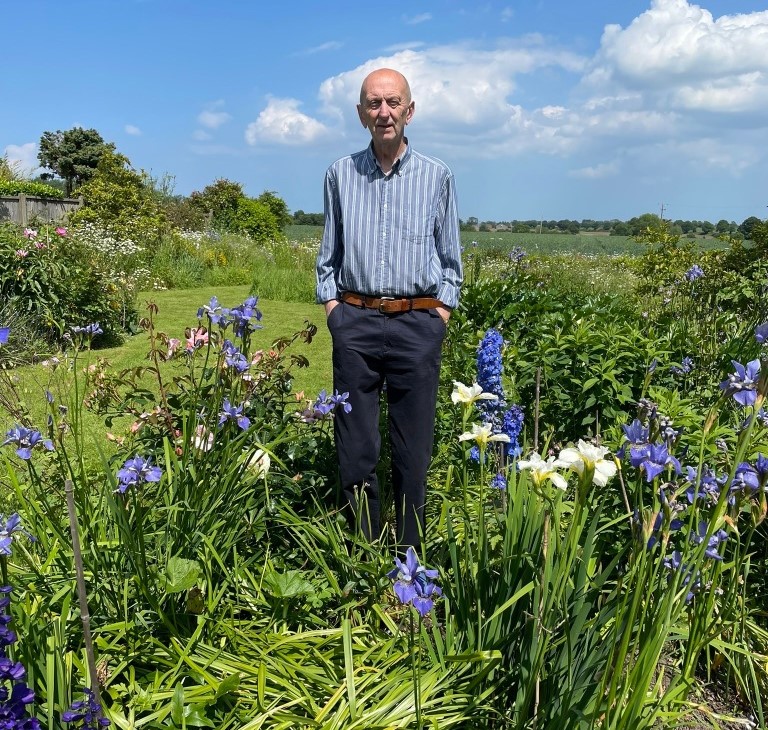
In his 1975 essay entitled ‘Writing Autobiography’ Laurie Lee expanded on ’the need to leave messages for those who come after, saying, “I was here; I saw it too.” ‘ I remember being intrigued by this notion in the early 1980s, and I began attempting to record in poems the small fact that I, too, was seeing something of it. My subject matter then was the ‘ordinary’ scenes and lives around me in Lincolnshire, and I still write about the people, the land, the towns, villages, and natural history of my home county.
In 1984 a friend lent me a copy of Proof, the long-gone Lincolnshire and Humberside Arts magazine of new writing. This introduced me to other magazines of contemporary poetry, which featured poems by the celebrated and the little-known writers of that time, some of whom are still working. I subscribed to a number of titles and began to submit my own poems to their overworked but encouraging editors. Over the years I met and learnt from writers living in Lincolnshire and further afield, and I became involved in local events. My continuing membership of the Nunsthorpe Poetry Group, which meets in and near Grimsby, has also figured prominently and enjoyably in my writing life.
It is a privilege to have been associated with the late John Lucas’s Shoestring Press, which has published my collections since 2001. Four of the poems below are taken from these books.
*****
Robert Etty: Eight Poems
THE THING ABOUT THE PEOPLE ACROSS THE ROAD
Thomas and Frances, Thomas and Gertrude,
Thomas and Annie, Francis and Freda
have nothing to say to each other or us.
Sidney and Alice (Eternally Knit) have lost
their tongues, too, like Mary Ann (5), Lucy
(11) and Ellen (16), in the nettles.
The Greenwoods lie under the sycamore tree
near the Sheardowns and Cornwells and Outwells
and three Albert Dashfords ivied together
with Lawrence the pilot, John Theobald M.A.,
Smith, Smith, Smith and Smith, Stokes of Stoke and
May Welfitt (Died Sadly in Melton Mowbray).
May Jesus Thy Bitter Pains Assuage
Dear Partner of My Pilgrimage
Charles wished for his Martha, who may have concurred
before angels carried her off to her rest.
Under Mavis’s name, a snail underlines
Affliction sore She long time bore
and a scuffling rabbit turns its scut on
the green Black Death mound the mower missed,
over which in a moment the heavens
have opened and a wren and a blackbird
give vent to emotion and flit
from a rail to wet moss on wet stone.
Not a peep from God’s Acre, except for
the wren and tick-ticking drops
through low leaves now and then, but nothing
to waken the dead or the living, who
live very close and have planning permission
for windows overlooking the neighbours,
who never gossip or take exception,
but keep in a neighbourly way
their own counsel about what it is
they could tell (if they could)
of how far into evening this rain will drag on,
or the thing about the people across the road.
From A Hook in the Milk Shed (Shoestring Press, 2013)
FOUR BRIDGES ROAD
There are three bridges on Four Bridges Road.
You drive between one bridge’s steel parapets
as you leave the substation behind.
The second’s a brick humpback half a mile on,
over a stream they’ve been clearing.
Soon after this you change down
for the third, a humpback again near the post box,
where bulrushes chafe in the wind. Another,
the fourth, is looked for sometimes
by drivers who think names need explanations
and couldn’t rest if they left without one.
Four Bridges Road has a bridge too few –
unless, on a map no one bothered to keep,
a watercourse bridged by the road was marked (Piped)
and it’s crossed a hundred times a day by tractors,
lost plumbers, mothers with troubles, and pheasants
indulging a death-wish. That was the other side,
this is this, and neither’s been letting on.
It’s one of those roads that take you the distance
under false pretences. You count three bridges
over three streams to the sign at the end
that points out you shouldn’t be certain.
From Passing the Story Down the Line (Shoestring Press, 2017)
ON THIS SITE
on June 16th 1452
Nothing Happened
If it weren’t for this plaque on the terraced house front
of 77 Sixhills Road, no one
would be aware. So many things happen
everywhere it’s refreshing to learn that
here nothing did. It depends on what didn’t
happen, though: clearly there wasn’t an Earth’s Core-
deep earthquake, no slaughter of armed bandits
stealing manure, no plague of gannets
or athlete’s foot, no well water turning
to liquefied madness, or old women
giving birth to otters. Then again,
nothing else either.
75 and 79 remain rendered
and plaqueless, their days of events and non-
events unimmortalised for eternity.
But 77 stands self-evident
that here was a day when nothing happened:
no rabbits lolloped, no dandelion clock
shook its seeds on a breeze, no light rain
decided to fall a bit later, no
teenage girl kissed a teenage lover,
no labourer lifted a row of potatoes,
no father mourned a son.
On May 27th 2019
the sky’s pale blue
with two vapour trails making a Y.
A man on a scaffold’s repointing the chimney.
He calls to a man with a dog and some milk,
who laughs, and unlocks his car. The cat
on the window sill sneezes and blinks.
A boiler van slows outside and the driver
checks numbers and moves further down.
It won’t be long, and something will happen.
From Planes Flying Over (Shoestring Press, 2020)
SONIC BOOMS AND OTHER NOISES
Two Typhoons from RAF Coningsby
exploded the sleep of large parts of London
and reportedly two Home Counties at least
at 04.20 on 1st December 2019
in Quick Reaction Alert Procedures,
and thousands of shivering tweeters composed
discomposed post-apocalyptic tweets.
We slept through it here, being out of earshot
and peaceful enough, but February 27th
2008 was different altogether.
Mention the Market Rasen earthquake (5.2
magnitude) in this town, and stories
emerge of wardrobes waltzing, supine TVs,
sets of chef knives spearing off racks, tail-
chasing dogs, and shocked clocks showing 00.56.
Instead of a tranquil after-blast
came sounds of ordinary items disturbed,
like photo frames diving off mantelpieces,
biscuit tins crashing, books dominoing.
If a train had used the house as a tunnel,
that was how it would feel.
The only explosion I heard as a child
shook all the utensils, pots, pans and tea caddy
in our little kitchen, and brought my mother
rushing outside for fear the glass roof might cave in.
Ancient putty showered from windows,
pears dropped like bombs off the neighbours’ tree,
and I’d never been so excited.
The English Electric Lightning had vanished,
having been invisible anyway,
and left our cat with a nervous condition
and half the village with sweeping to do.
Today’s like that day, with a radio on,
bees inside foxgloves and cows in the shade.
Except, obviously, for the sonic boom.
From Beyond the Last House (Shoestring Press, 2024; previously published in Stand 20(3))
THE APPLECART
There aren’t many places they’d rather not be,
but the sun’s working hard to compensate.
A table and chairs are set out on the lawn,
with assorted cakes and tea or iced drinks,
while smiles and small talk and topping up glasses
push the applecart into the shade.
Certain concerns really ought to be aired,
along with a choice of uncertain ones,
yet conversation confines itself
to current upsetting global matters
instead of two or three closer to home
which participants plan to steer well clear of
before they shake hands and steer down the road,
exhaling as the distance increases
and noticing, as they haven’t always,
how June days fade into peaceful twilights.
But Christmas might be their next get-together,
when, should someone feel the pressure to host,
and should the excuses bank have run dry,
a duty call wouldn’t raise any dust,
with platters and anecdotes circulating,
festive amnesia, and no applecart.
Then comes the cold spell before spring again,
and dates for diaries, and all the blossom.
BIRD FOOD
The car park at Viaduct Lookout, Death’s Corner,
on State Highway 73, the route
through the Alps from Greymouth to Christchurch,
is where the kea extend a warm welcome
(to vehicles, generally, more than to drivers).
They watch as you park and then waddle over
from perching on Don’t Feed the Kea signs,
in twos and fours or gangs on the make,
green-brown, large and fearless, with head at a tilt
as if to catch compliments you pay them
or quiz you on ornithological terms.
You take selfies with them and take in the view,
and don’t see the first eight peckish kea snack
on your wheel weights (lead’s soft and tastes sweet),
your window and door seals, your wiper blades,
radio antenna, and, given half a chance,
your shoe soles, your backpack and anything in it –
whatever’s tempting and less energetic
than unearthing larvae or searching out carrion
or nestfuls of socially conscious birds’ chicks.
But word flies around, and guide books have warnings,
so kea-watches are soon set up,
and, wheel weights intact, you steer round Death’s Corner
and head for Christchurch, where unremarkable
small birds feed and pass unremarkable lives.
IN TOWN IN THE RAIN
Days pay no attention to weather,
so morning splashes onward regardless
to keep its appointment with afternoon
and pass on a few isolated showers.
Someone says, ‘Well, what she said to me was
“Yes, he’s a boy, and yes, he’s a friend …” ’ –
debate about whether this means he’s her boyfriend
dissolves inside conversations among
other part-audible, damp-shouldered shoppers
unfolding dampening lists entitled
Lettuce or suchlike in red rollerball
as they dither under an awning.
Which brings to mind Peter Pitcher BA
(a Pitcher worth more than a thousand words),
who played in goal once for Halifax Town
when sickness laid low their first choice and reserve,
but wasn’t called up to redeem himself
and entered academia instead.
This qualified him, in a manner of speaking,
to answer the calling that laid him low
and led him to wander through town in the rain,
lamenting the way the planet was heading.
After a time he ceased to lament
and took to reciting names of volcanoes,
warblers, amphibians, and so on,
and left for a new town he’d found by chance,
where incomprehension was understood,
and a failing football club liked his style.
Rain’s falling still onto not just the just.
The oil painting in the auctioneers’ window
shows town, sheep grazing, and white and grey clouds
long before Peter Pitcher went wandering.
YOUR VISIT TO COLTHO
The sign for Coltho, where marigolds grow,
is five and a half country miles from a town
with a Co-op, a buttercross, almshouses,
and a choice of two on its Best Things to Do list.
You’ll find a hamlet blessed with a church
but not with a congregation (for which
blame urbanisation, low pay, dark winters,
and housebuilders building somewhere else).
Colthonians are still thin on the ground –
and thin underneath it, in more ways than one,
as St Edith’s churchyard has you believe,
but a tombstone’s as silent as the graves
that keep a lid on the histories of billions.
(Not, though, in Coltho, where whole populations
with several cousins wouldn’t have filled
the market day bus on a mild Christmas Eve.)
But tour the place, since you’ve come all this way:
stroll through the glebe with its earthworks and cows,
picture peacocks on the manor house lawns,
and turnip root-chewing cottagers
whose final plots weren’t headed by plinths
with epitaphs set in the stones above,
but who took long leases near people whose were,
and no one calls with carnations for either.
Then bid present residents good afternoon,
and, if time allows, drive slowly to Sapley
(a hamlet your satnav may not locate,
being fifteen fields remoter than Coltho)
and wonder whether, perhaps, you’d have lived here,
among these hedges and rippling crops.
And why it was that you live where you live,
as you turn your mind to driving there.
 The High Window