 The Moyka River, St Petersburg
*****
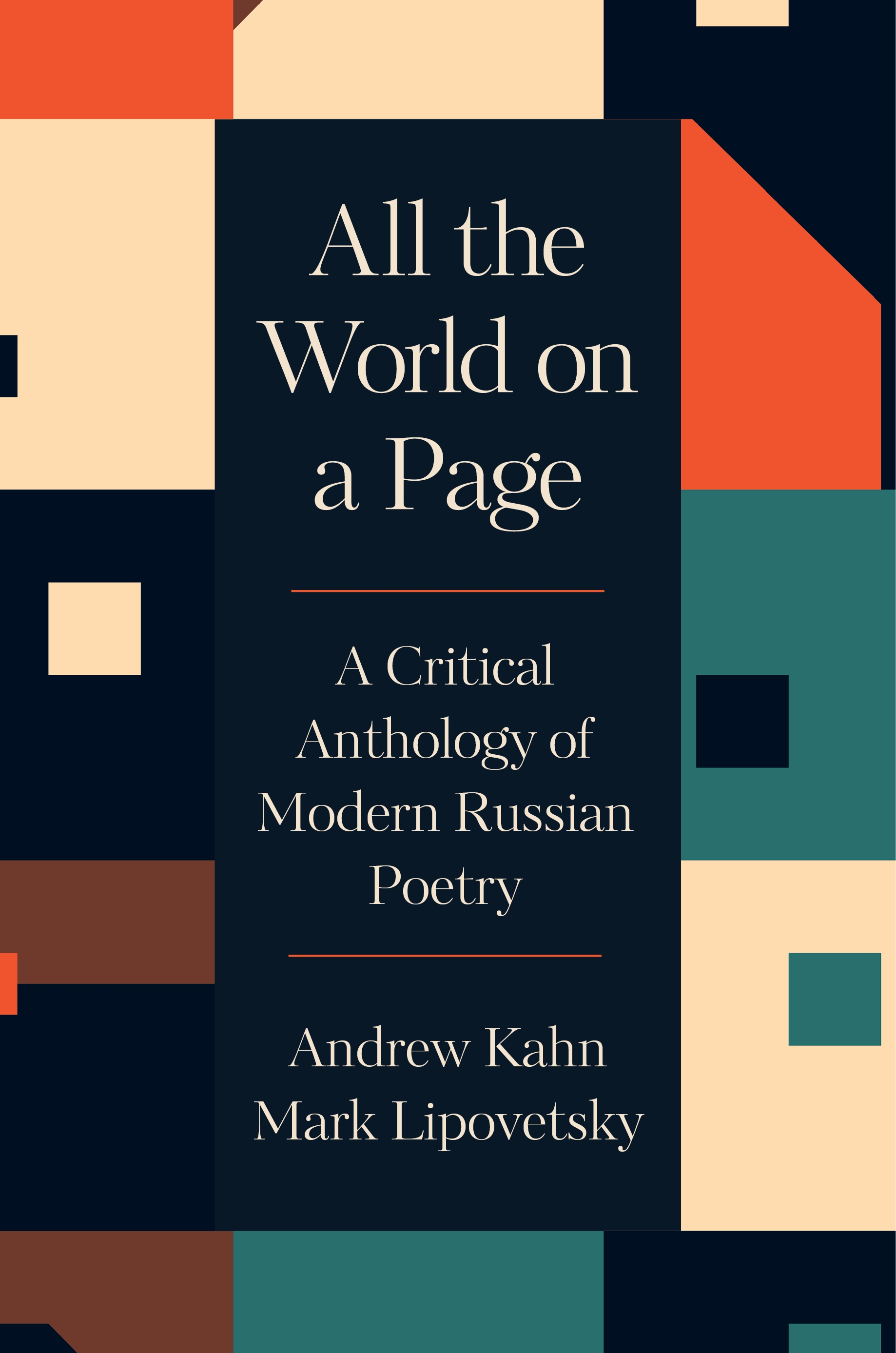
All the world on a Page, a Critical Anthology of Modern Russian Poetry,
selected with essays by Andrew Kahn and Mark Lipovsky
Princeton Univ. Press. £35. ISBN: 9780691207162
Reviewed by Belinda Cooke
*****
*****
Joseph Stalin and the poet Osip Mandelstam agreed on one thing – the centrality of poets and poetry. For Stalin, they were the ‘engineers of the soul’, while Mandelstam famously said: ‘ Only in Russia, poetry is respected – it gets people killed.’ To reinforce both mindsets, we have Joseph Brodsky on trial in 1964 for ‘social parasitism’, defending his right to be defined as a poet in spite of his lack of educational and state-backed credentials: ‘I thought it came from God.’ Within this highly researched great doorstopper of a book of around 500 pages, presumably years in the making, we see this debate continue to play out. The editors make no apologies for excluding state-endorsed writers, such as Evtushenko and Voznesensky who were much lauded both at home and abroad in the sixties, with sell-out stadiums. Rather, it reveals poetry’s sustainedly vexed relationships with the state: from Silver Age poets who lived through the Russian apocalypse of Revolution, Civil war and Stalin’s purges, right up to the present, including evolving radical feminism that broke away from Russia’s Soviet-influenced, conformist interpretation. Readers may recall how this later feminism got a lot of air play in the West when members of the protest band Pussy Riot were arrested in 2012. Thus, with Vladimir Putin’s increasing restriction on free speech, we see the present writers in no happier relationship with the State.
The introduction’s broad modernist framework, includes some challenging reading as it surveys shifting perspectives both on translation itself, and the evolving critical theory that has underpinned analysis of these poems. The introduction works in tandem with individual essays on the thirty-six chosen writers, all substantially referenced along with guidance for further reading and a critical analysis of an individual poem of each poet. For newcomers, a word of warning: don’t expect a ‘greatest hits’ survey of individual poets, but a more nuanced gateway into the Russian world of poetry so widely loved in Russia compared to its minority appeal in the West. And as a bi-lingual text it is particularly beneficial for aspiring linguists and students. For those more familiar with the field, due to its idiosyncratic choices, one moment it will feel like meeting an old friend, the next you may come across an unknown pleasant surprise. In the case of the latest recent contemporary poetry, it will offer a taster of what’s ‘out there’ in the minefield of contemporary media-fuelled texts, where only hindsight, will enable us to find what will be enduring.
Keeping with the idiosyncratic theme, I did find the translations a little top-heavy on longer poems, rather than the more manageable lyrics, but the good news is that, the editors were clearly consistent in the choice of translators, avoiding a misconceived loyalty to rhyme and metre frequently found in the texts of academics. Such translations rarely stand up as poems in the English. They do include most of the big names: Mandelstam, Akhmatova, Tsvetaeva, Pasternak and Mayakovsky, and the later Nobel prizewinner, Brodsky. There is also a good showing of the most significant avantgarde group of the twenties, the OBERIU ( ‘The Association for Real Art’). (The fate of this group was particularly tragic. The group members: Kharms, Oleinikov, Vvedensky, and Zabolotsky were repeatedly imprisoned and persecuting during Stalin’s Purges, and Oleinkov was shot in 1937). However, don’t be surprised if any of your favourite poets are missing. Though, for example, there are the Russian Berlin exile poets, Khodasevich, and Nabokov, (better known for his fiction), I was disappointed not to see the wonderful surrealist Poplavsky included. Similarly, it was good to see the musical bards, Vysotsky and Galich, who did the circuits in the sixties and seventies, getting a showing, but the absence of, arguably, the lead bard of that generation Bulat Okudzhava was a significant gap. His song to the Moscow river, ‘Song of Arbat: ‘you are my calling, happiness and torment’, once heard, is never forgotten (https://www.youtube.com/watch?v=TCK_EYIv9s0)
Fortunately, the editors helpfully set out their stall with respect to their own selections, emphasising that this is a ‘critical’ rather than ‘historical’ survey as the title makes clear, thus justifying their analysis of individual poems. More broadly, they focus on the individuality poets retain within modernism and, presumably, the threatening social context, summarised in these, if somewhat generic themes: love (Mayakovsky, Tsvetaeva), desire and sexuality (Nabokov, Brodsky, Rymbu), friendship and betrayal (Akhmadulina), the human condition existentially (Blok, Losev, Vysotsky, Stepanova), cultural memory (Mandelstam, Shvarts, Barskova), religious and metaphysical insights (Kuzmin, Khlebnikov, Vvedensky, Kharms, Goralik), terror and war (Satunovsky, Oleinikov, Zabolotsky, Gor, Galich, Fanailova), the mundane (Kholin, Prigov, Rubinshtein), and, not least, the subject of poetry itself (Gumilev, Guro, Khodasevich, Pasternak, Mandelstam, Akhmatova, Sedakova, Nikonova). All are considered either directly part of the Silver Age or its heirs.
But speaking as someone who first got to know Russian poetry in 1976 it was simply good fun to journey back to memories of my own first encounters with the field – the carpe carpe diem enthusiasm of Mayakovsky’s ‘Listen!’: ‘So if the stars are kindled, /doesn’t it happen in answer to someone’s pleas?/Doesn’t it mean someone wants them very much to exist?’ , or Pasternak’s pantheistic, sensuous merging with nature: ‘Poetry, till my voice is weary and wheezy, I shall swear by you: / you’re not some sweet-voiced dignitary, / you’re summer in a third-class carriage, / a precinct, not a pretty tune.’ (‘Poetry’) Then we have Gumilov’s ‘Sixth Sense’ a tribute to poetic inspiration written a year before the Bolsheviks assassinated him on a trumped-up charge:
But what shall we do with rosy-fingered dawn
high in the cold expanses of the sky,
the place of quietness and unearthly calm,
what shall we do with deathless poetry?
In contrast, we have the lesser-known Eleno Guro who tragically died young of leukemia was a lovely discovery for me. Take these moving lines here on her poem on the death of her child: ‘ Elena Guro, “Gone to sleep, gone quiet now, so kind’:
Life I loved far less
Than how I loved you.
And life follows him, life leaves me—
Nothing to be done.
There he sleeps, so good, so kind— Nothing to be done.
He wore himself down over some far away thing . . .
Pine trees, pine trees!
Pines above the meek and quiet dune
Await him.
No need to wait: he sleeps serenely— Nothing to be done.
Mandelstam, a poet least able to compromise his art, was to die tragically from typhoid in a transit camp on the way to a three-year exile. The choice of the less well-known ‘The Horseshoe Finder’ is certainly apt, evidencing the challenging intellectualism of much of his poetry – is art surviving or just becoming a hollow ring?:
Where to start?
Everything shudders and sways
The air trembles with comparisons.
No single word is better than another,
The earth hums with metaphor
…
All the various rounds of copper, gold bronze
Lie with equal honor in the ground,
The age bites down on them, leaving the marks of its teeth.
Time clips me, like a coin.
And I have already felt the loss of myself.
And in the case of Akhmatova, similarly they have opted not for one of those heart-stopping love lyrics to the indifferent husband Gumilov: ‘Breathless I cried: ‘It was all / just a joke. I will die if you go.’ / He smiled so calmly, so terrifying,/don’t stand in the wind.’ (‘She wrung her hands under the dark veil’) but to a nine-poem sequence on her craft.
As we move into the Soviet experience, the more we get writers telling it like it is, with no shortage of ennui and urban decay. You really need the rolling ‘r’s and gutterals of Vysotsky’s singing voice to appreciate ‘My Gypsy Song’: ‘But the morrow’s just as bad, joy is gone forever, / so you drink and smoke in bed, hungry and hung over’ (‘My Gypsy Song’). Then you have the bleak humour from the conceptual artist Prigov’s ‘Three Poems about Washing Up’: Just when you’ve finished up the dishes Look—a whole new pile awaits / What kind of freedom is this / Just let me make it to old age’. Kholin in ‘Fences. Trash-heaps. Flyers. Ads.’ doesn’t even take the trouble to comment, he lets the detritus speak for itself: ‘Dressers with mirrors. Wardrobes. Couches. / Walls full of bedbugs. The tables have roaches./ The lampshades are sagging. The ceilings are dim. // On the beds lazing are languishing wives./ The men are at work. In the kitchens—old women.’ Elena Shvarts, star of the underground Leningrad scene in the seventies then transforms the theme into something more subtle, universal and, paradoxically, here in ‘Rubbish Heap: ‘I haven’t the strength to sing your glories, resplendent rubbish heap! / How you lie sprawled at sunset, a matted tousle, / And a black cat in his white bib picks and rips/A tune, like a pianist, in your heavy torso. ‘
But it is refreshing then to return to Olga Sedakova’s more lyrical proximity to earlier Silver Age poets:
The poetry of earth will never die,
but if the end were drawing near,
he’d shed his oars and cease to steer
his trusty barque beneath the sky—
as hope would crumble to the ground,
so he would glide through waters deep,
though ruined faith would surge and leap
to ride the wave of pulsing sound.
(‘The Grasshopper and the Cricket’)
Without doubt the value of this book is the sheer breath of information about current movements in Russian poetry and certainly, in this respect, some mention just be made of Maria Stepanova who having left Russia immediately after the full-scale invasion of Ukraine in February 2022 has since, as one Putin’s most outspoken critics of Putin’s regime, established world-wider recognition, though more for her prose than her poetry. This said, space doesn’t allow a full showing of all that is available, so by way of conclusion I would just draw your attention to the one poem that is so totally in your face that it won’t be ignored – a shock, horror, too much information, keep in the bedroom poem, that is at the same time an hilariously, gloriously assertive expression of defiant feminism, human resilience and assertion of political freedom. Here we have excerpts from Galina Ryambu’s 178 lines of ‘My Vagina’:
I think, well, maybe the vagina will bring down this state for real,
drive out the illegitimate president,
disband the government,
abolish the army, taxes on the poor,
the FSB as a structure of utterly vile power and oppression,
will deal with the police,
with conservatism and revanchism,
will dismantle unjust trials, free
the political prisoners,
make impossible putrid Russian nationalism,
the humiliation of the oppressed, fabricated cases,
will shatter oligarchy and patriarchy,
paralyze the troops deployed in other states—
farther and farther
into militarism’s pussy!
My vagina is love, history and politics.
My politics is the body, the everyday, affect.
My world is the vagina. And I bear peace.
Yet for some I am a dangerous vagina,
a fighting vagina. That is my monologue.
Belinda Cooke’s seven collections include Russian and Kazakh translation, in particular, Marina Tsvetaeva, and a memoir of her mother: From the Back of Beyond to Westland Row: a Mayo Woman’s Story (The High Window Press). Her latest collection of poetry, The Days of the Shorthand Shovelists, is due out from Salmon (2025).
 The High Window