*****
Michael Vince: Legwork • Katrina Naomi: Battery Rocks • Elizabeth Gibson: A Love the Weight of an Animal • Ness Owen: Naming the Trees • Elaine Briggs: Cusp • Rhian Elizabeth: maybe i’ll call gillian anderson
*****
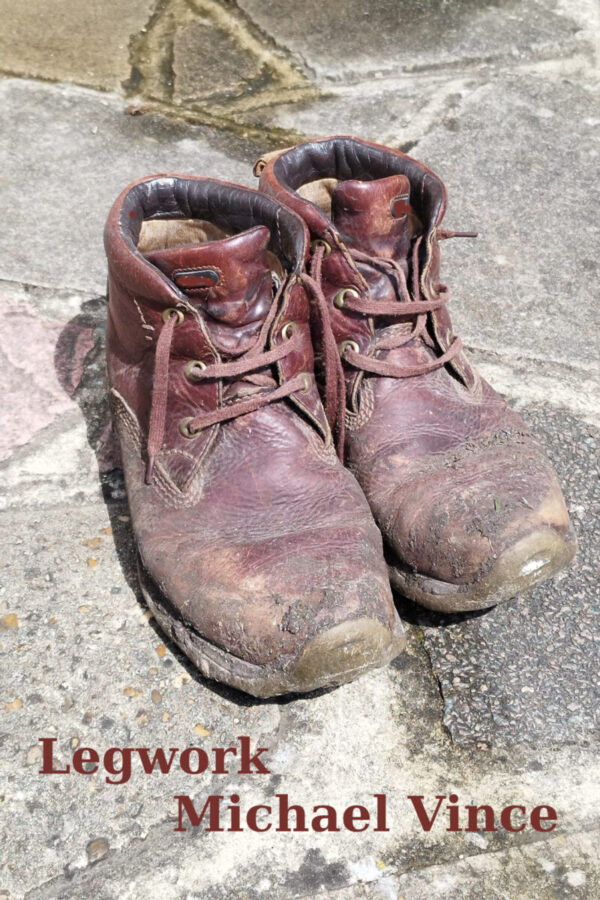
Legwork by Michael Vince. £10. Mica Press. ISBN: 9781869848385. Reviewed by Edmund Prestwich
Michael Vince’s generous, intelligently reflective Legwork impressed me deeply. It’s a book that repays careful reading and rereading. I’ll try to say why by looking at some poems in the opening section, ‘Around Greece’.
Poems in it recall short expeditions within Greece, exploring by bus or on foot. They present small incidents with a fullness of life that makes reading them an immersive delight. They make encounters and events we might normally think of as trivial shine with a kind of archetypal, even numinous light while remaining thoroughly grounded in the day to day realities of rural and insular Greek life. One side of this achievement, of course, is a matter of vision. The poet can see this luminous significance in ordinary things. That involves generosity of feeling, intelligence, empathy and a selflessly receptive imagination.
The other side is sheer technical skill of a kind that is both polished and modestly self-effacing. Vince’s syntax and metre don’t call attention to themselves but it’s through their subtle and continuous work that we come to share his vision. Throughout the book, most poems are written in short lines and long sentences. The poet uses this combination to achieve a double effect. The continuity of the sentences makes us feel the interrelatedness of the poems’ details and creates suspense as to what will come next. At the same time, by breaking the flow with line endings Vince frames individual details and emphasises words in a way that makes them shine out distinctly, not becoming subsumed within the larger movement. Complementing each other, these effects of suspense as to what will come and framing when it does give each detail a sense of emphasis. ‘Lamb’, for example, begins
In an island village, high up,
half abandoned, where goats perch
among ruined houses, we walk
along a winding street, watched by
suspicious cats, greeted by
the occasional dog acquainted
with tourists. On a doorstep
a young woman sits with her pet
seated beside her, a lamb
with a lead and collar.
How much more circumstantial could writing be? But a striking part of the total effect is how unlocalized the experience is. We never learn who’s walking with the poet or which island they’re on, let alone which village they’re in. And so without losing their particularity the scenes and qualities Vince describes take on archetypal resonance and evocativeness, whether they be physical things like mountain, sea and sky, bread, animals or people; abstract but specifically named concepts like generosity, which is beautifully and playfully dramatized in the poem of that name; or still more abstract ideas tacitly suggested by the arc of the poem as a whole, as ‘Lamb’ suggests the ambiguity of our relation to the animal world by reminding us that the eating of lamb is a ritual of the Greek Easter.
Currently, though, my very favourite poem in this section is the enchanting ‘Spa Town’, which combines longer, more undulating lines with freer imaginative play. After eleven lines describing a small spa town or village in the heat it focuses on one patient. I’ll need quite a long quotation to suggest the delicate interweaving of tenderness, humour, irony and compassion as it does so:
Here we watch one, an old man in pyjamas
stroll out unsteadily down a concrete pier
towards the ocean, followed by a ginger cat,
tail up, pacing to keep company. The man
turns back several times and mutters,
exchanging nods with this attentive creature
who hasn’t come here for its health. They look
like a couple out for a walk, taking the air
on holiday. When they reach the end of the pier
perched above the waves, the cat sits
and grooms. The old man lights a cigarette,
and convinces himself that nobody can see,
while the ginger cat waits, much like a nurse,
or a child out with grandpa, who comes each year
for coffee-less, wine-less days. The old man
gazes out, where the healing waters mingle
with the bitter salt. He takes laboured breaths,
then turns. He says the word, the cat agrees,
and they both begin their slow return to the shore.
Such sensitively evocative observation expressed in simple language is a pleasure in itself. So much, for example, is implicit in the way the suggestion of ease in ‘stroll out’ is countered by ‘unsteadily’. Beyond that, there’s a moral as well as aesthetic beauty in the way the poet effaces himself from the scene, letting the poem be completely filled by the old man and his situation. It almost feels as if we’re seeing it and reacting to its emotional suggestions for ourselves, and this makes for a peculiarly intimate, lingering involvement. In fact, of course, all our impressions arise from the poet’s choices about what to notice and focus on, and from the similes he floats. Successively comparing the cat to wife, nurse and grandchild brilliantly superimposes a series of easily visualised imaginary scenes on the actual one, each with its own emotional resonances, and in the actual scene our sense of the old man’s fragility and self-consciousness is quietly heightened by contrast with the cat’s self-containment and the graceful physical ease that the narrative seems to imply. Finally, in keeping with what I said earlier about the archetypal resonance of these poems, images like the bitter salt, the ocean and the shore seem fraught with symbolic suggestiveness, making us feel the old man’s conscious closeness to death in a way that’s the more haunting for being indefinite.
The book is divided into four sections, ‘Around Greece’, ‘Fish’, ‘Visiting Relation Can Be Difficult’ and ‘Far Shore’ – titles which in themselves suggest how the poet interleaves gravity with quirky humour. Although I’ve concentrated on the Greek poems that dominate the first section and the beginning of the second, the book covers a range of subjects and approaches them in different ways. I’ve remarked on Vince’s obvious intelligence. Often this appears as a shimmer of implicit reflections on the physical scene the poet presents. Sometimes it takes a more cerebral, conceptual form. ‘Fish’, ‘Legwork’ and ‘New Boots’ explore abstract concepts by developing a single comparison. ‘Legwork’ is of particular interest as it’s the title poem. In fact I read it as among other things a description of the book’s approach to writing. It begins
Going over the same rough ground
seeking an answer, it’s a matter
of setting things out, finding the route,
as a distance walker first lays out
maps, and fetches from the loft
boots and sleeping bag, makes lists
of food to take, buses to catch,
glances at the weather forecast. What
will happen along the way this time…?
The fact that the poet sees walking as exploration and looks forward to surprises even on familiar ground reflects the openness of mind that I like so much in his work. Far from considering such openness as at odds with thought and deliberate technique, the poet presents planning and care as conditions of the discoveries he hopes to make. In the end, after an arduous climb his allegorical walker must
xxxfollow that gradual descent
shaped by long past laborious days,
now that an ache in calf and thigh
embodies the process of legwork.
The way the poem redeems ‘embodies’ from cliché is a joy in itself, and points to something fundamental about the procedures of the whole book. Even in developing explicit abstract concepts or exploring elusive ripples of reflection, all these poems embody the experiences and ideas they present in densely, vividly and grittily concrete images. At the same time, to go back to what I said earlier about how often his images have an archetypal resonance, although only a small number of poems explicitly focus on pursuing elusive ripples of reflection, they nearly all have a tendency to expand into them. ‘Burning’, for example, vividly describes how the poet and his companion laughed when they realised that what they thought was a catastrophic blaze was only the moon rising behind a hill; then describes how his father saw the Crystal Palace burn and how people called the disaster ‘the end of an era’, not wanting to see it as ‘the first step into a new one’. The poem ends
xxxxxxxxxxxxxxxxxxxxxxxxxxLater,
in a country not very far away
and of which we knew a great deal,
firemen looked on but did nothing
as the synagogues flamed; Kristallnacht,
a warning beacon for the coming terror
of bombers in the dark high up
guided from below by the burning.
It’s hard not to see this as speaking to the current instability of the international order. And it seems significant that Vince describes the burning of the Crystal Palace as the first step into a new era, rather than merely the beginning of one. Hovering behind and uniting all the poems of Legwork is the ancient metaphor of life as a journey. It becomes explicit in ‘New Boots’, which takes stock of the wearing out of old habits and even friendships, ending
Places and people, cushioned
at the raw edges, blistered,
how they ache to hobble back
as worn manageable shapes
when it’s all too late, and boots
once loved are dropped down
heavily, with a painful sound,
into the bin. Then it’s barefoot
that a new journey of self begins.
Am I letting ripples of suggestion carry me too far in hearing a faint echo of the famous ‘Lyke Wake Dirge’ beginning ‘This ae night, this ae night’ at this point?
Edmund Prestwich is a retired school teacher and admirer of other people’s gardens who lives in Manchester. He enjoys reading, writing and watching things grow, especially his four lively grandchildren. He has published two slim volumes of poetry, and his poems and poetry reviews appear in a number of magazines.
*****
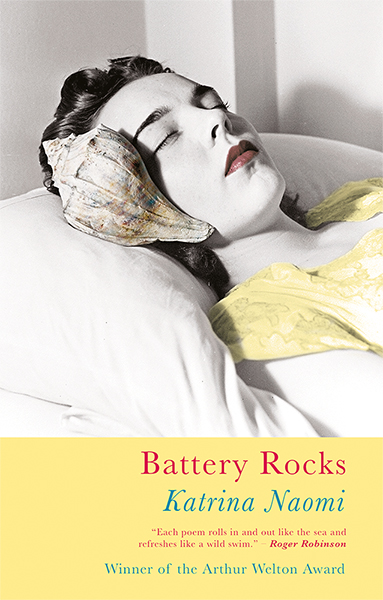
Battery Rocks by Katrina Naomi. £10.99. Seren. ISBN 9781781727546 . Reviewed by Patrick Lodge
The marvellous writer about the natural world, Roger Deakin, virtually founded the wild water swimming movement with his book, ‘Waterlog’. Deakin was a strong advocate for the therapeutic aspects of such swimming – “you jump in with all your devils and leap out a giggling idiot”. The movement has prospered enormously over the last decade. Even Nick Cave is an advocate – as he told ‘Big Issue’, “if you’re the type of person that wakes up feeling a little despondent, go and jump into freezing water. It’s so f***king catastrophic to your nervous system that it recalibrates everything”. It’s very likely that Katrina Naomi, the prolific, prizewinning and distinguished poet who now lives in Cornwall, would agree with these comments as this collection, winner of the Arthur Welton award, celebrates the joy of the all-year round dip in the deep, in this case off Battery Rocks in Penzance, her holy headland.
Naomi considers herself an accidental poet, coming late to the craft, inspired by the like of Sharon Olds and Mark Doty. Certainly she has Olds’s characteristic engagement with the natural world – in Naomi’s case a world mostly represented by the sea – and her view that that world can be a source of beauty and awe as well as a means of reflecting upon deeper, personal themes. The idea of taking a swim each day and writing about it might appear a passport to a rather dull and repetitive collection – maybe like watching endless re-runs of Baywatch – but this is far from the case as Naomi, while enjoying the swim qua swim, courageously faces her own demons and pushes herself to seek a deeper understanding of her limits and what it might mean to transcend them. “I’m dead keen to get to my writing desk as soon as I’ve swum” she has said, and the much written about relationship between a repetitive physical act like swimming and the surge of creative juices it can create is a productive one for Naomi. She has explained how it works, noting that being a poet can mean spending, unhealthily, a “lot of time inside my head” but “swimming has enabled me to reconnect with my body and this has really freed my poetry up”.
The collection is divided into four sections with each covering one season. This is not an arbitrary decision as the challenges faced do change according to the season though wild swimming can be dangerous at any time – in June 2025 coastguards were called to rescue swimmers off Battery Rocks who had got enveloped by fog and were completely disorientated. It is this edge of danger that elevates this collection above a pastoral whimsy. Linked to that is Naomi’s development of a strong personal relationship with the sea through the poems. This is no mere Ruskin-esque ‘pathetic fallacy’ as she avoids a soppy sentimentality in favour of a hard-headed view of the sea in its moods. Indeed, Naomi personifies the sea with a strong emphasis on its dangerous seductiveness. The opening poem contains many of the themes later developed. In ‘Fickle Lover’ the sea become just that; it leaves gifts – ‘razor shells, man o’ war, jags of glass’ – each suggestive of a sense of threat, of potential harm. After all, Naomi recognises, ‘ours is not a relationship of equals’, but remains willing to play: ‘I’m going / deeper’.
Wild swimming certainly seems to enliven participants – one member of the Battery Belles and Buoys swimming group proclaims that “It’s like being completely alive and all your senses have been heightened”. Naomi seems to have had a dynamic relationship to the sea for a long time – symbolically dunked in the sea at three days old and never ‘dried myself off / never wanted terra firma’. The sea makes her alive and is more an expression of a whole lifestyle, an attitude to living, than just a morning’s chilly dunk. It seems the danger and the unpredictability are the attraction, the ‘sensible, the understood. That isn’t living’. The sea is ‘like sex; good sex, is the nearest / to swimming on a chill, bright day’(‘Golden Shovel: After Iris Murdoch’). This poem, which uses the ‘golden shovel’ form where each word of one line of another poem becomes the end word of each line for the new poem, is well handled and is one example of Naomi’s willingness to experiment with form yet remain quite accessible.
Naomi’s sea takes many forms. Sometimes a female with ‘a shouty body’ that plays with her in a kind of happy rivalry, a contest but always with an edge – Naomi takes her on and survives, ‘the sea grins: till tomorrow.’ (‘The Sea & Me’). Occasionally light-hearted, the most powerful poems more often describe a relationship between swimmer and the sea that has an undertone of abuse. The sea speaks for itself, notes the swimmer’s ‘struggle not to cry’, estimates how much water she will take in ‘…as I hit her full in the face’ and, in a classic of coercive control, knows she will return despite all: ‘She says otherwise but I really know her / better than she knows herself’ (‘The Sea Speaks’). While ‘danger is a mild attraction’ (‘Thoughts Over Hot Chocolate’) the sea seems able to draw to the surface deepest fears and memories. In a moving poem in memory of Sara Everard, Naomi plays with the idea that the sea may be dangerous but so too is the land for women. Everard’s murder brings back memories of ‘my own attack / 36 years ago’. These memories resurface again in ‘Cormorant’ where the close presence of the flying bird recalls many previous moments of danger – a brush with a possible paedophile, ‘…the plane I didn’t take, the drink I left on the bar, the alley I didn’t cut through, / the knife my attacker forgot to carry’. The poetry does not diminish these memories, nor make light of them, but the sense is of the swimming as essentially therapeutic – “I’ve learned to swim in rough seas’. (‘i.m. of Sara Everard’).
The seas get rougher in the Winter section but also more seductive. The opening poem, cleverly entitled ‘Stirred’ where the sea is as ‘clear as a martini’, pulls no punches – a launch is in full knowledge of ‘certain numbing / on into the raw grip’. Naomi remains unshaken despite the sea’s efforts to get her to swim beyond her capacity with ‘its woozy lotus voice’ of a dangerous but attractive lover. Poems hint at the internal struggle to get out into the flow in deep winter when 45 minutes under the duvet calls, rehearse the excuses for not swimming today or the mental toughness to swim further ‘…to the buoy to the dark blue edge / of the shipping lane the start of very deep water / the ledges beneath like rows of shelves’ (‘On Distance’). In the end one feels this is an addictive pursuit – ‘I always feel the sea is calling me back in’ as one Battery Rock swimmer put it – despite the danger. The aptly titled ‘Valentine’s Day’ – with a George Mackay Brown epigram, ‘What evil joy the storm’ – portrays the sea again as a dangerous and demanding lover – an implacable adversary that ‘wanted a body’ but mistakenly throws Naomi onto the rocks and ‘…realised // its mistake / how it had left itself // swimming back out alone’.
There is a lot more to this collection than one woman v the sea. Naomi may love the sea but one thinks she would prefer it to stay in its place. The witty ‘Life Underwater’ explores an upside-down world where all that you know is underwater – a gentle squint view on the climate crisis and rising sea levels that, in the end, pulls no punches. Naomi is pessimistic –‘I give it 30 years’. An elegiac poem explores the landmark St Michael’s Mount – ‘I swim in your elongated vowels, / luxuriate in them’ (‘Poem for St Michael’s Mount’). Encounters with other denizens of the deep, including a hydrozoan, the ‘pink mini-monster’, allow Naomi to float on a wave of striking, imagery – ‘ …wiping welts along swimmers’ bodies / Your lacy, lengthy, bike chains / your party poppers of venom’. Despite the potential for harm Naomi wants this creature ‘gorgeously alive’ – testament to the wild swimmers full appreciation of with whom she shares the sea that compels her.
You don’t have to be a wild swimmer to enjoy this engaging collection. You may not even like the sea but once you’ve read ‘Battery Rocks’ you may find it has you in its grasp. As another Cornish poet, Angela Stoner, puts it in ‘Seasong’:
‘The sea is sly.
She never quite lets go.
We think we’ve left that sea-birth far behind
but we’re haunted by the ocean always.’
Patrick Lodge is an Irish citizen with roots in Wales.. His work has been published in several countries and he has read at poetry festivals across Europe. Patrick has been successful in several international poetry competitions. His fourth collection, There You Are, is due for publication by Valley Press in late 2025.
*****
A Love the Weight of an Animal by Elizabeth Gibson . £10. Carmenta. ISBN: 9781739374594. Reviewed by Ian Pople

There is a sense in which this book is well summed up in its title. A number of the poems in this very convincing first collection focus on animals and particularize both the animal and its location in ways which feel very empathetic and loving. And, as such, these poems are not what we might ‘conventionally’ consider as nature poems. If you were to come to this collection with the expectation that you would find Tennyson’s ‘nature red in tooth and claw’ or its more recent avatar in the work of Ted Hughes, you would be sorely disappointed. The empathies that Elizabeth Gibson has for these animals are not the kinds of Hughesian empathies for the pike, or the hawk roosting, or the jaguar pent up in its cage at the zoo. However, that latter vision would, I suspect, be close to Gibson’s.
The very fine, ‘The goose at the end of the world,’ begins, ‘A belligerent goose has remembered that the towpath / belongs to him, and he becomes wider and wider, // a hisss of steam as he inflates. On days when I cry / about not knowing what friends are or whether // I have them. ‘ And the poem ends with the narrator of the poem sitting by the goose, ‘and we look up and down together. / He honks a sigh – an ending – and, after a moment, I echo it.’ This is a poem, I take it, about the difficulties of acceptance. It is not simply that the goose has to accept the human, but that the human has to accept the goose and, in accepting the goose, comes to accept themselves. Here, the goose appears to be at the end of the world, because that is where, initially at least, the narrator feels themselves to be. In fact, however, the poem has a kind of subtitle, ‘Ancoats, Manchester.’ So not only are the narrator’s emotions part of the encounter with the goose, but they are located in a particular place. Gibson places those emotions very careful, not only in the narrator but in the place, so the reader, too, is located and held in the placing of the poem.
That working with location is part of the trajectory of the book. The poem that follows ‘The Goose at the end of the world,’ ‘To write without fear,’ is, in a sense, all about the struggle to locate. This poems lists the ways in which conventional ways to locate can fail; that failure not only occurs with words, though, as the narrator of this poem concedes, ‘word shapes are vital,’ but that failure occurs with such things as age, birthdate, the Chinese year of the animal, or star signs. The poem ends with the comment, ‘I want to wrap you in power / and poetry. // Can I do that without hurting anyone? Show me, love.’ Gibson’s plea is one that many writers might feel acutely; in what ways can we describe and locate the other without doing that person a violence or, at the very least, appropriating them into our own world view, thus negating their own agency. And there is an interesting ambiguity in that final imperative: does ‘Show me, love’ mean ‘Will you, my love object, show me how to put you in a poem and offer you power?’ Or does it mean, ‘Please will you show me love’?
The cover blurb of A love the weight of an animal tells us that the book is ‘a love song to Manchester life.’ As I’ve suggested above part of the locating that this book worries over is, in part, assuaged by the naming of parts of Manchester. This is a way of making place concrete, reified, so that the emotions can seem to lack on control, but the city offers a kind of stability. A love the weight of an animal concludes with a formal sonnet that begins with the lines, ‘Once, a little fish swam across a wide, warm sea / till it came upon and island, with a beehive, bright and pretty.’ In the course of the poem the fish metamorphoses into a bee, which dares ‘to believe it could be true to both its worlds.’ And the final two lines are ‘There was some doubt there, though, till that night when you told me: / But…you’re a Mancunian! – so casually, and so free.’ Although, the formality of the sonnet form does not quite play to Gibson’s strengths, the fact that the poem is the last in the book brings that need to locate to its culmination. That metamorphosis from fish to bee can mean a number of identifications offered in the course of the book. But Gibson’s ability is to work with those identities and show how they can offer not only a freeing but also a freedom, not always the same thing.
Ian Pople‘s Spillway: New and Selected Poems is published by Carcanet.
*****
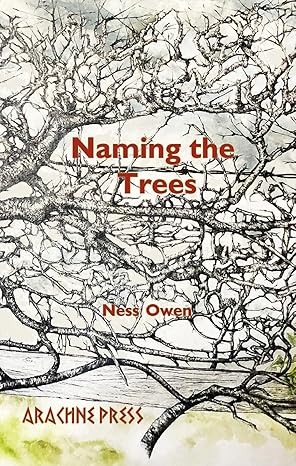
Naming the Trees by Ness Owen. £9.99. Arachne Press. ISBN: 9781913665951. Reviewed by Fiona Owen
This is a book of roots and branches, of holding, and holding back the encroachment of development that threatens to overcome beloved, common land. These are poems that sing of trees and of rooting into both land and language as acts of resistance to capitalist forces that care for neither. This is Ness Owen’s third collection, and it links to ‘Achub Penrhos/Save Penrhos’, a public campaign to save a local Anglesey/Ynys Môn woodland from becoming a leisure park complex – which would mean, as Owen tells us in her introduction, ‘the felling of many trees and the end to the majority of public access’. This holiday complex was granted planning permission in 2016, that year of terrible choices and bad decisions, to build on the much-loved nature reserve on Holy Island, Penrhos, a woodland originally part of a local estate and ‘a haven for wildlife including endangered red squirrels, ancient woodland, bats, fungi and thousands of migrating birds’. It is a place ‘very much part of my childhood’, Owen explains – and this is true for many locals.
In a sequence of poems entitled ‘Penrhos’, originally commissioned by the BBC and broadcast in 2022 on the BBC 4 radio programme United Kingdoms, the sequence opens as an incantation, naming the trees in both Welsh and English:
Mae’r onnen ar gyfer y breauddwydwyr
Ash is for the dreamers
Y gerddinen yw ein gwarcheidwad
Rowan to guard us
Mae’r fedwen ar gyfer cariad
Birch for love …
Then comes an evocation of place through its particulars, as trees are imagined cut: ‘Ivy holds fast as roots are cleared, / heartbeats counted from face-cut // to fall in chorus of chainsaw snarl …’ and we are shown ‘what it is to / love a forest with song’. ‘Cynefin’ is an apt Welsh word sounded here; it means ‘a place where we belong’. And though this sequence is rooted in Penrhos, a wider sense of belonging comes through the poems in this book, for we all belong, as earthlings, to some landscape or other, to a world ‘forest’ – which brings to mind the science fiction novel The Word for World Is Forest (1972) by American author Ursula K. Le Guin, who wrote of the interdependence of forest with life-forms: ‘A forest ecology is a delicate one. If the forest perishes, its fauna may go with it’.
Have we lost ourselves, then, straying too far from the ‘mother tree’, Owen seems to ask:
We are holly-green,
lichen splashed,
roots exposed,
heads tipped to ground
craving the kinship
beneath our feet …
‘Show us …’ the poet beseeches, ‘the language of giving’ so ‘we might / unlearn our dislocation’.
These poems cry out for the protection of the commons underfoot where local habitat, and all the fauna and flora it supports, can thrive. This habitat, after all, is an extension of ourselves, and should be cared for as such.
These poems are making a stand, are about standing ‘in the place where you are’, as the REM song goes, and singing from there – for, otherwise, ‘How are our voices to be heard?’ asks the poet in ‘Hushed’. Protest is legitimised in this poem; in Wales, especially, it has only been by ‘banding together’ that ‘our freedoms have been born’, through ‘Beca taking / down the gates’, through ‘the Women’s Peace Petition … Cymdeithas / dumping the uniaith signs’. Language matters, poetry and folk stories matter, just as the trees and forests, the commons matter – all precious, all part of a rich diverse inheritance, all in need of protection from the forces that would silence and steal.
As Owen writes in ‘Hold Each Word’, let us treasure language:
Hold each word a little longer
xxxtill echoes fill your ears
and you remember the
xxxlilt of your tongue
‘Adra’ means home in Welsh and these are poems that stand for all that home symbolises: family, community, continuity, heart and hearth – and, more widely, everyone’s home: ‘mother earth’. Though these poems are rooted deeply in the land of Wales, they branch as wide as the world with an embracing reach. The poem ‘Adra’ explores how, despite the linguistic pressures of an almost overwhelming ‘tide that takes no holding as // summer turns Porth to Bay / Rhyd to Ford’ – the influx of English challenging yr hen iaith, the old language that is Welsh – all the same, ‘we never // will bury our dead’. Using Welsh keeps the language alive and there is dedication to that act of embodied preservation, just as there is to holding back the incoming tides of ‘development’. The poet reminds us that we live – dwell, abide – in language and language carries deep memory. Our English word ‘eco’, for instance, comes from the Greek ‘oikos’ meaning ‘home’. And Owen’s is an ecopoetry that includes humans and their languages in its flesh and bones.
These poems honour the names of things, in both Welsh and English, for names have power, the concrete and proper noun favoured over the general and abstract. Throughout the book, Owen draws on aspects of the Celtic tree calendar, such as in the poem ‘Beech for Our Protection’ where ‘The forest needed to feast / and everything was language’ or ‘Hazel for Wishing’ drawing on folk tradition.
In the poem that won Owen first prize in the Greenpeace UK’s Poems for the Planet 2022 competition ‘Then the Geese Turned Up’, the geese, arriving in Anglesey after their long migratory flight from elsewhere seem to bring with them an antidote to the development-speak that asks: Why would you deny us a high quality / destination leisure village, five hundred chalets, / luxury spa and water sports centre?’ Never mind ‘a few old trees’ and don’t ‘jet skiers have rights / too’? We all know the sound of such silver-tongued marketing lingo – except for the geese. They are having none of it and lead the other birds into a rowdy chorus so that ‘the mudflats’ sing, the sea lavender blooms and the lapwings heckle: ‘some of us, you know, are here to stay’ – fauna and flora claiming their ancestral land.
Wales was once extensively forested and Ynys Môn, Owen’s home, and mine, was once famous for the Druids’ sacred oak groves. It was the Romans, in around 60 CE, who hacked down the trees, as a way to destroy the power of the Druids. Mona, as the Romans called this island, was then a centre of resistance to Roman rule, and millennia later, here is one small woman using her voice, her art, her poetry to do similar: to stand with the trees, with their names and the languages of place, naming as an act of empowerment, as a way of putting ‘one foot in front of another’ to ‘find a forest and / breathe in evergreen alleviations’.
Fiona Owen lives on Ynys Môn where she writes and makes music with Gorwel Owen. Her fourth book of poems is Anima/l (Cinnamon Press, 2024). She taught creative writing, literature and other arts/humanities subjects for the Open University for twenty-four years, retiring in 2022. Fiona now runs occasional Eye of the Storm ‘writing at depth’ sessions on Zoom and writes an occasional Substack under the name ‘Learning from the Marigold’ here: https://substack.com/@fionaowen1?utm_source=user-menu Further details: www.rhwng.com https://fionagorwelowen.bandcamp.com
*****
Cusp by Elaine Briggs £9.99 Cinnamon Press ISBN: 9781788641739. Reviewed by J.S. Watts

Cusp opens with two quotations: a quotation from Keats and a quotation from Sappho. The Keats’ is: ‘Then I felt like some watcher of the skies’. Whilst the sky is a frequent presence in this poetry collection, the poems in Elaine Briggs’ Cusp are not so much primarily focused on watching the skies as scrutinising the land and seascapes beneath them, as observed or imagined by the poet, and the detailed garden-scapes that the poet describes in imagery-rich detail. Having said that, I’m sure it’s not unintentional that the first and last poems of the collection contain strong sky images.
In the first poem, Afterbirth, the sky appears to be an element viscerally linking us to our common humanity:
crash-landing futures
sight not yet
awakening the caul
behind the eyelid
still amnesiac
the strung-out body
barely pre-pubescent
surfing on the tail
gate of the cargo plane
taking off
In the final poem, The garden waits in the scent of lilies, the sky is presented as a natural culmination in a cycle: ‘of matter, growth and decay’ :
A downpour blast, the sky blots out,
insects scramble under, away.
The sky re-opens, the lilies keep their quiet.
In between these two poems, humankind is depicted alongside, and then assimilated into, the natural world, as land and sea from the North of England to the South of France are explored in detailed and vivid imagery. Sometimes the subject of the poem or the view being displayed take precedence; often it is the creative, rich, potentially surreal, images that take to the fore, drive the poem forward and create the mood, as in the poem Weave Unweave:
My door is a bramble, its loom a tapestry
where I sit, tailor made, above silken prickle threads
and blindly weave a matted mess with interlocks
of leaf cane root, and still it admits the night foxes,
Initially, the poems and their locations are visibly peopled, and relationships are subtly explored. There is the: ‘daughter, keeper of chickens’ in The Egg Bearers, closely followed by:
Daughters, granddaughters
with their supplies sitting tight,
hold their paper bags of love and memory.
In The Ides of July the sometimes uncomfortable interactions are with a French family and their garden on a visit to France. In Stone Time the family connections are generational and seem personally familial to the poem’s narrator:
three of us out
walking one winter
the road a straight light rise
In the very next poem, Mother floats over the Kent estuary to Grange and all points west, the adult child/ mother relationship is explored further against a backdrop of an estuary seascape: ‘grey, uncluttered and remembered’ until the daughter and elderly mother, in a seemingly valedictory gesture, and leaving behind the last vestige of humanity as found in a haunting bird’s call, take to the sky:
let’s gather speed in flight, as if together
we’ll leave behind the final curlew’s human voice
and at the last, breathe open sea air.
As the collection progresses, human relationships, though present, increasingly seem to move to the edge of things, and become the backdrop to the natural world and the selectively described works of art and music that depict and embrace it, as in In reply to Daughter who Messengered me when I was not online:
I live isolate on a rim in this urban heritage,
mind wandering empty free through forests, down rivers,
ears tuning in to the dull roar of night
or the magic of fingertip music by day.
Or as in Vapour, where the sky makes another significant appearance:
More clouds have come and gone
than I can tell, droplets gathering
in their own way, dissipating the same…
much as I do with vaguery
to haze my face, then a melt,
small water for the garden plot.
By the end of the collection we and the poems are in France, now the poet’s home, in the gardens at Giverny and Maulévrier: ‘ears half in easeful love/ with a limpid trickle’, ‘viridian lake spume / is there for you/ to walk on water’ and breathing in the lilies of the final poem as: ‘The sky re-opens’.
In these confident, descriptively rich poems the reader is invited to walk in the world, its wildness and its gardens, alongside the poet and to gaze at the sky with her.
J.S. Watts is a poet and novelist. Her poetry, short stories and non-fiction appear in diverse publications in Britain and abroad and have been broadcast on BBC and independent radio. Her published books include: Cats and Other Myths, Songs of Steelyard Sue, Years Ago You Coloured Me, The Submerged Sea, Underword (poetry) and A Darker Moon, Witchlight, Old Light and Elderlight (novels). For more information, see her website https://www.jswatts.co.uk/
*****
maybe i’ll call gillian anderson by Rhian Elizabeth. £9.99. Broken Sleep Books. ISBN: 9781917617062. Reviewed by Rowena Sommerville

maybe I’ll call gillian anderson is a short collection of powerful poems, exploring the author’s turbulent youth, her experiences as a young single mother, and her feelings now that her daughter has grown up, left home and gone to university.
‘maybe I’ll call gillian anderson’ is the opening poem, beginning with an image of the writer on the front doorstep, watching her daughter ‘fly off / into the vast, calling sky of her life’ and ending with the phoning Gillian Anderson fantasy, hoping for romance and a pleasurable diversion from the sad feelings. Rhian Elizabeth uses ‘ordinary’ punctuation, but eschews capital letters (apart from her own name on the covers etc), which I found a bit challenging, and I was briefly thrown in this very first poem by a reference to ‘listening to the carpenters all day long’, as I imagined the writer putting up with tradespeople in the house, but I soon realised that she meant the Carpenters’ particularly sad and beautiful music. The poem ends with her hope that ‘gillian anderson likes the carpenters / and crying.’
The second poem ‘drowning on a stranger’s couch’ goes back to her time in Sweden – evidently as a young/er woman, though possibly already a mother – and describes an encounter with an older woman, grand and cultured, but lonely, who takes Rhian Elizabeth to her house, complete with swimming pool, paintings and antiques, for an overnight stay. The poem ends:
xxxxxxxxxxxxxxxxxxxxxxxxxxxxxxxxxxxyou will never
write the letter you vow you will write when you eventually
return home to wales a few weeks later, the thank you to the
stranger who misses being a mother, from the girl who misses
being a daughter.
The themes of absent and disappointed and/or disappointing parents, alongside Rhian Elizabeth’s own fierce grief at her daughter’s departure, recur throughout, with implicit themes of what it is to grow up, to (have to) be the adult in the room, to accept and to refuse responsibility. In ‘the bolter’ she describes a friend telling her:
it’s time, you need to stand on your own two
feet
we then gather that this is in response to the daughter leaving home, so the notions of dependency and adulthood are neatly inverted, and the last line describes the daughter as ‘finally free to run’.
The poem ‘glasgow’ goes back to Rhian Elizabeth’s youth and the unhappy experience of working in a hotel kitchen for an angry and unreasonable chef, the only comfort being an ally – a young lad from estonia who supported her and taught her useful practical and kitchen skills. Sadly, this young man moves on without warning (‘onto some other adventure’), leaving her alone with the chef:
xxxxxxxxxxxxxxxxxxxxxxxxxxxxxxxxwho called me stupid,
and other names you said real men don’t call girls
but by then you’d also taught me how to say
fuck you in estonian, taught me not to cry.
The final poem is ‘i didn’t call gillian anderson’, and in it the writer outlines various activities and stages on the route to her own ‘growing up’, and to beginning to come to terms with her daughter’s leaving home. She toys with the idea that she could ‘tape a poster to a lamppost’ as for a missing pet, but acknowledges that the daughter ‘is not lost, she is free’. This poem closes with her not making the fantasy phone call:
because I learned a long time ago that
beautiful women aren’t the solution
to your problems and because, you know,
i don’t have her fucking phone number.
So maturity is achieved, or at least a trenchant kind of realism. Luke Wright, on the cover, describes these poems as ‘punchy assured stuff’ and that is exactly right. I look forward to reading more from Rhian Elizabeth, she has a powerful and direct voice.
Rowena Sommerville is a writer and singer, and lives on top of a cliff looking out to sea in beautiful North Yorkshire. She has worked in the arts for all her life, sometimes successfully. She originally wrote and illustrated books for children, is widely published in poetry magazines, and her first adult collection, Melusine, was published by Mudfog Poetry Press in 2021. She won a Hedgehog Press Stickleback leaflet competition in 2023 and was the Visual Artist in Residence for The High Window in 2022.
*****
 The High Window