*****
The Letters of Seamus Heaney • Beginnings Over and Over: Four New Poets from Ireland
*****
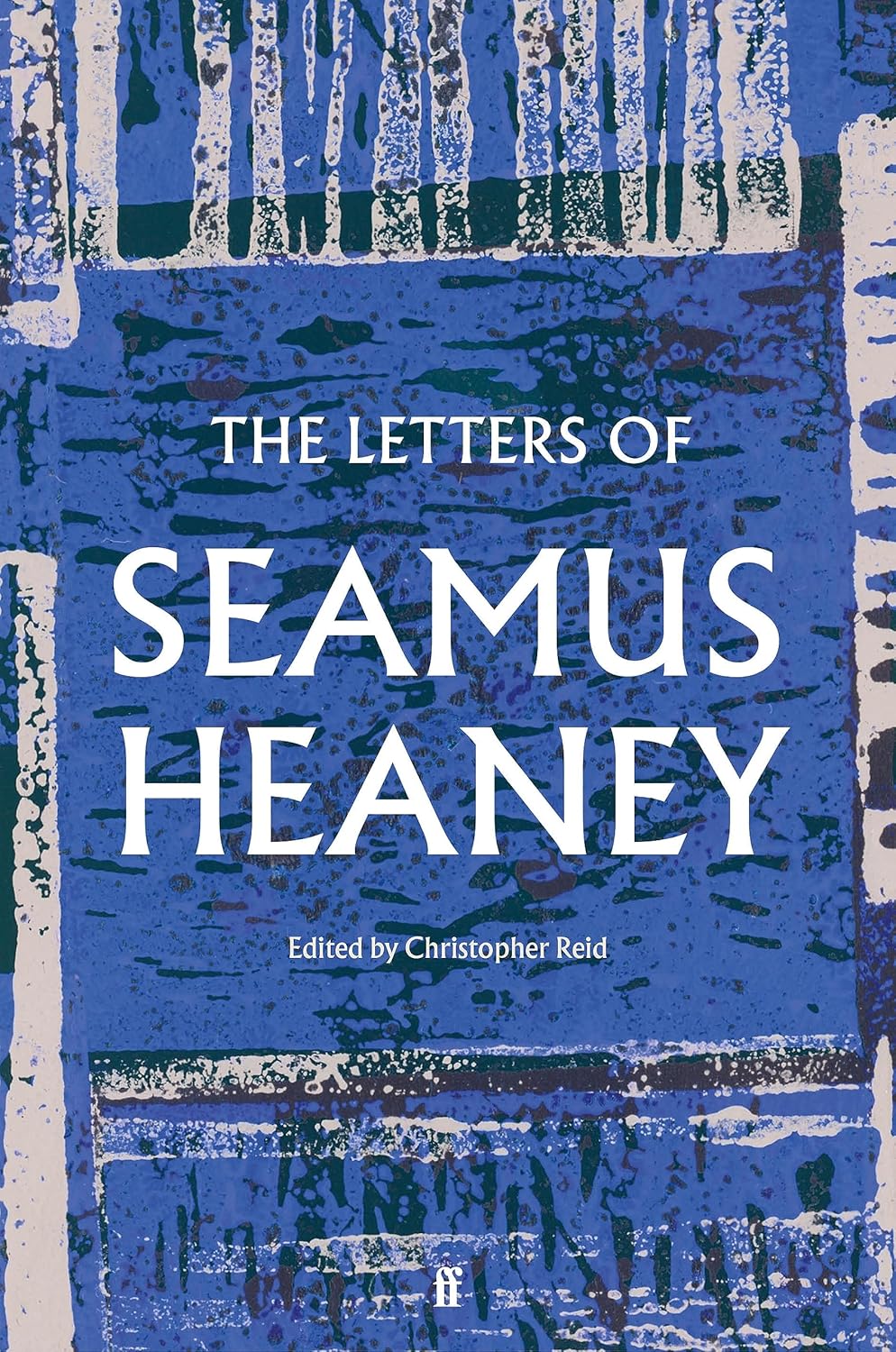
The Letters of Seamus Heaney edited by Christopher Reid. £20. Faber. ISBN: 9780571341092. Reviewed by Tim Miller
After decades of interviews and readings, the poet Seamus Heaney wrote to a friend offering this advice: “There is no reason, duty or sense in baring one’s soul to a journalist asking why.” The title “Famous Seamus” began to follow Heaney almost immediately after the publication of his first book, Death of a Naturalist, in 1966, and after his death in 2013 a moment of silence was observed by more than 80,000 fans before a football match in Dublin.
From the beginning Heaney was uncomfortable with his own success, and this unease casts a deep shadow over his newly-published letters. Born in 1939 in rural Northern Ireland, Heaney’s renown led him all over the world, from teaching stints in California and at Harvard, to hundreds of literary festivals and tours, as well as every award imaginable and culminating in the 1995 Nobel Prize in Literature. Reading his letters, though, I was struck by how Heaney’s response to his own prominence, and to changes in technology and the media, echo the anxieties and unease many of us feel today.
For example, when Heaney writes that “my heart usually sinks when I hear the thump of a heavy envelope on the hall floor,” I don’t think of a writer overwhelmed by more fan mail. What I think of is how all of us are tied to the ping of our phones, and how the demands of work and our response to the news have become unavoidable.
Poetry and literature could not have asked for a better ambassador than Heaney, who had a natural eloquence, easiness and good humor. As his letters bear out, he seems to have been as kind and generous as his public persona, and there appear to be no skeletons in his closet.
But there was, as he put it, “a mixture of guilt and responsibility” over the honors that were heaped on him, and he often wished in private that the awards and prizes could go to those poets “less gilded with ‘success.’” The endless invitations to appear and perform—even as they came with opportunities for travel, and guarantees of adulation—are always coupled in his letters with the wish to “escape from my status as Mascot.”
Coming to prominence as he did during the rise of television and, later, the internet, Heaney also worried about the status of literature in such a hurried age. Never in doubt about his own abilities as a poet, Heaney was nevertheless aware of the accidental nature of success. He was overwhelmed in the face of thousands of other writers who only wanted a blurb from him, and he felt powerless to be of much use in the face of the “the million books of useless poetry” that yearly sink into oblivion. He often seems bewildered that his poetry—a mix of autobiography on his rural upbringing, and a lifelong fascination with mythology, history, and archaeology—should have caught on at all, and he remained unwilling to let any chance at promoting the deep value of poetry pass him by.
Yet it all came with a cost. Many of his letters were written in transit, usually on the flight from Ireland to America, and he asked late in his life, “Why does it require a journey of six to eight hours, at a height of three to four miles above the earth, to get me writing letters to friends?” But often enough even these essential communications are delayed: “In the last two days,” he writes at one point, “I have written thirty-two letters—none of them a real letter, of course, but all of them a weight that was lying on my mind even as the accursed envelopes lay week by week on my desk. The trouble is, I have about thirty-two more to write.”
It is hard not to see ourselves in all of Heaney’s despair over never having the time to focus on meaningful things, or to ever escape the headlines of the day. Always called on to comment on the Troubles in Northern Ireland, his words following September 11 are echoed nowadays by everyone who feels obliged to “respond”: “feeling inadequate yet uneasy about marching into public grief. Feeling wrong in not making some kind of declaration, feeling there was nothing adequate for the declaring.”
Clearly enjoying the fact that people like President Bill Clinton would visit him in hospital, and nagged by the knowledge that most poets would do anything to be in his position, Heaney still repeatedly wished that he could retreat and simply find the time “to write to friends on personal and central and fragile matters.” For me, anyway, this is the central takeaway from his letters. As I neared the end of Heaney’s life, and as his responses to friends and strangers took on more and more of an auto-pilot tone (how could they not?), his desire to step off the treadmill and step away from the circus of commitments and demands becomes more and more pressing, and more and more impossible: “all I do nowadays is ‘turn up’—I’m a function of timetables, not an agent of my own being. And it’s going to be like this for weeks and months still.”
This is one reason why readers will not find the personal Seamus Heaney in this book. (And indeed, the misguided belief that this is possible is only the product of the pathological wish of poets like me.) In the end, Heaney’s letters are largely a record of someone who let himself “get into a life of hurry and podiums and senatorial pomps.”
Given these demands, it is even more remarkable that we have the poetry at all, and for my money the bits of Heaney that will last come from his 1975 collection, North, and the long sequence called “Squarings” from his 1991 book, Seeing Things. Here we can see the powerful, bardic and public (as opposed to merely academic) voice of the poet, handling history as well as his own past. At the same time, the unease that hovers over Heaney’s letters also imbues the hesitancy that runs through much of the rest of his poetry, as if he was unwilling or unable to risk and reveal too much.
The most moving letter comes from July of 1988. Responding to a writer planning a book on his work, Heaney was uncomfortable with its biographical focus and unnerved that the scholar had visited members of his family. He wrote of the “shock of intrusion” which the planned book caused him; writing specifically about a location mentioned in his poetry that was now embedded in scholarship about him, Heaney was horrified to imagine that a map, indicating how other scholars or fans could find the place, might be published.
“It is one of the most intimate and precious of the places I know on earth,” Heaney wrote, “one of the few places where I am not haunted or hounded by the ‘mask’ of S. H.” Heaney’s letters place him, then, in that unenviable company of celebrities that he no doubt never aspired to join. He is put in the position of anyone who has entered the public eye only to subsequently complain about the extent of that eye’s curiosity, and his own inability to control the voracious appetite of the very institutions that underlay his success.
Twenty years after writing this letter, Heaney was similarly ambivalent about the publication of what amounts to an autobiography, Stepping Stones. Essentially a book-length interview with the poet Dennis O’Driscoll, Heaney worried that the project was both self-indulgent and too prying (“I’m not at all a teller of my things”). At the same time, Heaney was well aware of the biographies of his favorite writers, and one perk of his fame was the ability to visit their graves and homes as often as he could, referring to such visits without irony as pilgrimages. As it happened, Heaney lived to see (as he put it) his home ground turned “into a stamping ground.”
Other than the text message to his wife sent just before he died, letters to his wife and children and family are not included here. It is also telling that that text message—Nol timere, Latin for Don’t be afraid—immediately became splashed on the sides of buildings, and has since taken on a life of its own. Nobody else could have given Virgil a viral moment, and Heaney’s last lesson to anyone who cares about art and culture is that poetry is meant to be lived with (and indeed died with) more than studied and annotated, and that powerful language is still here to help express what we mean by being alive. Whatever our differences are with an Irish writer who was, remarkably, able to crisscross the globe because of the success of his poetry, we can learn a great deal from his unease with how culture is disseminated, and how technology has made it immensely difficult for any of us to achieve privacy, or the kind of quiet that is unaware of the current headlines.
Reading Heaney’s letters, it was always a relief when I turned the page and discovered that Heaney and his wife were visiting fellow poet (and Nobel laureate) Derek Walcott, at Walcott’s Caribbean home on the island of St. Lucia. “Already I have drunk coconut water from a trepanned coconut,” Heaney writes during one visit, “shown my pale belly to the dismayed beach-persons, wobbled in the turquoise waters of the sea, drunk the habit-forming rum punch and generally slackened.” I wish he’d been able to do this more often, and that wish is always a reminder to myself to lay whatever book aside, to put my phone in the other room, and to refuse the (admittedly very few) invitations to appear.
Tim Miller‘s books include Bone Antler Stone, Notes from the Grid, and To the House of the Sun. His poetry has appeared in Crannog, Southword, Londongrip, The High Window, and others across the US and UK. He is online at wordandsilence.com, and can be heard on the poetry podcast Human Voices Wake Us.
*****
Beginnings Over and Over: Four New Poets from Ireland. Selected by Leeanne Quinn. €12.50. The Dedalus Press. ISBN: 978-1-915629-43-2. Reviewed by Colin Carberry

Dedalus Press, one of Ireland’s most historic and prestigious publishing houses, offers a Mentoring programme for emerging poets who were ‘born in or presently living in Ireland, and writing in English or translating existing poems of their own from other languages for English-language publication.’ The mechanism is as follows: during three ninety-minute online mentoring sessions four poets receive feedback on individual poems, suggestions for revision and advice for the shaping of a chapbook or first collection. This anthology showcases a selection of the work of Mai Ishikawa, Róisín Leggett Bohan, Emer Lyons, and Cal O’Reilly.
I will mix up the order of the poets, starting with Corkonian Róisín Leggett Bohan. One of the most technically skilled and accomplished of the four names represented here, with work previously published in The Irish Independent, Magma Poetry and Poetry Ireland Review and nominations for awards, Bohan is already an important poet in her own right, and doesn’t appear to need much mentoring (although her editor also deserves some credit here). Engaging, empathetic and cathartic, some of her themes are rooted in her work as a nurse, and there is a poignant undercurrent to her best poems, although shorn of special pleading or sentimentality:
EXIT MUSIC FOR A BOY
i.m. N.L.
Always you to shape a quiet exit
out back doors of parties
I’d watch you leave over
some slow-dancing shoulder.
Always you, me — best friends
coming off shift, splitting a greasy
breakfast, your drowsy mouth
grinning as you played with the biro
stuck in my night-duty hair.
Always you to be sidetracked: falling
from my window, your eyes averted
to tanned limbs of girls on the cricket pitch.
You broke your leg; I pushed you to the pub
and back for weeks — our tipsy-laughs tripping
potholes, the hospital stacks throwing us bad shapes.
Always you to conceal your leaving, slipping hushed — gone.
The silence slapped me like a siren, sometimes I hear you
laugh as I pass the recovery room.
The refrain ‘Always you’, repeated four times, is risky, but because the rest of the piece is well wrought and assured she gets away with it. The poem gives us a genuine sense of both the nature of the relationship between speaker and best friend, but also the type of person N.L. was. One quibble is placing the word ‘gone’ on its own at the end of the third-last line, preceded somewhat dramatically by a dash, when a lower key word might have worked better in order to convey the sense of discreetly leaving a party. I also found the line ‘The silence slapped me like a siren’ a tad jarring and blaring, when the idea of mute numbness might have been more appropriate. The ending is both apt and ironic: passing the recovery room, in which N.L. succumbed to death, the speaker imagines she hears her old friend’s distinctive laughter and is left saddened but also, somehow, renewed. Among my favourite poems are ‘Anticipation of Anaphylaxis’, ‘04 C 14598’—a powerful piece about the poet’s father (which incidentally was longlisted for the National Poetry Competition)—‘The Somnambulist of Sceilig Mhór’, ‘The Cryptographer’ and ‘His Coat’. Two or three of her poems made no lasting impression on me, but from the evidence overall Bohan has already produced the blueprint for a cracking debut collection.
Mai Ishikawa’s work is somewhat surreal—time, facts, reality, slip, slide, collide and collapse, as we are taken on wild rides that begin encouragingly but sometimes end in a somewhat awkward, inconclusive way. Writers should be wary when using words like ‘deep’, ‘dream’ ‘love’, etc, but throughout these poems we find almost stock phrases such as ‘the deep secret of pines’, ‘A trust so deep’, and the repetition of the word ‘recede’ (‘the girl recedes further’, ‘the salt water recedes’, ‘and names you knew receded’, with the same word used twice in the poem ‘Unfinished’). Then there’s ‘one by one’—deployed four times over two succesive poems—as well as the use of the word ‘dream’ throughout. I also wondered what to make of the poem ‘Bump-a-dump’ (‘Will I consume my womb, / the mushroom in my room? / Would I fly or would I cry? / Consume and make room.) When Ishikawa avoids rhyming verse she produces reasonably decent results, but perhaps three or four pieces could have been re-worked. The most accomplished poem among the fifteen on display here is the final one, ‘Our Dreams’:
Ten years ago, I was the fringe of skirt
dancing in the wind,
refusing to touch the ground.
Now I am in stillness.
Everything has receded like a tide,
baring broken buggies, old tyres,
skeleton bikes. I suspect
that the water was just a dream — which I miss
the way I miss oily chips
the perfume that had me wrong
the heels that bloodied my toes.
These are etched on my senses.
Like nostalgia. Like lies.
Birds walk on the sand and peck for prey;
their lives depend on
our dreams receding.
Emer Lyons is not wholly a novice to the Irish poetry scene, having already had poems published in Poetry Ireland Review, The Stinging Fly and Banshee, and this is evident in the quality and maturity of her verse. There is also a certain visionary quality to her work (‘tradition around here is a mass of memorabilia / of the unknown, of the remarkable — / wild wonders…’), which echoes in the mind long after reading. ‘Paraphrasing Visions’, one of the most fully achieved pieces in this sequence, owes something to the Aisling dream-poem tradition:
there was only one chance —
to break, to be broken, to be stronger
i didn’t know it then, that the end would come
much as imagined and i would be glad
climb aboard the middle of this night shift
tradition around here is a mass of memorabilia
of the unknown, of the remarkable —
wild wonders have bizarre tail feathers
mourners come
chanting about sacrifice
[i heard some-
times your voice
but you were
not there
just the debris
of a flashback]
The poem doesn’t immediately give up its meaning, but it is accessible nonetheless. And how about those final lines, so sparse and succinct, yet so suggestive. The ‘debris’ of a flashback—why debris? I don’t really know, but when I review my mental lexicon for other possibilities I find that somehow she has hit on the right word. Great care with word choice is evident throughout her other poems, and many of the poem-titles themselves (‘Paraphrasing Visions’, ‘Theoretical Archaeology’, ‘Elegy for God’s Own Country’ ‘Somebody Killed the Cat’) are intriguing and, well, ‘poetic’. But despite her deft and sure touch Lyons does not claim to know anything for sure, and it out of this spirit of ‘unknowingness’ that a number of her poems arise:
i shout all this through the window at you over the traffic noise:
just because i’m telling you the truth, doesn’t make it real.
(‘Theoretical Archaeology’)
But when she deals with grief, she renders emotion in a way that hits us where we live:
i can’t look directly at anything
that might hurt to remember
that we were once so close
we wanted our eyeballs to touch
(‘Somebody Killed the Cat’)
i’m afraid of the loneliness of poetry without you —
what if inside is more drizzle than rain?
there were days before when danger was a lake of cold water
and to think i was afraid of jumping in
your Dad’s not getting any better
people are always telling me things i already know
(‘Elegy for God’s Own Country’)
Cal O’Reilly, currently studying at Queen’s University Belfast, is a recipient of the Foyle Young Poets of the Year award, the Edna O’Brien Young Writers Bursary, the T.S. Eliot Prize Young Critics Scheme and the Freedom to Write project by the John Hewitt Society and PEN na hÉireann. The first two poems, ‘The Party’ and ‘Naming’, come at us with a breathless intensity that threatens to overwhelm us, but when he slows the pace down just a bit he pulls off some effective, original and disciplined poetry—such as ‘Portbou’, set in the hilly seaside Spanish town:
Hiking in a binder was a shit idea,
my lungs reach to surface, come short.
There’s a sweat mirage on the camera,
a baked red brick rubbed
on the back of my calves
A road you’d find in a motorbike advert
winds down to the sea, too far
below to hear. Cicadas sing
with their whole bodies, all-round
vision hidden in the scrub.
Just when I think I’ve gone wrong
daubs of paint show the trail
ascending still. I reach
the ridge. The sea is so blue
I want to show it to someone.
This poem pulsates with life. As the speaker climbs the steep road ahead of him, his ‘lungs reach to surface’, a ‘sweat mirage’ surrounds the camera lens, and ‘Cicadas sing / with their whole bodies’ (what a lovely, whole image), but he eventually reaches the ridge and all is well. However, in art as in life we don’t hit the sunny high points by accident: we must labor to be beautiful. There is a throwaway Cendrars-style jauntiness and haughtiness to the poem’s final lines, which is achieved without diminishing the complexity and discipline that came before.
‘he meets the criteria and will be referred to the endocrinologist’ is also a well constructed and intriguing poem, with just a touch of Auden’s ‘The Unknown Citizen’ about it. It contains some interesting autobiographical content and one wonders if O’Reilly’s motive for becoming a poet has its roots in the fact that ‘he was sad when. / he had a happy childhood’:
he doesn’t know if he knew at that stage.
he recalls being seven in the lashing rain, hurl-thud
through shin-guards grappling for the sliotar.
that doesn’t have to mean anything but it could.
we have mined his childhood for proof.
his mother recalls a daughter.
he was more outgoing as a child.
he was sad when.
he had a happy childhood.
I believe it is a wonderful idea for a publishing house to offer a mentoring program to younger, less experienced poets, in order to hone their skills with an eye to offering them a potential book deal—the literary equivalent of a football’s club’s Academy giving their young players the chance to break into the first team’s starting eleven—and editor Leeanne Quinn has done a fine job of selecting and curating the final product.
Colin Carberry is a Toronto-born Irish writer and translator now living in Linares, Mexico. His work has appeared in numerous journals, newspapers and anthologies worldwide (Poetry Ireland Review, Cyphers, Exile: The Literary Quarterly, The Irish Times, Reforma, Jailbreaks: 99 Canadian Sonnets, El Norte, and The Antigonish Review) and in three poetry collections, and his poems have been translated in many languages. His Selected Poems, Ghost Homeland (Scotus Press, Dublin), was translated into Bangla and published in Kolkata, India, in June 2024.
 The High Window