
*****
Imtiaz Dharker: Shadow Reader • Rhiannon Hooson: Goliat • Patrick Cotter: Quality Control in the Miracle Factory • John Murphy: Notes • Antony Johae: Foreign Forays, Poems of Travel in Europe and the Med • WayLeave Pamphlets: Lilith Speaks; Maria Isakova-Bennett: Subcutaneous; Rebecca Bilkau: Still Life • Louise Warren: Poison
*****
Shadow Reader by Imtiaz Dharker, £12.99 Bloodaxe Books. ISBN: 978-1-78037-709-4. Reviewed by Judith Taylor

The ‘Shadow Reader’ of Imtiaz Dharker’s title is a fortune-teller who, when she was twenty-five:
… licked his finger, flicked a page
xxxxand told me the year of my death.
xxxxxxxxThat year has arrived. (‘In the Year of My Death’)
From this, the opening poem, Dharker embarks on a looping, exploratory journey which is both an oblique autobiography and an examination of the state of the world in what was foretold to be her last year in it.
The fairly plain style of these poems and their informal, often conversational tone, serve to draw the reader gently in among the dazzling range and variety of imagery and reference Dharker explores, from art to daily life, from mythology to the internet, from history to its present-day reverberations. The collection is formed of succeeding brief series of connected poems, miniature sequences almost, but with broader interconnections all through, and periodic returns to tell us more about the Shadow Reader and his prophecy.
In a review I can’t do more than touch on some of the aspects of the journey Dharker takes us on. In some ways it is almost like a flicker-book, a succession of contrasted and related fragments: from the traditional weavers who:
xxxxxxxxxxxxxxxxxxxxxxxxxxxxxare weaving
their times in thread, teaching the loom
the way of the world…..
xxxxxxxxxxxxxxxxxxxxxxxxxxxxxSongbirds turn
into bombers, gazelles to armoured tanks … (‘Loom’)
to the sweatshop worker who has escaped, but only so far:
It doesn’t buy a lock on the door.
It doesn’t buy a life-jacket (‘What you can buy with a bangle’)
or the disappeared person who ‘has gone to learn a new script’ while the book she buried in the garden sprouts its truth (‘However’)
She examines, too, the sources of this knowledge. There are some traditional ekphrastic poems, and also poems that show us glimpses in ‘the light of a phone / falling on the face of a witness’ (‘Witness’), cities viewed from drones whose purpose we are left to guess, ambiguous video footage of a woman lying, possibly dead, on a station platform (‘On mute’)
Colonialism and its legacy are constantly present in this interlinked world. One poem looks at a Zoffany, Colonel Blair and his Family and an Indian Ayah, in which the painter ‘gives them / a noble version of themselves to take back home / and hang above a marble fireplace’, but Dharker’s upfront reaction is:
Not an ayah, you want to say, a child.
and she draws out the assumptions and self-justifications of Empire:
xxxxxxxxxxxxxxxxxxxxxxxxxxxx… They think of themselves as kind
masters. She has been given a cat to hold.
On the wall is a landscape with elephant
and scenes of savage customs
…. This
will be a conversation piece in Perthshire. (‘The Show’)
Dharker adds her own illustrations to some of these poems and this one is particularly pointed, with the Blairs greyed out and only the girl and cat in focus.
In ‘Pink’ she looks more directly at the British empire, with an arresting and deflating metaphor:
The Truth had a pink skin like a child’s balloon
at a birthday party, and everyone had to sing
Happy Birthday and God Save the King.
This went on quite a long time, the singing
the skin stretching, stretching over the truth
till you could see right through
to its nothing.
And she is alert to how divisions and injustices persist when the empire is gone. Returning to the ayah in ‘Did anyone say what happened to the girl?’ she answers her own question:
She is still here, is a lavish room
in her own country.
She is still the ayah, only the masters
are new.
Threaded through these are poems from Dharker’s own experiences of migration and displacement: the child who imagines answering ‘go back where you came from’ with Glasgow invective – ‘Go back / to yer cave and bile yer heid, ye dolly walloper‘ (‘Back’); the poet who is inspired by Blake and (a little against her better judgement) Larkin, as well Faiz-Uncle; the woman who walks through London at night, imagining the forgotten people:
where they lived and when
they moved, what they ate, the hunger
they endured, the plagues that came and went
and came again. (‘Night Walk with Ghosts, Smithfield’)
and whose lifetime of being ‘questioned / at every border, stopped and searched … called exotic, / hysterical, hormonal, foreign, neurotic’ (‘What it grows into’) has her trawling the Internet for a weapon of self-defence, only to relegate it to the wardrobe: ‘still bubble-wrapped, / next to the wellies’.
And in ‘For the Minicab Driver Who Looked as if He Needed Feeding’ she dramatises how her own assumptions about community based on shared ethnicity:
Before I can stop them, the words
fall out of my mouth, And where
are you from… I mean,
your people?
fall into the gulf of class and money between her and the driver:
He looks back for one second
and his face is a passport
and his back is a flag
and he says, Barnsley,
and I pay, and get out.
Towards the end of the collection she considers her digital legacy: ‘The horror of it … the ignominy’ (‘Writing the Will’). The sequence this kicks off, satirising the shallows of social media, is the only part of the collection I found a little unsatisfying. Maybe it follows too closely on the intense and meditative ‘Night Walks’; maybe I just get enough of characters like Bunny and Bobby and Bubbles elsewhere. But as the collection moves to its close, Dharker again pulls the focus nearer to home, to a woman returned from long travels, putting her life in order, and reckoning with the aftermath of that long-ago prophecy – the paradoxical freedom it gave her:
There was no way I could die
at thirty-five or forty-five. I crossed murderous roads,
ran red lights in rickshaws, took flights
in turbulent skies
but that she is now leaving behind:
I try to read the names of the ones who are dying
when it should have been me
but all I can see is the name of the earth, right here
written over and over in the dying year. (‘But the radiance’)
She ends, though, in defiance:
If I can hear the iamb of my heart I’m not dead
xxxyet. My walk is a sonnet.
xxxxxxMy walk is Ma Sha Allah.
xxxxxxxxxMy walk is Fuck you, Shadow Reader. (‘I Walk in the Shadow’)
This is a rich collection, and a reader whose culture is narrower than the poet’s will need the help of a search engine in places – I recognised Duleep Singh, for example, but I had to look up Faiz Ahmad Faiz, and I’m sure there are nuances I missed altogether on a first reading. But I think the decision not to footnote was the right one: the apparatus needed would be distractingly dense, and a book like this, into which a poet has poured so much experience and thought, will always demand that a reader pause, consider the new windows it has opened to them, and return to read again. Though the tone is anything but didactic, there is a lot to learn here, and to savour.
Judith Taylor lives in Aberdeen, where she co-organises the monthly ‘Poetry at Books and Beans’ events. Her latest collection, Across Your Careful Garden, is published by Red Squirrel Press. She is a longtime volunteer with Pushing Out the Boat magazine, and one of the Editors of Poetry Scotland.
*****
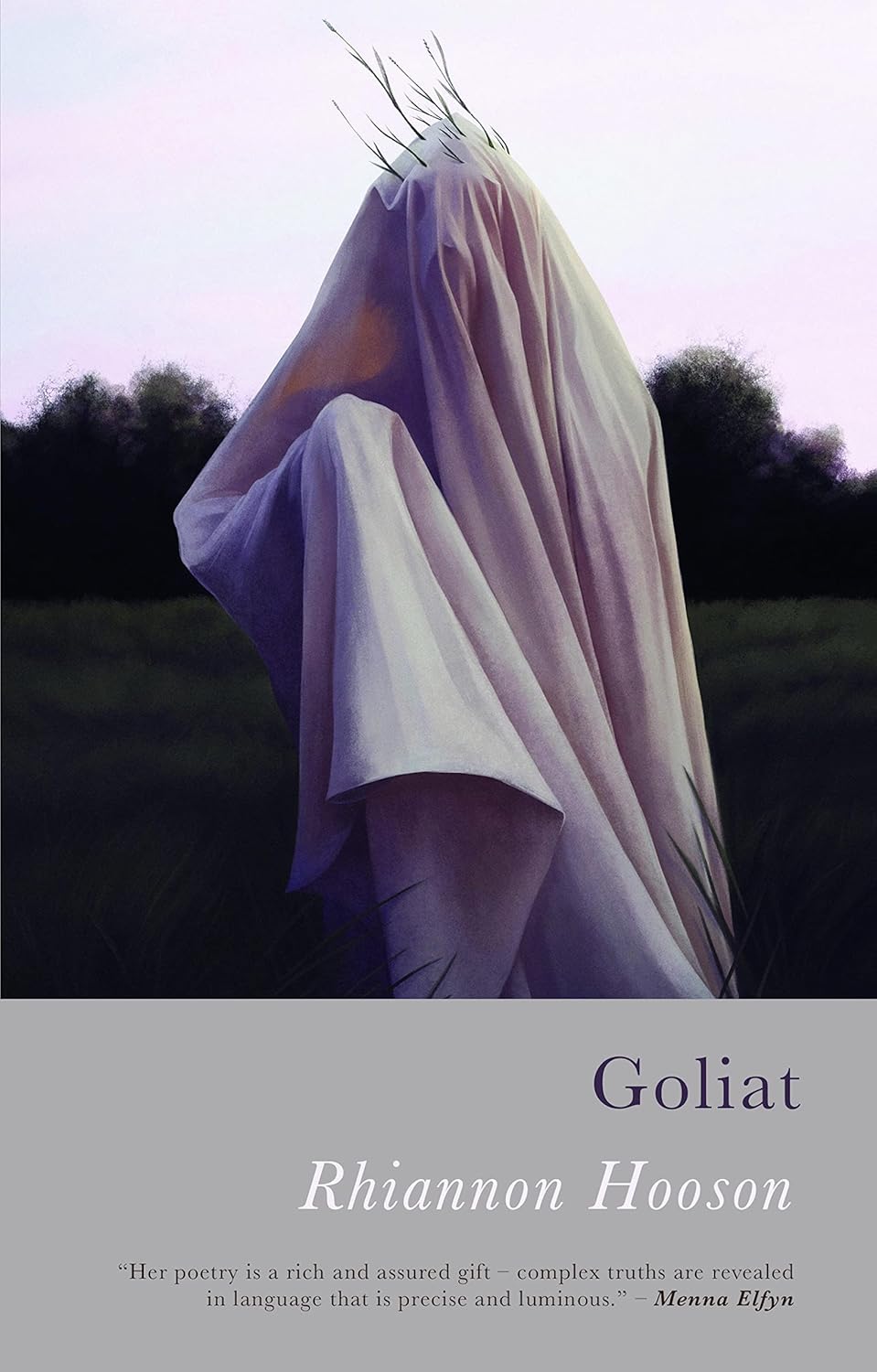
Goliat by Rhiannon Hooson. £9.99 Seren 2022 ISBN 978178172 6563. Reviewed by Patrick Lodge
The American poet, Sharon Olds, once described her approach to putting together a collection, noting that, when “I see that I have a lot of poems around a subject, I start to put a book together”. The issue of ‘theme’ in poetry collections has initiated a considerable amount of discussion as to whether it is in any way important. Sophia Blackwell, poet and editor of ‘The Poetry Writers’ Handbook’, suggests there is no real need for a theme just a sense of cohesion though outlier poems of quality should be entirely acceptable. Jane Commane, of the excellent Nine Arches Press, has talked about a sort of cumulative ‘ripple effect’ pervading a collection.
It may be more helpful to see some unity less in terms of theme and more in terms of a poet’s predicaments – the things that bother them and demand writing about – as generating the poems and a subsequent collection. Unlike novels, where one can broadly expect that, in most cases, narrative and an organisation into chapters will propel a book forward, poetry collections seem different insofar as their contents – the individual poems – while ordered in a particular way, each require an intense and singular attention however much they form a unity of some sort.
The intriguing collection Goliat is Rhiannon Hooson’s second after the admirable The Other City, has no overarching theme that links the poems – though the poems are sparked very much by Hooson’s “predicaments” which do give coherence – and therein lies the grace and power of a diverse, sinuous and mysterious poetry. Denise Levertov argued that the best test for a good poem is whether it is possible to paraphrase it – the best is simply unparaphrasable and in ‘Goliat’ here are ‘good’ poems with each demanding engagement on its own terms and resolutely resisting précis. Even the title – which, if the title poem is a guide, probably links to whales and oil fields in the North Sea rather than the first artificial Romanian satellite or projects measuring health effects of wireless technologies – offers little in terms of a lighthouse guiding those adrift except a contentment to go with the flow. But it really doesn’t matter because Hooson is in total control of her poetry and is quite happy to surprise and tease. There is a magic and mystery to this book which always seems deliberately to stand a step away from easy categorisation and is so much the better for it.
One of Hooson’s ‘predicaments’ is the potential for environmental disaster that has only got greater since this collection was published. ‘Doggerland’ is a gentle but achingly sad lament for the migratory white-fronted goose which the RSPB added to its endangered red list. The closing stanza acts as a wider, salutary warning: ‘The shadow of a wing / on the rind of the water / and then nothing’. Hooson delights in the natural world – ‘a gentle haunted world’ (‘You and I are ghosts of the future’s forest’) – and its creatures though never in a sentimental way; simply we are grounded as part of the natural world (and the natural world is part of us). Swans litter the fields ‘like torn papers’ (‘Outliers’), whales, perhaps themselves despairing, deny the ‘lamp-eyed blink of the deep sea mermaid’ in favour of the ‘singular infinities of the wintering sea’ and the ‘urge / / to aim ourselves / like arrows in the warming water / and beach’ (‘Goliat’).
Pervading all is a sense of loss, of regret that things could not have been different. The marvellous ‘ ‘What was Left in the Orchard’ offers a sensuous list of varieties of fruit; not harvested owing to another human intervention, Brexit, and now forming ‘A rubble / of apples cobbling the red earth’. ‘The Tangible World’ laments -‘We are strangers here.’ – the taking for granted of this world but more powerfully, the commodification of it. It’s not that we don’t still appreciate things but that they have become ‘slick / to our grip, and we slide across hours / like oiled metal.’ A life lived has reduced to pictures we take and social media ‘feeds’ that create only ‘glorious solitude’. In desperation perhaps, “Like God, we codify the tangible world / into proof of our own existence’ and it is a stunted existence though Hooson’s ability to capture an image with delicacy sometimes beautifies it. She appreciates ‘the way silence settles / across a wet morning and the roe deer / raise their heads’ though threat is ever present, ‘Where once we walked water rises. / You and I are ghosts in the future’s forest’ and the wolves may be running. It is often said that climate activism aims to save the planet but the reality is that humans are the things that need saving – the planet will roll on, changed and denuded, but still there without humans. Hooson hints at as much: ‘Again and again the sun sets, swings / under the earth’s belly, lifts a work edge / of clouds come morning’. (‘You and I are ghosts of the future’s forest’).
It would do a great disservice to Hooson to imply that her subject matter is simply the natural world. Her imagination is very active and wide-ranging and her poetic craft is well able to encompass the most disparate of subjects; holidaying with a character from Game of Thrones, exploring Romanian marriage traditions, examining Typhoid Mary’s role in spreading disease and death and the problems of looking after a roll call of monsters. If the question is asked of Hooson, well what can poetry be about, her answer in this collection is absolutely anything. Always though there is the remorseless inspiration at work creating poetry that is on the edge of meaning but which draws the reader into the subject matter, gently but inevitably, with its stunning, sustained imagery and descriptive power. She sits between the mythic and the mundane and documents the interrelationships carefully. ‘Concerning the Care of Monsters’ is a unrelenting, magical tale where the narrator feeds and cares for a range of mythic and real creatures/monsters from mermaids to zombies, fairies to three-headed dogs. At base the poem asks the question what do we actually know about who and where we are and with whom we share this space – and more chillingly, they come to be fed at the moment but what if…? Hooson has the uncertain mentality of an inhabitant of the borders between places – perhaps the Welsh Marcher lands with which she is associated and the Welsh folklore traditions (see ‘Horse Skull Crown’ with its nod to the Welsh wassailing tradition of the Mari Lwyd) have given a sense of contingency.
‘Stag Boy’, which takes its inspiration from a painting by the Welsh artist Clive Hicks-Jenkins from his ‘Beastie Boy’ series, is archetypal Hooson with its appreciation of difference, of complexities of being and of ambiguous dividing lines. It also has the hallmarks of an imaginative leap from a real meeting. A café encounter with a veteran – whose state of mind is economically and enigmatically captured as he ‘comes with a letter folded and folded again / and the pockets of his jacket are full of coins / and coloured wrappers and half-smoked / cigarettes.’ – leads to him sleeping in the café but any threat remains potential only, ‘but the stairs don’t creak / and no door rattles’. There are hints here of the interface between Man and Beast, the interface of animal and human that seems to intrigue Hooson – stag boy in the scrubland at the back of the café, in an homage to the Hicks-Jenkins painting ‘looks regal there / in his brocade, his crown of tangled antlers’.
This collection is driven by inventiveness and surprise – ‘Something came to shore’(‘Sea Change’) and the reader is never quite sure where that shore is or what indeed is on the beach. Hooson is not afraid of her poetry and her craft and verbal dexterity constantly shine through. She is not afraid to experiment either; halfway through the book is a long sequence of poems, ‘Full Moon on Fish Street’, which is an intriguing fictional narrative which, to use Hooson’s description, are ‘blackout poems which use as their source material words from a single page each of The Waves or To The Lighthouse by Virginia Woolf’. Or take ‘Dirtwife’, a sequence which takes its starting point flowers and fruits and their role in dyes; a sequence which clearly demonstrates Hooson’s sheer delight in language and the sound of words.
This is a collection of the first order and will repay reading and re-reading. The poems dance and shimmer and are full of movement and vitality. ‘Southiou’ is a moving elegy to the photographer, Khadija Saye, who was killed in the Grenfell fire. Saye once wrote that “we exist in the marriage of physical and spiritual remembrance” which could be a description of where Hooson’s poetry lies. She writes, in lines that might describe her writing, that ‘I dashed my shadow out ahead / like a woman throwing water from a bucket’ (‘Then when you have turned again towards the north’). It’s a pleasure to stand in the way and get soaked through by these exquisite poems.
Patrick Lodge is an Irish citizen with family roots in Wales. His work has been published in several countries and he has read, by invitation, at poetry festivals across Europe. Patrick has been successful in several international poetry competitions and reviews for several poetry magazines. He is currently working alongside the Time and Tide Bell project on a long poetry sequence. Three collections, An Anniversary of Flight, Shenanigans and Remarkable Occurrences were published by Valley Press, UK. His fourth collection, entitled There You Are, is due for publication in late 2025.
*****
Quality Control in the Miracle Factory by Patrick Cotter. £13.50. Dedalus Press Press. ISBN: 978-1-915629-41-8. Reviewed by Colin Carberry

Before I had even gotten my reviewer’s hat on, I scanned the index of the PDF of a book of poems that Pat Boran, editor of Dedalus Press, had just emailed me, in order to get a flavour of Corkonian poet Patrick Cotter. I liked the sound of the final poem in Section I, ‘Elegy for a Corkwoman Who Died in Winter’, so I read that one—and was moved to tears:
Forty-year-old waif, wife to the roofless
streets you perished on. My glancing face
as familiar and regular to you as cutting
winds. I was one who gave without ever
giving enough, clawing in the crannies
of my jeans for coins and fluff, silvery
and brassy tokens with the value of old
coppers, poor exchange for your smiles
and thanks. Vanessa, you had a ten-dollar
name living thruppeny bit days. You knew
our gaits, you listened for our tinkling hands
but never knew the inside of our heated homes.
Small comfort now to you the fires of cremation,
our tepid tears as the flesh drifts off your bones
like smoke, when all along your skin deserved
to be lit by pearls, unctioned by L’Oréal and Chanel.
Why had this poem about a woman I had never met by a poet whose work I hadn’t read affected me so powerfully? Well, the word ‘waif’ in the opening line suggests a small girl essentially defenseless against life’s injustices and cruelty, someone who doesn’t have the wherewithal to cope with what is happening to her, while the rest of the line / first word of the second line—‘wife to the roofless / streets’—echoes the ending of Douglas Dunn’s poem ‘Anniversaries’: ‘Sweet soul in the athletic rain / And wife now to the weather.’). She is one of hundreds of thousands of anonymous homeless people scattered across the globe—a human being who once had a roof, a family, and hopes and dreams, but was reduced to relying on the mercy of strangers, such as the poem’s speaker, who describes himself as ‘…one who gave without ever / giving enough, clawing in the crannies / of my jeans for coins and fluff, silvery / and brassy tokens…’ It isn’t until the ninth line of the poem that we move from the universal to the particular and the poet reveals the woman’s name: Vanessa. This is when the speaker begins to realize that he, too, has suffered a loss. Sure, he helped the lady with small amounts of money, and the odd bit of food, a coffee, perhaps, but now he recalls with a sharp pang of guilt that Vanessa ‘never knew the inside of our heated homes.’ The linkage between ‘our heated homes’ and ‘the fires of cremation’ in the following line is both ironic and unsettling. Vanessa may have died from exposure, but in the final analysis she was a victim of ‘the Dollar Shitstem’, in dub poet Linton Kwezi Johnson’s phrase. The poem’s poignant final lines—‘…along your skin deserved / to be lit by pearls, unctioned by L’Oréal and Chanel’—is (as Cotter explained to me in a brief email exchange) the poet’s way of ‘telling the elite in society that she deserved to be as treasured/spoilt as they are.’
When Cotter turns his attention to the wider world the pages begin to ooze blood wrung from the straight-up savagery of modern conflict. The book’s second section, ‘Songs in a Time of War’, represents a catalogue of and a detailed commentary on the horrors of some of this and the previous century’s wars (World War II, Ukraine), war crimes (the dropping of a nuclear bomb on Nagasaki), and genocides (Gaza). Cotter is less “politically engaged” than politically informed. (Is there anything more nauseating than virtue-signalling Western poets or academics speaking truth to power from their ‘hotbeds of rest’—to quote Kildare Dobbs—in Toronto, Washington or Dublin?) Cotter’s sympathies lie with the innocents of history, not the belligerents.
Nor does he avert his gaze when some of the ‘good guys’ happen to bear Irish surnames. Despite their own past as victims of ferocious colonial oppression, the Irish or their descendents have participated in some of history’s most heinous war crimes. In ‘Angels over Nagasaki’, for example, Cotter compares Charles Sweeney, a U.S. Air Force officer and pilot who dropped the ‘Fat Man’ atomic bomb on Nagasaki on 9 August 1945, to the semi-mythical Irish king Sweeney who was cursed by Saint Ronan and driven out of his wits: ‘A mad Sweeney with no need for a yew tree / to hoist him into darkness, to help him incinerate / innocents for his God-trusting Protestant / republic.’ Nagasaki was the most Christian (Catholic) of Japanese cities. In one of the poem’s epigrams, Shomei Tomatsu reflects on the irony of Japanese Christians being targeted by a Christian polity: ‘Although the majority of Americans may be Protestants, they are still Christians, which means that both the assailants and victims pray to the same God.’ However, several of the crew members of the plane were ‘Tadhgs’—a pejorative term used by Northern Irish Unionists to refer to local (Irish) Catholics—so Japanese Catholics were nuclear-bombed by a pan-Christian coalition. Ironically, this vengeance which U.S. leaders initially considered to be both a form of divine justice and a means of preventing greater bloodshed eerily mirrors Oliver Cromwell’s belief that his army’s ethnic cleansing of Ireland from 1649–1653 (long before a Bosnian Serb warlord invented the term) amounted to “the righteous Judgement of God upon these Barbarous wretches…and that it will tend to prevent the effusion of blood for the future”:
…a left cheek all that remained
after the Protestant Republic’s merciless
flypast, picaroon-crewed half by Tadhgs,
a Gallagher as well as Sweeney. One angel
was lifted as a trophy, like a Byzantine lion
pillaged by Venetian louts, contrabanded
to Chicago. After forty years of fermenting
remorse, Gallagher dispatched her back,
all five compact kilograms of her,
with a Jesuit for a guardian and apologist.
And when Cotter focuses his gaze on the Israeli-Palestinian ‘conflict’, rather than immerse himself in hot water, he adopts a middle path, exploring the suffering of innocents on both sides rather than the acts of the combatants. In i Who Needs A Burning Bush? of ‘Levant Diptych’ he expresses solidarity with Palestinians living under brutal Israeli occupation and collective punishment (…as their trimmings / fall to the floor, they spell out the name / of the latest child to be bulldozed homeless, / not far enough from Nazareth’), while in ii October 2023 he sympathizes with the plight of Israeli innocents killed or captured by Hamas militants: ‘crunching in the dark, / Gaza’s last apple for miles has been put in the mouth / of a child hostage to keep her from screaming.’ Eternally driven by the unholy trinity of sectarianism, hyper capitalism, and ethno-supremacism, everywhere is, and always will be, war.
Almost half the poems in the book are written about, or in the skins of, dogs, horses, donkeys, pigs, goats, crows, snails, moths. In the section titled ‘Woe Menagerie’ we find one of the best poems in the book, ‘The Pig Factory’. Cotter loves nature and animals—but not so much his own species, one suspects. It’s not that animals don’t fight and kill each other, over mates or resources, say, or even engage in occasional bouts of organized warfare: what differentiates us from the other animals is our insatiable greed. For Cotter, a pig factory represents in miniature the efficient Capitalistic savagery of the human animal:
Among the honking, snorting throng, some child’s
pet – a banbh, bottled-reared and brow-stroked
whose widening grin and happy waddle
were cuddled until the day came to be prodded
into pork…
I was almost physically sick reading the following lines, which inevitably conjured images and sounds of Death Camps in my mind: ‘…There, a line of clattering / hooves whose honks turned to the squeals / of rusty hinges, hundreds in a chorus. / And the squeals turned to screeches of terror / and the screeches turned to screams of excruciation.’
Some of the poems I could take or leave, but even those ones that didn’t particularly appeal to me, in terms of the content matter, the description, internal rhyme, and word-choice are superb. Take the following poem, for example. I don’t really care how things look from the perspective of miniscule creatures living in terror of snails, but the end result is entertaining and edifying (and one of the poet’s functions is to show us new prisms through which to see our world):
Whorley snail, terrifier in its botanical realm,
ravager of leaves with its shearing jellied
mouth. Its shell protects only against shrivelling
desiccation in a drought. It scabs a snotty screen
across its home’s gaping door. A shrew’s milk teeth
could crush the crisp of its armour. As a baby, poised
on a daffodil stalk, it is a mobile brown globule
slowly pouring itself, a muddy raindrop, an uphill-drip.
Sometimes slow enough to appear still, like an inedible
stone or flake of wind-dropped bark to a cloud-high
crow. For all its ponderous existence it extols no
philosophies, but provokes thought in others, not least
tulips who rasp at one another through their roots
at times of ooze and prowl, after dews and wind howl.
The mastery of the thing. ‘Snail Notes’ is textbook stuff, as good a poem as you are likely to find anywhere; in fact, after umpteen readings I almost have it off by heart.
Filled with closely observed, constantly arresting and truly original and powerful images and themes, the poems in Quality Control in the Miracle Factory are of an unusually high caliber, such as one seldom finds. And, unlike much of today’s verse, they make you feel as well as think.
Colin Carberry was born in Toronto and spent his childhood in Lanesboro, Co. Longford, Ireland. He now lives in Mexico with his wife and two daughters. He is the author of four poetry collections, including Ghost Homeland: Selected Poems (2020), and is the translator of Love Poems by Jaime Sabines (Biblioasis, 2011), along with two earlier volumes of Sabines’s verse. His poems have appeared in anthologies, journals and newspapers worldwide, and have been translated into many languages.
*****
Notes by John Murphy. £10.00. The Lake Books. ISBN: 978-1-0369-1124-9. Reviewed by Charles Rammelkamp

John Murphy’s new collection deals with a surprisingly eclectic mix of mid-twentieth century music legends, American and British. Notes includes over two dozen paeans to some of the great blues, jazz and rock artists of the second half of the twentieth century. Coming from the same generation as Murphy, I found them particularly satisfying, though I grew up in America and he in the UK. Indeed, that shift in perspective makes the topic even more appealing, coming from a fresh angle.
The selection may seem haphazard – not a single Rolling Stone in the bunch – and in his introductory remarks, Murphy acknowledges there “is no solid rationale” for his choices. Indeed, the subjects of his poems were “chosen for varying personal reasons.” But that’s the best kind of rationale, isn’t it? Go to Wikipedia if you want an encyclopedic list of influential musicians and an objective account of their accomplishments. These poems are personal, the experience they capture genuine. Take the very first one, “Blossom Dearie.” Not necessarily a household name, Dearie was an American jazz singer who collaborated Miles Davis, Johnny Mercer and others. She was distinguished by her high girlish voice. Murphy writes:
Her voice was pink
and blew rainbow
streaked bubbles
that popped
like a marshmallow
bounce on the ears.
You can hear the effect her voice had on Murphy as a post-war British teenager, “the songs and notes / coloured by that pink voice.”
In the main, the poems are written from Murphy’s point-of-view, in his own voice, but one, “Bob Harris,” is in the voice of its subject, “Whispering Bob,” a BBC radio music host, once parodied by Eric Idle. “My name is Bob Harris,” Murphy begins, and the poem ends spotlighting his voice:
I hope it brings music
close to you, as close as I feel
to that universal rhythm
that moves us all.
I’m a DJ.
I’ve done my bit for music.
The radio personalities were a huge part of the popular music culture of the 1960s and throughout the rest of the century. In America, Dick Biondi at WLS in Chicago was the first American DJ to play a Beatles record on the radio. Wolfman Jack on KDAY and WNBC was another radio legend.
John Lennon, Paul McCartney (“Blackbird”) and George Martin – the “fifth Beatle” – all have poems in their honor in Notes, as do noted American musicians like Bob Dylan (“The voice grates into our ears. / The words speak a sweetness…”), Brian Wilson of the Beach Boys, Buddy Holly (“the devil’s music with three chords, / defiance and the invincibility of youth.”) and Elvis Presley.
What does a British kid make of the Americans? Murphy’s Jimi Hendrix poem, about his rendition of “The Star-Spangled Banner” at Woodstock, gives us a clear idea.
He leans into the notes, pushes the strings
into screaming jets, the tat tat tat of death,
whistling shells slamming into ears.
In a muddy field on a Monday morning…
Later in the poem Murphy spells it out more explicitly in reference to the “conscience of a nation”:
Jimi came a long way from Robert Johnson.
But his notes connect with injustice
through the ages, from black folks
toiling in the cotton fields to the
napalm-soaked rice fields in Asia.
In addition to the rock stars themselves, Murphy highlights people like Sam Phillips, the Memphis, Tennessee, record producer (“the man who invented / rock and roll”) who brought us Elvis Presley, Jerry Lee Lewis, Carl Perkins and Johnny Cash. There’s also a poem about Phil Spector, the record producer and songwriter who worked with everybody from the Ronettes, the Beatles and Ike and Tina Turner to Leonard Cohen, the Rolling Stones and the Four Tops. He was later convicted of murder and died in prison.
One musician that Murphy highlights who had escaped my attention as teenager is Cyril Davies, “one of the pioneers of British R&B,” as Murphy explains in a note, and in the poem he describes
his harp like a train full of notes,
rocking through Chicago,
calling to the best of British
blues and small club gigs,
pushing the blues into focus.
Later in the poem, Murphy writes that Davies’ mojo came from Chicago
to a small club in Ealing.
He blew through the pain.
Chicago calling to him, to close
his eyes, harp to mic
and blow the dust off the blues.
Having contracted Pleurisy the previous year, Murphy explains in his notes, Davies died in 1964, barely thirty years old.
The title of the collection obviously alludes to music, but a second section to the book contains Murphy’s notes on ten of the subjects of the poems, from Peter Green and Chuck Berry to Roy Rogers, Sam Phillips and Robert Johnson. Murphy extols the movie, Jazz on a Summers Day, a film about the 1958 Newport Jazz Festival, in his note about Anita O’Day (“arms akimbo, spread / to gather the music”). In his note about Jack Bruce, bass player for the legendary band Cream, which also included Eric Clapton and Ginger Baker, Murphy describes how Bruce’s iconic riff for “Sunshine of Your Love” is a tribute to Jimi Hendrix. He recounts an amusing story about encountering Bruce and Baker at the Rikki Tikk club in the Thames Hotel in Windsor. Murphy and his pals considered approaching them but thought better of it, sensing “they wanted to prepare themselves for the gig. Ginger Baker would probably have told us to piss off.”
Though not mawkish in the least, Notes expresses a satisfying nostalgia for a bygone era, at least for this septuagenarian rock and roller. Coming from Murphy’s perspective, the poems have an authenticity that captures that magical era in music.
Charles Rammelkamp is Prose Editor for BrickHouse Books in Baltimore. His poetry collection, A Magician Among the Spirits, poems about Harry Houdini, is a 2022 Blue Light Press Poetry winner. A collection of poems and flash called See What I Mean? was recently published by Kelsay Books, and another collection of persona poems and dramatic monologues involving burlesque stars, The Trapeze of Your Flesh, was recently published by BlazeVOX Books.
*****
Foreign Forays – Poems of Travel in Europe and the Med by Antony Johae. £9.00. Mica Press. 9781869848392. Reviewed by Peter Ualrig Kennedy
Foreign Forays is Antony Johae’s fifth publication – a slim but satisfying collection of poems of travel, which reflect and illustrate Johae’s lifetime of journeys to foreign parts. As a young man, after leaving college, Johae packed his bags and, in his own words, “launched out on inspired travel to Europe and beyond.” Inspired indeed, as his experience of cities and villages abroad, and the journeys themselves, have engendered an array of poetic tributes and memories, all in Johae’s own individual and recognisable style.
The opening poem in the pamphlet, ‘My First Bike’, harks back to schooldays in peaceful Henley-on-Thames, musing on the interruption of his bike ride by an altercation with some bigger lads and leads on to young Antony making for the station: “Then, from the platform, I’ll see the London trains roar by.” Even then he was drawn to London and to the grand possibilities of travel further and further on. The poem “… reflects this incipient Wanderlust.”
Antony Johae’s recollection moves on to a reminiscence of a time of being ill in bed in Colchester. ‘Staring through my Window in Winter’:
There’s a tree with ivy coiling up;
from my sick-bed it seems like a slow strangulation;
Through the top pane of the window he sees the plain blue sky of Essex, and his thoughts soar upwards:
I think of home passages looking down at the Blackwater,
the sight of the islands – Mersea, Osea, and Ray –
estuary and withied creeks, sanctuaries and purple saltings,
Already the poet’s mind is “full of flights – those taken to far places” and so takes us to the coda:
I get up to draw the warm curtains,
see my case, lid open, beckoning me to pack.
By the time he does get going, he is off to Bruges where “It was grey autumn on Flanders’ flats;” and it seems rather dull in Bruges. The poem’s affect is itself fairly flat, as he wanders “lonely in a drizzle with the crowd,” but then comes a cheering vision:
The rain easing, I saw them as I turned a canal corner,
four musicians on a platform ready to play –
and when they started, the clouds seemed to separate
to the rhythm of their raggy waltz
Could they have been the Dave Brubeck Quartet, or four Brubeck avatars? Whichever they were, “the city took on its lost colour” with their music. And what of Johae’s style? As he progresses through Europe his viewpoint is that of the interested observer, certainly not detached, as he finds himself involved – and his inner eye is taking part in his adventures.
On the train I see myself in the glass
get up from my second-class seat
brush aside my finished glass
draw up to her, dark-haired Argentinian,
hold her hard around the waist
and to plucked notes and piano chords
accordion blasts and sweeping strings
set off in supple dance.
The poet permits himself to dream, but in the poem ‘Refugee at Calais’ where he and wife and daughter are stopping at a municipal camp site, he comes across harsh reality.
As I went back to the comfort of my bunk
I thought of him returning to the camp they called La Jungle
– to a half-shelter of plastic, pumped water, squalid washing and despair –
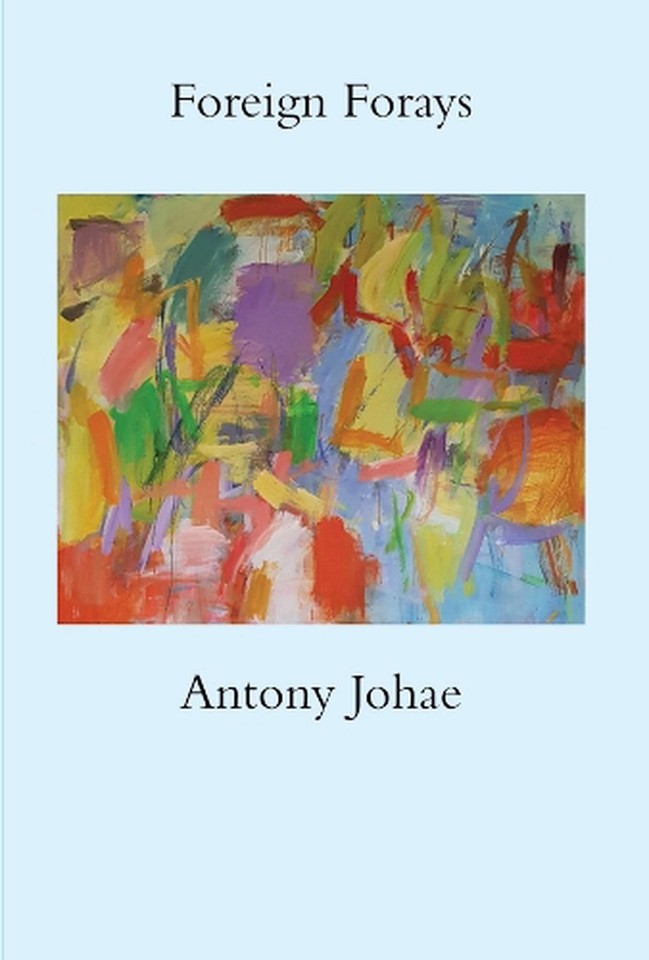
These poems are in free verse; some straightforward top to bottom renditions, others with a variety of formats and line spacing. White space and multiple indents are a significant element in ‘Burnt Sorrento’, an ekphrastic poem treating of the painting ‘Sorrento’ by Brenda Jones which appears on the cover page of this enticing collection. ‘Burnt Sorrento’ is a bravura attempt to relay those hot colours to the eye and to the ear.
There is one poem in a rhyming style – ‘In the Men’s Room at the Fryderyk Chopin Museum, Warsaw’. The rhymes are mostly slant, and the metre where it exists is conversational. Perhaps not easy on the eye, and somewhat jokey; however ’In the Men’s Room’ comes to life in recital.
The last poem in the collection, ‘Arrival at Rafik Hariri International Airport, Beirut’ is, for me, the clincher –especially in its last line. It would be unfair to ‘Foreign Forays’ to divulge the final line – better far for you, dear reader, to get hold of this handsome pamphlet and to read ‘Arrival at Rafik Hariri ’ for yourself.
Peter Ualrig Kennedy is lead organiser of the poetry collective Poetrywivenhoe, and a past editor of the quarterly magazine Wivenhoe News. He edited the contemporary poetry collection ‘Days begin…’ (Wivenbooks 2015). He created and edited the series ‘Poems in Lockdown’ (Watermelon Press 2020, 2021, 2023). His poetry has been published in several journals in print and online. His debut collection, ‘Songs for a Daughter‘, was published in June 2021 by Dempsey & Windle.
*****
Three WayLeave Pamphlets Reviewed by J.S. Watts
Lilith Speaks by Clare Proctor £7.00 Wayleave Press ISBN: 9781068576218
An accomplished and technically varied collection of poems that consider the female experience. Using events from history, myth and more mundane domestic settings, Proctor explores the limitations placed on women by society, art and circumstance and sometimes ourselves. Often dark, these poems are also subtly rebellious, thoughtfully intelligent and insightfully nuanced. I’ve chosen to quote from the opening poem, Shhh:
Why aren’t girls taught the words
and how to hold them
so when they’re needed
they don’t melt on the tongue
like communion wafers.
All the poems are a dark delight, however. I was especially taken with the title poem, Lilith Speaks, which takes its source from a 15th century witch hunting manual that stated knowledgeably that witches collected: ‘male organs in great numbers’, keeping them in birds’ nests or boxes:
We keep them as pets,
tied at one end
to stop their innards falling out.
Brainless, they wriggle in the basket,
blind as worms, feeling only
the way their skins rub against each other,
leaking and sticky,
stained in scent.
*
Subcutaneous by Maria Isakova-Bennett £7.00 Wayleave Press ISBN: 9781068576201
According to the back cover blurb, this is Isakova-Bennett’s sixth pamphlet and a very fine one it is, too. The sparse, but delicate poems explore family, loss and the lot of the dispossessed. These are poems of loss and grief, but also hope.
The poems are highly visual and often use images of visual art to create what amount to written sketches, as in this extract from Lines:
I’ve taken to painting
the flower heads, the young leaves
in ink and thread, paring my drawing
back to line and colour With one curve –
let’s say a J – I bring my father back to the table.
The people in the poems frequently come across as broken by their experiences. I am sure it is not a coincidence, therefore, that the final poem in the collection, The green glass vase will break, deals with creating something positive from something broken:
At your destination,
don’t try to reassemble
the vase;
its old form has gone –
but in the workshop at the lough-side
tip out the crushed pieces
and fuse them into something new.
Subcutaneous fuses history, memory, poetry and emotion into something quite special.
*
Still Life by Rebecca Bilkau £7.00 Wayleave Press ISBN:9781068576225
A pamphlet celebrating death and grief and thereby life itself. Beginning with the iconic medieval image of the dance of death in Last Dance:
Here we go. Will you know or know or still not know,
snipe from the unsafe shadows, or tango into the storm?
and again in Me and the Dans Macabre, where the image of the dance is something to be painted, not directly participated in, this is a pamphlet exploring a weighty subject with an elegant lightness of touch and poetic dexterity. This is death in all its fullness.
Death – the one thing we can guarantee will happen to us all – is examined from a multitude of viewpoints and experiences, but using, time and time again, images invoking how natural it all is. In Last Dance death’s roots lie in a: ‘eternally invasive’ hedge and non-benign quince. In Forebear the roots begin: ‘against our family tree’. In the next poem, A preserve:
The tree we planted to root us to the new garden
is old enough to shock us with a shining crop:
it is an apple year for all the experts say it shouldn’t be.
By the pragmatic and final, in so many ways, poem Tomorrow into today, death is absorbed into the natural order of life:
I’m lime tree,
and chaffinch, and the light is right and good.
As the Church of England Order for the Burial of the Dead says: ‘In the midst of life we are in death’, so, in the midst of death we are in life (and transformative poetry).
I feel I should end this review with a summary comment on all three pamphlets, which form a set of sorts. Each was selected for publication from the 2024 Litfest/ Wayleave Pamphlet Competition judged by Ian Duhig and Jane Routh. The printed pamphlets themselves are fairly basic: stapled grey card cover with an inset coloured image, no contents page and no page numbers, containing, at a rough and rapid count, between 17 and 20 poems each. The only significant differentiation being the front cover image and different coloured front and end pages: simple and unostentatious. The thing linking all three pamphlets is the excellence and dexterity of the poetry they contain.
J.S. Watts is a poet and novelist. Her poetry, short stories and non-fiction appear in diverse publications in Britain and abroad and have been broadcast on BBC and independent radio. Her published books include: Cats and Other Myths, Songs of Steelyard Sue, Years Ago You Coloured Me, The Submerged Sea, Underword (poetry) and A Darker Moon, Witchlight, Old Light and Elderlight (novels). For more information, see her website https://www.jswatts.co.uk/
*****
Poison by Louise Warren. £10.50. Tuba Press. 48 pp. ISBN: 9780907155799. Reviewed by Rowena Somerville
Poison by Louise Warren is a pamphlet of poems about poison, poisoners, and relevant people of interest, followed by quite extensive notes on the various poisons, cases and characters alluded to. The tone throughout is generally rather gothic, with a dark sense of enjoyment of the sinister, and a slightly Victorian feel. The opening poem ‘Flypapers’ reads as though written by a woman ill-wishing her husband. It ends with:
Such a gentleman he is, such strong wet lips.
I picture him licking the green leaves on the fine wallpaper.
The notes tell us about arsenic, its (historic) use in green pigments, and about Florence Meybrick who killed her husband in 1889, through feeding him arsenic she had obtained by soaking flypapers.
‘When My Aunt Turned Into A Table’ – referencing the bizarre effects of strychnine – describes the imagined poisoning of the said relative, who then folds over rigidly, forehead and heels on the ground, like a table:
By Sunday she had taken on a dreadful hue,
we gave her a good polish to bring up the shine.
Joan brought in a vase of flowers from the greenhouse
to liven things up.
I thought that this poem was very effective in being actually quite shocking as well as ‘horribly’ amusing, and it stood out, avoiding the pitfalls of the lessening response that the repetition of an archly ‘sinister’ tone will inevitably bring.
In ‘Freud Dreams’ Sigmund becomes ‘my own herbarium’, as his addiction to nicotine led to cancer, and he became, in effect, a living/dying example of what the tobacco plant can do. In ‘The Little Match Girl’ Warren explores the dreadful effects of yellow phosphorus on the – mostly women and girls – who made matches, this being poisoning by industry rather than by an individual:
In her dark blouse and hat,
the gap widens in her jaw
between the fairy tale and the girl.
Slack mouthed – with the ache of it,
she holds the candle of herself unlit
against a dull wall.
The poems are well written and take some unexpected approaches to their various subject matters, but, for me, the narrowness of overall topic did have rather diminishing returns; in the end, I found the collection a little too coherent and lacking in surprise or challenge. I also feel there is some slackness in the putting together/ proof-reading of the pamphlet – the paper is thin, there are inconsistencies in presentation, one example being the varied styling of the numbered notes underneath the poems, and also there are some occasional random punctuation marks floating in space, all of which effective editing should have tightened up.
Having said which, this is an engaging collection of poems about poisons, and it contains some good writing and strong imagery – including that very original way to make a table, should IKEA be closed.
Rowena Sommerville is a writer and singer, and lives on top of a cliff looking out to sea in beautiful North Yorkshire. She has worked in the arts for all her life, sometimes successfully. She originally wrote and illustrated books for children, is widely published in poetry magazines, and her first adult collection – ‘Melusine’ – was published by Mudfog Poetry Press in 2021. She won a Hedgehog Press Stickleback leaflet competition in 2023 and was the Visual Artist in Residence for The High Window in 2022.
*****
 The High Window