
*****
Fabio Morábito: Invisible Dog • Dunstan Ward: Departures
*****
Invisible Dog by Fabio Morábito, tr. Richard Gwyn. £11.69. Carcanet Press. ISBN: 9781800174528. Reviewed by Colin Carberry
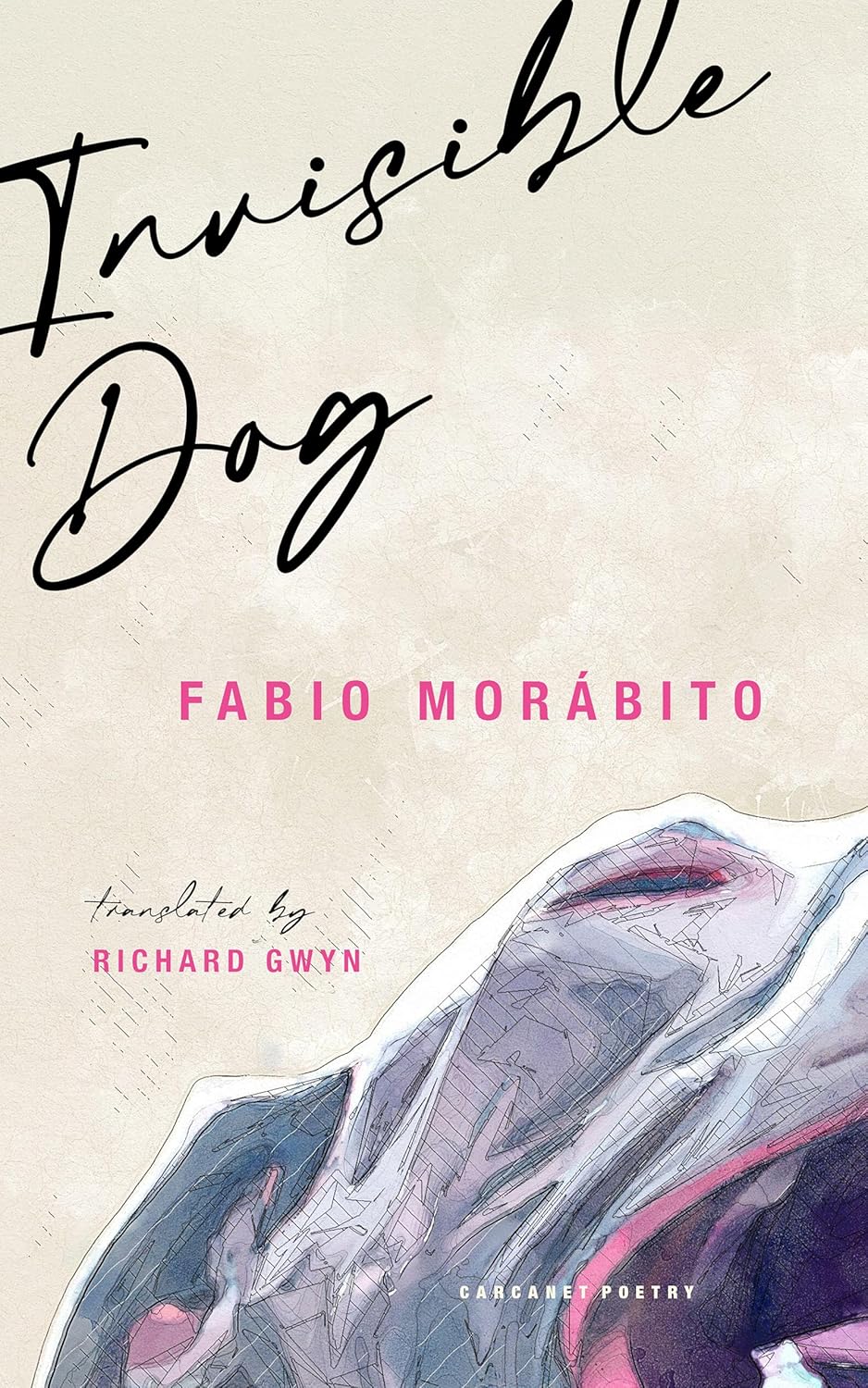
Fabio Morábito is one of Mexico’s foremost poets and short fiction writers. The author of five volumes of verse, four books of short stories, a collection of essays, and two novels, for which he has won numerous awards and honours (including the Xavier Villaurrutia Award, Mexico’s most prestigious literary prize), he has also translated into Spanish the work of many eminent twentieth century Italian poets, among them Eugenio, Ungaretti, Pavese, Montale, and Cavalli, and his own works have been translated into several languages.
Curiously, for such a well-known figure, this is the first time a book-length selection of his poetry has appeared in English. Composed of 44 poems culled from his previous five collections, Invisible Dog represents the core of Morábito’s literary and philosophical concerns and preoccupations going back to the release of his debut collection, Lotes Baldíos, in 1985. However, despite his literary success, he remains something of an “outsider”, and many of his poems derive from a sense of linguistic and cultural displacement and estrangement. Born to Italian parents in Alexandria, Egypt, in 1955, when he was fifteen, his family relocated from Milan to Mexico City, and he has lived there and written in Spanish ever since. He initially began to translate Italian poetry into Spanish as a sort of literary shadow-boxing before going on to write his own poetry in his adopted language. As a result, a feeling of foreignness hovers over and permeates his work.
His poems are filled with references to the sea (a metaphor for language), waves and beaches; run-down buildings, vacant lots, hills and mountains; and animals (cows, dogs, elephants, whales), insects (ants, flies), and reptiles (lizards). Animals, insects and reptiles appear in the titles of six of the poems (‘Six Lizards’, ‘To let out the fly’, ‘Invisible dog’, ‘The dogs are barking in the distance’, ‘Three Ants’, and ‘On the television I watch a wounded elephant.’) In ‘Ajusco’, the poet sees in a cow nosing through strewn refuse and beer cans left behind by drunks the figure of the exile rummaging through memories of his previous life, his childhood, his ongoing elsewhere-existence: ‘Slabs of exile / and calm accumulate / in your figure, cow. / You look around you, / then lower your head / to rummage in the trash / like an enormous dog.’ And in ‘As before a meadow’, the poet compares himself to a cow grazing in a big field or ‘like a whale parked directly / in the path of migrating plankton’, gorging, astonished, in ‘the great meadow of language’:
As before a meadow a cow
placidly lowers her head
and only raises it to count her blessings,
or like a whale parked directly
in the path of migrating plankton,
sometimes I surprise myself, stalled
and overwhelmed, parked
amid the great meadow of language.
The poem concludes with a writing manifesto of sorts: ‘…to know that everything’s digested / and what is lost makes a detour and returns. / This is why I write: to recover / from the depths all that adheres there, / because it is the only detour in which I believe, because to write opens a second stomach in the species.’
Morábito’s chief preoccupation could be said to be no less than language itself. Throughout his verse there are notes of loss, guilt, exile, and alienation, in the form of longing for his African childhood and his “former” language (Italian). But when he comes ‘face to face with it all’, he discovers, in retrospect, that he gains more than he loses. This bleak epiphany comes with the melancholy caveat that with every choice there is a loss. In the book’s opening poem, ‘In Limine’, for instance, in the process of examining the cultural and linguistic milieu he left behind he concludes, somewhat paradoxically, ‘for the one who turns his back / on everything…for the one who loses his edge, / I gain origins / land’—his ‘true land’: his ‘nomadic /desert tongue’:
For the one who turns his back
on everything, I come
face to face with it all;
for the one who loses his edge,
I gain origins, land,
I gasp my varied and
solitary alphabet
and finally find my nomadic
desert tongue,
my true land.
The opening lines of ‘Because I Write’, one of his best-known poems, also explore this feeling of uncertainty: ‘Because I write in a language / that I learned, / I have to be awake / while others sleep…I write before daybreak, / when I am almost the only one awake, / and can make mistakes / in a language that I learned.’ And in the rather poignant ‘Now, After almost Twenty Years’, the poet grapples with the twin fears that he has either forsaken Italian or that he is in the process of losing, or has lost, his mother tongue—‘which ‘slips through my hands’, ‘deserts my dreams’, ‘becomes cold / breaks away in segments’—while still not yet sure whether Spanish has become his mother tongue. Even after thirty years of writing and winning major awards in his ‘adopted’ language, his relationship with Spanish remains complex and precarious:
Now,
after almost twenty years,
I begin to feel it:
Just as a muscle atrophies
for want of exercise,
or takes its time
responding,
the Italian
in which I was born, wept,
grew up in the world
—but in which I have not yet
loved —
slips through my hands,
no longer sticks
to the walls like before,
deserts my dreams
and gestures,
becomes cold,
breaks away in segments.
Is it possible for a language other than one’s first language to become one’s mother tongue? I am not a linguist, and don’t feel qualified to offer a comment either way, but it is this linguistic and literary conundrum that haunts Morábito’s imagination and provides the fodder for many of the poems in this collection. Continuing in this vein, in ‘I am the last person’ (which his translator describes ‘as a sort of threnody’), the poet frets over the notion that the Italian that he continues to speak to himself in middle age ‘has ceased to be a language and is only a heritage’:
I am the last person,
the last speaker of a language, my own,
that hangs entirely on my tongue,
a whole heritage of words
that will fall into oblivion
the day I breathe my last
Despite being a passport-carrying (naturalized) Mexican citizen, and a well-respected academic and decorated author, one is left with the lingering notion that he will never be truly Mexican, or at least in the way that other Mexicans view themselves. In his excellent ‘Translator’s Note: Writing In Another Mother Tongue’, Richard Gwyn elaborates on the notion of mexicanidad and how it reflexively excludes those not perceived to be Mexican enough: ‘The question of language leads naturally enough to that of Morábito’s Mexicanness (mexicanidad). On the same visit to Mexico City that I met Fabio, I spent some time with the translator Lucrecia Orensanz, who had put into Spanish a talk that I was due to deliver about Welsh poetry, in commemoration of the Dylan Thomas centenary, and during the course of a long bus journey across the city, Lucrecia explained to me what she believed mexicanidad amounted to. She suggested that Mexican culture is difficult for the outsider to penetrate, lacks porosity, resists integration.’
Further along in the Note, Gwyn provides us with more valuable insight into Morábito’s ‘nomadic tendencies’ and his feeling of not fitting in, anywhere: ‘In a lucid appraisal of the poet, titled ‘The Stateless Verse of Fabio Morábito’ the Spanish poet and critic Francisco José Cruz writes of Fabio’s ‘unrepentantly nomadic condition… the feeling of not entirely belonging anywhere’ which ‘develops within him a razor-sharp consciousness of provisionality;’ that his is the ‘poetry of a loner who seeks to pass by unperceived’. I believe that it is precisely because of the facility with which he describes these nomadic tendencies that Fabio’s work is so accessible; he describes his foreignness, his outsider status, in a way that is familiar to all of us, is part of the universal experience. He achieves this, at least in part, because writers – most especially poets – are forever reaching out beyond language in order to express the ineffable…’
However, in this respect Morábito is not unique. Many writers have been forced to abandon their first places, for political, ethical, economic or religious reasons (Beckett, Conrad, Nabokov), and have adapted to new climes, languages, and challenging situations. Mexico offered the budding writer (and his family) safe haven, citizenship, stable employment, and bestowed upon him the highest literary awards and honours in the land. And in turn Morábito made the very best of the opportunities afforded to him by his adopted country. Ultimately, I don’t believe one should attribute undue importance to the concept of nationality, which the great Irish-Canadian-African writer Kildare Dobbs once memorably described as ‘a consoling fiction’. We are all nomads.
As a translator of Mexican poetry, I am keenly attuned to the complexities of rendering high quality verse into English. I had the benefit of being able to read the poems in both languages, and—a few small quibbles aside—would have rendered them in pretty much the same way. Perhaps the term ‘co-author’ might be more accurate than translator to describe Gwyn’s accomplishment—a term which carries inherent within it a connotation of something derivative of the original, but not quite the real thing. Not so here. The spirit of fidelity to the original poems is retained throughout, and while Gywn avoids taking unnecessary risks or liberties (these poems fall somewhere between translations and versions), in the process of faithfully and accurately transporting the original cargo intact across the bridge between the two languages, he creates poetry of his own: the benchmark for a work of literary translation.
Colin Carberry is a Toronto-born Irish poet, translator and reviewer currently living in Linares, Mexico. His Selected Poems, Ghost Homeland (Scotus Press, Dublin) was published in Ireland in 2020. He has translated and published three volumes of the great Mexican poet Jaime Sabines, including Love Poems (Biblioasis), selected and introduced by Mario Benedetti.
*****
Departures by Dunstan Ward, Cold Hub Press. Reviewed by Stephen Romer
Dunstan Ward came late to the actual composition of poetry, or at least to its publication; but he has been steeped in the art for years. He writes about this engagingly in his poem ‘Failure’, in which he lists previous occupations (the reverse, I suppose, of Rimbaud’s hair-raising CV, which starts with poetry):
Here I give thanks to the god or goddess of failure,
Nike’s shadow sister, perhaps, her wings furled,
who rejected me for all those unactable roles:
Marist seminarist; St Pat’s prefect; officer
in the Territorials; Young Otago Farmer;
candidate for an endless doctoral thesis
on Pater, in Reading; and banished me to Paris.
As for the part of poet, she kept me waiting
a lifetime, until I’d learnt how to play it for real.
Ward, born 1942, native of New Zealand, left those shores in 1971, and settled in Paris where he has lived, very centrally in the heart of the rive gauche, a stone’s throw from the Seine, for upwards of half a century. But if Departures demonstrates anything it is the pull of our childhood place, the formative loam, where our soul first put down tender roots, whose pull persists and even strengthens over time. In Dunstan Ward’s case, a childhood running free, but under the watchful gaze of a strict father, and a tender mother, on a farm in Otago.
I have empathy and respect for late starters; one of the pleasures to be had is the knowledge (at least in Ward’s case) that the work has at last emerged or broken through a barrier of self-censorship, with the pressure of a waterjet through a small aperture, as Coleridge described poetic intensity. As I said, Ward has been steeped in the art, notably as the co-editor, with the poet’s widow Beryl, of Robert Graves’s collected poems, in the great Carcanet and Penguin editions. He is a very different poet to Graves, though, less prone to myth and the muse, than to real encounters in the real city of Paris, and to a frequently elegiac, rueful irony, which remains, always, refined and urbane – except for moments of exposure or vulnerability which are all the more affecting thereby. His style is determinedly unrhetorical, downbeat, and yet firmly constative. And that is another mark of the accomplished late-starter, they arrive with a fully-formed authority.
Here, for example, is the poem ‘Departure’ in full, which shows the kind of authority the accrual of the years can bring:
‘Will I ever go back?’
A last wave to my friends
in the crowd at the dwindling dock,
as the great Greek ship glides
down Waitematã Harbour,
then out to the opening sea,
till, far behind me, the land,
now only a long dark shadow,
finally fades from sight,
never, in years ahead, from my mind.
That long dark shadow lies across the opening section of the book, which taken as a whole is a notable addition to the genre of family chronicle in verse, founded I suppose by Lowell’s Life Studies, but ably developed by a poet like Anne Stevenson when she traces her family history in puritan New England. The collage form, extracts from letters and notebooks and diaries, is part and parcel of the genre, and Ward makes use of all three. His earlier volumes (Beyond Puketapu (2015) and At This Distance (2019)) both contain memories of the New Zealand childhood, but in this new collection he addresses the family history, the original migration, in 1842, from cramped England to the vast acres the other side of the world, formally and in full. It represents also, in this third volume, a gain in confidence, the poet coming into his own.
Now generally condemned, the colonial project nevertheless took grit and guts and graft – and Ward is alert to this: what it must have been to buy ‘on spec before they left England’, ‘fifty acres of “good land” in Waimea West’ – with no guarantee as to its suitability. Six months at sea for starters, and you’ve comprehensively burned your bridges. In keeping with the toughness of the life, the diary entries (this from Joseph Ward, the poet’s great-grandfather) can be matter of fact to the point of brutality: ‘ “doctor at my house / most of the day. At 4pm my 4th son born. / Got two loads of dung” ’. But apparently the gamble pays off, ‘By the late seventies/ he possesses ninety-six thousand acres / in the Clarence, seventy-six thousand sheep.’
Deftly, shuttling backwards and forwards among viewpoints and eras, Ward weaves his version of the family history, also relating it to world events (the Great War, inevitably). This alleviates what might be too prosy a list of names and dates. The focus eventually homes in on his own father, Everard, an embattled farmer, and his son’s quaking at instructions or even when, relaxed, his father repeats and anecdote for the nth time –
Yet, at the end, as he shakes with laughter,
Wiping his eyes, or crashes a fist on the table,
Even to us our reaction doesn’t seem faked…
That crashing fist… in the end, Wards’s long-suffering and beloved mother leaves with her brood for England.
The death of the poet’s mother is the occasion for some of the finest, most vulnerable lyrics in the book. His poem ‘A Message’ is one of them, and it displays Ward’s unshowy style at its best:
Before I die, or start to die, I thought,
I’ll write a message.
I waited for the words.
‘I loved my mother,’ I wrote.
‘I don’t want to live on here without her.’
But if I find her, I thought, again,
which is far from certain,
she’ll only worry, she’ll look at me and say:
‘You shouldn’t have done that.
I can manage perfectly well on my own.’
You’ve lost all those years you would’ve enjoyed (…)’
And it is thinking of his mother’s resilience and longevity that he can write this, in lighter vein, deploying the justified privilege of an about-to-be octogenarian:
Soon, on my next ninth of June, I shall turn eighty.
I’ve already made a birthday resolution:
To live to ninety (and, if I can, beyond).
More sombre, but invariably done with wit and aplomb, alongside the gravitas, are elegies for friends and colleagues, especially two fine poems in memory of Ward’s friend and mentor, the poet Vincent O’Sullivan. These, and others in the vein, are once again very much genre pieces – the quiet, often witty, often moved, anecdotal elegy. The bon mot thrown off over the Brouilly (and treasured thereafter). Ward has mastered different genres, including the elegant, quasi meta-poems, on occasion placed in Parisian cafés which, though more familiar territory, are cleverly turned. But the thing I value most in Dunstan Ward’s poetry is what I described above as the quiet, but firmly constative manner, as in these closing lines of ‘Friendship’:
One of the great blessings of my life:
Friendship; given, like grace.
This is achieved with a style that only comes from scrupulous self-criticism and a long apprenticeship.
Stephen Romer’s first collection, Idols, was published in 1986, and three collections later, Set Thy Love in Order: New and Selected Poems appeared in 2017. He has been active as a translator from the French (Decadent Tales, Paul Valéry, Yves Bonnefoy and Gilles Ortlieb notably). A book of essays, Chaos and the Clean Line: Writings on Franco-British Modernism was published this year. He teaches English at the University of Tours, and French translation at Brasenose College, Oxford.
*****
 The High Window