
*****
Jane Hirshfield: The Asking: New & Selected Poems • P.W. Bridgman: The World You Now Own: New Poems and a Novella in Verse • Mike Barlow: A Land Between Borders • Victoria Kennefick: egg/shell • Lynne Wycherley: Alighting in Time
*****
Jane Hirshfield, The Asking: New & Selected Poems. £14.99. Bloodaxe Books. ISBN: 9781780376790. Reviewed by Ian Pople

For some on this side of the Atlantic, an appreciation of Jane Hirshfield is a bit of a litmus test. And this 360-page Selected suggests some reasons why. There is a thirty page group of new poems at the start of the book, which then moves onto a selection from her ten previous collections beginning with her first book Alaya which collected poems starting from 1971, and the book finishes with poems from her 2020 book, Ledger.
Perhaps part of the reason for Hirshfield’s status can gleaned from the fact of her editing the anthology, Women in Praise of the Sacred: 43 Centuries of Spiritual Poetry by Women in 1995. And, the spiritual in her writing that has gained Hirshfield praise and status on both sides of the Atlantic. Since that early point, she has received praise from such as Czeslaw Milosz, who has commented, ‘A profound empathy for the suffering of all living beings… It is precisely this I praise in the poetry of Jane Hirshfield. The subject of her poetry is our ordinary life among other people and our continuing encounter with everything Earth brings us: trees, flowers, animals, and birds…’ In addition to this kind of praise, Hirshfield has also received a wide range of some of the most prestigious poetry prizes that America has to offer.
Hirshfield received lay ordination in Soto Zen in 1979. And while Hirshfield has rejected the notion that she is ‘only’ a ‘Zen’ poet, she has, herself, commented, ‘When we bring that spirit of openness, permeability, exploration, and courage into our lives and our hands, everything else follows: a deeper saturation and compassion, a recalibrating sense of proportion, an increase of the possible.’ In this type of statement, Hirshfield binds both the empirical and detached which in the poetry might seem to reach its apotheosis in a poem such as; ‘Poem with Two Endings.’ Here, she writes; ‘Say “death” and the whole room freezes – / even the couches stop moving, / even the lamps. / Like a squirrel suddenly aware it is being looked at. // Say the word continuously, and things begin to go forward. Your life takes on / the jerky texture of an old film strip. // Continue saying it, / hold it moment after moment inside the mouth, / it becomes another syllable. / A shopping mall swirls around the corpse of a beetle.’
I’ve quoted this at length to suggest how Hirshfield works her ‘material.’ Not only the material of the world but also the material of the poem. The immediacy of that first line and, perhaps, its sense of truth, as mentioning ‘death’ so baldly in the company of others is not likely to endear. But part of Hirshfield’s cleverness is the picture painted in those next two lines, of the couches and the lamps stopping moving. That sense of the couches’ stopping moving adroitly captures the physical reactions of the listeners. But the sense of the lamps’ stopping moving is a beautiful addition. Perhaps we might see this as the stopping of movement around the room so that the light given off by the lamps does not move with the shadows of those standing in the room. However, any explanation of the image just seems banal beside the precision of that three word phrase, ‘even the lamps.’
Hirshfield’s further insistence that the word ‘death’ might continue to be held in the mouth reaches its culmination in that sense of detachment; ‘it becomes another syllable.’ But then this idea is opened that out to the further image of the corpse of the beetle in the shopping mall. And, here again, the reader is pulled into an empirical reality; the corpse of the beetle. But what Hirshfield does next is to contrast it with the immensity of the shopping mall. It is testament to the power of the poet that these links between beetle, death, syllable and shopping mall work so successfully.
As to the ‘two endings’ announced in the title, they are: ‘The group of life is a strong as the grip of death.’ And then separated by some space and further down the page is; ‘(but the vanished, the vanished beloved, o where?)’ The brackets, the lower case ‘o’ are all Hirshfield’s, although I did wonder if there might have originally been a comma between ‘vanished’ and ‘beloved.’
It is possible that the ‘first’ ending is simply too sweeping for Hirshfield, and that the second ending is one that came to her in the moment of writing the first. If the published version is correct, then there is something almost as sweeping. This line not only opens out death to included ‘the vanished’ as a whole, but also specifies a vanished beloved. And that pairing is powerfully lamented in the careful rhetoric of ‘o where?’ The rhetoric is careful in that a capital ‘O’ where would, perhaps, have opened things out too far. The lower case ‘o’ almost washes the lament back along the line; a lament stated almost under the breath that links in a personalised fashion back through ‘the vanished beloved,’ to a large ‘the vanished,’ at the start of the line.
Starting with her 2006 book, After, Hirshfield ‘adopted’, if that is the right word, two particular forms, the, mostly, longer form, she calls an ‘assay.’ And the second, much shorter form, perhaps more likely to have a Zen relevance, is the form she calls ‘pebbles.’ And example of this latter is ‘Lemon,’ ‘The grated lemon rind bitters the oil it steeps in. / A wanted flavour. / Like the moment in love when one lover knows / the other could do anything now wanted, yet does not.’ Hirshfield has been involved in translating tanka from the Japanese and adopts both the form and the kind of address of tanka here. As we might express from such a form, the text begins with that image of the lemon rind in the oil, with the adjective ‘bitter’ turned into a verb. The poem repeats the word ‘wanted.’ Firstly, in terms of flavour and then in terms of a human relationship. Hirshfield both opens and specifies that relationship with the words ‘one’ and ‘other.’ That movement from the image to the moral is both expected but also well controlled, the bitterness of the lemon worked through to the self-control of the lover.
Hirshfield’s ‘assays’ start from the opposite point, so to speak. They seek to explore an abstract concept by naming it first and then making it concrete in details and images. As such, the assays have titles such as, ‘To Judgement: an assay,’ ‘To Opinion: an assay,’ ‘”Of”: an assay,’ or the later, ‘Humbling; an assay.’ This latter is, actually, part of a sequence of tiny ‘pebbles.’ And the complete ‘Humbling; an assay,’ is ‘Have teeth.’ Hirshfield’s ‘pebbles’ often have this koan like quality. An ‘assay’ can be defined as ‘the testing of a metal or ore to determine its ingredients and quality.’ And that sense of testing a subject is live in these poems.
‘To Speech: an assay’ begins: ‘This first, this last; / there’s nothing you wouldn’t say. // Unshockable conclusion your most pure nature, / and so you are like an iron pot – / whatever’s put in, it holds.’ If there is something slightly safe an obvious in this description of speech, it is perhaps because Hirshfield is laying the ground for something deeper later on. Those lines offer a bare description of speech, perhaps in the way at the assayer will simply look at the object from the outside before putting that thing under the hammer and the fire. And that deeper assay follows: ‘We think we think with a self. / That also, it seems, is mostly you – / sometimes a single spider’s thread of you, / sometimes a mountain. // The late sun paints orange / the white belly of a hawk overhead – / that wasn’t you, / though now and here, it is.’
In those two verses we have a careful movement from an abstract that is moved centripetally inward to the self, which is, in turn, here identified with speech and carefully delineated with the second person ‘you.’ And in that self, speech can either something tiny and seemingly fragile, or else it can be something vast and seemingly immoveable. And I’m sure we’ve all come across speech like those two representations and the spectrum in between not only in others but, perhaps more importantly, in ourselves. And then the poet reaches out to the natural world. In doing so, she recognizes in that her depiction is, itself, speech, albeit written down. The natural world of the hawk was not language, it was simply ‘you.’ But the necessity of the poet is to write down. What Hirshfield suggests here is that the identification of the hawk must lie with the hawk alone. However, what the poet has to do is to both make that identification for herself, but also for the reader. It is in the making that the speaking lies, in both senses of that word.
‘Zen’ means, basically and reductively ‘meditation.’ Hirshfield’s great gift is to meditation on the page with a quiet and often devastating precision. Concentrating on her forms, the ‘assay’, the ‘pebble,’ does her some disservice. She is basically a free-verse poet whose particular focusses have particular names. And throughout this lovely collection, Hirshfield shows again and again how, if we could only be as quiet, perceptive and concentrated as her, the world would be a better place.
Ian Pople‘s Spillway: New and Selected Poems is published by Carcanet.
*****
The World You Now Own: New Poems and a Novella in Verse by P.W. Bridgman. £21.00 / $28.95 (CAD). Ekstasis Editions Canada Ltd. ISBN: 9781771715522. Reviewed by Colin Carberry
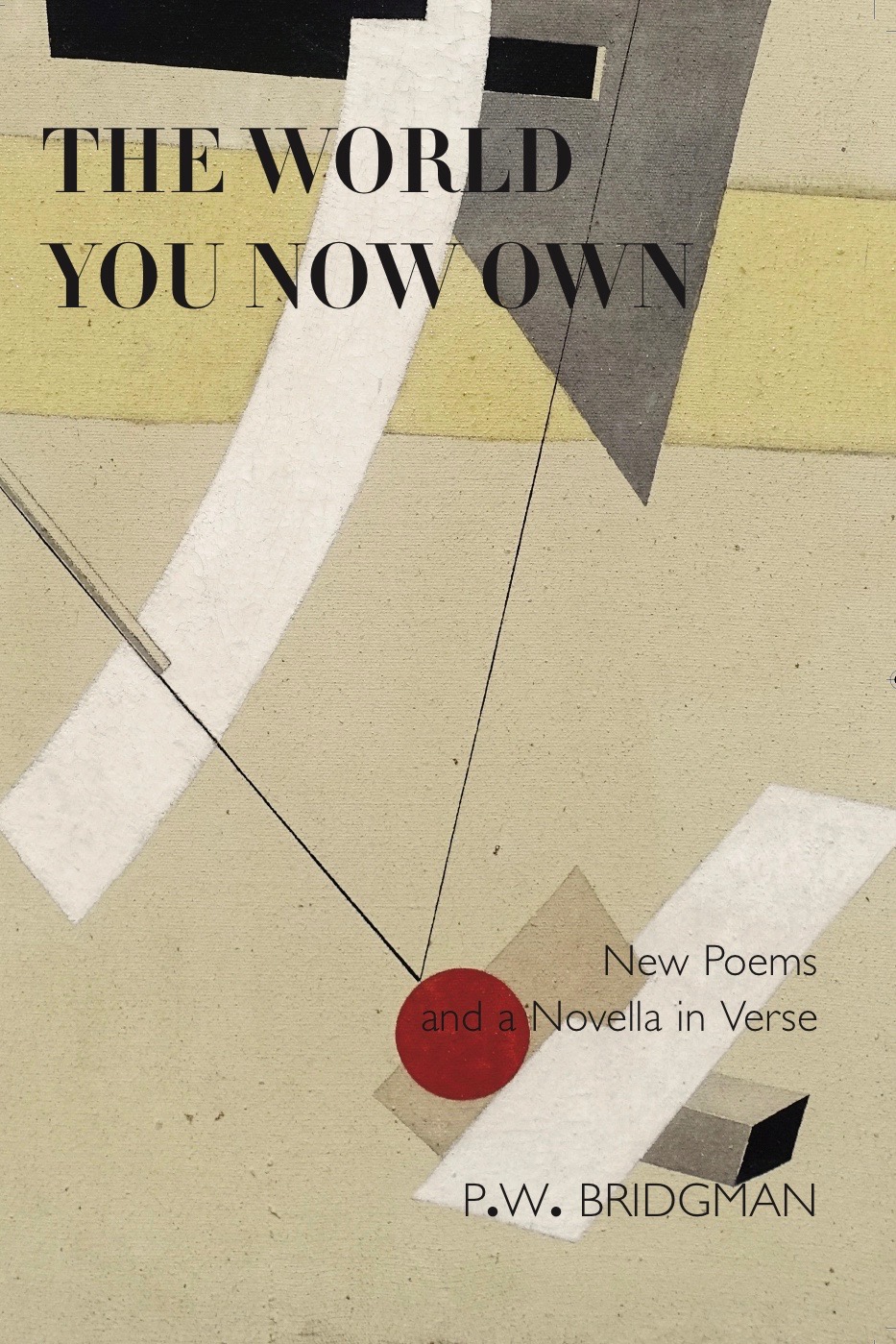
Acclaimed Canadian-Irish poet and short fiction writer P.W. Bridgman’s fifth book, a hybrid volume which combines poems published since the release of Idiolect, his well-received previous collection, with a novella written wholly in verse (‘Deliverance 1961: A Novella in Thirty-Two Cantos’), is packed with profound, skillfully-crafted, engaging and cathartic poems that deal with sometimes dark historical and political subject material, the intensely serious tone of which Bridgman leavens with tender love poems and gentle sardonic humour.
The notions of freedom and futile escape from (and into) the world, with all its challenges, ugly injustices, sickness and death, are explored throughout the book. The last lines of the book’s opening poem, ‘Training Wheels Off’, about a little girl learning how to ride a bike, provides the book’s title (‘One last wee wobble, / then you’re away / into the world / you now own’). And in a longish poem in the same section (Our Better Selves), ‘It Wasn’t Enough’, the speaker explores his strained relationship with his father, with whom he hadn’t spoken for nine years. The father figure, sitting in his plush office lined with paintings of the speaker’s late mother (ironic, given he treated her badly too: ‘The only life more loveless than mine was / my mother’s.’), comes across as distant, self-important and controlling, and uses an antiquated diction from a bygone Colonial era to belittle and guilt-trip his son, who can’t seem to do anything right in his eyes:
It wasn’t enough, he says, that I gave up my paid-up
place at Cambridge to finish my degree in Canada.
It wasn’t enough that I “took up with”
a common country girl from the “colonies”.
The final indignity is being cut out of his father’s will because of his refusal to bow to the old man’s (unstated) demands, but instead of taking this emotional blow with shock and anger, he relishes it as the fulfillment of his long-desired escape from years of brow-beating and psychological abuse:
Just as my flight is called,
I ring home from Heathrow.
“We’re free,” I tell my prairie girl.
“I refused. So, it’s all going to the
telephonist.”
The complex and difficult fathers in Bridgman’s writing are imaginary; fictional creations, sometimes incorporating aspects of troubled people he has seen or heard about through his work as a judge (from 2007-2019)—which required that he hear and decide many tragic cases arising out of marital breakdown and family dysfunction—or across the course of his life.
In ‘My Nitobe’ the word “free” appears five times as does the word “emancipation”. Written from the perspective of a seventeen-year-old off to university to study arts (not science, as his father would have wished), he soon discovers that life in the big world is not all Guinness and Skittles, and his understanding of the concept of freedom changes as a result:
Soon I discovered that “free” can also mean
un-tethered, at sea, adrift, unmoored.
Lost.
Too proud to confess it,
I slipped into depression,
a kind of clinical homesickness.
But in Nitobe, ‘a garden built in tribute to a peaceable Japanese man, / desecrated during unpeaceable times between nations / and later restored in reconciliation,’ the future poet finds a haven, ‘the place where, by degrees, toward degrees, I found my way.’
In the two subsequent sections (Our Lesser Selves and Our Contemptible Selves), the poems take on a darker hue as the characters in them react to a wide variety of challenging situations, among them war crimes, disappearances, natural disasters, psychological abuse, and sudden death. Bridgman also explores the suffering of the innocent and defenseless. The short poem ‘Kite’, for example, a gem of precision and compression, is almost unbearably sad. One can picture the grief-stricken boy staring up at the sky, wondering what kind of a God is up there, if any:
“Hold it, please, Daddy?”
“Mm-hm.”
His mother’s last gift to him,
the kite tugs the way her memory tugs
at our bruised hearts.
My mobile rings.
I fumble and the kite slips my grasp.
“It’s gone to join her,” I say to him, lamely.
Sorrow and disbelief cloud his eyes.
And In ‘Red Dress Day: 1962’, a rather grim and chilling poem, the poet shines a light on the plight of Indigenous peoples in Canada and media collusion (?) in hushing up or ignoring a sad and sordid catalogue of crimes committed against them (in this case in the form of ‘vanishing Ojibwe girls’)—a source of great national shame. Indigenous women and girls especially have been the subject of predation by members of the settler-colonial population; they have also received inadequate protection from law enforcement—itself a form of collusion. While significant effort is currently being expended in order to achieve reconciliation with Indigenous peoples regarding these historical wrongs (mainly through the courts and the mechanism of The Truth and Reconciliation Commision of Canada—set up in 2008), despite official and academic recognition that what happened to the Indigenous peoples of Canada ammounted to cultural genocide discriminatory attitudes and practices among sections of the Canadian “settler” population persist:
Mothers paced and fretted. They peered nervously out their
windows. Fathers probed the bushes with flashlights,
softly calling out their daughters’ names.
We knew about the missile crisis, that the Leafs
might win the Cup, that I Love Lucy began at seven.
Then, vanishing Ojibwe girls weren’t newsworthy.
Word of them never reached us.
The use of the word “softly” in the third line of the excerpt quoted (above) is exactly, heartbreakingly, the correct one. It serves to humanize a people long dehumanized, ignored, or demonized. And we find this all throughout the book: Bridgman has an unerring knack for choosing the exact right word to render both meaning and emotion. There’s an aspect of this poem that draws upon the poet’s own personal history: when he he was about 10, a man who actually served as the church basement Santa Claus each year in his little town in northern Ontario was convicted of raping a young Indigenous girl, an event that shocked and horrified the community. It is from that shock and event that triggered it that the poem is drawn, in part:
We couldn’t have known that a hunter lived on our street,
that he was the church basement Santa.
He had a red suit. He wore it only at Christmas.
He asked us if we’d been good.
This poem should become an important one in the CanLit canon. A fully achieved poem, it contains no verbiage, just the exact right words in the right order. And how about that savagely satirical final line? Let’s see: once a year, a man who would be convicted for rape emerges from a church basement, dons the red suit of Santa Claus, a saint and the universal embodiment of Christian virtue and generosity, to ask children if they were good? One can only imagine what First Nations people made of such vile individuals. Was what was good in the eyes of the settler-Colonists and their God good for them? A cursory glance at the historical record would suggest otherwise.
The book concludes with ‘Deliverance 1961: A Novella in Thirty-Two Cantos’, an account of a chance encounter between two troubled characters on a train from Vancouver to Union Station, Toronto, that is ‘told largely through flashbacks, that reflects what is sometimes referred to as the Madmen era—a time unquestionably of lesser social enlightenment than our own.’ (From the Introducion). It is unusual to find a long poem in a smaller collection—even more so a novella in verse—preceded by an Introduction and even a Dramatis Personae page as well. The word “risky” came to mind, something the poet comments on in the Introduction: ‘…it is not easy to write in 2024 about the past. Indeed, it can be down-right dangerous. A writer’s characters in a period piece written today cannot reflect uncomfortable historical realities without evoking responses—sometimes very visceral ones—that are informed by the standards and sensibilities of the present.’ Another risk is the sheer difficulty of writing a long poem such as this, in free verse cantos. But he succeeds admirably: the poem is well-paced, entertaining, and convincing, and the poet derives great joy from poking fun at human foibles and mocking the good, the self-important, and the ornery, and his instinct for choosing the correct word again evident throughout. I initially wondered if the book could not have in fact been two books, given the quite different tone between the two main parts of the book, but by ending with the novella the effect is to temper the darker tone of some of the earlier poems and end things on a gentler, more comedic note. There is also a circularity in that the characters in the novella are fleeing unfulfilling lives or domestic situations, the same as many of the characters in the earlier poems, including the opening section, in which the notion of “freedom” is examined. With the publication of The World You Now Own P.W. Bridgman must now be considered one of Canada’s leading poets.
Colin Carberry is a Toronto-born Irish writer and translator now living in Linares, Mexico. His work has appeared in numerous journals, newspapers and anthologies worldwide (Poetry Ireland Review, Exile: The Literary Quarterly, The Irish Times, Reforma, Jailbreaks: 99 Canadian Sonnets, El Norte, and The Antigonish Review) and in three poetry collections, and his poems have been translated in many languages. His Selected Poems, Ghost Homeland (Scotus Press, Dublin), was translated into Bangla and published in Kolkata, India, in June 2024.
*****
A Land Between Borders by Mike Barlow. £12. Templar Poetry, 2023. ISBN 978-1-911132-63-9. Reviewed by D.A. Prince
William Faulkner’s lines ‘The past is never dead. It’s not even past’ (from Requiem for a Nun) would make a fitting epigraph for this collection. Barlow opens this collection with a poem set in an unspecified location, at an unspecified time. While we, as readers, will place this is the twenty-first century and set it on England’s Kent coast, bringing in our own knowledge from television news, the situation is timeless.
They step ashore to the applause of shingle,
the crossing behind them all sea-fret, the long
silent swell, suspense of the moment.
Wrapped in the past with its nightmares
and dreams, salt wind on their wounds, they struggle
up-beach. Two steps forward, one back. [‘The Shingle’s Applause’]
Migrants, refugees, asylum seekers: we place them in ‘our’ world. Barlow, however, repositions what them in the following poem, ‘They came down from the north’, he moves the time back from the boundaries of the twenty-first century to the times when migrants came ‘on the look-out for strays or rustled beasts.’ They came across ‘the porous and mutable borders’ and this time the reader’s knowledge supplies the debatable lands between Scotland and England, and a vaguer time frame — fifteenth/sixteenth century perhaps?
They were all chants and songs,
a way with difficult instruments, words
we had no words for, tunes
we couldn’t dislodge from our heads.
They brought with them woven lengths
the colour of the hills; sea-salt, silver,
ship-wreck gold, strong liquor.
In just two poems Barlow has established the framework for this complex, ambitious collection: edges, borders, constraints, geographies, the constant travels of people and their influences, along with a breaking down of the us/them divide. The collection’s title holds a clue: it’s ‘A Land …’ not ‘The Land …’ The poems will go on to explore both physical and metaphorical boundaries, and also the spiritual.
The collection is divided into three sections: ‘Vanishing Point’ (largely about land borders); ‘Fata Morgana’ (how water both divides and connects); and ‘Urgent Blood’ (where the boundaries between life, death and the spirit world become more porous). These divisions aren’t absolute, which suits the theme. Borders can be negotiable, shifting, transformed as time passes. A political thread runs through the poems, never as polemic but as a recognition of a larger truth. ‘They came down form the North’ ends:
They stayed, bedded down,
got under our skin, strangers
turned into ourselves,
the making of us.
These poems listen and observe. Barlow only starts to include poems referencing personal life once he has established the context of the lives of others. ‘Re-settled’ shows a solitary man in his ‘square apartment’ remembering his former life — ‘… the tent, the hearth, / the pot where the family’s next meal waits’. ‘Worlds apart’ looks at the border between two people — ‘Sometimes she answers him not in the tongue she married him in / but a language she talks in her sleep.’ The choice of longer lines mirror the reflective alone-ness of the husband. Barlow is adept at settling on stanza structures and and line lengths that unobtrusively support his poems.
‘The perpetual present’ — which could also have been an alternative book title — introduces the ghosts/spirits of past migrations:
And they are with us still, ghosts
caught between the future and the past,
shuffling through the newsrooms of the world,
gathered at railway stations, roadsides, camps,
borders where wire and tear gas greet them
or their gaze falls to contemplate
the uncertain promise of the sea.
Only after the deliberately non-specific locations and the establishing of key themes does Barlow allow himself to focus on landscapes closer to his own home: Salter Fell, Bowlands. This opens up a natural expansion of the collection into local history and his connection to it, to people who have used the land in the past and in various ways. ‘The pall bearers’, based on Fenwick Lawson’s sculpture ‘The journey’, (the funeral procession of St Cuthbert), introduces the word ‘soul’ — a word that will flicker through the collection, a constant whose boundaries resist definition.
Where are they coming from,
and where are they going, their journey
a dark mass moving
xxxxxxxxxxxxxxxxxxxand not moving
through sea-fret?
Whose soul is it their load’s the lighter for,
the weight of a lark’s song lighter,
climbing beyond hearing?
It’s a great temptation to quote from every poem. This is one of the pleasures of Barlow’s work, the way he finds new sources of energy in language but in a way that never feels forced or strained. Like that line about the lark’s music, ‘climbing beyond hearing’, he can find words for what is inherently indescribable. In ‘Along the coast road’ he ends on ‘… silhouettes / against the shifting silvers of the sea, / cut-outs cut out of far-off homes.’
The second section, ‘Fata Morgana’, picks up and expands images introduced, apparently casually, in the opening section: islands, real or imaginary, and the sea as border. The mirage-island — ‘on a tight-rope of horizon’ — gives scope for exploring ideas through this
other-worldly location. An ostensibly straightforward account of a holiday (‘Getting away’) to a low-key destination becomes mysterious —
The town itself was soporific,
the inhabitants like sleep-walkers, eyes open
but fixed on a make-believe horizon.
It has all the familiar features of a foreign holiday, including the children eager to be photographed; the final line, ‘None of the pictures have come out.’ uses natural language to suggest the strangeness. It’s like ‘The Isle of Good Intentions’ — ‘for how can the past / be held to account // at a time/ and place there’s no / accounting for.’
The past: another of the words slipping in and out of these poems. The ‘Fata Morgana’ section allows for more historical probing — another way of extending the scope of the collection. There are narratives, like ‘The Tugboat Lucinda’ and ‘Finn the Finn’, as well as ghost ships from the past. ‘The good ship ‘Holigost’’ was a clinker-built carrack, built for Henry V’s navy, whose wreck lies off the Hampshire coast — ‘her soul a faint boatshape’ — all war over for her, though not for the twenty-first century.
… broken timbers, prefiguring
the many ghosts to come, our own dark
spectres gliding, seven centuries on,
beneath the set-piece calm
of Gare Loch, halflives glossed over
by the storybook of politics.
In Barlow’s final section, ‘Urgent Blood’, his themes converge:
our selves caught
in the flux of themselves
souls searching
for an inch long equation
with which to explain
everything
There’s no full stop, nothing to end the ever-expanding rearrangements of the universe in which the ‘soul’ travels. This section holds poems about stranger — and sometimes more threatening – events and images: ‘Underwater bike-ride’, or ‘Sudden thunder’ when a bird crashes into a Velux window, the noise conjuring fears from the past. Humanity is ‘a drab crowd scene, weave of stitched-up lives’, and ‘… a dumbed-down chorus no one listens for.’ (from ‘Witnesses’). Yet that word ‘soul’ comes back, with stubborn resilience: it’s here in the final poem, ‘The candles’:
Yes, let us say there was a flame once. It went out.
There will be others. They too will go out.
Our hearts also are tired, our souls dark, but we —
we are the candle-lighters, wedded to metaphor.
Evidence for this? While I was writing this The High Window round-up of new poems arrives, containing two poems by Mike Barlow that carry forward the ideas woven into this collection. He is writing about the never-ending stuff of life as it morphs and slips across borders, finding its own way, the way he has always done. These poems will push forward, prodding not just at our consciences but also at how we use language to tell they way we live. It’s an absorbing collection.
D.A.Prince lives in Leicestershire and London. Her second full-length collection (Common Ground, HappenStance, 2014) won the East Midlands Book Award 2015. Her third collection, The Bigger Picture (also from HappenStance) was published in 2022.
*****
egg/shell by Victoria Kennefick, £11.99, Carcanet Poetry. ISBN: 978 1 80017 383 5 Reviewed by Jonathan Timbers

Kennefick has produced a second collection – egg/shell – that matches and magnifies the virtues of her witty and vivid first collection, Eat or we all starve.
Just like the first collection, egg/shell is mainly autobiographical. Thematically, it falls into two parts, reflected in the divided title. The first theme concerns the poet’s miscarriages. The second is about the impact of her partner’s transitioning. Kennefick writes emotively and unsparingly but engagingly about the first theme and with grace, humour and love about the second. In doing so, she does not shy away from her own hurt and ruefulness, while remaining full of compassion and goodwill for her partner. As she puts it: ‘It is / hard to hurt and then explain the hurt / so as not to hurt anyone’ (Child of Lir). Actually, she manages to so with complete authenticity. So while she may self-deprecate with her Catholic humour brand of humour, she is to be honest a bit of a saint:
(11) Victoria is nailed to the cross, or rather she nails herself.
(12) She dies, many times over. This is the truth, you see
(13) Victoria takes herself down from the cross
(14) She lies on her bed, alone, and sighs. In three days, she will take up Pilates.
‘Victoria Re-Enacts The Stations Of The Cross. Don’t We All?’
This self deprecation turns, at times, into self-loathing. There’s a sour note in the lines:
xxxxxxxxxxxxxxxxxxxI want to die
Of longing for the doughy body
Of a toothless child clung to me
Dribbling absolution down
Its double chins
And disgust in these:
Who cares what you think of me?
– O Pain! –
– O unbearable sadness
you are such a prick.
‘Ode to self-loathing’
Egg obviously refers to her own eggs, but also to her partner’s rebirth. The shell is what she (her partner) must break through, the fractured empty egg. In fact, towards the end of the collection there is a poem about breaking eggs in an art gallery installation. Taken by itself that’s all it is but as part of the collection it seems cathartic:
“We have made
the most beautiful egg painting taking it into
our own hands, this cell, and making the
most intense shade of rich yellow
streaked like the dawn, but inevitably running vertically
smelly.
Still
Intentional.
‘Tempera’
She brings the themes of her inability to go to full term and her partner’s transitioning together in ‘Cygnus, The Swan in the Stars’, where she imagines leaving her ‘battered corpse’ behind and undergoing ‘a transition from one form to another, so I can take the shape of a swan’. Swans and their doings are the subject matter of many poems, each reference carrying the weight of their mythic identities (and the inevitable W B Yeats reference). For example ‘Swan Song’ ( the last poem in the collection) riffs on the end of their marriage:
We pat the earth
with the flat
of our hands
imagining each other’s
backs. A bald, featherless
patch on the grass.
You sing, even so,
our little song.
The mute swan stays mute.Similarly in ‘The Wild Swans at The Wetland Centre’, swans are central to a poem about miscarriage (‘this morning there was blood in the toilet water’) and her relationship and the fluidity of identity ‘ ‘we split on liquid’ (referring to her reflection with her partner or perhaps a swans refection mixing with her own). There is something polyphonic in this multi-layered approach.
This collection is conceived as a whole, like sonata form, with contrasting but related metaphors and themes. The poetry is musical not only because of her beautiful handling of the cadences and colours of language but because of the arrangement of the poems.
Even the poems that do not relate to the main themes offer potential complex thematic relationships to those that do. The excellent ‘Special Topics in Commemoration Studies’ asks students in a pastiche school groupwork exercise to:
Compare and contrast this trauma to others you know.
This trauma being the Irish Civil War.
I should perhaps add that as a man this is the first book of any kind I’ve ever read about the experience of miscarriage. Because Kennefick writes unsentimentally and so directly, it is easy to empathise with the emotional and spiritual impact of this distinctly female experience. Poems such as the ‘No. One’ sequence are devastating but also dramatic, direct and vivid:
……………………………I was carrying the world –
so fragile, this future predated by a timeline of cramps.
‘No.One: Ivy’
The sac is small. Come back
In three days. I don’t
bother, it’s all over in two
‘No Three: Willow’
We should perhaps have a new verb in English: to kennefick – to meet personal challenges with unsparing honesty, humour and compassion. Kennefick is a contemporary poet for those who don’t usually read contemporary poetry, as well as those who do. This collection is highly recommended.
Jonathan Timbers has been a teacher and lawyer; he’s worked in a tank factory, a prosthetic limb factory and the last cloth cap making workshop in Leeds (at the time). He helped organise and gave evidence. to the UN inquiry on the impact of austerity on disabled peoples’s rights in the UK. He was once the mayor of Hebden Bridge and Mytholmroyd and thinks that Ted Hughes is England”s greatest war poet. He occasionally publishes poetry and reviews; otherwise he lives a life of complete self indulgence, with his cat, Polly.
*****
Alighting in Time by Lynne Wycherley. £10.00. Shoestring Press. ISBN 978-1-915553-59-1. Reviewed by Kathleen McPhilemy
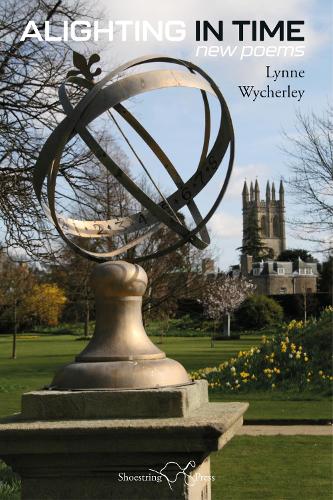
Lynne Wycherley describes her new collection as a ‘labour of love’ and certainly, it ranges over the places which have mattered most to her, from the Fens of her childhood to her new home on the Devon coast. Many of the concerns are familiar: the passion for the natural world and its creatures presented as under threat as well as a nostalgia for a world and ways of life which have vanished, both perceived as victims of digital technology. This collection is also marked by a sequence of poems centred on Merton College, Oxford, where the poet once worked, which is dedicated to the memory of the former Fellow , librarian and medieval historian, Dr Roger Highfield.
Another familiar feature of Wycherley’s work is her fondness for recondite vocabulary, whether taken from astronomy, biology or incunabula. This is such a marked characteristic of all her collections that we need to look beyond the inconvenience of having to consult a dictionary for every other line to consider more carefully what the poet is doing with language. In the first place, she is forcing us to read carefully and slowly so that we pay full attention to what she has observed and is writing about. Secondly, her use of precise if unfamiliar words reflects her own determination to pay attention to the phenomenal world.
The opening poem, ‘To a Neutron Star’, perhaps inspired by photographs of deep space, uses the vocabulary of science, ‘atom’, ‘nebulae’, ‘plerion’ together with visual and tactile metaphor, ‘small bright face suspended’, ‘flick a feather’, at once acknowledging contemporary astrophysics and recalling Keats’ sonnet, ‘Bright Star’ in its evocation of brightness, coldness, loneliness and distance. The presence of Keats is felt again in ‘In Praise of Small Weavers’ when the dormouse is described as an ‘eremite’, a very Keatsian word. However, while Keats’ evocation of the sensual beauties of Nature often expressed a melancholy sense of human mortality, the melancholy in Wycherley’s poems proceeds from the destructive impact of humanity and, in particular, of digital technology on Nature. This is expressed most starkly in ‘Child, Fox’ where the memory of encountering a fox:
child Fox. Fox, child
is seen as a meeting of creature with creature impossible since ‘the phones came’, which the poet views as stultifying. These ideas are developed in ‘Birth of a Book-lover’ , where the advance of ‘data-speak‘ is seen as more inimical to life than death itself, which is at least part of the natural process of regeneration.
bit rates per second, closed-loop control system
our lives shrunk to operatives
grey-bleak, while books – late-found –
were creaturely;
Wycherley is clearly very fond of books, not just for their contents, but in themselves, as objects, something also evident in her poems set in the Merton College library: ‘These fascicles, / red cloth. These burnishes, / Morocco. Hegel, Buber, / bowered.’ The juxtaposition of authors with their bindings suggests that, for the poet, books are a kind of incarnation. The precision of language –‘fascicles’ not just books, Morocco’ and ‘cordovan’, not just leather, is part of her poetic approach, the need to attend to and identify the nuances of the physical, especially when she is so painfully aware of the loss which has already occurred or is about to occur.
Nostalgic is not perhaps an adjective that Wycherley would welcome; her antagonism to the electronic age is too passionate. Nevertheless, some of these poems do use nostalgia to make their point. ‘For the Subpostmasters’ laments the loss of the sense of community built around village post offices which were also village shops: ‘He’s tins, aspirin, elastic bands, / eggs? Sue brought them this morning,’. The post-offices become a metonym for the vanished life of the village, with local shops, primary schools, churches and library-vans. The poem then moves to an attack on the ‘regents …. wielding their shears’ who have replaced the human contact of the postmaster with the ‘Faceless face’ of technology. The imagery here reflects the implementation of cuts by central and local government as well as corporate bodies, but the vocabulary choices of ‘’shears’ and ‘regents’ manage to suggest alien powers impervious to human intercession, whether mythological or superterrestrial. However, Wycherley does not look at the past through Hovis-coloured glasses; she acknowledges that her childhood home in the fens was ‘No idyll. It flooded in summer, / brackish, otter-haired, our / tatters swept in our parents’ arms, / their faces daybreak-grey’, while at the same time celebrating the closeness of nature she experienced. Moreover, as is evident here and in previous collections, her hostility to wireless technology is thoroughly researched and well-informed.
In some ways, this is a rather sad book; despite the celebration of the life of Roger Highfield and despite the determined effort to reroot herself in Devon which inspires the last section, the sense of loss not only in relation to the past but also the future, is very strong. The depiction of children climbing on to a school bus is contemporary and accurate: ‘necks bent – // in a four-inch pool / to scroll, glaze over, scroll // all the drowned birds // while trees, unloved, sway by’. Added to this are feelings of mortality, impermanence and the fragility of existence. The memories in ‘Brook Cottage’ end plaintively ‘- as if the brook //still utters, as if I once existed / after all. ‘This Library Fringed with Leaves’ concludes; ‘Too soon these leaves / and health will fail – / fast-fade, crackle, white-out , null.’ I hesitate to say there is a spiritual element in Wycherley’s work because ‘spiritual’ like ‘fey’, which she uses several times and attempts to redeem, are words which are degraded in common usage. However, in ‘A Fern for Christina Rossetti, she refers to ‘the Breath’ and in ‘A Prayer for Lost Gardens, she speaks of ‘a slip of light from / indelible Light’. Wycherley is a poet of light, but despite these lines, it seems that light too is under threat. ‘A Quest for Sunlight’, which is almost a hymn to the sun, ends:
yes no,
yes no,
yes, no
Are these streaks of sunlight flickering through the trees, or the final victory of binary codes?
Kathleen McPhilemy grew up in Belfast but now lives in Oxford. She has published four collections of poetry, the most recent being Back Country, Littoral Press, 2022. She also hosts a poetry podcast magazine, Poetry Worth Hearing.
*****
 The High Window