*****
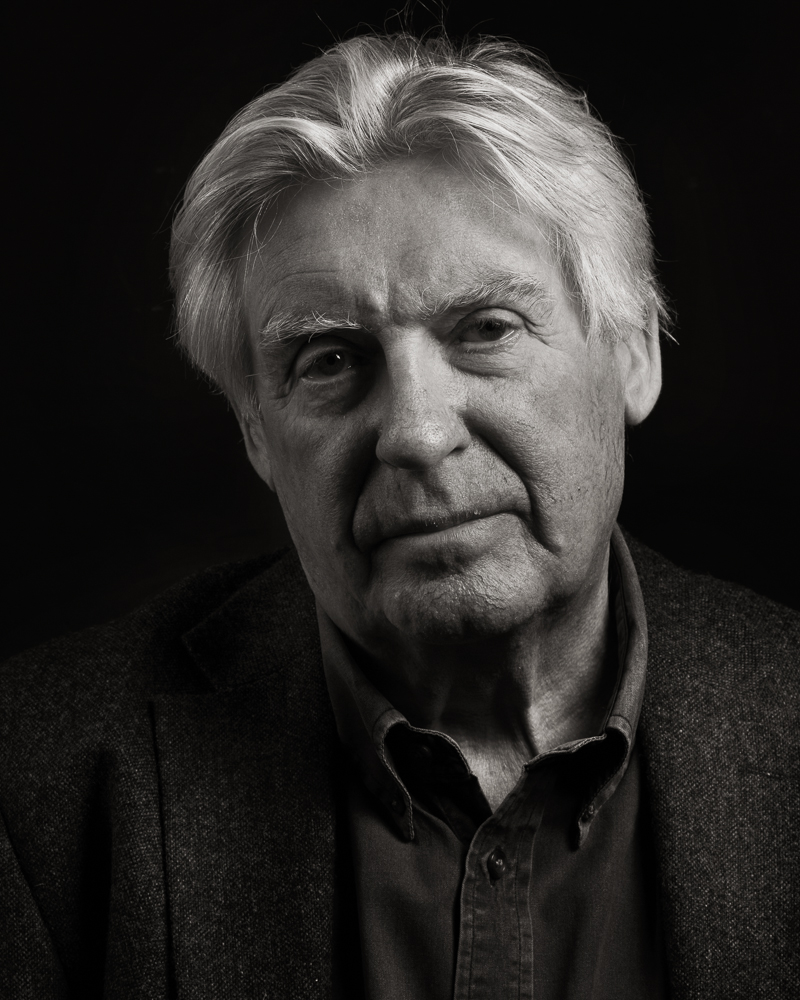
David Harsent has published thirteen volumes of poetry. Legion won the Forward Prize. Night was triple short-listed in the UK and won the Griffin International PoetryPrize. Fire Songs won the T.S. Eliot Prize. A Broken Man in Flower, Harsent’s versions of poems written by Yannis Ritsos while in prison camps and under house arrest, was published by Bloodaxe in 2023. A new collection, Skin, came from Faber in March 2024. Harsent has collaborated with several composers, though most often with Harrison Birtwistle. Birtwistle/Harsent collaborations have been performed at major venues worldwide, including the Royal Opera House, the Salzburg Festival, the Concertgebouw and Carnegie Hall. He holds a number of fellowships, including Fellow of the Royal Society of Literature and Fellow of the Hellenic Authors Society. He is Professor Emeritus at the University of Roehampton.
*****
Richard Skinner has published seven books of poems, the most recent of which is White Noise Machine (Salt, 2023). Richard is Director of the Fiction Programme at Faber Academy. He also runs a small press, Vanguard Editions, and is the current editor of 14 magazine.
*****
The Conversation • Two Poems from The Tanglewood Sonnets
*****
The Conversation
When and why did you start writing poetry?
I was eleven, and on my way to Sunday School, when I leaned over the first floor bannister at the post office building where my grandmother lived and worked, and where I had lived until I was nine, intending to slide down to the ground floor (something I often did), when I tipped over and fell the entire depth of the stairwell: about twenty-five feet. I still remember that fall, almost moment by moment. When the family doctor learned of this (he knew the geography of the building; he made a weekly call to my bed-ridden great-grandmother and my war-wounded father) he asked, ‘Is he dead?’
Inexplicably, I was only concussed. After a couple of days in hospital I was taken back to the post office and (unnecessarily, I dare say) put to bed. It was decided, I don’t know why, that my grandmother would take charge of my convalescence. Between the beef tea, the Lucozade, and the spaghetti hoops on toast, she went to the library to get me something to read – no TV, of course, and the radio was a piece of furniture the size of a dolls’ house, anchored in the living room. Among the books she brought back was A Bumper Book for Boys, or some such tome. It contained accounts of derring-do – polar expeditions, jungle exploration, colonial triumphs, suicidal cavalry charges and hagiographies of Baden Powell and other such grotesques. But between each account of a Thin Red Line or half-naked savages with nose-bones and a cooking-pot, some errant editor had slotted in a poem.
The poems held me. (I might say, en passant, that I really like the idea of a just-post-war radio as a dolls’ house: in one room, a tiny Mrs, Dale writing her diary, in another Alvar Liddell reading the news, in a third, Norman and Henry Bones, the boy detectives, bringing miscreants to justice.)
The poems held me, but I didn’t quite know why. In part, it was the music, the four-beat/three-beat lines; but I was drawn to the narratives, which I only partly understood, of betrayal and revenge, of love and loss, of witchcraft and shape-shifting, of mischief and murder. The language was sometimes beyond me, but I found I could learn by example: the images were strong and the stories compelling, so meaning unraveled.
I asked my grandma to go back to the library and ask if there were any books that contained poems like these. It’s clear that the librarian knew her job, because grandma came back with Quiller-Couch’s Oxford Book of Ballads. The poems between the patriotic heroics were border ballads. Perhaps it was an act of sabotage by an editor with a likeable sense of humour. I read those poems day in, day out. I wrote 11-year old imitations of Tam Lin and the Demon Lover. I never returned the book to the library.
Who introduced you to poetry?
I had written poems and stories before this. When I was in primary school I wrote, as a classroom exercise, a story reworked (stolen) from a book I had at home, and a poem based on (stolen from) a book called The Lord of the Rushie River, the tale of a motherless girl whose father goes to sea and leaves his daughter in the care of a loathsome woman who treats the girl brutally and dresses her in rags. The girl’s only friend is a swan, on whose back she rides as it flies. I was forbidden to read the book because it made me cry. I think I secretly wanted to be an ill-used orphan with a swan as my rescuer. I’d read – and had read to me – poems and stories, and I’d written stories and lines of my own, but I suppose it must have been Arthur Quiller Couch who stoked the fire.
How aware are and were you of the dominating presence of older poets traditional and contemporary?
One of the results of that fall was that I missed taking the 11-plus and, though I passed the 13-plus, went, at my father’s insistence, not to the fine grammar school on offer, but to a Technical High School, to which I was wholly unsuited and which was, in any case, an appalling institution staffed by floggers, ignoramuses and thugs. Its academic record was farcical. It offered only ‘technical’ subjects, save English and the recently adopted ‘British Constitution’, which I think was forced on it. No foreign language, no music, no history, no geography, but whole afternoons of metalwork technology and technical drawing. As a result, I left school at sixteen and didn’t go to university.
I was a fierce autodidact from a background which, despite my grandmother’s middle-class origins and family connections, was working class in terms of housing (social), finance (minimal) and cultural appurtenances (scant). My father was a bricklayer-labourer who had left school at 14, my mother worked on the same PO switchboard as my grandma. I had no mentor; my reading was based on guesswork and my choices unstructured. My plan was to read everything, and I tried to, but it was a bit like shuffling a deck of cards and turning either James Elroy Flecker or T.S. Eliot. I read randomly through the canon. Bit by bit, I more or less found the shape of things and formed opinions. I lived in the library and found that my post-school job in a bookshop gave me the opportunity for systematic theft.
My ongoing studies were also hampered by the fact that I was, in effect, a member of the working poor. I married early. As a twenty-year-old husband and father of a baby daughter, I was (we were) twice declared homeless. After that, we lived for six years in a two-up, two-down, cottage with no bathroom and an outdoor privy. My elder son was born in that place. I worked in the bookshop by day and, at night, wrote through to the small hours. And I read in every spare moment. As a late-teenage and early-twenties aspirant, Modernism was my lynchpin.
What is your daily writing routine?
If I have something in hand, I work for most of the day. For a time, after the bookshop, and then a ten-year spell as a publisher, I funded my life by writing commercially, though I published poetry throughout those years and never really ever thought of myself as a screenwriter and/or thriller writer. When I was writing crime fiction or screenplays, I worked insane hours to get those tasks off my desk. There were always drafts of poems and open notebooks on my desk alongside plot-summaries and screenplay treatments. This is not to deride entertainment fiction or TV and film, it was just a matter of priorities. Truth to tell, it turned out I was pretty good at commercial writing and (from time to time) made a handsome living. I also taught in universities on and off. Most particularly, I spent a very enjoyable near-decade at the University of Roehampton where I was given enough leeway to be able to focus on poetry and writing for the opera stage so as not to have to watch the dawn come up as I signed off on another episode of ‘Midsomer Murders’. And given my truncated educational record, I was (and am) pleased to have gained my professorship, my honorary doctorates and my fellowships. I’ve strayed from the subject…
What subjects motivate you to write?
My poems are fictions. I often trade off dream-images: that is to say, I adapt them; I put them to use. Of course, they’re my dreams and I don’t disown them, but the ensuing poem won’t be autobiographical. I suppose it would be best to say I’ve never felt the urge to write from life. My purpose in poetry, more or less from the outset, has been to frame a narrative using a lyrical vocabulary. It wasn’t ever a theoretical approach; I simply found myself doing it. The so-called Review Group, those poets most associated with Ian Hamilton’s little magazine of that name, were said to (invariably) write short, interpersonal lyrics. The notion was that anything over eight lines was looked at disapprovingly. I was part of that group for some while (Ian Hamilton became a close friend) but my interest in the short lyric lay in how it might be the basis for an extended, though fragmented, narrative, one that would take the weight of progressive incident and event, and where the reader could trace a complex emotional pattern. ‘A Dream Book’ (Fire Songs) might be taken as a late example of this.
Of course, there are, in my work, what might be called themes. When asked what do you write about? I used to say ‘Sex and death’. The joke wore thin, though it was never really that much of a joke. From the outset, interpersonal relationships have been a returning subject. So has that other dynamic of human conflict, war. I was born in what was called ‘the worst year of the war’; people close to me were deeply affected by the war; as a result, I was deeply affected by it. Legion is, perhaps, the most obvious response to that, but my versions of the poems Goran Simic wrote while besieged in Sarajevo, and of the poems Yannis Ritsos wrote while in prison or under house arrest during the Papadpoloulos dictatorship, were fed by the same impulse.
Another repeating theme is our brutal and soulless way with the natural world. The developing threat of the sixth great extinction has everything to do with our having lost touch with the subtle and complex mysteries of nature, that is to say with the creatures with whom we share the planet, with the creatures and with what grows and blooms and sustains. The European skies have lost 30 million birds since the 1950s. Britain’s biodiversity record is atrocious; we are one of the most nature-depleted countries in the world. A million animal and plant species are close to extinction. That savage depletion is occurring in other countries year in, year out. I wrote – at the request of the Ptuj Poetry & Wine Festival (in Slovenia) – an Open Letter to Europe on the subject. The Festival published it as a pamphlet. It appeared, in translation, in broadsheet newspapers throughout Europe. Those who rule the planet, who govern, control and exploit it, seem to have no knowledge of the peril we’re in. Or they simply can’t conceive of – or tolerate, or allow – a world that is not for-profit. When I used the word soulless earlier, it was them I had in mind. What’s needed is something akin to soul-retrieval. Capitalism stands in fierce opposition to that; it always has.
Those themes might find their way into the poem as it develops from that first nudge: become part of the narrative, illustrate it, direct it, become a narrative constituent. There’s a better way of putting that, but to investigate it more deeply would be to court inhibition. I think of X.J. Kennedy’s quatrain warning of the dangers involved in compositional scrutiny: The goose that laid the golden egg / died looking up its crotch / to find out how its sphincter worked. / Would you lay well? Don’t watch.
There are touchstone images in my poems: flight, birds in flight, a white bird on a blue (sometimes white) sky, white on white, a white bed in a white room (black is erasure but white is effacement), a painting in which human figures are sensed only as a hidden weight in the canvas, a ‘white’ book, water over stone, the hare: as interruptant and protagonist, the Fool as interruptant, dreamwork/dreamlife, a house of women… These, and other, images, (also certain words and lines) will turn up from time to time in poems where they take on a different weight and energy, a different texture, a different narrative purpose.
I said, recently, of a sequence I’d written, that my characters carry the narrative. My concern with extended narrative (often fragmented) has often led – logically enough – to sequences, some of them book-length. These are, as it were, through-composed; it’s in their nature. Apart from some poems from the early books – poems that might appear autobiographical, but are not – the only poems I’ve written that settle on a subject from the outset have been commissions (which I rarely accept). ‘Bowland Beth’ is probably the best example.
It’s often said that my work is dark. I can see that it is, as a matter of comparison. What most often provokes me is an image or a trigger-word or a part line. Where those opportunities come from is a mystery to me. The best I can say is that they crop up. Then lines accrue.
What is your work ethic?
I don’t really know what that means. If it has something to do with motive, I’m not sure how that would (or could) apply. I simply take up the impulse to write when it occurs. As I said in my last answer, opportunities crop up. Nabokov likened that feeling to a nudge. I recognise that: a hint, perhaps, but without subject; an uninterpretable whisper; or that I know something has (as it were) entered, something like a temperature change or a shadow falling. That apprehension will be quickly followed by an image or a word or half-line. It might, rarely, be a memory (it would never be an idea) though that will have been changed, blurred, in the recollecting and will almost at once develop as fiction – memory being fiction anyway. Our histories, not least our emotional histories, are what we last remember.
How do the writers you read when you were young influence your work today?
I don’t know; or, rather, I don’t know if they do. I suppose those poems that moved or disturbed me will have left traces.
Whom of today’s writers do you admire the most and why?
If I were to provide a list, I’d be certain to forget someone; or, perhaps, mention someone of whom I might come to think less well.
Why do you write, as opposed to doing anything else?
I assume you mean anything else in the arts. As a publisher, I was a good editor, but a lousy businessman; I lacked the acumen. Numbers – I mean figures – are a mystery to me; that is, they’re mysterious. Seven, nine, thirteen… A significant part of my work has been writing for the opera stage or for the concert hall. I’ve worked with several composers, but my collaborations with Harrison Birtwistle – four operas and as many song cycles over a period of thirty years or more – was a life-changing experience. The visual arts, painting in particular, have always been important to me. I wrote a long sequence that was loosely based on the relationship between Pierre Bonnard and the woman who called herself Marthe de Meligny. I gain emotionally and spiritually from painting, as with music, and always have done. I’m neither a composer nor a painter because I have no gift for either, but it’s not a matter of choice or exclusion. I write because words are my means of interpreting the world. My vision, for better or for worse, is only achievable in (or through) poetry.
What would you say to someone who asked you ‘How do you become a writer?
Read.
You published your first collection, A Violent Country, with Oxford University Press in 1969 and went on to publish four more collections with OUP including Mister Punch (1984) and News from the Front (1993). Looking back on those early volumes, which parts of the work still stand the test of time in your view?
There is, I know, a notion that early collections are the work of one’s apprenticeship, but I don’t really hold with that. It can be the case, I suppose, that there’s some sudden, sharp change of direction between early books and what is then seen as the poet’s real purpose – affiliation with a movement or theory, or the (supposed) appearance of a mature style – but I think pursuing one’s gift is most often a case of consolidating and developing subject, or finding that word-choice is becoming instinctive in the way it feeds lines. I think I set out my stall with those earlier books or, better perhaps, began a journey; I knew what steps I was taking but not where I was going. I still don’t. It’s been said of my work that I’ve never written two books that were alike. I suppose you could say that that’s not quite true of A Violent Country and After Dark, but that Dreams of the Dead was a departure: it established my focus, which was already in evidence and has remained pretty constant: what John Burnside referred to, in writing about Loss, as ‘the human drama’. (Even Legion held to that in its way.) I have been told that a recent book by Andrew Duncan, on British poetry of the 1970s, had Dreams of the Dead as one of the key books of that time. I’d like to think it was; it was for me in terms of discovering a way forward.
There’s a line in Loss that I filched from a poem in After Dark. It’s doing different work, but it’s unchanged. As I’ve said, that’s a characteristic of my work: touchstone lines and images that reappear in the way that composers use themes or painters reference image. Their purpose, I think, is to provide evidence of continuing themes but, on each occasion, they serve a different purpose. I don’t summon them, they present themselves, and when they do I almost never resist them. The really attentive reader would, I hope, go back to those touchstone words, phrases, images, narrative moments – that extended and continuing pattern – and look at the way they are central to specific passages and narratives, but also inform mood and purpose throughout. I ought to say that this particularly applies to my later work.
You moved to Faber in 1998 with A Bird’s Idea of Flight. Several collections followed at regular intervals, including Marriage (2002), Legion (2005), Night (2011), Fire Songs (2014), Salt (2017) and Loss (2020). In each of these collections, I see a presiding structural conceit that drives the work. In Flight, for instance, it’s (obviously) the circular journey; in Marriage, it’s the ‘mysteries of domesticity’ as you call it; in Legion, it’s the idea of the ‘testimony’ and in Fire Songs it’s (again obviously) the ‘song’. I think you’re right to say that no two books of yours are similar in form. Did the move affect you or your work in any way? Did these forms come more easily to you because you had so much work behind you by then?
There was an OUP contract on my desk for A Bird’s Idea of Flight and the final version of the manuscript more or less ready to submit. Like many OUP poets, I’d been unhappy, for some time, with the senior management’s apparent lack of commitment to the list. (Not, I hasten to add, the fault of the editor.) I think Hugo Williams had already jumped ship; I was more than ready to do the same. Of course, OUP – disgracefully – closed the list a year or so later: conclusive evidence of the way things were going.
I had begun my libretto for Gawain and was planning to make a final pass at A Bird’s Idea… before sending it in. While I was working on the libretto, a weird thing happened. I interrupted myself, without knowing I was going to, when a scrap of verse came into my head. I stopped, scribbled those few words in my notebook, and went back to work. The lines were: He was clean and gone / Long before the bus / Left the yard, Corpus / Christi writ thereon. Where they came from: what prompted them, I can’t remember; I’m not sure I ever knew; but obviously they’d come to mind for some reason. I can only suppose I’d read or seen or heard something that caused that errant compositional moment. As I continued with Gawain, interruptive lines kept cropping up. By the end of the day, I had…I can’t remember, now…twenty or thirty such squibs in my notebook.
Over the next few days, while continuing to work on the libretto, I wrote more. In all there are sixty-three. It became evident to me, as they appeared, that I was writing the biography of a priest, who was tortured by uncertainty, temptation, and the strictures of faith. Quite why was, and remains, a mystery to me. I was told once, by a bishop, that, having been brought up a Baptist, I would (‘obviously’) become a Catholic. My priest is Catholic. I thought, at first, that the squibs were a sort of exercise in comic extravagance. Then I saw that they were not. I published the sequence, privately, under the title The Potted Priest – ‘potted’, I suppose, because the poems were just a few lines each; only three hit the bottom of a very small page.
I sent the booklet to friends. One of them, Christopher Reid, responded very positively and suggested that TPP would be ‘everyone’s book of the year’. At the time, Christopher was Faber’s editor. He asked me, en passant, whether I happened to have a manuscript he might see. A Bird’s Idea of Flight would have been something of a turning point for me whoever had published it; and a turning point it was, but not just because it was taken on by Faber.
However, I think there might have been a new sense of freedom under Christopher’s editorship. (I should add that my last collection with OUP was News from the Front, and I still think well of that book.) Maybe the change itself, and the new energies to be found in Christopher’s enthusiasm, the sheer professionalism of Faber, and being part of that list, gave a general sense of purpose and possibility that hadn’t been evident at OUP. It was, definitely, a time of more intense writing: for years I wrote every day and seemed to be never without lines in my head and the beat of poetry in my ear. Having been asked about this recently, I went back to Elsewhere, the long poem that ends Night, my fourth Faber collection, and wondered how it was that I got up every day to write the next seven-line stanza of what became a poem of 749 lines.
I might say, en passant, that when Harrison Birtwistle and I were discussing a piece for Mark Padmore (who sang Orpheus in The Corridor and doubled as Jason and Aeson in The Cure), I asked Harry what he had in mind. He said, ‘Perhaps a journey. You know, like Winterreise.’ I mentioned that Elsewhere had been described, by one critic, as my Winterreise. Given that the Müller cycle, set by Schubert, is 380 lines and lasts 75 minutes, that notion wasn’t pursued. The sequence that I wrote, that Harry set (after much to-ing and fro-ing and some misunderstanding), and Mark sang, was Songs from the Same Earth – 96 lines.
I think you’re more or less right about what you call the structural conceits, the patterning, in the books you mention, apart perhaps from that in Fire Songs, the title of which, by the way, was suggested by Matthew Hollis, then my editor, who not only rescued the book from a somewhat desperate last minute attempt by me to find a title, but also persuaded sales-marketing to agree to a title change at a moment somewhat beyond the fifty-ninth minute of the eleventh hour. I thought the focus of the book would be apparent: the four Fire Songs that I saw as the spine of the book: that is its imperative, although there are poems in there that are no less crucial to the book’s shape.
The narrative of the four songs is not difficult to follow; it has an interpersonal thread which works in parallel with aspects of the climate crisis and historical accounts of conflict and barbarity. They form an inter-related and interdependent story. A man determines to destroy by fire everything he owns: the sequence starts with that. (I saw a TV show about Michael Landy’s piece of performance art, Break Down, in which he set about just that task.)
The first poem in the sequence, Fire: a song for Mistress Askew is an account of the trial, torture, and death by burning, of Anne Askew, a Protestant martyr. She is cast as visionary and fire is a crucial factor throughout. Her prophetic utterance (given her by me) It will be fire, it will be fire, it will be fire is a significant and propulsive line that delivers energy, purpose and direction through the four poems. Evidence of the heat-death of the planet is present throughout: our indifference to the plundering of the planet, the consistent attack on the biosphere, now, in the later stages of the Anthropocene, persistent contempt for the sacred, and a refusal to understand that we are a part of nature, informs the Fire Songs from start to finish.
So I thought the suite of Fire Songs would be given particular attention, but though the reviews overall were uniformly good, that didn’t happen. Maybe the balance of the collection, or even its contents, might have needed to be differently managed to bring that about. My fault.
I don’t think you need to worry about that. It seems to me that the four ‘Fire Songs’ are the four pillars holding up the rest of the book. They are central to it. I’d like us to move on to your most recent collection, Skin, which was published by Faber in February 2024. I think it’s a masterpiece. It’s made up of 10 parts, each of which is discrete, but placed together, they pack one hell of an emotional punch. Some of them were published independently as pamphlets by some fantastic small presses. Can you please talk about the genesis of these different parts and how they all fitted together?
As you say, some appeared before their inclusion in Skin: Salt Moon and Nine were both published by the wonderful Guillemot Press, Of Certain Angels came from Dare-Gale Press, a small publisher that has recently started a strong new list featuring contemporary poets, and Fine Press Poetry published a truly beautiful collectors’ edition of a selection of poems from Animals Silent in Darkness under the title A Clockwork Diorama.
Increasingly, my vision is best served, or so it seems, by a sustained narrative, though not (Elsewhere excepted) by long narrative poems, so my recent work has consisted most often of sequences and it seemed right that a new collection should contain those written (roughly speaking) after, or just before, the publication of Loss. There are nine sequences in Skin The final, tenth, piece is a fractured narrative, whose parts can be described, I guess, as sequential. Each piece, save for Nine, ends with an epigraph; someone reading through those epigraphs would, I think, get a pretty well-formed notion of what connects the sequences. (I don’t want to characterize it: that’s for others to do.) It’s also the case that there are those images, lines, key words, repetitions, that thread through my work: they all share – or, rather, came to share – aspects of the vision that (as with all artists) is my interpretation of the world: that is to say, the interiority that governs that interpretation. As I’ve mentioned, the way in which those images, lines, etc., can do different work in different places is (has become) an aspect of the patterning in my work, an extended linkage. a short passage in the poem ‘Room thirty-seven’, from the sequence ‘Hallways and Rooms’ in Skin, is taken from a poem in my second collection, After Dark, fifty-one years and eleven books ago. The way in which that passage suddenly presented itself to me, and what it brings to the much later poem, came as a revelation.
To expand a little on a remark I made earlier, I first saw the opportunities presented by a sustained, but broken, narrative when I was around Ian Hamilton and the so-called Review School. For me, those short, interpersonal poems only had weight and purpose as an interrogative sequence, where a sustained narrative developed aspects of ‘the human drama’. It seemed to me that the characters involved needed more scope and space: that the reader deserved a better account of those little psychodramas, and that this could be best done by, as it were, turning the pages to find different episodes from the drama in question.
Ian published Dreams of the Dead in the New Review: a poem best described as episodic and, in terms of scope, unlike anything I’d written before. His belief in that sustained narrative gave me confidence. I went on from there. It’s maybe worth noting that Dreams of the Dead was the title poem of only my third collection: this preoccupation goes back a long way.
The language in Skin is very dense. It’s clear you have spent a great deal of time and effort in your word-choice and this care really stands out when one reads your work slowly. I’ve been reading your poetry pretty intensively for a number of years now and what I’ve found is that it also works if one reads your work quite fast. There is thin ice between your work and the abyss beneath, so you have to skate fast over the words so that the ice doesn’t break. I’ve found the same applies to the work of Geoffrey Hill, especially the later work. Why do you think this might this be the case?
No idea. All I can suggest is that the narrative, though fragmented and (intentionally) incomplete, might draw the eye. Reading my poems fast, as you describe, doesn’t trouble me, but would were it not for your qualifying remark about word-choice and reading slowly. But I’ll go back to Geoffrey Hill to investigate the comparison, (He one said to me, ‘David, you and I come from the same stock.’ My father was a brickie; his was a village copper.)
I’d like to turn your attention to The Tanglewood Sonnets. David, this is a staggering sequence of poems. I couldn’t believe what I was reading when you sent them to me and I am very proud to be publishing them. We’ve talked about how alike they are to György Ligeti’s Études pour piano in their stringency and brevity and for their impact. Can you please tell us a little bit about where these poems came from and how you formed them?
Tom Stoppard was once asked where he got his ideas from. He said, ‘If I knew, I’d go there.’ I recall Martin Amis being asked much the same question: where does it come from, not so much the reason to write – subject and compositional notion – but the impulse, and he quoted the Nabokov response I mentioned earlier, likening the onset of a novel not to any formed idea, but to something akin to a nudge, an alertness. I would say, an emotional awakening. I know there are poets who decide on (arrive at) a subject and make a plan, not least, I think, when they have an extended piece in view. I can see how that works and I don’t deride it, but with me it’s the nudge.
My younger son, Barnaby, when he was small, once asked me: ‘Your poetry – do you just make it up as you go along?’ I admitted that, yes, that was pretty much what I did. What tends to happen (and I don’t want to think too closely about it) is that lines and images arrive, dependent on each other, and I make sketches, and lines start to take shape. Obviously, as I progress, things become richer, more opportunities present themselves, the narrative becomes self-sustaining, characters advance that narrative – an emotional development – and music and word-choice provoke new opportunities. (I don’t suppose this is unique to me.) Sometimes, as I’ve mentioned, certain touchstone images and lines fall in, or ‘crop up’ might be more accurate, and enrich the mix with echoes of, or references to, earlier work, that shed light on the work in hand. (I think that might be unique to me.) So, the compositional me is focused on the lines as I write, but the instinctual me is, at the same time, reaching out.
I’ve said that some of my work (Elsewhere is an example) seems to get written – or, at least, get underway – in a sort of fever-dream. My joke title for the Fire Songs poems (that set of poems, not the collection) was ‘Red Mist’. I can feel that I’m not giving a very accurate account of this, but that’s not surprising, perhaps, since I’m trying to describe not just something as abstract as a nudge and the way that nudge develops, but a nudge, and a development, both personal and particular.
My particular interest, mentioned earlier, but worth repeating here, since it throws light on the Tanglewood poems, was in the way that a series of short poems might connect to make a discernible narrative: a chain-narrative, if you like, ‘beads on a string’ was one reviewer’s description. I have pursued that notion: an extended narrative given in brief (though, as things have gone on, less brief) scenes from a drama that probably starts in medias res and might draw to a close but have no obvious conclusion.
The Tanglewood Sonnets is such a narrative. It can, I think, be read as a novel, if the reader is prepared to use its images, its episodes, its musical hints, and its word-choice, as a means to gaining its dramatic shape and narrative drift; that is, the reader might also make it up as he/she goes along. I ought to say, perhaps, that these are sonnets more or less by accident. Starting to fashion lines for the first poem, I wrote a couplet, then embellished the next two lines with a third, and so on. It was when I began the quintain that I saw what was going on, and went with what I seemed to have fallen in to. They’re not sonnets, of course, they’re fourteen-liners, but I’m happy to adopt the loose description that is current. As it happens, instinct served me well. Fourteen (as it turned out) fourteen-liners was what the narrative stretch wanted.
Thank you for that very comprehensive and illuminating description of your process. To me, it seems as if these poems are carved on air. They come from nowhere with such power. Truly remarkable. What’s in store for you in the future? Have you felt the nudge of any new work?
I never stop working. My notebook gets used pretty much every day. There was a short pause after Dare-Gale published Of Certain Angels, the Guillemot edition of Nine, and Bloodaxe bringing out A Broken Man in Flower. Not long before that, Guillemot published Salt Moon, a collaboration with my elder son, his photographs, my poems; then, a bit later, Faber published Skin. Maybe, given that output, a break was inevitable, but it makes me uneasy. If I’m not writing, I don’t know what I’m for.
When Harrison Birtwistle died in 2022 a significant part of my compositional life was curtailed. Harry and I had collaborated, on and off, for more than thirty years. The moment when he cold-called me, to ask whether I’d consider writing an opera with him, changed my life. The opera was Gawain. It opened at the Royal Opera House. That piece, our subsequent work for the opera stage, plus song cycles and solo pieces, were (and still are) performed worldwide. When he died, we were talking about (and I was making notes and sketches for) a Glyndebourne commission that will now never happen.
After that cold call, Harry became a close friend, and our work together was an indivisible part of my life. There is no easy way for me to characterize its importance to, and influence on, my creative thinking. Harry’s was the most interesting mind I have ever met. His way of encountering the world through his art – and in life – was deep, wholly unique, always revelatory; being close to that, being part of it, was exhilarating. I miss him and I mourn him, and I thank the gods (of whom, in The Minotaur, I say: [they] look down and laugh) for bringing us together.
I hope, though, that my life in music will continue. I’m currently talking about new pieces with three very gifted composers, all of whom I’ve collaborated with before, and we’re eager to start work. We need commissions, of course, and are hopeful, despite the fact that the arts in this country have been systematically trashed and deliberately defunded over the past two decades or more.
That aside, I’ve written fairly seamlessly since I moved to Surrey from London two and a half years ago. Before we found somewhere to buy, we rented and I found myself, pretty much by accident, living on the Pilgrim’s Way, close to Gunpowder Mills, then in a house called Tanglewood, and now in Wonersh, (middle English for ‘crooked field’) which is next to a small wilderness called Blackheath, names that prompted lines, though lines very far from the ‘poems of place’ that those titles might suggest. At present, I’m working on a poem called The Dance of the White Spider. The white spider has been cropping up, lately, as a touchstone image. You’ll be unsurprised to learn that I’ve no idea why or how that little critter appeared on the page; nor do I yet know quite what, or how much, it wants of me.
NB: Our thanks to Paul Brookes for interview technique.
*****
David Harsent: Two Poems from The Tanglewood Sonnets

****
III THE RETREAT
This light in city streets: she calls it nightshade.
Glass darkens; shutters go up; the backstreets huddle.
She is walking blind, as when he first found her,
and speechless, now, but she has left a note –
Let it go, let it all go, break or burn.
Road-noise is a neap tide broaching the kerb-line, drag
of water on a pebble beach, foul air as sea-fret.
How to shoulder aside those abandoned journeys,
her sometime-self setting out and then again…
There’s a train to that retreat of sea and stone.
Its passengers are numb with sorrow. Their children
have found them out. She boards the train and sleeps.
In her dream she is seaborne and abandoned.
He has mapped the place and is hurrying to meet her.
XI GOSSIP
Women washing the new dead: a photograph
in faded silvertone. A man is laid out to be swabbed.
She goes there and takes on the task. Her hands
on his body. He stares. His wounds are dry.
When she hauls on his arm he rolls over to come arse-up.
Birds in the rafters, rattle of small machines,
a smell of scorch in the air, and blossom, and iodine.
The dead man is pliable. He stares. She wonders
what it would be to feel grief, where that would begin and end.
Gossip from table to table takes in other men
who live in memory, a place the women
have recently abandoned. A day like any other,
its rhythms and repetitions. The silvertone is rainlight.
She soaps his back, takes a pumice stone to his heel.
 The High Window