*****
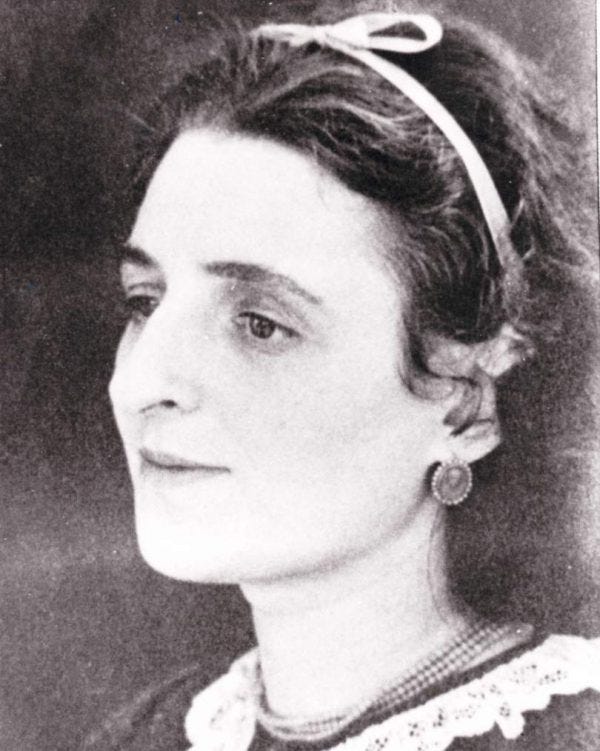
Laura Riding Jackson (born Laura Reichenthal; January 16, 1901 – September 2, 1991), best known as Laura Riding, was an American poet, critic, novelist, essayist and short story writer.
*****
Sam Milne: The Poetry of Laura Riding
Most people who know of Laura Riding probably think of her solely as the poet who abandoned poetry. This is a fair, if unenlightening, assessment. The fact of abandonment does not entail a loss of value. The poetry she did write is of extreme critical interest. Although she warns of ‘interpretation’s waste’, ‘the cries and the comments of beak-minds’, we can gently step aside from these cautions by recalling her own considerable, and influential, creative and critical prowess. (I cannot take seriously Peter S. Temes’s view that ‘By disavowing her poetry, she also disavowed, implicitly, all who would attempt to interpret it, for they would have to begin by assuming that in it lay at least some value.’) She regarded her own work as ‘new poetry… written outside the shelter of contemporary criticism’, stating more fully that ‘I was religious in my devotion to poetry. But in saying this I am thinking of religion as it is a dedication to, a will to know and make known, the ultimate knowledge.’ It is the latter part of this statement, and its enactment in her work, which has sometimes led to difficulties in appreciating and interpreting her (at times it seems) formidable ‘fortresses of contemplation’ — ‘a poetry in extremis’ as she described it. It is puzzling to know why.
Philosophical poets are not that rare (one can think of Empedocles, Lucretius, Shelley, Wordsworth and MacDiarmid, for example) and Laura Riding is one of the finest among them. It may be that such an intellectual position is rather unpopular today in our largely sceptical (if not mocking) age which regards philosophy as largely redundant, or only of marginal interest to the Academy. Or it may be due to the ever-increasing tendency towards specialisation, the view that the poets should stick to poetry, the chemists to chemistry, philosophers to philosophy, and so on. This narrowing of the mind’s interests is hardly what Riding thinks of as ‘ultimate knowledge’ (an echo perhaps of Hegel’s ‘absolute knowledge’). Throughout her poetry and prose we find her, in Barbara Adams’s phrase, ‘searching for a unified identity’, exploring reality as a whole, to forge Wordsworth’s ‘music of moral fraternity’, to establish ‘a fresh modern view of the nature of modern poetry’ as she expressed it. She is hardly alone among the moderns in valuing poetry so highly. We have Wallace Stevens’s ‘The Necessary Angel’, for example, and Hart Crane’s belief that poetry has the ‘capacities for presenting the most complete synthesis of human values.’ To instantiate this synthesis Riding’s intention is to return to poetry’s origins, and to find there what matters, in a resolution of art, religion and the spirit which recalls Hölderlin’s poetry in its lyrical, learned intensity.
Riding’s poetry is not particularly concerned with the crafted finality, or even semantic certitude, of a single poem, but rather with the commitment to writing a continuous poetry which slowly, over many years, begins to reveal the intellectual and spiritual drama of a life. She envisions poetry not as some kind of stop-gap compensation or therapy then, but as an inexhaustible spring of renewable, constantly changing meaning –an invaluable, irreplaceable power which reveals what matters most in our lives. The poems that are written, the poems that are available to us within the tradition, she regards as entities eternally at strife, agons of composition. She goes to the well-spring of ancient poiesis, to bring into being that which matters most in an engaged existence, — our cry against, our outrage at, death. This Heraclitean fluidity of thought, the equal necessity of all moments, enables the maker, the poet, to shape being, to disclose new worlds which often emerge and then immediately withdraw themselves – an action that goes all the way down, plumbing the very depths of being. This is a crucial point she returns to time and again in her criticism, that there is a sanctity to poetry which is very often uninterpretable in its manifold paradoxes and contradictions. (Although she influenced William Empson’s criticism, one can hardly imagine she would agree to the narrowing-down, the quantification if you like, of ambiguity to a mere seven types. For her, equivocality is more abundant than that, more ontologically abundant.) In abiding by this primal source, poetry may even annul itself, and give way to an even greater truth, a limitless plenitude of meaning – ‘the span of mind’ of which Riding speaks, the Socratic lesson that nothing, especially knowledge itself, can ever be fully mastered this side of ‘the great surmise.’ So we discern in her work the drive for an integrated vision, a continuum of values which encompasses female liberation, the desire for a re-integration of the creative imagination, the supremacy of the mind or intellect over nature (David Perkins has argued persuasively that Riding’s poems ‘have the action of intelligence as their form and content’), the pursuit of ‘an active literature of spirituality with the dignities of modern intellectuality,’ and the eventual need in her life to abandon poetry in the pursuit of other intellectual interests.
For Riding the new poet has to cast her style, her form, in the light of the ‘vexed ghost’, ‘the shadowing ancestry’ of tradition — ‘the dusty blight of books’, ‘rhythms of old circumstance’, ‘the illegible dialect of tombs.’ This regenerative voice can only be discovered within ‘That Ancient Line’, ‘the long-drawn-out | shadow-war against the old ones’ as Amy Clampitt called tradition. Poetry’s ‘living knowledge’ is pitched against logic’s ‘precise madness’, ‘the massacre of thought’, our ‘rational disgrace’, in a neo-Blakean dispensation. The empiricist is viewed as ‘the big dunce with the little sieve’, the artist’s search for a ‘human-hearted poetry’ compromised by ‘this fully apprehended planet’ which has been slowly ‘fed to the mathematic hounds.’ Her cultural pessimism runs deep, and is almost Spenglerian in its gloom, writing of the epoch’s ‘general palsy’, our ‘temporal ailing visions’ which ‘widen to a watery zero.’ A full list of phrases is revealing: ‘ruin unfolds from ruin’, ‘a full moon of waste’, ‘the spectrum of incongruence’, ‘precipitant despair’, ‘we are become… miniatures of fortune’, ‘the rags of shamelessness’, ‘the accolade of stilted vision’ (the last two phrases fine previsions of the state of things today). So we find the poet taking on a ‘singlehanded conflict’ as she describes it, against the age’s mores, much as we hear Wittgenstein fulminating against ‘an age of declining culture’, ‘the terrible degeneration that [has] come over the human spirit.’ In such a barren landscape, paradoxically perhaps, hope can flourish:
If the music will at first seem harsher than older tunes, it is because the new poet must be endowed with the ruthlessness of the pioneer. He is a little harder, a little more muscular because he is called upon to be equipped not merely for static ecstasy or despair but for a progress into an unexplored terrain… he is preoccupied chiefly with meaning, but a meaning inevitably rhythmical and poetical since it is a barren life reborn, touched and shaded with accent… a symbol of peace and reconciliation between the inner nature of a man and the external world without him.
Here we have the roots of that inimitable jerky, percussive music, owing much to jazz, tango and ragtime, we associate with Laura Riding’s work, her attempt to establish a poetry which ‘takes us on, and on, to hope of something.’ It is a poetry which (perhaps incongruously) on the surface at least, seems remote from the public arena, but in fact carries important countermoves against cultural despair. Riding argues that poetry’s task is ‘to call upon… idealism to convert the world into a more accessible place, kindlier, less terrible even if its manoeuvres as such have to be conducted in a syntax which is riddled with doubt and restlessness’. In this way poetry’s ‘candid converse’, its ‘self-inquisition’, can ensure both dignity and truth in a complex and diverse age, a poetry grounded in a strong, unifying personality: ‘Let us seem to speak | Or they will think us dead, | revive us.’
We have ‘no other hope of passion than words’ Riding declares, ‘true words’ bringing us to the ‘full possession of the human inheritance’, ‘the beneficent duty that words lay upon us’, ‘the ring and spirit and mental movement of true wording.’ Words, however, are more than just a mere ‘verbal niceness’, ‘a linguistic ritual.’ For her, they embody an ethical responsibility which falls heaviest on ‘that ancient mystery-monger, the poet’, whose work discovers ‘a new covenant’, a ‘living thread | By which the cloth of being, | Though an ancient rag, | Moulders not utterly’ — revealing the true splendour of ‘the common things | That also wait their hour of light.’ To oppose ‘the way the world speaks’ in its customary dullness and brutality, the poet pitches an ‘intenser self’ which surmounts ‘the stuttering, slow grammar of self’, dredging from ‘the dark substance of the mind… such quickness as makes life’ — an inchoate, chthonic ‘blessing’, an action akin to Hegel’s ability, according to one of his students, ‘to raise up the most powerful thoughts from the deepest ground of things.’
Prefiguring the Open Field theories of Charles Olson, Riding writes of poetry’s ‘open presence’ before reality: ‘a pulse of mind, of rhythm, of thought’ which transforms ‘visions into actualities’, ‘reconceiving… being’ as a ‘steadily shining countenance’, ‘a quickening of substance’ transcending fate’s ‘blind persistence’, its ‘blind scheming’. This openness surmounts determinism’s ‘blind-spun spaces’ (a phrase akin to Geoffrey Hill’s ‘Their best of worlds since on the ordained day, | This world went spinning from Jehovah’s hand’). Out of this ‘Cavernous nothing, tumid with life’, ‘this gospel of oblivion’, comes the human voice beseeching clarity and order. Her conception of poetry’s power is of the highest denomination then, regarding it at ‘a level of expression above all common levels of expression, existing on a higher plane of synthesis’, possessing a ‘unique height of linguistic and spiritual distinction.’ These are very high claims, and suggest hopes that, in the end, could perhaps lead only to disappointment and disavowal. Poetry’s place in the hierarchy of the arts and sciences is such, she argues, that it can prevail over the world’s ‘ragged union’, its ‘weighted sack’ — the ‘blindness and noise’, ‘the ‘perjuring’ and ‘unloving gossip’, the ‘reckless strum of hate.’
As in Rilke’s great poem ‘Orpheus. Eurydice. Hermes…’ the poet’s voice awakens ‘the sign of emptiness, | An empty grail, an empty world’, so that we experience ‘the shock of hearing ourselves speak’, bringing some peace and harmony to the world’s ‘quarrelsome variety.’ For the visionary poet, existence is ‘A world of self-blind pages, | Staring to be read.’ Whatever poetry may be, then, in its multifarious definitions, for Laura Riding it ‘opens upon comparison’ (in contradistinction to the logicians who tend to close down on precise definition — one thinks of I.A. Richards’ forays into literary criticism, for example) and, possibly arguing against the likes of D. H. Lawrence, she believes it should have no truck with ‘automatic sentiment’ (or contra the realists, that it is not ‘A mere enumeration of parts’). ‘To have a poetic consciousness of existence at least some of the time, in at least some phases of experience, is the normal human dignity’ she states categorically, aspiring in her work to what she perceives as the ‘pure human tone’, the ‘human integrity’ she discovers in the finest poetry, admiring especially John Donne’s ‘strong humanity and daring’, Shakespeare’s ‘raw unsleeping eye’, and Robert Frost’s ‘human strength of mind.’ She places stress on the importance of ‘linguistic exactitude’. Words for her have to be ‘exact and just.’ So it is that we listen to the restless and searching tone of her perplexed verse, which faces up to the intervallic, episodic reality of modern life, full of discord and dissonance, ‘a division’ she believes that can ‘prove the whole.’ She describes the modern scientist as opposed to all of this, calling him the skilled optician who wears ‘the most perfect spectacles ever made’, stubbornly blind to what is essential in life.
There are other forces she believes which drag us down from ‘the spell of unity’ as she names it, the ‘final unity’, ‘the living whole of being.’ Superficially these forces include ‘idle speech… falseness of word’ that mock our human distinction, all that is ‘a wild fraud’, ‘the mortal chatter of appearance’, our ‘quotidian inanities’, our ‘grave-chatter’ including what we would now call political ‘spin’ or propaganda. But at a deeper, existential level, she regards time and death, that double-headed monster of mortal corruption, as the greatest weight upon us. Her work is riddled with references to our transient despair, our ‘mortal premonition’, our ‘mortal gait’, our ‘mortal measure’, our ‘live shroud’. She writes of ‘the corrupt oxygen of time’, ‘the slow-logic of time-making’, ‘With the clock devouring itself | And the minutes given leave to die’ — the ‘clock-accents’, our ‘mortal simulacrum’, our ‘slow voiding.’ Death is a ‘vast inundation’ and is ‘the true story’. She writes of ‘the ancient test of death’, ‘death’s abrupt meridian’, ‘the mouldered mouths of the dead’, ‘Time’s sickness’, its ‘narrowing hours’, ‘the fragmentary hours’, ‘the clock-moored hour’, ‘the dumb hour’, ‘the tired hours.’ Implicit in this dissolution is the human trait of acquisition, our ‘groping greed’, ‘the money-rout’ as she calls it, compounded with our loneliness and selfishness—the ‘Abyss of lone eternity’, our ‘immense solitude’, ‘each twisted house’ of self, each ‘twisted coil’ of solipsism. She speaks of our ‘original loneness’, ‘the naked eye of human selfhood’, ‘The reasons of each are lone, | And lone the fate of each’ — ‘We close our eyes, we clutch our bodies, | We rise at dream’s length from each other’, so that even the act of love is seen as a dividing force. Habit, as in Beckett’s work, is viewed also as a damnation, a falling-away from truth. She writes of the ‘deathly monotonies of repetitions’, of the tedium of ‘usual things’, of ‘King Habit’ — ‘habit’s reluctance’, its ‘laced accustomedness.’ Custom, as in Proust’s great novel, smothers terror – we are ‘citizens of habit’ she writes, ‘We know nothing of each other | But a habit’ — our ‘dull eyes pressed’ in languor. So it is that routine, ‘the close habitual path’ as she calls it, separates us from the things that matter, miring us in pain, sorrow, anguish, struggle and defeat – ‘the rising days succeed to vacancy’, she writes, ‘the same day goes on and on’.
Behind these failings lies our capacity for sin, the fallenness of our nature. Although she is sceptical of Christianity’s ‘operatic heavens’ and thinks of Christ as the ‘ghost-king’, she is quite clear about our decline from our ‘ancient self’, stating unequivocally ‘Do not deny in the new vanity | The old original dust.’ She emphasises throughout her work ‘the stricken mouth’, ‘the stricken mind’ (the tone again reminds one of Geoffrey Hill — his ‘smitten man’), ‘our language’ which ‘bears the scars’ of our ‘corrupted Past’, ‘the tear in our thoughts.’ Forced into the severance of self and the concomitant competition, humankind moves away from a realm of perception to one of possession (‘the eternal taint’), the realm of ‘death’s full succession’, its ‘fatal sill’, ‘snakehood’s tears’, ‘a lost memory’ of wholeness, ‘the internal infection of the bone’, ‘the debauched provinces of the body.’ Adam and Eve are ‘this foolish pair’ condemning us by their ‘faint rebellion.’ It is evident that Riding is willing to adopt the Judaeo-Christian tradition in order to realize and clarify her own poetic-philosophical vision. But what exactly is that vision?
In essence, it is that of Spinoza, the philosopher who stressed ‘the reality of the mind’, a thinker she often refers to in her work. Her poetry turns on the mind’s axis, ‘thought looking out on thought’ as she calls it, searching for the ‘perfect counterfeit’ of truth, the Muse breaking through the wall of appearance: ‘And the witch, for her own honour, | Takes on substance, shedding phantomness.’ Like Spinoza, she is intent on striving for ‘a beautiful intellectual integrity’, ‘a full embodiment of intelligent being’ as she calls it, endorsing his belief that ‘the mind is eternal in so far as it conceives things from the standpoint of eternity.’ There, for Riding, all ‘human griefs’ are ‘gathered in’, and ‘word sits with word finally’ in a ‘gathered instantness’ where ‘We shall be wholly joined’ and ‘words from earthy durance loosed.’ Poems are ‘incidents in the good existence’, endeavours ‘to tie the beginning to the end’, in ‘the simple instantaneous light.’ ‘The mind’ she says, ‘is continuous… the feelings are discontinuous’. It is a place of healing (or should be) where ‘all the egoistical hysterias’ quieten down, and ‘the shudder of life’ is given ‘sense to ponder.’
The poet is Being’s ‘voiced consciousness’, and her poetry ‘changes accidental emotional forms into deliberate intellectual forms.’ This striving for ‘one lasting integration’, this struggle to establish ‘our ultimate identities, | selves that Agree’ is jeopardised, however, compromised, by contingency and accidia, our necessarily biased (as she believes) self-absorption and self-centredness. All things are at cross-purposes, even words themselves – ‘words obscure words’, the poet ‘Torn between hope of no rest | And hope of rest.’ In Wittgenstein’s memorable phrase, we ‘run against the boundaries of language. This running against the walls of the cage is perfectly, absolutely hopeless.’
Although the imagination can envisage an ideal realm, the mind itself remains a ‘savage, half-awakened land’ hurling ‘life back into the thin teeth | Out of which it first whistled.’ The human condition is indefeasibly bound up with paradox and self-contradiction (‘all things are themselves contradictory’ as Hegel has it — all concepts burdened with antithetical meaning). Luke Carson has written that ‘uncertainty is irreducible’ in Laura Riding’s work, adding ‘it is an effect of an ambivalence in the structure of the modern subject’, and we can see over the whole continuum of her writings how unity is always interrupted by contradiction and ambiguity, our ‘crossed estate’ as she calls it. So it is we find her writing about ‘perfect contradiction’, ‘paradoxing truth’, ‘a desperation of extremes’, ‘this close ambiguity’, a despair at the eternal clash of thesis and antithesis in the ground of being. ‘Much is there indeed contrary’ she says, ‘this living side of death.’ This equivocalness, this imperspicuity, lies not only in the texture of life itself but in the mind’s ‘internality’ also (‘this unknown something with which the Reason collides when inspired by its paradoxical passion’ as Kierkegaard expresses it). So it is that Barbara Adams talks about the ‘inner dialectic’ of Riding’s poetry, describing it as ‘a continuous interior monologue, telling the story of her inner being.’ The mind’s arena bears the brunt of this multiform reality — of blindness, ignorance, conceit, delusion and impotence — and Philosophy, the ‘Lost lady with the question-marks’, helps a little to lift ‘the sceptic fog.’ For Riding, however, there is a greater power than all of these, and that power is love (‘the vision is love’, ‘love… is everything’ she writes), the delicate harmony between people. Beyond all the conditionals (‘…is there a minute can last?’; ‘…is there a simple thing can stay?’; ‘Were I as you would have me…’; ‘if I say | Or if I do not say…’ — phrases which remind one once again of Geoffrey Hill, especially the end of his sonnet-sequence, ‘Funeral Music’) lies love, ‘that old fury’, which resolves everything in a higher synthesis: ‘Eyes looking out for eyes’, ‘a joining has been | of the fastening of fingers | And their opening’; ‘More than the clasp even, the kiss | Speaks of loveliness, | How we dwell apart, | And how love triumphs in this’; ‘Through their long watch defying | time to make them whole…’; ‘And have the shield of solitude pierced | By the existence of another!’. The theme continues in her prose:
I suspect that the heart of human integrity is in the love that can be between men and women, human male and female, — that from their self-giving trust in each other all peace and mutuality between human beings, as all new life, flow.
Before this union, this reconciliation, can take place, however, a balance must be struck between the sexes, the antithetical tension, the ‘critical segregation’ as she calls it, resolved: ‘All does not come to light | Until the two halves meet.’ Her stance is far removed from the traditional ‘silk provinces’ of womanhood as she perceives them, where lies ‘a failure of achievement of mutuality’, that can be overcome only through fulfilling an ‘illimitable completeness of being’, and thereby abolishing women’s ‘adjunctive relation’ to men. Jeanne Heuving writes that Riding ‘wished to alter the entire set of gender and linguistic relations that maintained this masculine domination’, hoping to constitute a proper ‘reciprocal relation’ between man and woman, an ‘agency of the intrinsic unity-nature of being.’
The sphere of Riding’s intellect revolves around the transcending of fierce antinomies: man and woman, conscious and unconscious drives, light and dark, intellect and sensuality, vision and nescience. It is the hallmark of her furious restlessness, her music of doubt, which revels in life’s ‘quick, tumbled spectacle’, the ‘quick fever called day.’
In her work we begin to see then the slow unfolding of a distinctive philosophy, one in which ambiguity is centrally located but also one in which life’s recalcitrant collisions can be overcome through a concentration on the powers of the imaginative, creative spirit. One feels she would have agreed with Hegel that ‘in the spiritual life of humanity are to be found the lineaments, however distorted, of what is ultimately most real and most true.’ Although her poetry is taken up with such distortions (‘the false mirror’, ‘the unquiet’ of human understanding, in Sir Francis Bacon’s words — in his essay ‘The Four Idols’), this is far from being the complete picture. The spirit, that ‘tremendous compulsion that overcomes a tremendous inertia’ as she precisely describes it, can somersault us into that realm where ‘truth is a patient goal, | An end which waits all ending’, a place where we can await truth’s ‘astonished flash’ revealed in all its ‘naked felicity.’ The problem, however, as she sees it, is that ‘truth begins where poetry ends’, a tragic diremption where words are seen as but fugitive entities, and whatever is most prized and valued (for example, poetry) may have to be sacrificed as impermanent and vanquishable.
The slow pace of doubt can be traced through the labyrinth of her verse, the manifold threads slowly unwound and gathered, and what is often viewed as an iconoclastic move, the abandonment of verse, can be seen as a decision which is not merely erratic, random or fickle, but one long and deeply considered, demonstrating a disciplined attention to what she regards as being ultimately true. In the end, poetry for Riding remains irremediably partial. Its essence falls short of a higher truth, a higher synthesis – like everything else which is temporal, it is continually vanishing into its opposite, coming into fruition, dying, and being absorbed into a further domain. This vision is a complex one, uncovering the incongruity in every human point of view, including that of the traditionally privileged visionary, the poet; but merciless maybe and uncomfortable as the philosophy may be, it is surely not cognitively or imaginatively insurmountable. In disavowing poetry Riding is striving for a more compendious vision through a dialectical process of antagonism, hoping thereby to replace the masquerade of the partial with truth’s perceptual immediacy. This intellectual pose is not a new one: one can detect it in the writings of Sir Francis Bacon, for instance, who wrote in his essay quoted above, that ‘whatever [the] mind seizes and dwells upon with peculiar satisfaction is to be held in suspicion’, for ‘philosophy [cannot] be based on too narrow a foundation.’ Poetry’s bridge to truth then having become too limited for her, she turned elsewhere, to philological and anthropological studies. I think Jerome McGann has summed this up most succinctly by saying that ‘she did not repudiate her earlier work in poetry… she merely renounced poetry as the appropriate vehicle for truth.’ Indeed she herself said that ‘I have never ceased to bless the historic fact of poetry.’ In the poems themselves we find references to poets as mere ‘weather-vanes’ compared to philosophers who seek grander ‘fires of speculation’, the poet disparaged as a mere ‘blarneyman.’ We hear of poetry’s ‘feigned visions’, its ‘laborious infatuation’, its ‘fictitiousness’, ‘the lie that does as well as truth | For a time…’. Its meaning ‘strained beyond the flesh’, ‘the metaphor falls short, the truth is tidier.’ Poetry, bluntly, is ‘a blind niche.’ (Plato’s censures in The Republic come to mind here.)
In her prose writings we discover a distrust of grammar and all of its ‘incomprehensibles’ (as she calls them), unable to cut through the ‘appearances of thought.’ Joyce Piell Wexler argues that Riding ‘felt that poetry inevitably appealed to the senses and therefore could not express absolute truth.’ Whether or not this is how we perceive it, presumably she felt she was moving on to a higher plane of contemplation – ‘the place of utterance on which human speaking spoke the language of being with a full, universal explicitness of sense’, and to the realisation that poetry ‘could not be itself a warranty of truth of word’, seeking an unfallen language, as it were, where ‘the true quality of the human’ could be found in this ‘one conference of doubt.’
The vortex of poetry (‘that cramped mirror, faithful constriction’) could retrospectively be viewed then as a prelude to true speech, poetry revealed (too harshly to my mind) as nothing but a ‘clownish pretence’ at truth. (This is as far removed as it could possibly be from Dante’s vision at the end of The Divine Comedy, where poetry leads to divine revelation.) What Amy Clampitt called ‘the frail wick of metaphor’ was no longer able to sustain Riding’s restless, stirring imagination. She sought a vision beyond poetry, in the ‘mind’s hereafter.’ This is a difficult, radical path to follow, that has its philosophical basis in her Platonic belief that ‘the exact image | Is unphenomenal’, where ‘The one original substance is one’ in the ‘immortal mind’, and in her more modern, existential conviction that if you ‘Tear down the wall of self’ you can ‘Expose the terror of fulfilment.’
I believe that her poetry is best read in what she calls ‘a single presentation of fact’, that is in its entirety, as one long poem rather than in a division of cells — what Hugh MacDiarmid in his long poems calls ‘A vast density in unity’, ‘the sustaining consciousness’, ‘the fierce dialectics’ of an intricate, ground-breaking style, a place where contradictions and ambiguities disappear, and (in Hegel’s words) ‘the wanton antagonism of wills’ and the ‘violent opposition of ideas’ are surmounted. So it is she demolishes (as she sees it) language’s ‘cardboard cottage’, for our ‘time-tongued eloquence’ and words ‘connive no more.’
Poetry is reduced to silence. In Wittgenstein’s dispensation, ‘There are, indeed, things that cannot be put into words. They make themselves manifest. They are what is mystical’, a statement which his biographer, Ray Monk, believes to be both a logico-philosophical truth, and an ethical precept. Perhaps Riding’s reticence can best be viewed then as sitting within this living tradition, and not be dismissed as an irrational (almost absurd) exception. Peace, or resolution, for her is the ‘silent word alone’, for ‘we shall not break | the patent silence for mere singing’s sake.’ ‘Let us honour the great empire of Silence’ Thomas Carlyle wrote, and there is a sense that that is just what Laura Riding did in the end, striving for ‘truth’s first soundlessness.’
Laura Riding’s abandonment of poetry then is not an egregious, wilful act, but one based on disciplined judgement. In pursuit of truth, poetry itself may have to be jettisoned, for poetry is only one aspect of life’s plenitude, its folly (she writes, following Erasmus, that we are ‘strong in folly only’). Every synthesis (her own poetry, for example) produces its antithesis, and every new search for fresh signification leads to more binding, unifying truths in the dramatis personae of the mind. Searching for some other paragon of truth, Riding’s Gnosticism took her on a radical voyage of discovery to ‘ultimate knowledge’ which would have no truck with what she saw as poetry’s ‘Illusion of well-being.’ With what she believed was its impoverished vocabulary and grammar, poetry (for her) impeded the path to metaphysics, failing before Reality as she saw it. In this age of ‘new credentials’ as she terms it, humankind (‘baffled and bewildered’) still continues to be obsessed with ‘the comparison of names, | And signs, searching of eyes, | Hands and the blurred records’, deceived at every turn by the ‘tokens’ of reality (words) which approximate only, and never arrive at, the Heideggerean thing-in-itself. Poetry is but a ‘way-station’, ‘A small circle of meaning | Within a larger, the larger arena being ‘Truth.’ ‘These things are not yet tellable’, she writes, the ‘day of instantaneousness’ has not yet arrived. As readers of her work, however, we can still dwell on the close texture of her verse. ‘I have not done and yet I can’t go on’ she says resignedly, a situation more extreme, more despairing, than Beckett’s ‘Unnamable’ whose last words are ‘I can’t go on, I’ll go on’. Laura Riding took her own strictures literally, writing of ‘the plenitudes of pain’, the burden of ‘the sweltering and shivering’ spirit, the Heraclitean ‘straggling world, | Pursuing laws of change.’ The best poets, she argued, have a ‘quality of self-possession in their work’, and I believe we detect just such a quality in hers, even if, like Rimbaud, she gave poetry up in the end, favouring other pursuits. There are, after all, other passions than words: ‘How shall such wisdom be preserved | When peace, the slow-to-gather storm |Sweeps in…’
Laura Riding cannot be the only person who has thought that the primal vision lost (‘the aboriginal catastrophe’ as Cardinal Newman called it) we are left with nothing but ‘book-death’, ‘our learned littleness’, our ‘ragged margin of proportion’:
Oh, shall we not command ourselves to take the watch? From the watch we shall rise to do, when spirit in us reaches its utmost, and can no more: we shall give reason action, and give spirit rest.
Here, then, is ‘Reason’s last keeping.’ Work begun in hope did not end in despair:
I fell forgetful.
I had learnt to be silent…
So I began to live.
Sam Milne is a Trustee of Agenda and a regular contributor to the magazine. He is an Aberdonian living in Surrey. He has just finished writing a play on the Scottish communist, John Maclean, and has recently completed a translation of The Iliad in Scots, which is to be published next year.
 The High Window
So pleased that people are still reading and appreciating her work.
LikeLike