*****
Kelly Davis: The Lost Art of Ironing • Patrick Osada: The Warfield Poems • Annie Fisher: Missing The Man Next Door
*****
The Lost Art of Ironing by Kelly Davis. £10.99. Hedgehog Press. ISBN: 9781-1-916830-30-1. Reviewed by Annie Fisher

Reading Kelly Davis’s strong and confident first collection, I was reminded of some lines from Emily Dickinson:
Yesterday is mystery –
Where it is Today
While we shrewdly speculate
Flutter both away –
Kelly Davis has an astute sense of history, but refuses to let it eclipse the present as Dickinson’s poem suggests it sometimes can. She looks at the past with a perspective that energises the present, and she faces the future full-on. This is from the prose poem ‘Meeting in Deep Time’:
I’m on a journey inside my husband’s head. We normally exist
in different worlds – me with my words, him with his rocks.
But now I’m editing his book and travelling back 400 million
years. […] xxxxxxxxxxxxxxxxxxxxxxxxxxxxxxxxxxxI’m seeing
pyroclastic flows obliterate ancient slopes; and swarms of
rounded drumlins under the grass, like whales breaking the
surface; realising that a million years is the tiniest sliver of time;
that the two of us and every thought we’ve ever had, are at
once utterly unimportant and infinitely precious.
It’s an original love poem and typical of Davis’s intelligent, unsentimental take on things.
Where other first collections might loiter with childhood memories over many pages, Davis takes us through a whole lifetime in a single, brisk poem. Here are some extracts from ‘To My Hands’:
When I slid into the world,
you came out clenched, like two walnuts,
then you gradually uncurled, finding your way
into mouths, eyes, porridge.
[…]
Soon you moved fast enough
to make boys spill their seed.
You balanced cigarettes, held soggy joints
[…}
You are still labouring
pecking away on keyboards –
more stiffly now.
And this is from another cleverly succinct poem, ‘Prove your Identity’:
Enter: Location
Cumbria for more than half my life:
North London Jewish girl adrift;
interloper, blow-in, link in a diaspora chain,
drop in an ocean of DNA rain.
There are many references to poets of the past such as Dickinson, Eliot, Keats, Sexton and Heaney. It’s as if Davis sees them standing in a long line behind her as she sends her first collection out into the world. None of them will be tapping her on the shoulder reproachfully; she has her own voice and is bold enough to banter with the best of them. The book ends with five lively versions of Shakespeare’s sonnets in which she combines the traditional sonnet form with contemporary language. These could be a gift to secondary school English teachers presenting Shakespeare to their pupils! Here’s the opening to the Kelly Davis version of Sonnet 1:
If all the supermodels on the earth
could clone themselves, they’d live for evermore.
But artificial youth has little worth
and beauty set in stone becomes a bore
Davis also pays tribute to previous generations, to ancestors lost in the Holocaust, and to the quiet stoicism of women born in more repressive times than our own. The title poem recalls her mother-in-law who ‘lived through the war/and ironed everything’ and whose children ‘knew she loved them/because their sheets were always smooth as glass’. Davis acknowledges that she has been fortunate. Were she to meet Emily Dickinson today:
… I’d take her back to her room,
make sure she had all she needed:
a jug of water, a Bible, a notebook, a pen,
a choice about how to live, and when.
(from ‘If Emily Dickinson were my Best Fiend’)
The poems are presented in a variety of poetic forms and have been arranged with great skill. They speak to each other in ways that become more nuanced with each re-reading. The Lost Art of Ironing is a highly readable collection from a poet who has been honing her skills for some time now, who has had the patience to ‘trade the sudden blaze for the slow fuse’ and deserves a wider audience.
Annie Fisher’s background is in primary education. Now semi-retired she writes poetry for both adults and children and sometimes works as a storyteller in schools. She has had two pamphlets with HappenStance Press: Infinite in all Perfections (2016) and The Deal (2020). A third pamphlet, Missing the Man Next Door, was published by Mariscat Press in May 2024. She is a member of Fire River Poets, Taunton.
*****
The Warfield Poems by Patrick Osada. £10. ISBN: 9798323560141. Reviewed by Richard Palmer
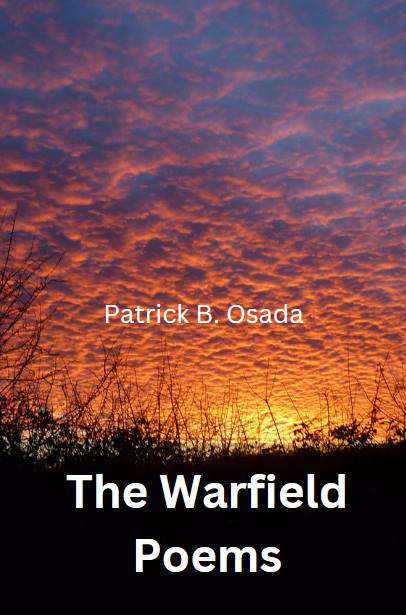
Patrick Osada’s collection is an elegy to a vanished and vanishing part of England, not ‘exceptional’ in terms of natural beauty or historical significance, but once ‘untouched’ and ‘unspoilt’ in an area ‘riven by motorways’ and ‘concrete towers’. Osada has a deep feeling for the landscape and natural life of the parish of Warfield, where he has lived for many years. These poems show a detailed and loving knowledge of his patch.
Sometimes the very poems have changed as Warfield changes. In the opening poem, West End, Warfield, we see this in operation. Osada harks back to the time of the ploughhorse and the ‘head brass’, to ground us in Warfield’s history. The sun now shines on the ‘tractor’s screen’, and the horse is now ‘a different breed’, ‘more like a family pet’. But this is just a change in farming practice. The fields are still there.
The poem, however, now itself changes. The poet has revised it to reflect more fundamental alteration:
The farmer has his plans –
he’d sell the lot today
and welcome new estates
as he lives miles away…
Yet the poem is no mere polemic. We get a strong sense of the poet’s attachment to the place where he lives. As the sun breaks through, he sees ‘where larks have climbed to sing’, where ‘young swallows dart and flash’ and ‘a cat strolls down the lane’. Nature, in all its variety of movement and life, is the subject of the song.
This sensitivity to the poet’s surroundings pervades the poems. In Frost Epiphany, the poet expresses his feelings walking up ‘Larks Hill’ ‘in an icy dawn’. The ‘cold air and moonshine’ transform trees and grass, and indeed the very horses, who stand as still as statues, in a passage reminiscent of Ted Hughes. The poet has a sudden powerful,‘humbled’ sense of a ‘God of creation’.
Osada has an eye for detail and in a sense this is the point of this collection, as he contrasts small, vulnerable creatures with the intimidating avatars of urbanisation. In Larks Ascending, the eponymous birds are ‘dots against the sky’, ‘tiny crested, feathered scraps’. Yet their birdsong rises ‘clear’ above the ‘drone’ of traffic as:
Miraculous, daredevil birds
sing out a challenge and a prayer:
an invocation to the Spring
Their vulnerability is evident, but their spirit rides high, inspiring the poet as it inspired John Clare.
In contrasting language, the poet makes his feelings clear about the threat to his countryside. In Green and Pleasant, the invasion of ‘an alien crop’, oilseed rape, the language is harsh. The spring is attacked, polluted by a ‘bitter’ scent ‘hanging on air, pungent, sickly’. The fields are full of ‘fluorescent acid yellow flames’ – poisonous and napalm-deadly. As the rape ‘burns England’s heart’, it burns the poet’s too.
The countryside is not, nevertheless, viewed with sentimentality. In Sallow, the ‘thistledown’ which emanates from the willow in spring is seen as an invasive nuisance, drifting ‘through every window, open door’ evading the efforts of ‘tidying hands’. Yet nature, not technology, comes to the rescue:
a longed for shower of rain
brings sweet relief and damps it down
There is technique as well as substance to these poems, The reader senses the craftsman at work in a number of ways. The traditional ballad form is humorously taken for A Walk in the Country, with the ‘townies’ being startled by the grinning farmer with his bird scarer. Blackthorn is a love sonnet to the eponymous hedge plant, the rhyme scheme adapted to suggest the extent and movement of the ‘drifts of snow-white petals’. Some poems are in free verse; others adopt the tetrametrical or pentameter patterns used by poets for centuries, but all are steeped in the poet’s environment. He reaches back through time for language to make the present palpable. In Quelm Lane Finds Serenity, for example, the very name raises the ‘ghost’ of the past at the same time as the leaping squirrel propels us into the here and now.
In several of these poems, Osada’s feeling for the natural world is almost religious. This is most explicitly shown in Goldfinches. The birds are initially described in clear, straightforward language, with their ‘tinkling, bell-like calls’ and movements in a ‘flash of gold’, with only a hint of their significance as they appear ‘on dull Lenten days’, but by the end of the poem their connection with Jesus is revealed, for they:
pulled out the thorns to free Christ’s crown.
In doing so, his blood was spilled
and blessed them with a love profound –
marking cheeks red as sacred birds
The collection ends with On Cabbage Hill Again, where the poet reminds us of the plough horses in the opening poem, and of his fears for the future, which, by the time of the final poem, has come to pass. The farmer has ‘sold off all his land’ and by implication, has sold out the countryside. The poet is left, like the buzzard, circling ‘shrinking fields’.
There is much to enjoy in this collection, and although some poems strike a more prosaic note, the poet’s feelings and craftmanship shine through many times, like his Warfield sun.
Richard Palmer is a retired English teacher living in Berkshire. He is a founder member of Temys Poets and has had work published in Orbis, South and other places. For a number of years he has been a regular poetry reviewer for South
*****
Missing The Man Next Door by Annie Fisher. £9.00. Mariscat Press. ISBN: 9781838450991. Reviewed by Chrissy Banks.
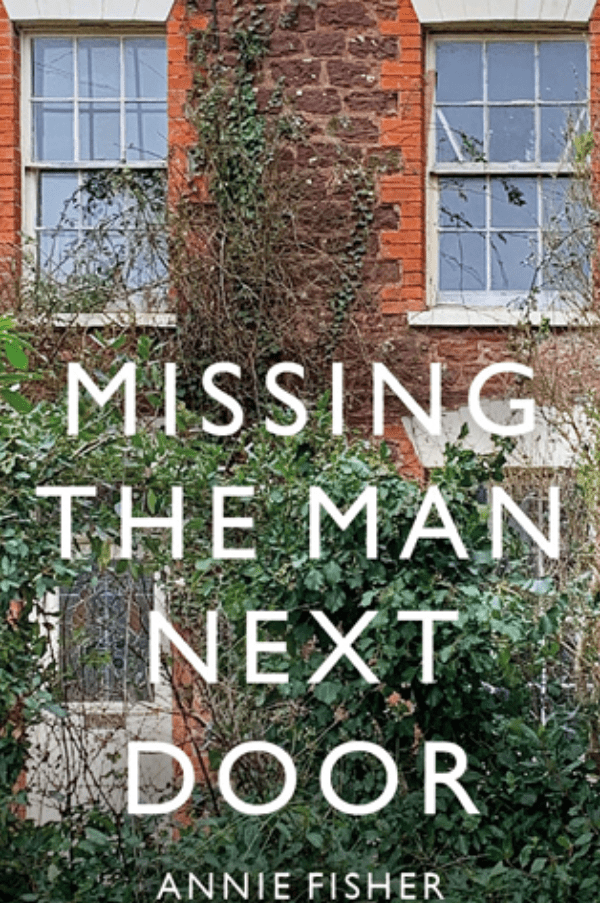
When you open a copy of Annie Fisher’s Missing the Man Next Door (and you really, really should), it doesn’t matter at all where you start. Any page will offer you something special.
Read the beautifully paced ‘Kyoto Sonnet’ for a tribute to Basho, overlaid with a touching, playful love poem. Read ‘Sitting with Friends’ to discover the friends’ unexpected, mostly inanimate, identities. For a particularly pared-down meditation on the living and the dead, read The Old Beech at the Lychgate, a poem of profound perception and acceptance. Then read A Muse Called Maureen for a total hoot or Mountain Lion to share the sweet ache of a schoolgirl’s sadness as DH Lawrence’s poem reveals to her, through the tragic death of a beautiful mountain lion, the extent of human cruelty and stupidity.
Then there’s the Man Next Door himself:
‘His Brian Blessed voice
blasting from behind the fence.
Good morning, Madam!
Good morning, Mrs Big-Knickers!’
Was he talking to the cat?
Or his late wife?
Or me?’
This poem tells us as much about the poet as her neighbour with his loud, off-key singing and poop-pooping of his car horn. Many of us would have felt sorely tested, but Fisher finds affection and humour in ‘the sounds of him’, loves the old man for his eccentricities and has me similarly hooked by the poem’s end.
Annie Fisher embraces variety – of form, style, tone and mood, from the wry, pointed address of the lambs (Rejoice in the Lambs) to the flights of fancy in RS., Me and the Great Maybe and the deeply moving elegy of My Mother’s Feet or the folksy song (The Old Dancing Woman of Bridgwater Town) that ends the collection. The memorable voices of the rather indignant lambs and the intelligently ruthless owl, both species certain and accepting of their own natures, wise in their reflections, speak directly to us and, with the lightest of touches, provoke us to question what we owe to other species we live alongside. Here is the fascinating shoebill, a critically endangered bird that can be found in the UK only in Exmoor zoo.
‘It will eyeball you
from its last ledge in history
as if it knew
as if it always knew.’
It is no surprise to learn from the cover that Annie Fisher has worked with primary school children. Many of her poems are alive with a refreshing playfulness and an innocently wicked sense of humour and imagination. The humanity in her poems is often accompanied by a graver, more uneasy mood to do with loss and sadness, but there are many steadying forces – an old beech, a wise worm, a list of favourite things, Jesus on the train from Waverley.
The famous characters who appear in Missing the Man Next Door are telling, reflecting as they do the lifelong importance for Fisher of poetry, which earns an essential place in her spiritual life, whereas religion seems to disappoint, though it still exerts a pull. Her ambivalence is coloured partly by Catholicism’s earthly representatives, the priests of her childhood – ‘Some were demons. Some were saints.’ Fisher grieves for her younger self and her friends, ‘too credulous, too tame/ pet mice, holed up in the dark’, but, typically, finds compassion also for the purring priests, who exploit their power over children, but who she recognises are ‘starved for lack of ordinary love.’
There is no shortage of love in this pamphlet, ordinary or otherwise.
Chrissy Banks is a poet, performer and writer. She grew up in the Isle of Man, but now lives in Exeter, where she runs poetry reading groups and occasional workshops. With Alasdair Paterson she co-presents Exeter’s Uncut Poets and was involved for several years with organising Exeter Poetry Festival. In a former life, she worked in teaching and for many years as a counsellor and trainer.
*****
 The High Window