*****
Fleur Adcock: Collected Poems • Thomas A Clark: that which appears • Ruth Bidgood: Chosen Poems • Billy Collins: Musical Tables • Peter Sirr: The Swerve • Michael Bartholomew-Biggs: Identified Flying Objects • Martin Jago: Photofit • Myra Schneider: Believing in the Planet • A.C. Bevan: Poundlandia
*****
Collected Poems by Fleur Adcock. £25. Bloodaxe. 9781780376837. Reviewed by Patrick Davidson Roberts

In 1967 Oxford University Press published Tigers, Fleur Adcock’s first collection published in England (The Eye of the Hurricane, in 1964, had been her debut in her native New Zealand), and the press would continue to publish Adcock off and on for the next thirty years. Since the closure of its poetry list, in the 1990s, and prefatory/simultaneous/resultant dispersal of its poets to other publishers, OUP is seldom given the credit it should be for the roster that it managed from the ‘60s to the ‘90s, suffering from the OU (to a certain extent) which lent it a patrician air that failed to reflect the radicalism of many of its poets (Zbigniew Herbert, Margaret Atwood, Anthony Hecht, Sean O’Brien, Jo Shapcott). One of OUP’s ‘60s generation was David Harsent, who recalls a contemporary of his and Adcock’s take on the press:
Peter Porter had a story about OUP. You’d go to see your editor there, and you’d go into one of those rather beautiful stone buildings, in Oxford, and there’d be a guy on reception, who’d send you to floor four, or wherever your editor was supposed to be. So you’d go to the lift, and the guy in the lift who was going to take you up would look mysteriously like the guy on reception. But you’d try to ignore that. Getting out at your floor, there’d be another guy – nominally the secretary of your editor – sitting in the antechamber before his office – and, well, he looked mysteriously like both the lift operative and the guy downstairs. Finally, you’d go in to see your editor, and, wow, he looked the same as the other three.
Reading Adcock’s Collected Poems, published by Bloodaxe (who first shared her with and then took her over from OUP) in time for the poet’s 90th birthday, more than a little of this personae/role-shifting comes to mind. There can be pressure, when reading a Collected, to look for the landmarks: Youthful Misstep, Early Promise, First, Second, Prizes, Dull Period, Revival, Serious Subject Area, First Elegies, Grand Passion Project, Elegies for Friends, Late Flowering, Sunset. Equally there is the danger of trying to ignore them (not every poet gets all of them) in search of Development – what the past few decades have termed where once was Range. The advantage of reading a Collected by a living poet is that most of these things can be dispensed with through the excuse of ‘well, there might be more’. If Adcock’s Bloodaxe colleague J H Prynne is showing anything this past decade (and it’s not clear that he is), it’s that there’s always time to double your corpus if sheer tonnage is your concern.
This is a large book – 600 pages of poems. It is undoubtedly stronger in the first half, and is intensely so in the first quarter, but throughout the book entire the consistency is in the clear-eyed nature of the verse. Both at its strongest and weakest moments, I was never left wondering if Adcock was sure what she was doing. There is an unblinkingness to the personae in these pages, and that quiet intensity is thrilling.
That intensity is clear from the start, in the poems found in Adcock’s two debuts (in New Zealand and in England), where the starkness can jolt the reader
Only air to hold the wings,
only words to hold the story;
only a frail web of cells
to hold heat in the body.
Breath bleeds from throat and lungs
under the last cold fury;
words wither; meaning fails;
steel wings grow heavy.
‘2’ of ‘Flight, with Mountains’ [26]
The clarity is almost harrowing, with the arch-Victoriana never quite softening the balladic, revealing that Mick Imlah didn’t in fact invent this stuff, twenty years after Adcock (my mistake). I expected – given the control and power of pieces like the above – for this form to dominate early Adcock, and to a certain extent it does, but when she lets her line out a little more in the first two books she does so assuredly and brilliantly too:
All my scars are yours. We talk of pledges,
and holding out my hand I show
the faint burn on the palm and the hair-thin
razor-marks at wrist and elbow:
self-inflicted, yes: but your tokens –
made as a distraction from a more
inaccessible pain than could have been
caused by cigarette or razor –
and these my slightest marks. […]
‘Knife-play’ [29]
Another consistency throughout this Collected is the indifference to fashion. At moments in the first two books I found myself thinking ‘that’s a 60s poem’ – you know: bit of Bishop, flash of Larkin – but then you look closer and, no, this is Adcock, never other than completely herself:
Three times I have slept in your house
and this is definitely the last.
I cannot endure the transformations:
nothing stays the same for an hour.
‘Hauntings’ [40]
In both ‘Knife-play’ and ‘Hauntings’ there lurks a hardness, even coldness, that sounds born of torment if not catastrophe. Adcock’s certainty comes in many forms, from the compassionate to the clinical, but its surety is constant.
By her second book with OUP, High Tide in the Garden (1971), the intensity has continued to build in the work, but rather than tightening Adcock’s form, the strength of that feeling has again allowed her line out a little, with a measured but devastating crispness, as in the astonishing ‘Gas’ sequence:
You recognise a body by its blemishes:
moles and birthmarks, scars, tattoos, oddly formed earlobes.
The present examination must be managed
in darkness, and by touch alone. That should suffice.
Starting at the head, then, there is a small hairless
scar on the left eyebrow; the bridge of the nose flat;
crowded lower teeth, and a chipped upper canine
(the lips part to let my fingers explore); a mole
on the right side of the neck.
No need to go on:
I know it all. But as I draw away, a hand
grips mine: a hand whose thumb bends back as mine does, whose
third finger bears the torn nail I broke in the door
last Thursday; and I feel these fingers check the scar
on my knuckle, measure my wrist’s circumference,
move on gently exploring towards my elbow…
‘1’ of ‘Gas’ [67]
The build in both these lines quoted and in the sequence as a whole is genuinely breathtaking, with Adcock’s assessment of the bodily physical and the chemical (in scars, in colourings) an almost alchemical feat.
By the end of the 1970s, in The Inner Harbour (1979) with its tough, almost braced-up sections, that longer line has assimilated the taut and wry observations of the short-lined earlier work, to produce something closer to Stevie Smith, but with that crispness puncturing the nocturnal depictions set down:
There are worse things than having behaved foolishly in public.
There are worse things than these miniature betrayals,
committed or endured or suspected; there are worse things
than not being able to sleep for thinking about them.
It is 5 a.m. All the worse things come stalking in
and stand icily about the bed looking worse and worse and worse.
‘Things’ [108]
That repetition at the end, far from muddying the clarity, rather compounds it, reaffirming its assessment in the eye of poet and reader alike.
While I stand by my judgment that this Collected is stronger in the first half and strongest in the first half of that, I find no padding in the second half. Adcock’s work in the 1970s is such a highwater mark (for me) that it was surely unsustainable. Her work of the 1980s would seem to bear that out; not wandering, so much as reiterating. By the time of Time-Zones in 1991, however, the clarity has tightened again, and the sharpness of diction is back:
What can I have done to earn
the Batterer striding here beside me,
checking up with his blue-china
sidelong eyes that I’ve not been bad –
[…]
Did I elect him? Did I fall
asleep and vote him in again?
Yes, that’ll be what he is: a nightmare;
but someone else’s now, not mine.
‘The Batterer’ [241]
‘Someone else’s now, not mine’ is as dry an assessment of age as they come, recognising the duty of the poet to perhaps not ‘pass on’ the trauma of youth to those younger, but to realise that anxieties and concerns have shifted: there are new worries, just as there are new people, both in ourselves and others.
In the last quarter of the book, Adcock seems to revisit (rather than replicate) the structural concerns and subject matters of her early work, but with the inevitably considered eye of The Older Poet. ‘Bat Soup’, for example, is a tricksy delight that displays the metaphysical while keeping that depicted firmly in the physical, fastening it down, almost, with the rhyme:
But it’s diluted with sky, not water,
the aerial plankton on which they sup.
Our solitary pipistrelle flickers
over her chosen suburban quarter,
echo-locating, to siphon it up.
[…]
‘Bat Soup’ [411]
I returned to ‘Bat Soup’ countless times in reading and rereading the Collected Poems and remain struck by its intellectual rigour. It’s quite a difficult poem – both the rendering and the reading – but all the more rewarding in its entirety for it. That Older Poet allows herself some wry enjoyment of herself, too:
Then, fingering my hair, he asks
‘What colour would you call it? Mauve? –
and briefly I’m transformed into
some exotic flibbertigibber
with rings on her toes, drinking Pernod
and dressed in an assemblage of wisps,
till I remember: he’s colour-blind.
‘No, just grey. But thank you for asking.’
‘Hair’ [517]
There’s something of an alternate Jenny Joseph wearing purple here, but that ‘assemblage of wisps’ takes us back, perversely in its wispiness, to the certainty of pure Adcock.
The book ends with new poems, the last full collection included being The Mermaid’s Purse (2021), and Adcock’s pronouncements on the political (including an elegy for a soldier killed in Afghanistan, ‘In the Desert’, that again bites with its clarity) moving more to the fore, but never hectoring, only clear:
The first election I can remember
is the one in which my father and mother
voted Winston Churchill out of office,
and we got the National Health Service –
which gave me an exaggerated view
of what democracy can actually do.
‘Election 1945’ [564]
Here and throughout the Collected Poems, there is the voice of a poet of real commitment and reach, brilliantly clear-eyed, whatever the personae.
Patrick Davidson Roberts grew up in Sunderland and Durham. He ran The Next Review 2013-16. His debut collection is The Mains (Vanguard Editions, 2018), his recent chapbook is The Trick (Broken Sleep Books, 2023). His poetry has appeared in 14 Magazine, Ambit, The Dark Horse, The Interpreter’s House, Magma, The Quince, The Rialto, and on Atrium, Bad Lilies, The High Window, One Hand Clapping and Wild Court.
*****
that which appears by Thomas A Clark. £19.99. Carcanet. ISBN 978 1 80017 385 9. Reviewed by Kathleen McPhilemy

Thomas A Clark’s collection of four volumes from the past thirty years could truly be called slow poetry. The poems are tiny, from a single line to two or three short stanzas, and are placed in a surround of white space. In Yellow and Blue, the third section, there are two or occasionally three blocks of print on the same page which may be separate poems but which establish a relationship with each other, just as sometimes poems on facing pages may interact. This technique, which reflects Clark’s interest in artists and visual arts, forces the reader to the same careful acts of attention that the poet aspires to. In the blurb, he states his growing conviction that ‘environmental damage can only begin to be repaired by many careful and repeated acts of attention’.
Although we do not need to be philosophers to read these poems, we can acknowledge the influence of Heidegger and Husserl, which is indicated in the title of the first book which is also the title of the whole collection. ‘That which appears’ is an English translation of the Greek-derived word ‘phenomenon’ and it is the belief that only through the careful observation of the natural world which arises out of walking through the landscape of the Scottish landscape, that a true recognition of ‘that which appears’ can be achieved. In an interview with David Bellingham, Clark said: ‘Shortly after I read Heidegger I discovered Husserl, and phenomenology in Husserl’s terms is largely about trying to figure out what can be said to be ‘thing’, and what are our assumptions of [the thing]. Are we seeing a stone, or is it the word ‘stone’, or is it everything we’ve learned about a stone?’ ((Bellingham, D., (2019) “Thomas A. Clark in Conversation with David Bellingham”, Journal of British and Irish Innovative Poetry 11(1) https://doi.org/10.16995/bip.756). Implicit in this question is the idea that language as much as the physical phenomenon is to be attended to and explored and also that this process of exploration is always subjective so that the observer’s assumptions are as much to be studied as the ‘thing’ which is apparently the object of attention. The process is exemplified in the title poem of the first volume:
it is the ache
of looking
perceives
behind appearances
that which
appears
(p.27)
The intensity of the poet’s attention is conveyed by ‘ache’ as the transition from merely ‘looking’ to ‘perceiving’ is achieved. ‘That which appears’ is not merely the egoistic ‘ache’ nor the physical object looked at but the fusion of subject and object in a momentary perception which is what the poet attempts to record in this vast accumulation of notes and poems.
Each of these volumes begins in the early morning and closes at dusk, but what is seen and the nature of the experience is different in each. In That Which Appears the poet seems most intent on recording what he comes across, in according respect and full attention to natural phenomena:
snow on moss on stone
(p.21)
However, the moments of experience which are presented are implicitly or, more often, explicitly subjective. The unreliable and fleeting nature of perception is recognised ‘nothing coincides / with its representation / stop look wait // the visible is fragile / the call of a whimbrel / might split apart’. (p.25) The writer is in the landscape but also has a responsibility towards the landscape: ‘removing a stone / to alter the melody / of a mountain burn / I listen / then place / it back again’. (p.29)
In the first book, there is almost no human presence, apart from the author. Even human constructs are mostly absent, so that a ‘broken gate’(p.55) comes as something of a shock, while the only other person appears towards dusk, perhaps as the lonely walker returns towards civilisation, ‘I … saw / in the remaining light / a man moving /among cattle’ (p.82) A few pages later, possibly the same man is seen again: ‘the man at the gate / the stoat, both have emptied / themselves of intention.’ It is very difficult to know what the poet means here, unless he is saying that both man and stoat as they are things observed with intent by the writer, in that subjective perception, lose any intentionality of their own.
Curiously, in the first volume, the predominant personal pronoun is ‘I’. In the second, The Hundred Thousand Places, it is ‘you’. it is unclear whether this an address to an actual person, or whether it is the impersonal substitute for ‘I’; often, it sounds rather didactic:
as you climb the slope
mountain after mountain
appears on the horizon
flowers of altitude
they were waiting
there for you to come
among them
to look across at them
from your own height
(p.128)
Again, there is the idea that ‘that which appears’ is only brought into being by the observer, but accompanied this time by the somewhat comforting notion that the experience of one perceiver will be similar to that of another. Like the first book, this one ends with the sighting of another, this time seen by ‘you’: ‘go down to water // as if you might / step down into the sea’ (p. 179) ‘far out in the dusk / where qualities mingle / a figure is standing / at the tide’s edge’ (p.180).
Yellow and Blue, the third volume, seems in some ways more abstract; there is a preoccupation with colour, not only the recurring yellow and blue of the title, but also green and much consideration of light. However, at the same time this book takes us into history and human culture, first through prehistoric remains, ‘ a hearth and post holes / a rammed stone floor / extending to a wall/ of neatly laid courses / by a threshold stone’ (p.194) through references to Highland life and the clearances (p 194). Pages 252-253 seem to be a brief summary of the culture and way of life, now lost, perhaps prompted by the discovery of a deserted house, ‘the lintel is broken / four walls still stand’ which is magicked into the present life by the poetic imagination (p.250-251)
by a window
blue cornflowers
in a yellow cup
continually
wake
The fourth volume, Farm by the Shore, moves through the forests, through spring and summer and closes at dusk in a house by the sea. It opens with an allusion to Eliot’s allusion to Goethe’s ‘Kennst du das Land’: ‘do you know the land / where bog cotton grows’ and there is a recurrent nostalgic or elegiac tone, as well as further references to lost Highland culture and a more personal note which recognises that careful attention to the thing should acknowledge the role of subjective emotion. Four lines praising the ‘grey line’ of the tide / that approaches and departs / from precision’ are followed by what seems to be an account of a quarrel:
in the truce of the morning
the bitter taste
of the memory of talk
a debris in the wake
of eagerness
(p.277)
Clark is meticulous in his attention to language throughout his work, but this may become more explicit in the last two books. In Yellow and Blue , p.225 is a catalogue of phonetic features, ‘roots rocks boulders / stops and labials’. In the last book, the debate over pronouns continues:
second
person
singular
or plural
(p.313)
Now, however, the ‘you’ seems more obviously a loved one, something confirmed by the folk song style of other poems. In one of the oddest, a pseudo-archaic grammar allows the poet to take the whole of himself, the observing subject and the observed object to the beloved other:
as I me went
by water side
full fast in mind
ran water sound
a lady bright
there gave me leave
to lay down lightly
by her
(p.338)
This poem illustrates the loving and careful attention that the poet pays to words and sound; the liquid alliteration on ‘l’, ‘f’ and ‘w’ and the subtle half-rhyme ‘mind/sound’ evoke the flowing stream. Even though the poems are so tiny, the poet successfully and almost invisibly deploys rhyme, repetition and variation; poems which seem little more than jottings are beautiful to listen to and repay, even as they may rebuff, analysis. This is a serious and beautiful book. My only niggle is the apparent tendency of environmentally engaged writers to retreat to places where nature is still beautiful, rather as the Romantics fled to the mountains of Cumbria and the Alps. However, although Clark may be writing from the periphery, I would argue that he is writing to and for the centre, as can be seen in this poem which has a resonance extending far beyond the local:
there are flowers
in the window
of the house collapsing
into the sea
blue flowers
(p.201)
Kathleen McPhilemy grew up in Belfast but now lives in Oxford. She has published four collections of poetry, the most recent being Back Country, Littoral Press, 2022. She also hosts a poetry podcast magazine, Poetry Worth Hearing.
*****
Chosen Poems by Ruth Bidgood. £11.00. Shoestring Press. ISBN: 978-1-915553-48-5. Reviewed by Stephen Claughton
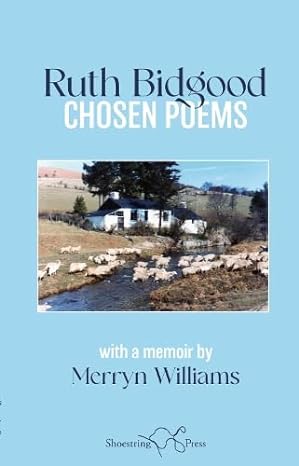
The Anglo-Welsh poet, Ruth Bidgood, who died in 2022 a few months short of her 100th birthday, was a late starter in poetry, but produced a substantial quantity of work, publishing 17 collections during the second half of her life, including four volumes of selected poems (one taken from her longer poems). Unsurprisingly, there is a good deal of common ground between the earlier selections and the poems that her friend, the poet and critic Merryn Williams, has chosen for this book. Nevertheless, Williams makes her own choices and has the advantage of being able to draw on the six books that followed New and Selected Poems in 2004. The excellent memoir with which she prefaces the book is an added bonus, as is her helpful select bibliography.
Ruth Jones, as she was before she married David Bidgood (whose father like hers was a Church of Wales clergyman), was educated at the same Port Talbot school that the slightly younger Richard Burton (then Richard Jenkins) attended. Like him, she was inspired by the Head of English, Philip Burton, who recognised her writing talent and to whom she dedicated her first collection, The Given Time, in 1972. She went on to study in wartime Oxford and after graduating with a degree in English, joined the Wrens, serving in Alexandria as a coder, which she thought was akin to writing poetry. She met her husband after the war and moved with him to London, Hampstead initially and then Coulsdon in Surrey, where they raised three children together. When they divorced in 1974, she went with her younger son to live in the family’s holiday home, a corrugated-iron bungalow called Tyhaearn (‘iron house’) in the small village of Abergwesyn near Llantwrtyd Wells, remaining there until she was eighty, at which point her family persuaded her to move to a less isolated house a few miles away.
Bidgood wrote quiet poems in plain language about everyday subjects that are nevertheless invested with deeper significance. Abergwesyn and the surrounding area are the dominant subject of her poetry, although she wrote about other times in her life and Williams includes three early poems, not in other selections, dealing with the way suburbs cushion themselves against nature and with the isolation and destructiveness of her failing marriage. These provide helpful indicators of what she was reacting against.
Retreating to rural Wales did not mean cutting herself off from other people. Rather, the elemental wildness of the landscape serves to bring the inhabitants together. In ‘Log Fire’, written when Tyhaearn was still a holiday home:
Come to the fire’, say my friends,
moving books and knitting from the settle.
Then I know I am back
after all the hours and miles,
and we sit in a sun-cave
all heat and brightness.
Companionship does not dispel the wildness, which would have been the suburban solution. Instead, they coexist. In ‘Supper’, she leaves the curtains open so that:
Each time the black window drew our eyes
we saw a known room strange
and unstable with storm, saw too
those threatened selves who had let such darkness in.
Williams refers to Bidgood’s Manichaean vision: ‘The light and the dark are constant factors in human life, almost equally balanced, neither of which can permanently defeat the other.’
The ‘Boy in a Train’, who is scared by an illustration in a horror-story he’s reading, may be comforted by the sight of the woman, presumably his mother, slumped in the next seat, but: ‘Sooner or later / whichever way you look for safety, / the black beast will be crawling in / at the corner of your eye.’ Here it is the beast of loneliness, but behind it all lies death, imagined in ‘Confrontation’ as a gun-slinging, High Noon antagonist, who may be bested for now, though both know ‘what the real end will be’. It’s a theme she returns to—less dramatically, but more affectingly—in ‘A Slight Stroke’, about Eryl Davies, her Oxford boyfriend:
Now his death had touched him
for the first time, brushing face,
arm, thigh, with gentle fingers,
promising return.
The past weighs as heavily on the poems as future inevitability. ‘All Souls’’ presents Abergwesyn as ‘a conversation of lights’ between houses and farms that would once have been part of larger communities: ‘I am a latecomer, but offer / speech to the nameless, those / who are hardly a memory …’ In the context of the poem, she will do this by drawing back her curtains and letting her house ‘sing with light’, although she also achieved it more literally in her researches as a local historian. A number of her poems, including ‘Burial Path’ (a striking poem from her first collection), ‘Emu’s Egg’ (about a man who emigrated and his friend who stayed and died) and ‘The Will’, are based on local events. Some are ‘found’ poems. ‘Grievance’ is taken from a letter that a servant, Alice Owen, wrote to her parents in 1712, complaining that her mother has asked her for money for a sibling, not realising how poor she is herself, or how hard she works, or the slander she has suffered at the hands of a philanderer she has rebuffed. In a letter from 1802, ‘Edward Bache Advises His Sister’ about the importance of preserving her virtue:
You are yet very young,
neither ugly nor deformed,
of a creditable family,
and not entirely destitute of fortune.
Not that I would have you consider yourself
of more consequence than you are,
but I would deter you from doing
that which is beneath you.
One wonders what his sister made of that.
Other poems address more present-day concerns. ‘Stateless’, which I read as a metaphor (‘In some nissen-hut of my mind’) for wariness of new relationships following divorce, uses an image that has a very contemporary relevance. There are, too, what we would now call eco-poems: ‘Oil Spill, 1991’, or ‘Polluted’, which is about run-off from an old mine temporarily polluting a spring.
‘Bereft’ is an elegy for R. S. Thomas (‘We have lost the one / who had words to catch / a wordless resonance’) and although Williams may well be right in saying that the poet Bidgood most resembles is Wordsworth, and Bidgood herself cited Edward Thomas as an inspiration, it is hard not to think of her as a secular version of that other Thomas. Their poems are equally rooted in the Welsh landscape, although they are populated differently. Thomas wrote about living parishioners, with whom he often had a difficult relationship, whereas Bidgood, who was more sympathetic, ironically wrote mostly about former inhabitants, many of them long dead. The churches and farms in her poems are frequently derelict. (‘Hawthorn at Digiff’ describes a diseased hawthorn tree growing in the middle of a ruined house, into which it would have been bad luck to bring hawthorn flowers.) Both poets gain solace from the countryside, but neither idealises what is (or has been) very much a working environment. Bidgood describes conifer plantations, reservoirs, old lead mines and slate quarries. The animals, too, can be a challenge. One poem, ‘Sheep in the Hedge’, vividly describes her attempt to disentangle an ungrateful animal (silly in the sense of stupid rather than innocent).
In ‘Driving Through 95% Eclipse’, she says: ‘how different is real / from ordinary’, which might be taken as a motto for a poet for whom the everyday was never ordinary, whether she was writing about a friend’s ‘Porch-Light’, or waking up to see the credits of an old film running against the background of a snowy landscape while snow is falling outside (‘Snow’), or missing seeing cow-parsley in bloom in ‘Road to the Lake’.
Ruth Bidgood was a very fine poet who deserves to be much better know and Merryn Williams has done a great service in putting together these Chosen Poems. Tantalisingly, some poems referred to her memoir are marked ‘not included’ and there is room only for single poems from the longer sequences. But that apart, this book is a pleasure to read and one can only hope that the interest it generates will lead in due course to a Collected Poems.
Stephen Claughton’s poems have appeared widely in print and online. He has published two pamphlets: The War with Hannibal (Poetry Salzburg, 2019) and The 3-D Clock (Dempsey & Windle, 2020). He reviews for The High Window and London Grip and blogs occasionally at www.stephenclaughton.com, where links to his poems and reviews can also be found.
*****
Musical Tables by Billy Collins. £12.99 Picador. ISBN: 978-1-0350-2248-0. Reviewed by Neil Fulwood

Musical Tables is helpfully subtitled ‘Poems’ and boasts eye-catching cover art (Alex Colville’s To Prince Edward Island) and a pull quote from Alice Fulton assuring us that “Billy Collins puts the ‘fun’ back in ‘profundity’,” though she never identifies the blackguard who took it out in the first place. Start turning pages and the typeface is elegant, the production design comforting and there’s a wryly amusing quotation (from Nick Laird) to kick the whole thing off, even if it doesn’t really have much to do with any of the poems that follow. The collection is divided into four numbered sections, though apparently not for any thematic or structural purpose but more because most poetry collections are ordered sectionally and if anyone’s going to dissent or upset the apple cart, it’s not going to be Billy Collins.
Forgive me if the above paragraph sounds snitty. I’m actually a big fan of Collins and I’m not ashamed to admit it. There’s an attitude towards him, generally evinced by culture snobs and hifalutin critics, that he’s safe, bland, far too easy to read, and should be regarded with no small degree of mistrust for having the gall to make it look so easy. More than anything, I think it’s the conversational tone of his work, as if he were simply remarking on things with the debonair wit of a Peter Ustinov or an Alistair Cooke while occupying a seat at a pavement cafe, that his detractors find so irritating. Like Stephen King, who makes the storyteller’s craft seem as if he just falls out of bed and dashes off 700 page novels on the way down, Collins attracts criticism for not being serious enough; not seeming to work at it.
To put it another way, to profess a liking for Billy Collins in certain circles is like walking into a roomful of jazz purists and saying that you prefer Nickelback.
I digress. The purpose of that opening paragraph was to suggest a comforting familiarity with a Billy Collins collection which begins before you’ve even read the first poem. You know what you’re in for: that folksy tone, like Garrison Keillor with line breaks; quotidian images which edge back just slightly to reveal a quirkier perspective; unobtrusive cultural references; understated wit; poems that unfurl in leisurely fashion across a couple of pages — ….
But wait. Here’s something different. Musical Tables breaks the mould quite radically. Of its 128 poems, none are more than eight lines in length. The shortest assembles six words into a single line.
This is Billy Collins is doing minimalism, folks, and to begin with it feels slightly disorientating. He steadies the vessel quickly enough: style and tone are recognisable from the outset and he loses no time in finding an approach to the short verse form that works for him and seldom deviates from it.
Broadly, the poems in Musical Tables fall into four groups: wry observations on the human condition (‘Last to Leave the Party’, ‘Motel Parking Lot’, ‘Children’, ‘Divorce’, ‘Zen Backfire’); whimsical meditations on various art forms, principally music (‘Thelonius Morning’, ‘D Major’, ‘Jazz Man’, ‘Pianissimo’, ‘Symphony No. 4 (Brahms)’); poems which basically function as pun or play on words (‘The Code of the West’, ‘The Sociologist’, ‘4’33” by John Cage’, ‘Yamaha’, ‘A Rake’s Progress’); and imaginatively quirky musings that are Collins’s trademark (‘Aa’, ‘An Exaltation of Frogs’, ‘A Small Hotel’, ‘Octopus Sonneteer’, ‘Carpe Diem’). A representative sampling:
Saying goodbye is so sad,
I don’t even bother
to turn around to see
what it was you just threw at me.
[‘Motel Parking Lot’]
The breeze was slight
and moved only three
of the six wind chimes
which formed a minor chord.
[‘Thelonius Morning’]
Say what you want
about me
but leave the horse
I rode in on out of it.
[‘The Code of the West’]
When a match touched
the edge of the page,
my poem filled with smoke,
then a few words
were seen to stumble out
in nothing but their nightgowns
with no idea which way to run.
[‘A Small Hotel’]
All of the above are effective in terms of what they set out to do: the rueful tone and cynical pay-off of ‘Motel Parking Lot’; the gentleness of ‘Thelonius Morning’, capturing a lovely little moment; the knowing chortle of ‘The Code of the West’, conjuring its profanity by via negativa; the sardonic commentary on destroyed early drafts in ‘A Small Hotel’ and the charming way Collins makes you feel sorry for the rejected words.
Musical Tables is full of similar examples – and as entertaining and accessible as the collection is, that’s basically the problem. The collection does four essential things and does them very well for the most part (there are probably less than a dozen fillers), but it does them so many times and with so little variation that something happened that I’ve never experienced before with a Billy Collins title: poetry fatigue set in.
Had Collins and his publishers gone for a smaller selection of these micro-poems, perhaps in a rearranged running order that encouraged a little more dialogue between them, I’m sure that Musical Tables would have hit the proverbial sweet spot. As it is, I would cautiously recommend it, with the suggestion that the reader dips in and out briefly and occasionally, taking quick hits of ready wit rather than savouring the enjoyment at length as one would his other work.
Neil Fulwood was born in Nottingham, England, where he still lives and works. He has three collections out with Shoestring Press: No Avoiding It, Can’t Take Me Anywhere and Service Cancelled. He co-edited the Alan Sillitoe tribute anthology More Raw Material (Lucifer Press, 2015), and has published three volumes of film criticism with Chrysalis.
*****
The Swerve by Peter Sirr. The Gallery Press 13.90 euros ISBN 9781911338451. Reviewed by Patrick Lodge
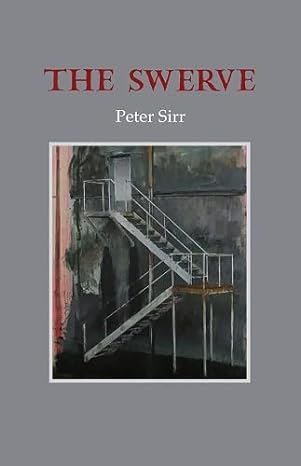
It would be a good bet that many reviews of Peter Sirr’s tenth collection will start with the opening lines from ‘Border Control’: ‘Not everything I said I did / I did in fact. Not literally. / But if it wasn’t all true / it was true-ish.’ – a quote which captures the poet’s playfulness, wry humour and sense of the contingent nature of our existence and the poetry that might capture it. As Sirr himself said in an interview on RTE, everything is ‘kind of trueish” as far as poetry can ever be true and anyway, “literal truth is never any fun”. This commanding collection swerves and sways in and out of time, space and memory and across a comprehensive subject matter. It is erudite, witty, reflective and, at times, angry about the world around us without ever losing a deep sense of the resilience of humankind – as he writes, ‘on the other side of the poem the universe is waiting, / patient and inexhaustible’ (‘A Saxon Primer’) and Sirr has done his best to bring that universe to us in tightly crafted, considered poetry. He seems open to all and any experience and to take it as it is or take it as far as it will go. The poems become a kind of investigation – almost an archaeological dig through layers of meaning – and, like the most accomplished poets, where a poem might go or end up is unpredictable though the journey is exciting.
As befits a poet in Ireland, Sirr seems to inhabit a thin place. Ghosts, the dead, revenants populate many poems; he talks with ‘ghost poets / of ancient conferences’ (‘May’). It is as if the poet recognises that all time is a continuum and the individual occupies a moment of it but one which is fully connected, especially to what has preceded. The dead may return for some ‘like Halloween / tricksters, bearing grudges and unhealable pain?’ but Sirr’s ghosts seem broadly more benign, kept in dreams or else sought as subject matter – ‘…I stare at the page where I try to write them, / half listening for a sigh or whisper, some / slight disturbance in the room…’ (‘Days of the Dead’). Of course ghosts can be ignored or left behind – ‘Haunting School’, with some humour, depicts the disillusion of one ghost possessed of ‘Such joy at first…’ in the exploration of its new status but who finds eventually ‘No one remembers you know; it’s time // to walk alone’. In a second take on that poem the whimsy gives way to the recognition that the truth is “we haunt only ourselves, are our own black terrors…’. This sense of one’s place in the continuum is important to Sirr; the past may always be present, coterminous and available to be mined – though there is no ‘magic reversing wand’ that brings its delights back – but the future remains unknowable, ‘It grows how it will, / wild and ungovernable’ and however much you try to hold onto the past and keep going; ‘the heavy hand / finds its way across and settles on your shoulder’ (‘Totenlied’)
In this intimacy with the past and its inhabitants, there are powerful poems recalling passed friends and acquaintances – ‘No Journey’s End’, takes its title from the marvellous long album track of the musician and dedicatee, Michael O’Shea, who built his own instrument and played it with paint brushes or, occasionally, chopsticks. The poem is affectionate, full of movement and delight in the eccentric and eclectic music and its originator, ‘a noise we had always imagined, rippling through us // as a hurry gathers, pauses, moves on’. Similarly in ‘The Boot’, written in memory of the Irish language poet, Liam Ó Muirthile, Sirr’s chance passing of a car being unloaded brings to mind Ó Muirthile unloading a car boot to the Irish poet Greg Delanty. Sirr is a little disingenuous in claiming ‘and there is no reason whatever to have remembered this” except this recall, this moment of insight, this car boot ‘swinging across years to your eyes’, is very much the powerful locus of Sirr’s poetry; a moment of sharp insight for us, ‘who take / so much with us we hardly see //until someone slips out into astonishing light / and wherever we were going we’re suddenly not’. It’s this ‘astonishing light’ which floods Sirr’s poems.
‘The Boot’ makes use of a trope, the time slip, used frequently by Sirr, unsurprisingly given his developed sense of the power and utility of memory. Indeed one of the most powerful poems in the collection, and the book’s title poem, begins with the author losing control of a car, ‘and then I’ve swerved out of time…’ to a recollection of an skid on ice with his mother driving. In a poem worth the purchase price alone, Sirr plays effortlessly – with trademark delicacy and control – with a bittersweet memory of trips from Dublin to Galway to visit a relation’s farm; a memory that swerves from childhood to adulthood and reveals the actual swerve to be the first evidence of his father’s fatal neurological disease, ‘this is the swerve that tilts him off his course / and won’t be corrected…’. Stephen Payne, reviewing an earlier collection, noted Sirr’s ability to make the physical environment “vibrate with history and memory” and it is this facility, evident throughout this collection, which makes such time slips work so very well. In ‘The Swerve’, the narrative of the interlocking journeys, the almost spiritual resonances, the portent of a death to come are all rooted firmly in the land, and, particularly, the farm, itself, from an old car rusting in the field to ‘…the light / soured against the red door of the milking parlour, // the stacked turf solid behind the tin screens / of the shed, everything greyed and wintered / as if something was still waiting to arrive…’. This is not simply poetic rendering of a mis en scene but a welcoming in of participants in the poem’s measured narrative and emotional exposition.
Several poems engage with a more brutal and contemporary world, like the droll environmental take on Noah’s saving of the animals (‘The Uncollected Animals’) where his descendants are making a pretty good job of destroying both the saved animals and the environment itself and are sent packing up the gangplank. Others focus firmly on wars and destruction, sometimes mediated by calling to his aid poets from the Tang dynasty: ‘Do you think Li Bai, Du Fu, someone is reading you / as the tanks roll in and the murderer’s rockets strike?’ (‘Reading the Tang Poets’). One imagines that Sirr hopes somebody is, indeed, reading poetry in such conditions. Sirr pulls no punches in his critique of war, notably the current conflict in Ukraine and, in a broad sense, seems to be seeking an answer to the question of what use is poetry, the poet in such circumstances where ‘…always someone is standing beyond consoling / his butchered children in the rubble and mud’. (‘Reading the Tang Poets’).
He has termed it an ‘act of privilege’ to be able to write about such things and answers the question of poetry’s use unequivocally by his right to make art from subject matter but more importantly by his unwavering focus on the human spirit that rises above everything. His poems sing of such spirit: half a building may have been blow away and it’s a slow and dangerous trek for water but, ‘Better than escape or the underground shelter / the quiet passion of what’s long known, / the poetry of sink and tiles and pillow…’ (‘Steps’). In some poems Sirr seems to feel the acute loneliness of the poet, the fear that no-one is listening anyway. The splendid ‘Talking to the Birds’, in recounting the story of a woman from the Andaman islands, the last speaker of a dying language, who spoke to the birds, moon, stars and ‘When the rain came I told it a poem’ because no-one else could understand her, may well have half an eye on the plight of a contemporary poet. Moreso the well-established pre- internet poet who might well lament along with Cicero, ‘but I had it, I was a very whale / among the boastful fry posting themselves // on the platforms’. (‘C in Old Age’).
Of course, the poet is fully aware that his poems are maybe “… not enough, I know / that: stops nothing, holds off / not a single missile…’(‘Proofs’). But Sirr is not a political poet per se and the utility of his work lies firmly in a simple redemptive perspective that sees the humanity, contemptuously ignored by the war-mongering politicians, as shining out in darkness. His job is to recognise that though light may fade from all we love, we must keep ‘singing // to blunt the darkness, to fold the light back in’(‘A Saxon primer’). Nowhere is this better achieved than in ‘Proofs’ cited above, where Sirr, despite knowing that ‘darkness falls’ still finds himself reaching for the life-affirming, for people just carrying on: ‘the projectors whirring in the underground / balloons on a pillar / where the party insists…’. And most of all for the celebration of the pianist, who, ‘by her blown out windows / as the sirens blare and neighbours flee // with what quiet fury / she brushes the ashes off the keys / and sits down to play.’.
Sirr wrote an introductory essay to RTE’s 2009 CD of Seamus Heaney reading his poetry in which he commented that we go to poets ‘we are led by our ears, our instincts and because of the way a particular configuration of language operates on mind, heart and body and won’t let us go” – praise that could equally be applied to ‘The Swerve’. This is a collection which will engage throughout the Summer holidays and be returned to again and again when Winter has come. It is joyful, approbatory and uplifting even in its darkest subjects and marks a poet at the peak of his powers. To say that Sirr is one of the best poets writing in Ireland today is both true and false for, ultimately, the range of his concerns and references, his utter skill, place him firmly beyond the country of his birth and establish him simply as one of the better poets writing anywhere today.
Patrick Lodge is a Welsh/Irish poet whose work has been published, anthologised and translated in several countries and he has read, by invitation, at several European poetry festivals. Patrick has been successful in international poetry competitions and reviews for several poetry magazines. His collections, An Anniversary of Flight, Shenanigans and Remarkable Occurrences were published by Valley Press in the UK. A fourth collection is provisionally entitled There You Are.
*****
Identified Flying Objects by Michael Bartholomew-Biggs. £10. Shoestring Press 2024. ISBN 978-1-915553-47-8. Reviewed by Jean Atkin

This is the sixth collection from London Grip editor Michael Bartholomew-Biggs, and there is a playfulness about it. This is perhaps unexpected, since the collection springs from nothing less than the Old Testament Book of Ezekiel. A foreword exempts the historic Ezekiel from any charge of speaking through the poems, but suggests an ‘Ezekiel-like (or Ezekiel-lite)’ voice sometimes comments on a present-day setting. Bartholomew-Biggs draws our attention to the remarkable, and sometimes the bizarre, in the Book of Ezekiel, suggesting for example that it makes ‘what is surely the first proposal for a heart transplant’.
Each poem is followed by a quotation from Ezekiel – so on heart transplants the prophet says: ‘I will also give you a new heart… I will take away the stony heart out of your flesh, and I will give you a heart of flesh’. And the poem that precedes this opens:
Rejection is a major issue
when a doctor takes a stone-still heart
and substitutes donated tissue.
Some of the poems are clearly personal, dealing with badly broken legs, that heart transplant, and grief. The legs are tackled early, in the opening poem ‘Physiotherapy’ which comes in two parts – ‘Theory’ and ‘Practice’. The language is vivid, concise and skilful:
Seen from a window, halfway up the hillside,
round hedges cushioning the valley’s vee
resemble parallel upholstered bars.
The cushioning hedges, inevitably distant, echo the upholstered bars as the speaker works to regain the capacity to walk.
Often there is wonder at the world, its history, and its possible futures. In the title poem, the ‘awed and shocked’ Ezekiel’s own words are interpreted as perhaps visionary.
Ezekiel did not make sketches. He left
words instead of blueprints. Hence his engines,
while attracting less mechanical
analysis than Leonardo’s,
leave a lot more room for extra
terrestrial imaginings.
As under many of the poems, Bartholomew-Biggs adds a note (as well as the Ezekiel quote) to expand on his work – here he gives a mention to Josef Blumrich’s ‘The Spaceships of Ezekiel’ 1974, which made me smile.
In fact I rather enjoyed the slightly impish diversions this collection brings to the reader – such as ‘Is Anybody There?’, in which, following on from Ezekiel’s marvellings over his visions of cherubim, the poet explores for the existence of human – or humanoid – creatures out there in the universe –
Astronomers have spotted eight
such planets so far – so far off
they have no clue who’s lurking out there:
could be Klingons, could be Clangers.
Sometimes the present day emerges in a poem. I liked ‘Street Theatre’, a poem following the occasion in which Ezekiel is ‘told to enact the siege and fall of a city whose inhabitants are to blame for its impending destruction’.
The poem’s protagonist lies down and ‘wonders why his precious flesh remains/ unbruised beside the gutters of Barbican’. He is shackled and expecting worse.
Black axioms
are hidden in the pockets of dark suits
on money men who must step round him.
Another poem in which contemporary politics appears is ‘Forthcoming Events’:
You’ve grown accustomed to old pessimists
who get things wrong. That forecast of a leader leaving
by a side way with his famous face concealed
forever was much overstated. He did nicely
in retirement with a pension and the standard knighthood.
The bitterly sharp crafting of this poem is both clear and furious – indeed I detect a seam of political – and spiritual – disappointment threading this collection, along with a good-natured wish for better.
In ‘Incarnation’, an isolated moment ‘like the sudden stranger/ striding through a bar’ is the setting for a challenge:
You split our boasting, wooing, whining
with a silence measured
by the rolling tick-tock
of a toppled empty glass.
The stranger leaves ‘before the raising of a voice’, and the ‘laughter and the bartering’ begin once more. But:
The swing doors spread and shut
behind your unprotected back
as if to beckon any
who might dare to follow,
empty-handed and alone,
and face you in the dark
beyond the disused stable.
The craft, inventiveness and wit of Bartholomew-Biggs is a match for his objections to societal inequities and to the capacity of politicians to ignore warnings. The apt nature of making poems off the back of a prophet’s words becomes clear. The notes under ‘Speak Wealth’ tell us how Ezekiel warns the king of Tyre that great wealth brings pride and a sense of entitlement. ‘You’re smart’/ says the poem, ‘as Archimedes: leverage/ will lift you up the rich list’.
Under ‘Whitewash’, Ezekiel says: ‘Her princes… are like wolves ravening the prey, to shed blood, and to destroy souls, that they may get dishonest gain. Her prophets have plastered for them with whitewash, seeing false visions, and divining lies to them’. The poem repeats the line ‘The whitewash would be bad enough’ at the start of each stanza. In the last –
The whitewash would be bad enough
but the gap is worse – it is
a forecast of complete collapse…
This is a mature collection from a poet with a distinctive voice, whose work asks searching questions about the world we’ve inherited, and how we’ll leave it for future inhabitants. But along the way, the reader is diverted and beguiled, as well.
Jean Atkin‘s new collection How Time is in Fields (2019) is available from IDP. Previous publications include Not Lost Since Last Time (Oversteps Books), and six poetry pamphlets. Her poetry has been commissioned for Radio 4, featured on Ramblings with Claire Balding, and added to ‘Best Scottish Poems’ by the Scottish Poetry Library. She works as a poet in education and community. She is currently Troubadour of the Hills for Ledbury Poetry Festival, and BBC National Poetry Day Poet for Shropshire.
*****
Photofit by Martin Jago, Pindrop Press, £10. ISBN: 978-1-8384373-8-1. Reviewed by Tom Laichas
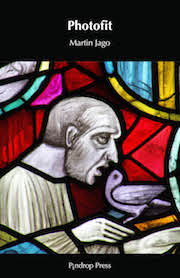
The cover of Martin Jago’s Photofit depicts a stained window scene in which a cleric whispers to an ortolan, a sparrow-size songbird whose flesh is, for some, a delicacy. Before reading Photofit, I’d never heard of an ortolan, an endangered bird whose hunting is now illegal. Wikipedia gave me details of its preparation:
The bird is roasted for eight minutes and then plucked. The consumer then places the bird feet first into their mouth while holding onto the bird’s head. The ortolan is then eaten whole, with or without the head, and the consumer spits out the larger bones.
The ortolan reappears as the title of a poem about halfway into the collection. By this time, we know what we’re reading: a harrowing account of a choirmaster’s repeated rape of a church-school choirboy, a first-person version of Jago himself. Jago keeps the assaults themselves off stage; the collection’s one explicit and repellant image is the devouring of an illegally procured songbird. It’s an image that stuck with me, a red thread stitched like a rough suture into the book’s spine:
There are black markets where
the trade still thrives, you only need
to know the right man,
say the right word to get
that fledgling gush of fat, blood
and viscera steeped in alcohol,
a decadence you can’t resist,
crushing the bones between
your molars, briny taste
of flesh, head and beak
hanging from your lips, the marrow
savoured to the last.
Jago could have opened Photofit with “Ortolan.” Instead, he begins in media res with an email from Hampshire police to the British-born poet, now resident in California, regarding a “matter of urgency.” Names and other details are forebodingly redacted. Throughout the email, Jago footnotes lines that provoke his growing dread as he realizes that his childhood trauma is about to be disinterred. “I look forward to hearing from you,” DC [redacted] signs off. In his footnote, Jago imagines his own unsent reply: “I’m not looking forward, only back.”
Jago now begins to sift the shatter of his past. Because memory returns fitfully and in fragments, the poems carom from resurrected trauma, to boyhood’s false normalcy, to memories of shame and silence, to the unwelcome eruption of all such recollection into the adult’s ordered life.
How to come to terms with such a wound? A successful theater director and author of works on Shakespeare stage performance, Jago turns here to poetry. He imagines himself as both a police detective interviewing a reticent victim and the victim himself: “I’m going to show you some poems,” says Jago-as-detective. Jago-as-witness is “sure it’s never going to work,” but the detective insists: “The trick,” says the detective “is trusting what appears.” What appears is a photofit, a police composite, a sketch rendered from the witness’s memory.
Later, Jago testifies against his actual abuser. He does not disclose his own verbatim testimony but, in the poem “Confessional,” reconstructs his abuser’s self-exculpatory account. Again, Jago footnotes the text, each note giving lie to the choirmaster’s alibis, which rely on witnesses who are, as the notes disclose, “deceased… deceased… deceased.”
After reading Photofit’s poems in order, I returned to them again, this time reading at random. Jago sequences his poems to resemble the disordered way difficult memories often resurface. As a result, many poems throughout the collection can serve as side-entrances, each disclosing a particular pattern of light and shadow that plays throughout the book.
One could start, for instance, with the poem “Cavalier,” in which the choirmaster, who has volunteered to drive the boy home after choir practice, stops his Chevrolet Cavalier in a carpark. The poem’s screen goes black just as the worst is about to happen. The lights go on again a line or two later:
… You see, he says, I told you you’d be next, so now
you know. And when I go inside Mum says, You’re late!
Now, go and wash your hands, your dinner’s on the table.
The lines are chilling, both because of what the poem does not show and because of the false normalcy which follows. Beginning here, a reader can construct a linear narrative: first the crime then the dislocation of the experience, impossible to share with family or friends.
Another way in is “The Cut.” Here, the grown man recalls a lover who cuts herself to release the pain of her own traumas. She tells him that he too is a cutter: “It doesn’t always take a knife,” she says. To begin here is to enter the wound’s ravenous insistence, as it tracks a man across eight time zones and several decades.
Or one can start with “Kintsugi.” The title refers to the art of Japanese ceramic-mending: rather than camouflage cracks, the ceramicist will use a paste infused with gold or silver; the visible lines of breakage become part of the restored object’s history. In the poem, a pillow fight between brothers shatters their mother’s porcelain bell. The pieces are hastily reassembled and glued, but the botched repairs are visible. Their mother “never noticed it was broken / or if she did, never said a word.” Start with this poem to better hear the collective silence which muffles a stolen boyhood.
Though assaulted by a choirmaster in a church, these poems do not curse God or repudiate the devotional choral works sung as a boy. Instead, the poems are distanced from both faith and song. In a sonnet titled “Requiem,” Jago writes that as a singer,
You live inside this song until it’s sung,
never guessing it’s a requiem;
the silence after has your tongue,
and life beyond its measure is a dying ember.
You live inside a song. How absurd,
to live in Tallis, Britten and in Byrd.
Photofit ends with “What Comes Next,” a talk with himself just after news of the choirmaster’s conviction has reached him:
The day after sentencing you drive
to Santa Monica, sit on the beach
and for a long time breathe as deeply as
your lungs will fill, then take off your shoes
and socks and paddle in the waves. Lights
out now in England. Lights out
at the end of his first day,
39 years and 364 days of his sentence left…
Here, I thought as I read, the fissures are intentionally visible—but the bell is restored.
Tom Laichas’s is author, most recently, of Three Hundred Streets of Venice California (FutureCycle Press) and Empire of Eden (The High Window Press)
*****
Believing in the Planet Myra Schneider. £9.95. Poetry Space 2024. ISBN: 978-1909404557. Reviewed by Pippa Little

Myra Schneider’s new collection bursts with her distinctive creative energy. Perhaps taking the adage from Studs Terkel to ‘dig where you stand’ she works from her own immediate surroundings – a leafy green outer London suburb – to explore the world’s plight through the lens of her own imaginative curiosity.
This is a generous and capacious collection which encompasses the smallest detail, from bees, bluebottles and dandelions in a threatened garden to the sweep of far countries and imaginative spaces unconfined – I love the insouciance of the opening lines here (‘Fishing Boats’):
I refuse to inhabit today so I’ve taken myself
into the silence of my study and now I’m slipping back
to 1905 in Collioure. Here I am, young again
There is anger, at the unthinking waste and damage we perpetrate on our beautiful wild earth – the concreting over of gardens and green spaces to produce wastelands – yet also deep appreciation of the ways nature insists on surviving between and among the cracks, sometimes unprettily but always infused with the truth and power of itself. Schneider’s poetic imagination has a similar energy: it breaks through, observes no boundaries, and fed richly from a lifetime of love for art, music and literature, blooms, rescues and transforms.
*****
A.C. Bevan, Poundlandia, Mica Press, £10, ISBN 9781869848378. Reviewed by Ian Pople
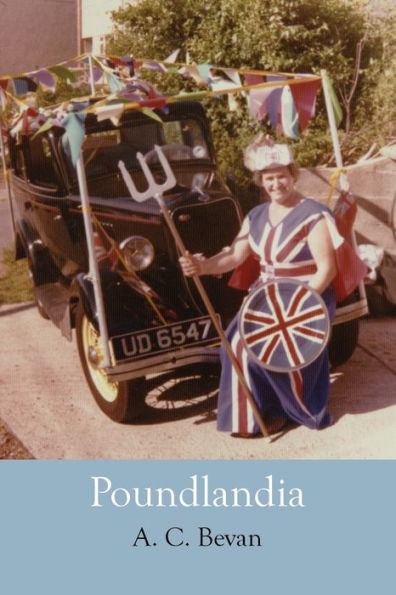
A.C. Bevan’s first full-length collection is a profound plunge into the state of Britain, as he sees it today. And given that this review is being written halfway through the current election campaign, its publication could not be more timely.
The book is broken down into three sections, each with a Latin title: the first, ‘Ab Urbe Condita’ which Google translate suggests means, ‘From the founding of the city,’; the second, ‘Terra Sancta,’ which my residual, schoolboy Latin suggests is ‘Holy Ground,’; and finally, Sub Urbia Rediviva,’ which Google translate suggests means, ‘Recycle under the city.’ So my sincere apologies to A.C. Bevan if the translations completely miss the point. A further internet search suggests that the first, ‘Ab Urbe Condita,’ is the name of Livy’s history of Rome. I take it that Bevan’s point here is that Rome might once have been great but later fell into decay and desolation; that Britain might once have been ‘great’ but that it has decayed into the ‘Poundlandia’ of the title. And before you switch off and think that this might be a book of relentless negativities, can I suggest that Bevan satirises pretention and the ways in which our ‘political masters’ have squandered the Blakean ‘green and promised land.’ And that Bevan does not do this out of a spirit of Farage like boosterism. What Bevan points up and laments is the ways in which the small, yet vital, nuances of community and communication can be squeezed out by those whose attitude to society is to eye the main chance. And the final section, ‘Sub Urbia Rediviva,’ offers something very different.
The first thing to notice about Bevan’s writing is the sheer technical fluency of it. It is possibly a commonplace that much of the best satire is written in quite strict forms that use those forms against those whose simple view of poetry is that it is formal. Bevan is adept at everything from tightly rhymed quatrains to triolets, to very well-turned sonnets. Bevan also has an excellent impersonation of Coleridge. And that middle section, ‘Terra Sancta,’ plays off a cod ‘Olde English,’ against the demotic, and I’ll come to that in a bit. The other kind of fluency is the one that arises from Bevan’s piercingly observed engagement with contemporary living. This is from ‘Lego Land,’ ‘In the interlocking back-to-back / Duplo starter duplexes, / identikit semi-detached, or rows / of red brick terraces on // overgrown toytown estates of /mini-mini-roundabouts / & concrete cows.’ Well, since I did actually live in Milton Keynes for a while, this kind of depiction is suitably familiar. And here is how the poem ends, ‘In / the tableaux of model citizens, / vignettes of minifigs in / situ, the miniature villagers in / their miniature villages, // we are here in our social settings, / in the infinite regress / of a not-so-great, Great Britain – / the isles of Toys”R” Us.’ This is certainly a kind of howl of derision. And its position towards the beginning of the book plunges us, as I’ve suggested, into a deeply plasticised, deracinated Britain.
The other thing that Bevan does so adeptly is skewer the pretentions of those who preen themselves on solutions to those problems. Bevan lives in Bristol and his ‘Whitewash’ shows up just that. It ends, ‘So, we changed our ways & tore such / signs of structural racism down / to show it never / happened in this city / – & so isn’t happening now.’ Bristol’s history with slavery has come under a lot of scrutiny of late, but Bevan’s fine poem refutes any sense that such matters have been overcome in contemporary life.
The short mock epic, ‘Terra Sancta,’ is laid out in ten ten-line stanzas with little reference numbers against the margin as if it were a variorum edition. As I’ve suggested above it’s written in a mock-heroic language, mixing an ‘Olde Englishe’ with an equally mock contemporary, as in the following example:
xxxxxxxxxxxProwesse,
noblesse, cortayse & deeds of
intrepidity for chaste damsels
in perilous distress or durance
dread? Alack, my phone is dead.
The poem as a whole is a debate over the state of England that ‘Terra Sancta.’ This is a debate between a Don Quixote like Arthurian and two ‘hooded brothers of the anti-social order.’ It is clear from the beginning who will ‘win’ this confrontation. In the end, the reader might require something a little less inevitable. But perhaps that is Bevan’s point, the reader can easily envisage such exchanges and, even, see them as confined to the stereotypes that Bevan draws. However, by stereotyping and satirising the protagonists, Bevan forces us to confront society in the way that Hogarth and Gilray did in an earlier age and that Private Eye’s ‘Yobs’ cartoons do today. Yes, both parties are caricatured; but if the caricature is too wide of the mark then they just become nonsense and there is nothing nonsensical about ‘Terra Sancta.’
Bevan’s final section which I’ve translated as ‘Recycle under the City,’ offers a range of poems and forms. The sardonic humour is still there, but here, a more personal Bevan ranges over everything from ‘Veganuary,’ to the death of his cat, Ignatius, to a very beautiful self-elegy written by a shepherd. Here, Bevan is much preoccupied by the layers of history present in both places and lives. Bevan is skilled at working what we might call pre-histories into a contemporary context. ‘Neolithic ‘ deftly associates the concrete, brutalist phase of architecture with ‘The exposed feature of a lintel slab / on the hard shoulder of an orthostat / or sarsen road by which it was dragged / at glacial speed.’ Bevan’s gift is to take these elements and make them work in ways which allow an elegy for both periods actually to work and be successful. The next poem, ‘The Foragers,’ does this from a more human angle. Here the foragers are ‘A tribe of hunter-gatherers / is picking through our wheelie bins, sifting our recycling bins, / dipping into skips.’ Again, all this might descend into mere whimsy, but Bevan’s iron grip on tone means that these things play off against each other to offer a much deeper and satisfying reading. This particular poem moves to its adroitly earned conclusion, ‘- a whole mystery & mythos. / In the night sky before bin day, / in the fixed constellations / or our satellites and suburbs, / Orion stalks his prey.’
Poundlandia is A.C. Bevan’s first collection. Over the years, his pamphlets have shown a writer who, as we have seen, is never shy of treating big subjects. Satire doesn’t seem very big in the world of British poetry at the moment, possibly the energies of satire have found themselves in the world of comedy, of which Britain feels quite blessed. Satire requires sharp observation and a pitch perfect ear. Although Poundlandia has been brought out by a ‘small press,’ we’re lucky to have Bevan who had those necessary gifts and is not afraid to use them.
Ian Pople‘s Spillway: New and Selected Poems is published by Carcanet.
 The High Window