*****
Mario Petrucci : afterlove • John Short : In Search of a Subject
*****
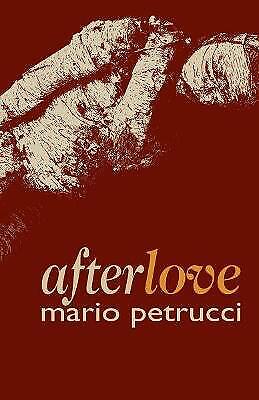
afterlove by Mario Petrucci. £9.99. Cinnamon Press. ISBN: 9781788640954.
Reviewed by Roger Elkin
Writing about the nature of poetry, Mario Petrucci in his adjudication report for the Envoi Poetry Competition 121 (February 1999) proffered the following:
If nothing else, a poem is a thread between author and reader, connecting the skill and sensibility of one to the sensibility and sensitivity of the other. It is a … subtle and complex form of aural intercourse. A reader’s mind, heart and spine should be touched and altered by every good poem they encounter … The expression of an age through imperative and soulful words is, at heart, a cooperative work.
While events and the passage of time may have challenged and changed Petrucci’s stance and poetic practice, much of this observation still has relevance: afterlove is replete with ‘skill’, ‘sensitivity’, ‘imperative and soulful words’; and possesses ‘subtle and complex form’. And here, ‘touched and altered’ by several readings of the collection, is my response to the ‘aural intercourse’ of afterlove.
Published in 2020, afterlove is the first part of a trilogy dealing with aspects of love, from passion, sensuous delight, carnal desire, its intensity, confusion and complexity, to its painful breakdown, ending and loss. The second part, Dawn Ravens (Lapwing, 2022) draws on poems by Saadi and Rumi to explore the pain of lost love; while part three, Moonbird: love poems (Fair Acre Press, 2023) is inspired by the writings of Pablo Neruda and e.e. cummings.
This collection’s title establishes the context. The poems read as fragmentary insights, remembered instances and impressions, slices of, and glances into, amorous relationships – lived, lost and continuing. The shape and stylistic trappings of the poems both replicate and reinforce this. Written primarily in tercets with short unpunctuated lines (sometimes a single word) in which the sense runs over from line to line, verse to verse, with words occasionally broken after the first syllable, and accompanied by liberal use of ampersands, portmanteau words, and a mix of capitalised and lower case at the start of pronouns, the effect is disturbing and initially disorientating. These stylistic features replicate the authorial stance: an ambiguous mix of tender delicacy, hurt and wounded passion and enigmatic uncertainty. Yes, there is love here, but there is also regret. While a sense of betrayal is felt, there is no sense of total condemnation: the loss of love of the partner is partially compensated for by remembrance of that love, and the continuing love from, and to, the children.
Of the collection’s four parts, the poems in section 2 and 4 are the most immediate, especially those referring to his children in which Petrucci’s skilled use of alliteration, freshly-coined imagery, internal rhyme and assonantal chiming are employed to full effect. In ‘little one’ his daughter’s palm ‘in my grasp seems a tensioned / underwater thing // finger-tight & / sinew-strung’; while in ‘boy’ he depicts his son ‘in distress / who turns from my offered / kiss so // helpless / that long look lost behind the eyes / galaxies away’; and recognises his own mortality: ’already far flown on my way to amicable / dust’.
This keen awareness of his mortality underpins ‘Lineage’ where, referring to parents and grandparents, Petrucci uses the concept of the ‘cascade’ of generations who:
fade bluely backward
into a widening wake of desire
a precise swarm – an exact
multiple of two
that eventually:
narrows down to me – this
hallowed sticking point
this temporary resistance
that opens again
to my own insistent children
to their children yet to come
In the collection’s final section several poems make reference to historical, mythological and religious figures. In ‘Saint Helena’ the fate of Napoleon parallels Petrucci’s lost love ‘in this / silent house loud with grief’. It is a sharp decline from his initial position of impassioned security in which he was:
an emperor once
in her eyes
That kind of emperor
history doesn’t deliver –
no hell-bent conqueror
but a visitor her cells
swarmed towards in allegiance
mutually disarmed
In ‘Prometheus’ he asserts that his wife, ‘a woman once / lofty with mildness’ has ‘become feather / and talon’ as her ‘lips stiffen to keratin’. Petrucci’s heartbreak at the changed circumstance is symbolised by the reference to the eagle that pecked at the heart of Prometheus:
head jerking
brow-deep in my chest while
still in this bed
you who have our child
have left for another man
that other man
again you finish with me to
soar unsated to him
In ‘Lazarus’ his ‘absent wife brought / no tenderness to his tomb’; instead recognising that though he ‘died alive’ there is consolation not from ‘the man of the Cross’, but
by innocent son
by spotless daughter
who melt a stiffened heart
and stir the stifled breath
However, probably the most remarkable and poignant moment comes in the concluding lines of the collection’s final poem:
your kiss
imagined in tenderly
insistent snow
quiet
just beyond
midnight pane
a situation amplified by the starkly-visual imagery and the punning ambiguity of the final word.
Writing (again in Envoi 131, February 2002) in the aftermath of 9/11, Petrucci was concerned that:
As writers we often ask ourselves to take risks that most people try to steer clear of … All I know is that writers must sometimes walk a dangerous and winding path between the plains of silence and the markets of speech.
In afterlove Petrucci has travelled those ‘dangerous’ ‘plains’ and risked taking steps to articulate with honesty and frankness the profit and pain of love. If you have ever loved, or loved and ‘lost’, or even neither, I urge you to read this important, moving and powerful collection; then proceed to discover the two accompanying parts.
Roger Elkin has won numerous first prizes in (inter)national Competitions, the Sylvia Plath Award for Poems about Women, and the Howard Sergeant Memorial Award for Services to Poetry (1987). He has published fifteen collections of his work include Fixing Things (2011), Marking Time (2013), Chance Meetings (2014), Sheer Poetry (2020), The Leading Question (2020), Small Fry (2023) and A Party Business (2024). He was the editor of Envoi, (1991-2006). He is available for readings, workshops and poetry competition adjudication.
*****
In Search of a Subject, by John Short. £7.99. Cerasus Poetry, ISBN 9798868453250.
Reviewed by Wendy Klein

Written in three sections: ‘Late Sun’, made up of early family history, ‘Endless Travel’ (what it says), and ‘African Rice’, a more disparate assortment of travel, love poems and other, this is a collection that flows artlessly from poem to poem. Liverpudlian Buzouki player, world traveler, travel poet, and Facebook friend, I feel as if I know John Short, though I have never met him. Despite that fact, his tightly constructed atmospheric poems, full of original similes and metaphor, never fail to surprise me. The title of this collection is, in itself, surprising given the scope of this poet’s reach, the ease with which his poems seem to emerge, it is hard to imagine that there is any very arduous ‘search’ involved. One has the sense that the lines simply flow from a deep, constantly replenished repertoire. In the title poem, Short describes himself as:
Enamoured of the pen
from an ealy age,
a pensive, semi-detached scribe
scribbling in notebooks
in search of a subject,
hungry for dirt and adventure.
‘Hungry for dirt and adventure’ – searching for it, finding it in places less travelled: from Tblisi, highly recommended in his travel notes, to university in Leeds where we find him romancing a co-ed engaged in: ‘Eager sex in a student bedroom’ as his ‘…red fan heater blows / Yorkshire’ through their lungs. (‘Fairport on a Portable’) In this first section we are introduced to the poet’s family and many other engaging characters including the fierce Ursuline nuns at a prep school where: ‘…if you didn’t know / the answer you’d be / slapped all the way round the chalkboard / till your memory improved.’ (‘Ursulines’). There are entertaining scenes of childhood play from Saturday matinees at the cinema to being herded early on a winter morning onto an: …oily beach strewn with bladder wrack / like something coughed up foul and green’ /. You can see it; you can smell it. An uncle is introduced in ‘Playing Soldiers’, from whom he later learns chess moves and: ‘the truth that mounted knights / were really not romantic.’ Such a satisfying end line.
There is real excitement for me in Short’s travel poems and frequent recognition as I have travelled in many of the same places, been inspired by them. In ‘Giralda, climbing a ‘dizzy tower’ in Southern Spain triggers a childhood memory:
My intrepid father
vertigo-free
perched inches from the edge:
huge under-hang
that only I could see.
A moment of sheer, agonized terror, vividly evoked. Everywhere in this section the poet finds the most apt descriptive words for the object or creature in question. In ‘COLD WAR, Tenerife’: The sun-baked terraces / where geckos stick / to memory with limpet toes.’ And so they do and where:
Bougainvillea brush-strokes
brilliant and dramatic
as a resident impressionist.
In ‘Night Ritual, Gascony’ there is:
undergrowth alive with secrets,
relentless cicadas chorus
and at the bridge a thousand insects
are floodlit for suicide.
‘Floodlit for suicide’! And so they are in Gascony, but, of course, they are the suicidal insects of summers everywhere. This poet musician has a skilled line in darkness, too. In ‘VIRTUOUSO, Athens’ he finds a musician who ‘Preternatural with ability,’ manages to end up: ‘in smoky nightclubs’/ where: ‘he grows fat and unwell; / ‘worshipped to an early grave.’
And just when you think there is nothing new to be written about the moon, Short offers this crisp metaphor: ‘but she’s a future tourist aspiration / this bright and silent sentinel / illuminating my porch.’ He gives ‘her’ the last word as she looks down on ‘streets of garbage overflow / and oceans heaving with plastic. / What will happen next? She thinks.’ Neat.
Wide-ranging in every sense of the word, Short comments on love in lockdown, ageing, refugees, rain that comes down ‘like silver knives’ a home town where: ‘…under the canal bridge / the local sorcerer formulated / curses against injustice. Socially aware, keenly observant and utterly unpretentious, his love poems project an affectionate cynicism about relationships, his presence in them lyrical and unassuming. A relationship contains: ‘the shape of happiness today / will be the same next year’ , the loved one herself portrayed as:
a wild enigma asleep in my arms
and it’s unreal you’re satisfied with me
when you could save the world. (‘Love Poem’)
About John Short’s collection Those Ghosts, A Life in Poems, the poet Victoria Ekpo writes: ‘There is music – languid and harmonious, a fresh youthfulness and time is a metronome that strikes through lustrous landscapes and characters of varying personalities.’ The same could apply to In Search of a Subject, but it is more than ‘ a steady companionable read’. These poems are full of dark corners, tantalizingly oblique observations, while remaining an effortless, satisfying read, modestly and clearly laid out on the page, no gimmicks. Magic; well done, Mr. Short.
Wendy Klein is the author of 3 full collections, ‘Cuba in the Blood’ (2009), Anything in Turquoise (2013) from Cinnamon Press, Mood Indigo (2016) from Oversteps books, and a Selected, ‘Out of the Blue’ from The High Window Press (2019). Her pamphlet ‘Let Battle Commence’, from Dempsey & Windle (2020), is a US Civil War memoir based on letters home from her great grandfather, a Confederate soldier in that war. She is working towards a fifth collection.
 The High Window