
*****
Pauline Flynn is a Visual Artist/Poet. She studied visual art at the Dunlaoghaire School of Art & Design and the National College of Art & Design Dublin, the School of the Art Institute of Chicago and Kyoto University of Arts. She has worked as a professional artist since 1985 and has exhibited in Ireland, United Kingdom, Japan and China. Her imagery is abstract using Acrylic/Mixed Media.In 2008 she took a break from painting and in 2010 completed an MA in Creative Writing at University College Dublin, where she began to write poetry and was shortlisted for the Patrick Kavanagh Poetry Award the same year. Her work is published in poetry journals including Poetry Ireland Review, the Eavan Boland Special issue in 2023, Skylight, The Waxed Lemon, (Visual Art), Into the Light, The Boyne Berries, and Sixteen. (Irl). Light, a journal of poetry and photography (USA), Orbis, and The Blue Nib (UK), She works and lives in County Wicklow in Ireland and finds painting and writing poetry to be a perfect complement to each other.
*****
Artist’s Statement
‘There is no abstract art. You always start with something. Afterwards you can remove all traces of reality’ Pablo Picasso
My work is abstract in form and has always found a starting point in the physical world. Greatly influenced by my formative art education in the ethos of the Bauhaus, and by a period when I lived in Japan as a scholarship student, absorbing its aesthetic, I strive to create images that are pared back and beautiful. I try to express something of an inner world, a world that words alone can’t express. I was drawn to the East early in my life and when I finally made it to Japan it was like a homecoming.
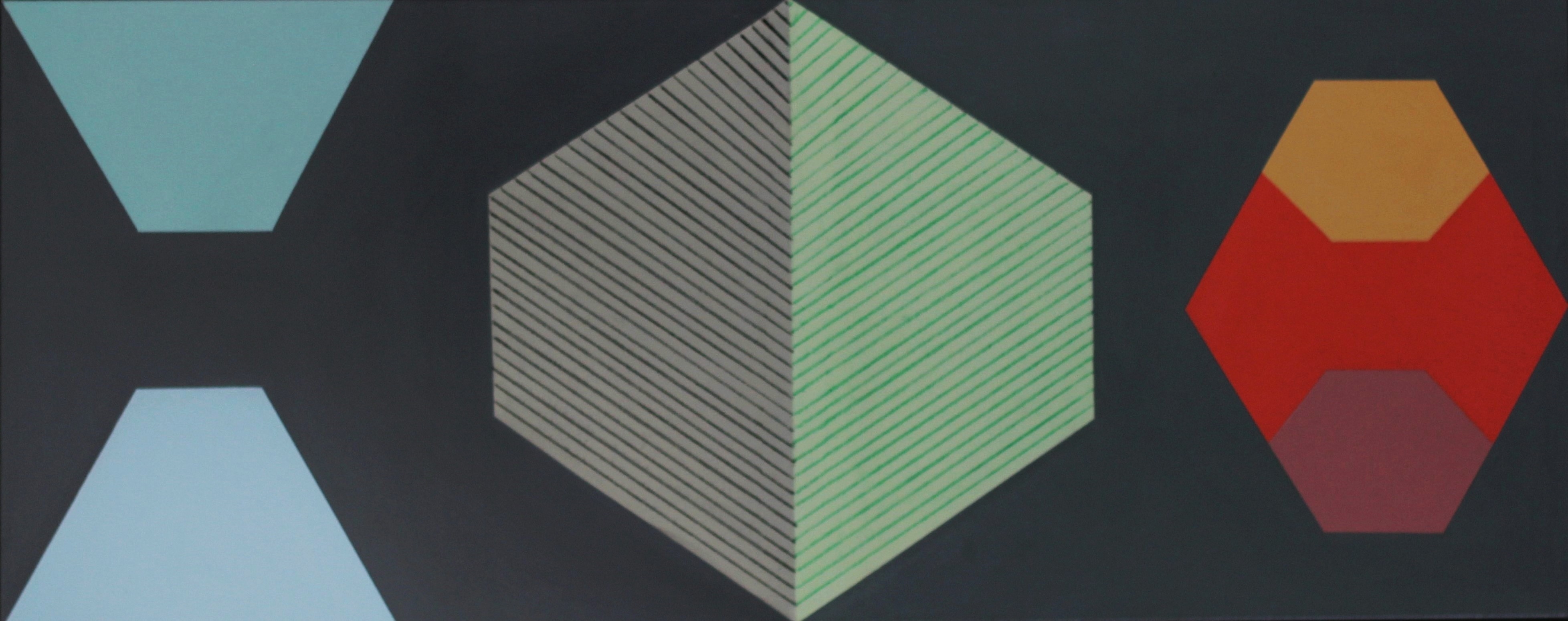
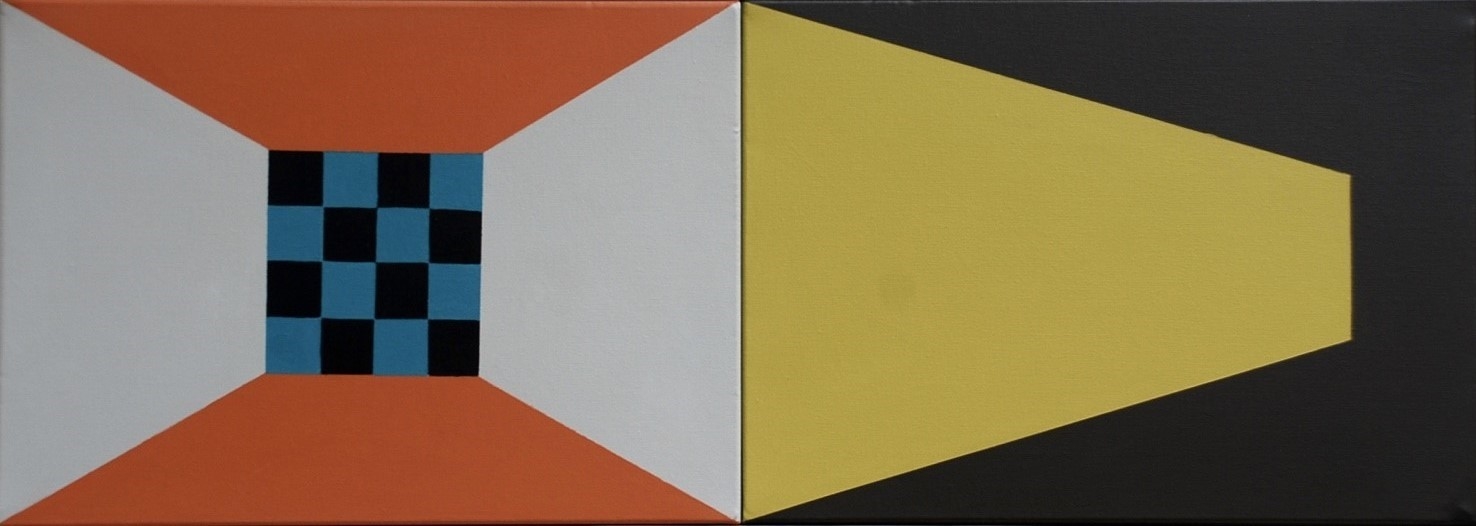
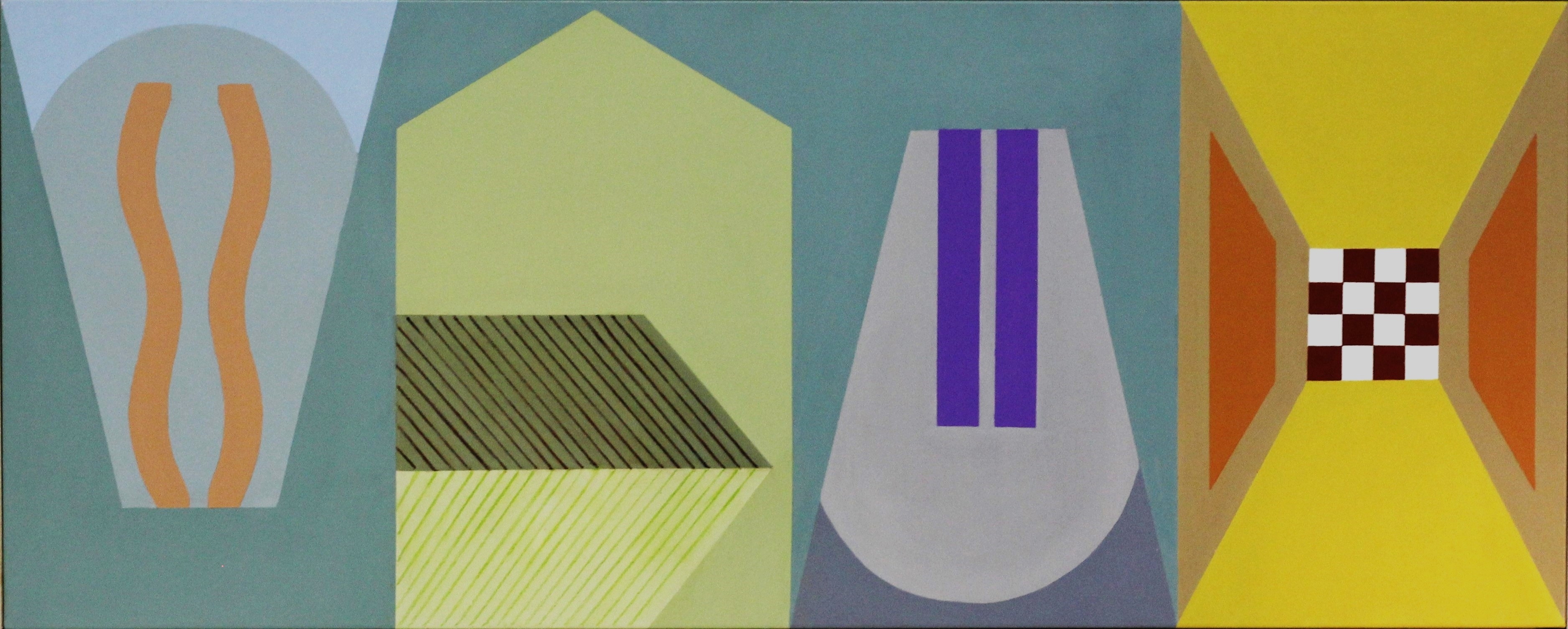
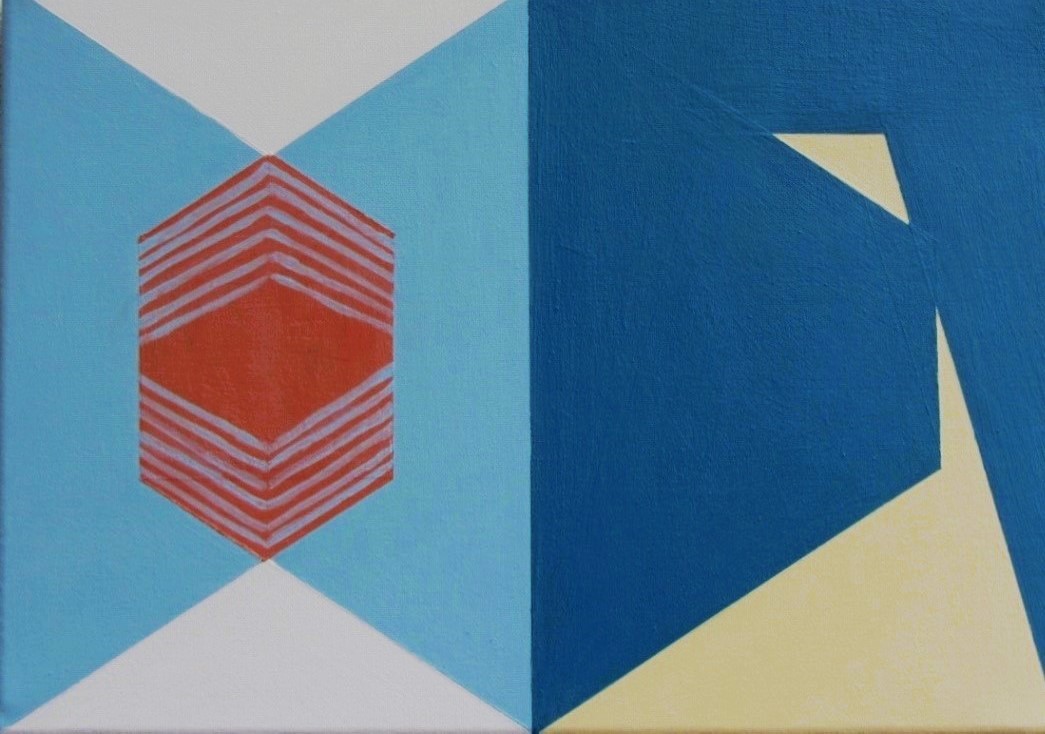
In 2020 I began this ‘Riband’ Series of paintings. I embarked on a new departure in the form of geometric abstract paintings in response to a few military medal ribbons in Limerick Museum. Formerly, my work was textured and loose, mainly painted on Japanese Washi. During the process of developing the imagery I set myself a limitation in the size of the canvas and leaving myself open to chance occurrences, five geometric shapes, both curved and hard edged emerged. Every small canvas worked together in a modular fashion. I chose to work on canvas with these shapes using flat colour combinations that are very influenced by a Japanese sensibility. Design is a key element in the work. I am interested in the arrangement of space, be it on canvas, in the home, garden or studio. My work is rooted in my life’s experiences. I don’t title the individual paintings but hope the viewer finds some resonance to their own lives in the looking.
I’m quite new to poetry and now write alongside my work as a painter. I do not illustrate my paintings with poetry but I find the arrangement of words and thoughts are similar to the way I build up a painting. Words are like a new medium to me and give me an opportunity to render more figurative images in the making of a poem as opposed to the strict abstract imagery in the paintings. Finding poetry opened up a whole new world for me and I’m very grateful for that.
I love to write about women I know and have known, women seen in art, met in history books or observed as I go about my daily life. Sometimes, it’s a momentary encounter that inspires me as in Café Switzerland in this selection of poems. A woman I observed in a café when I was nineteen but who stayed with me all my life as an inspiration. Someone who gave me an insight as to a kind of life that I might have, even though we didn’t speak to each other. [PL]
*****
Pauline Flynn: Paintings and Poems
*
ST. MARY’S COLLEGIATE CHURCH
She uses lavender oil to polish the pews,
tracks patterns in the figured wood;
angel step, fiddle-back, spalted, ghost.
Buffs and shines with a chamois, found
in a charity shop in the town, unused.
Not one of the faithful, and no matter to her,
she comes to the church to sweep and clean,
part of a government employment scheme.
On her day off, the pull is strong
to stone and tile, epitaph and tomb,
the carved vestige of a Viking longboat,
mason’s marks on gothic arches,
and men’s names on wall panels,
all known to her now,
their good deeds and achievements.
She leads us to the marble monument
of Richard Boyle, first Earl of Cork,
and caught in stained glass window light
tells us his tale, the lives of his mother,
his wife and fifteen children.
She reserves judgment on some of his ways,
but this young woman from the town
is fond of the man. She caresses the stone
as she would a pet lamb.
***

*
CAFÉ SWITZERLAND
From the outside, nothing momentous
happened that day – my nineteenth birthday.
I’d pinned a sprig of edelweiss,
soft as a fresh fall of snow
onto my frock and set off with Heidi
to buy coffee and chocolate
over the Swiss border with Germany.
At 11a.m. we stopped at a café
and I saw her on the terrace
reading a paperback.
Drawn to the relaxed way she sat
in the chair, her face shadowed
by the slight droop of her head,
the book resting on the edge
of the table, her order already served,
she took no notice of us.
I stirred the dollop of ice cream
into cold coffee and sank
into a sanctuary of silence.
I often think of her, unaware,
how on that day, she bequeathed to me
a silver salver piled high with gifts.
***
*
EL SUEÑO
Is she bored,
draped on that couch
like an expensive throw,
when she could be elsewhere?
Or does she delight in his scrutiny
of her body, the nuance of flesh tones,
play of shadow and light, challenging him
to capture the movement of her shallow breath
on the diaphanous layers of her dress?
Does she turn and face into oiled blackness
so that her shoulders fall back to offer him
her tender neck, breasts, in the full shaft of light,
the gold ribbon in her hair?
Or is it that she’s tired of the intrusion
and so withdraws, denying him admittance
to where she has gone––miles away.
***
*
THE VISIT
It was in Mrs. Pennyfeather’s
morning room where I first saw Rome,
where we leafed through postcards
she’d bought there to bring home.
I’d barely been to Dublin,
Cork on a school trip,
Bray on another,
to the amusement arcade,
bumper cars and candy floss,
a stroll on the seafront promenade.
She guides me to the Roman Forum,
home to feral cats,
the Colosseum, where gladiators
fought lions and died like rats.
We pass beneath stone-sculpted gates
and parasol pines along the Appian Way
to Caecilia Metella’s tomb – ¬¬a tower,
where we break for a cup of tea.
She, had no given name, was known
by the feminine of her paternal line,
so we must surmise, must decide,
by the grandeur of her tomb
that she was loved, and that what remains
of garlands of fruit and oxen heads
on the frieze, shows that she lived her life
in gentle ease.
The air in her Sepulchre is cool and moist,
birds swirl and dive and sing full voiced.
The sarcophagus may not be hers, nor the urn,
that held her ashes; they are scattered dust.
People come to picnic and to play where once
they came to offer food and wine and to pray.
*
***
BLUE NUDE
Apt that the nude is blue.
Shapes in paper laid out
in the form of her body.
Blue too, is one arm raised
behind her head, pushing
it down, legs twisted
beneath her.
And blue is the other hand
holding her foot close
to her hip, to keep
herself steady.
Blue is the thrust
of her right knee,
the space between
her thigh and breast.
Sharp cuts,
that make her who she is.
 The High Window