*****
Nicole Sealey: The Ferguson Report: An Erasure & Nicole Sealey: Ordinary Beast • Martin Figura:The Remaining Men • Jodie Hollander : Nocturne • Robin Thomas: Reminded of Something • Phil Barnett: Birds Knit my Ribs Together • Hedy Habra: Or did you ever see the Other Side • Iryna Starovoyt: A Field of Foundlings
*****
The Ferguson Report: An Erasure by Nicole Sealey. £12.99. Bloodaxe Books. ISBN 9781780376639 and Ordinary Beast by Nicole Sealey. £10.99. Bloodaxe Books. ISBN9781780376653. Reviewed by Ian Pople
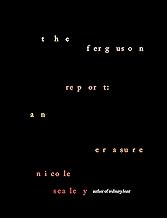
Nicole Sealey’s The Ferguson Report: An Erasure is just that; a ‘poem’ which arises from erasing large part of the Ferguson Report. The Ferguson Report, itself, is a document produced by the American Department of Justice into ‘the period of protests and turmoil,’ (I’m quoting from the back cover blurb) which followed the shooting of Michael Brown in August, 2014, in Ferguson, Missouri. Brown was, and here I’m quoting the back cover again, ‘a young, unarmed Blackman … shot to death by a police officer.’ My use of the words on the back cover is not an attempt to evade terminology; it is an attempt to reproduce the context of the book given by the publishers themselves.
As I’ve noted, the poem consists of reproductions of the original report, with most of the pages reduced to a background light grey print with a horizontal line through the writing. That text is still readable, but what Nicole Sealey has done is to pick out words, small parts of words and even letters in the ‘normal’ black print. Thus, on the first page of the poem itself the letters: ‘h’, ‘or’, ‘s’ and ‘es’ are picked out from a single line. From further down in about the middle of that same page, ‘hundreds’, ‘neigh’, ‘I’, ‘n’, ‘g.’ Towards the bottom of the page, ‘part’, ‘refle’, ‘x’, and from the bottom line ‘part’, ‘reason’, ‘par’, and ‘t.’ And from the next page, ‘particular’, ‘urge’ and ‘at gunpoint.’
It might be easy to dismiss the technique here, and perhaps we might all like to sit down to replicate it with some particular document. In fact, a recent issue of Poetry included a poem created from the same approach. But we can see, even from the partial sample, I’ve just picked out, the kind of slant that Sealey brings to things. To start a poem based on the particular, urban, highly charged Ferguson report with the word ‘horses’ is to spring a surprise on the reader. And Sealey then goes on to explore the horses’ neighing in ways which might associate them with humans panicking too. Thus, the foregrounded text emerges from the background document in ways other than the process of erasing one to find the other. And such a procedure might seem to be a metaphor for the emergence of poetry as a whole, from a background which might be ‘life’ in all its exigencies, in ways which both adumbrate and distil. In addition, the font of the book is generally quite small so that the reading process is both slowed down and focussed in ways which feed of each other.
The ‘original’ Ferguson report has subsections which are quite visible on the page. Sealey’s poem also has subsections which respond to that original text but emphasise, in turn, the sheer textuality of what is going on here. Sealey numbers her sections and then puts the page numbers of the original that she is working on, i.e., ‘i. pages one to twelve’, ‘ii. Pages thirteen to twenty-one’, etc.
Nicole Sealey’s The Ferguson Report: an erasure is a very powerful document, which plays in fascinating and evocative ways with that very loaded word, ‘erasure.’
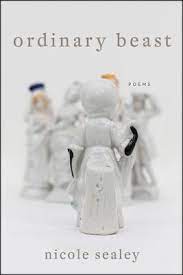
That slight skewing of vision that I pointed out with The Ferguson Report is present in Ordinary Beast published simultaneously with The Ferguson Report by Bloodaxe in this country. It’s opening poem ‘Medical History’, indeed, plunges the reader into its narrator’s medical history. It begins, ‘I’ve been pregnant. I’ve had sex with a man / who’s had sex with men. I can’t sleep.’ The poem then catalogues various ailments suffered by various members of the narrator’s family. And the poem ends ‘Uncle Ken, wise as he was, was hit / by a car as if to disprove whatever theory / toward which I write. And, I understand, / the stars in the sky are already dead.’ Sealey outlines the various ailments and then pull the reader back to the production of the text, ’whatever theory / toward which I write.’ Then it opens out to the stars in the sky before pulling the reader back into the ‘world’ and context of the people in the poem. And although I’ve described the poem as spoken by a narrator, the poem feels very driven by the poet herself, as if the authorising consciousness of the poem and the narrative ‘I’ were one and the same. And that sense of the ‘I’ in the book being Sealey herself threads through the book to bring its readers face to face with some very harsh realities.
Like Eliot’s Webster, Sealey can seem ‘much possessed by death and see the skull beneath the skin.’ In ‘the first person who will live to be one hundred and fifty years old has already been born,’ Sealey comments, ‘There’s far less between / ourselves and oblivion – skin that often defeats / its very purpose.’ And elsewhere the poems have great investment in teleologies. The sequence, ‘cento for the night i said, “i love you” begins, ‘Today, gentle reader, / is as good a place to start.’ And the sequence contains comments such as ‘We are dying quickly / but behave as good guests should: / patiently allowing the night / to have the last word.’ The poem ‘legendary’ ends with the lines, ‘So beautiful I almost forget, were / it not for history, to know better.’ And the final poem dedicated to Sealey’s husband, ends, ‘O, how we entertain the angles / with our brief animation. O, // how I’ll miss you when we’re dead.’
That rather curtailed, but rather sustained, view of the human condition is a slight pity when other poems such as her riff on the board game Cluedo features a witty sestina that ends with Mrs White speeding ‘into the starlit / night in a ragtop mustang belonging to Mr Green.’ In ‘an apology for trashing magazines in which you appear,’ Sealey sustains rhymes, half-rhymes and words containing rhyme with word ‘Pitt.’ It begins, #I was out of line, Brad Pitt. / You’re no Eliot Spitzer.’
It is, perhaps, The Ferguson Report: An Erasure which shows Sealey at her best. Its painstakingly deft working of poetry from such dark material demonstrates how we might actually live with such texts amid the world they represent.
Ian Pople‘s Spillway: New and Selected Poems is published by Carcanet.
*****
The Remaining Men by Martin Figura. £9.99. Cinnamon Press. ISBN:978-1788641548. Reviewed by Carole Bromley
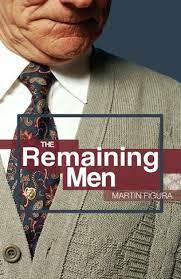
I was more than happy to review this latest collection from a poet I have admired since Whistle made me cry all the way home on a train from Newcastle. I also very much admired the poems in My Name is Mercy which came out of his commission to write poems about Odstock Hospital, Salisbury during the pandemic and was pleased to meet several of those poems again here.
This collection is more wide-ranging. In fact, I don’t remember ever reading a collection which covered so much ground. Here there are poems about roots, about personal tragedy, school, army life, mining (the title poem explodes off the page like a forgotten grenade), politics from Churchill to Putin, hospital life, his daughter and reunions. If that makes the book sound over ambitious, it certainly isn’t. The poems’ combined effect on the reader (and I guarantee you will read it cover to cover, all 79 pages of it, in one go) is one of a powerful ‘Condition of England’ book, as Sean O’Brien puts it so succinctly.
The opening poem, ‘Sunday 11 November, 1956’, imagines the world the poet was born into, ‘in the same hospital as John Lennon/ although no-one knows this yet’ and is followed by a powerful revisiting of the territory covered in Whistle, skilfully and movingly written in the negative, imagining that his parents never met:
my mother never met my father when seventeen, did not
die at his hands at thirty-two, because he never
I didn’t cry this time but it was close. What did move me to tears were the poems about the child effectively doubly bereaved. This from ‘The Boy Who Replaced His Mother’:
with a stick he found and ran along
the railings in the park,
by setting fire to the bandstand
and watching from the dark
‘Suzanne’ about the wedding of his sister (‘we were placed apart’), moved me too. This is how in ends:
After the Café, we went back to your house
at the end of what remained of a terrace
and sat on scatter cushions, listening to
Paint it Black by the Stones
‘Dead Dad’ sees the poet talking to his father’s body. It is a surprisingly generous poem in which he thinks about his own relationship with his father:
I see the last thought on your face and my heart/ flies to you…’
It is a rare thing to read poems about comradeship and male friendship and Figura does it so well in a sequence of poems commissioned by The Soldiers’ Charity about various army veterans from various campaigns. This from ‘Falling’ for a veteran from the Parachute Regiment:
the sudden illusion of
xxxxxxxupwards
xxxxxxxfollowed by
the ground’s
slow
delivery
all that’s holding you
billowing silk
air
This year the Miners’ Strike is very much on poets’ minds so I was interested to find ‘Seams’ which deftly conjures up an era of living in the midlands where pits were a backdrop to my childhood. Here the poet uses the mines as a metaphor:
to build on the uncertain ground
Under them. Some will do ok, others thrive
And some of you will drown
The title poem is particularly strong with its handling of what became of the miners after the pits closed:
Then the men surfaced for the last time and dispersed
some were left over. These men wandered about the town
until they each found their sweet spot.
Then they just stood there, looking out over the scarred coast
through red-rimmed eyes to the rough brown sea.
The sequence of poems about political figures is very strong and unusual. I, of course, can remember them all! My favourite of these witty, incisive poems has to be ‘Edward Heath Canvassing Bexhill, February 1974’. This prose poem is in the voice of a Labour voter and somehow succeeds in summoning up the spirit of that time. It made me laugh out loud:
O my goodness don’t just stand on the step like the man from the
Pru take your shoes off and go through to the lounge I’m Joyce and
this lump here is I’m afraid my husband Geoffrey you might want to
keep your coat on there isn’t much of a fire in there this here is
DennisxxxxxxxDennis the Menace we call him Dennis this is Mr Heath
the Prime Minister off the Mike Yarwood Show let me shift the cat…
The hospital poems I have written about before so you will just have to take my word for how spot on and deeply moving they are – or, better still, order a copy of this book right now. You won’t regret it. I’ll leave you with a few lines from My Name is Mercy:
Morning my darling, my name is Mercy
I’m your nurse for today, how are you?
Today is the nineteenth of January,
The sun is breaking through.
Carole Bromley lives in York where she is the stanza rep. Three collections with Smith/Doorstop and one with Valley Press. Winner of a number of prizes including the Bridport and Hamish Canham Awards and the 2022 Caterpillar Prize for poems for children. She is tutoring courses on writing poetry for children this year for the Writing School and the Garsdale Retreat.
*****
Nocturne by Jodie Hollander. £10.99. Liverpool University Press. ISBN: 9781802078138. Reviewed by J.S.Watts
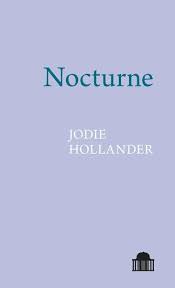
Nocturne, Jodie Hollander’s second collection, is, in many ways, a crashing, highly tempestuous work. It begins with the poem, ‘Storm (Key West, Florida)’, in which the poet watches the world tip over:
and a tree is yanked up, exposing its roots.
I feel my small self lifting from the ground,
but this time I don’t resist. I let myself go
to wherever it is I go in these storms,
In the very next poem, ‘Dream #1 (Liebestraum)’ it is a: ‘grand piano that fell from the sky’ and in subsequent poems horses break into dreams, the poet bursts into flames, kangaroos are: ‘jumping in front of cars, causing crashes’ and randomly destroying things, and there are: ‘restless volcanoes’, ‘fighting gangs of hawks’ monsoon rains and further storms. Indeed, the poet/speaker is forced to ask: ‘what else will crash down/ on me, from God’s big attic?’
As a result of this destructive wildness, the roots that are truly exposed are those of the poems’ narrator, the daughter of a professional classical pianist whose ‘emotional journey’ the collection explores. Hollander’s website confirms that she: ‘was raised in a family of classical musicians’, so it is tempting to assume the daughter is in fact the poet, though this is never overtly stated.
Regardless of who the ‘I’ in the poems actually is, these are strong, emotionally raw and honest poems exploring family dysfunction, parental loss and musical obsession, the pain they cause throughout the life of the subject, and the emotionally redemptive journey that ensues.
These are also calm, reflective poems of landscape, both geographical and psychological. Beginning in Key West, the poems travel geographically to Milwaukee (where, according to her website, Hollander initially comes from), Nepal, Santa Barbara, New York, Colorado, Denver, Australia, Montana, Alaska, Arizona, Oregon, and then return to Alaska, Australia and ultimately back to Key West. This physical change in location allows Hollander to explore the geographical world in colourful, arresting detail – Nocturne was long listed for the 2023 Laurel Prize for the best collection of nature or environmental poetry to highlight the climate crisis and raise awareness of the challenges and potential solutions. A good example of this is ‘Prairie Smoke (Flagstaff, AZ)’ where:
already the little buds
of Prairie Smoke are sprouting
everywhere in the canyon.
Such bright pink tufts
it’s almost hard to believe
their fragile little stems
survived the long winter
drinking in the sunlight
from deep under snow —
But beyond the natural landscapes, however strikingly described, the poems of Nocturne explore the speaker’s inscape, the emotional journey travelled by the pianist’s daughter from the time she was a: ‘small self’ hurt by her father’s obsession with music to the exclusion of all else, to her adulthood, when the pianist father is in decline, as in ‘After The Stroke’:
When the nurse first wheeled him out,
I hardly recognised his skinny arms,
his bony legs folded to the side,
the way his mouth drooped on the left.
and then in the poem ‘The Old House’ when the speaker finally accepts:
nothing would ever change:
music was still all my father lived for,
perhaps the only thing still keeping him alive.
Later, in another dream poem, ‘Geiger Key’, the speaker travels from childhood to an older version of herself:
I awaken to find myself suddenly aging.
The girl is sitting beside me on the bed.
She says the beginning may feel like the end,
and the end – just one way of beginning.
The language of the poems is primarily plain and colloquial. The drama is in the events and emotions, not the words used to describe them.
For all their plain speaking, and the emotional impact engendered by the contrast of simple language with the internal human angst being unpacked, these poems are also musical and lyric in tone. The plain speaking conceals layers of depth and tonal resonance, which augment the often visceral impact of the poems. In the same way, the frequently visual beauty of the physical landscapes painted in these poems contrasts strongly with the agony of the unfolding human inscape. Even when the landscapes are something other than beautiful, their depiction is sharply detailed and clear. They become an echo or reflection of the inscape being explored. As in ‘Kata Tjuda (Northern Territory, Australia)’:
Morning after morning
a terrible sun rises, revealing
the great red ache of this land.
What fires once burned here
smoldering through the rocks
like a kind of awful rash,
then oxidizing into a deep rust?
The poems sing from the physical and emotional debris they so often starkly depict and ultimately their song is one of hope, as in ‘Two Horses (Macedon Range, Australia)’:
it doesn’t really matter
whether the rains are coming,
or if that familiar darkness
will soon be on its way.
Seeing them here today
under this vast Australian sky
it finally dawns on me:
my life is more than enough, to be alive is a blessing.
These are powerful and memorable poems within an equally powerful and resonant collection.
J.S. Watts is a poet and novelist. Her poetry, short stories and non-fiction appear in diverse publications in Britain, Ireland, Canada, Australia, New Zealand and America and have been broadcast on BBC and independent radio. Her published books include: Cats and Other Myths, Songs of Steelyard Sue, Years Ago You Coloured Me, The Submerged Sea, Underword (poetry) and A Darker Moon, Witchlight, Old Light and Elderlight (novels). For more information, see her website https://www.jswatts.co.uk/
*****
Reminded of Something by Robin Thomas. £9.99 Cinnamon Press. ISBN: 978-1-78864-144-9. Reviewed by Neil Fulwood
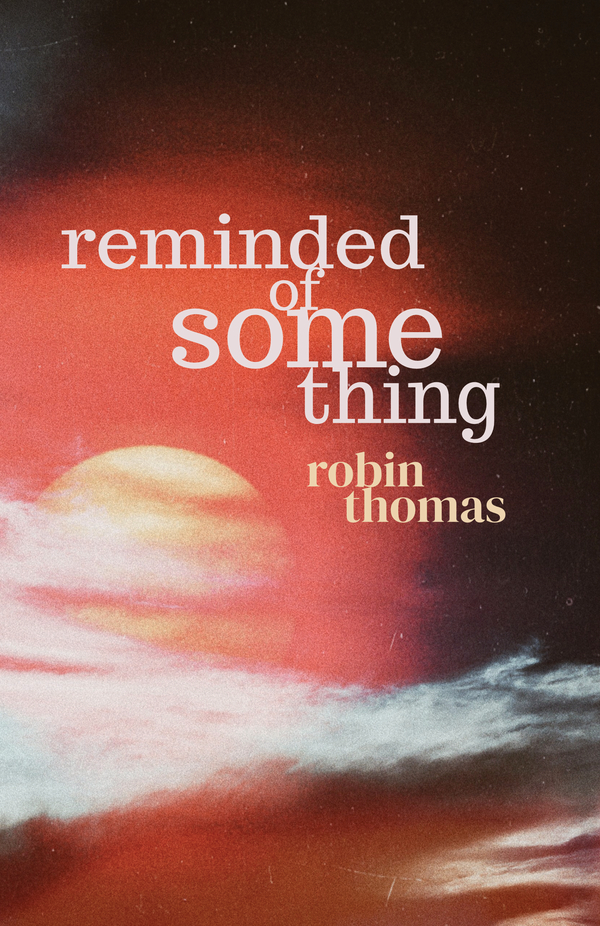
My review of Robin Thomas’s previous collection, A Distant Hum, for The High Window’s Spring 2022 issue began with the observation that the poet makes a virtue of concision – a statement that ought to be thunderingly obvious given that one of the chief pleasures and distinctions of poetry is its capacity for distillation, but isn’t always the case (increasingly, multi-page expressions of verbosity are becoming the norm). I concluded that Thomas had a particular talent for understatement – again, not something that is always the case, particularly amongst adherents to the confessional or life-writing style.
Reminded of Something displays the same commitment to concision – only one poem pushes beyond a single page – and understatement, and it would have been quite easy to rehash the superlatives from my previous review (only with different quotes dropped in) and declare it a fitting and eminently enjoyable follow-up to its predecessor. Except that Reminded of Something unfolds with a heavier heart.
The dedication – to the poet’s late wife – readies you for the collection’s defining theme. Its four sections are prefaced by a twelve-line poem, ‘The Engine’, which I shall quote in full.
Who remembers the birches
which swayed in the soft winds
of yesterday? And who recalls
the fires of their heart
when the sky was blue and the sun
a hot engine, driving through winter
to spring, through spring towards
joy; or the child which played
at the foot of the birch trees
which swayed in the bickering wind
drifting tomorrow
into its innocent head?
The first section, comprising a dozen poems on loss and remembrance, opens with ‘After many a season’, which again benefits from quoting in full:
all the things she was
compressed
expanded
to become
an event
and curtains closing
I
was just getting to know her
I’m generally suspicious of poems which use single word lines, the uncertainty always nagging away at the back of my mind as to whether that single word is enough to do the heavy lifting. Thomas proves that it can be done, and done elegantly. The wistful last two lines suggest a middle ground between mourning and the poet beginning to make his peace with a vastly changed world. Subsequent pieces achieve a similar effect:
How you would have loved it:
the power, the expression,
the tenderness … h’mm, let’s try again:
the thunder, the sweetness of rain,
mild, fresh mornings …
[‘On listening to a Brahms piano concerto’]
…
welcome home
when I come through the door.
As I lock it behind me I don’t
keep you safe.
[‘Where won’t you next be’]
I tease them from the sleeves they
don’t want to leave; I save some
for her to never see …
[‘The photos’]
The second section continues the theme of recollection and reflection: poems of people and places. ‘Their own lives’ invokes Larkin, but Thomas keeps the detail personal to his own experience. Then, with the prose-poem ‘The science of poetry’, the focus expands: Yeats’ ‘Song of the Wandering Aengus’ is sensitively reimagined through the lens of childhood innocence in ‘Angie’s Song’; ‘Life and work’ dismisses some lazy thinking about Beethoven while preserving the towering intensity of his compositions; canvases by Guercino and Vanessa Bell are brought to life (Thomas’s engagement with the visual arts was one of the great joys of A Distant Hum); and there’s even an affectionate little skit on Brief Encounter in ‘Mrs Jesson’s brush with life’. Nods to other poets abound: Eliot, Wordsworth, Brooke, Larkin again.
Section three comprises the sequence ‘Dark-eyed night’ which is too long to quote in full and does not lend itself to being abstracted. It pulls together much of what has gone before and hums quietly with its own power. Thomas’s unassuming humanitarianism and his unforced craftsmanship achieve a poignant symbiosis here.
The fourth and last section gifts us just one poem, as perfectly distilled as anything Thomas has written. It’s called ‘The news’ and it’s tempting to quote it verbatim. But I’ll resist doing so. It needs to be experienced by the reader in the context of the collection as a whole. Reminded of Something is not a book to be dipped into, flipped through or accessed casually. It should be read as a whole, in sequence, ideally in a single sitting, and when the ten lines of ‘The news’ break upon the reader, the effect is all the more powerful for their stillness.
Neil Fulwood was born in Nottingham, England, where he still lives and works. He has three collections out with Shoestring Press: No Avoiding It, Can’t Take Me Anywhere and Service Cancelled. He co-edited the Alan Sillitoe tribute anthology More Raw Material (Lucifer Press, 2015), and has published three volumes of film criticism with Chrysalis.
*****
‘Birds Knit my Ribs Together’ by ‘Phil Barnett’. £9.99. Arachne Press. ISBN: 978 1 913665 91 3. Reviewed by Alison Lock
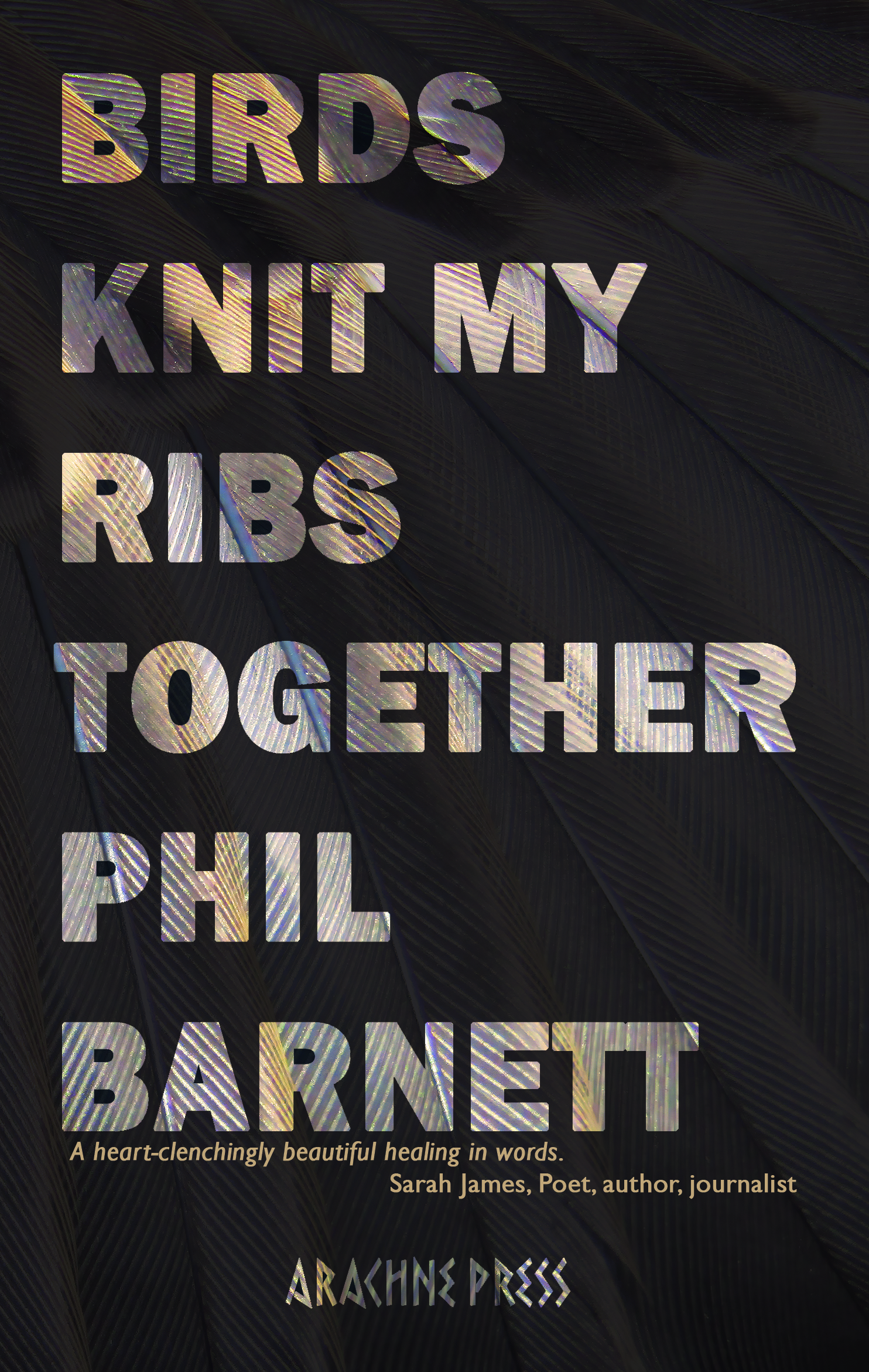
I’ve been aware of Phil Barnett’s work as a naturalist and artist as I see his wonderful photography on social media. Now, I find he is also a poet and, when I read his poems, his words bring me even closer to his subjects, every bird, and his relationship to them – perhaps a different, more intimate presentation than a single image can provide. His ability to capture these creatures in words reminds me of meditative writing in all its simplicity and clarity. As with the poetry of the 19th Century poet, John Clare, Barnett finds an intimacy that reveals a world of solace and joy in the natural world. When he finds ‘a god on the path’ – an injured bird that falls from the sky, he feels its wounds as deep as his own disability.
It is not unusual for poets to write about birds, a subject often seen as a symbol for something outside of our daily lives, creatures that represent an existential or ethereal part of us, lost souls that catch our eye, calling to us to be aware of a world outside of our own preoccupations. In ‘Bird Watching’, the poet describes himself as a: ‘bone bag’ who views the birds through a window, but it is more than that; in this poem, it is as though he has withdrawn from his body with all: ‘consciousness outsourced to birds’, and he has become at one with them. In ‘Trepanning’, by its title he is referring to the medieval practice of drilling a hole in the cranium as a medical practice in which to relieve pressure from the brain – an extreme allusion one might think but one that works in its context. He writes, the woodpecker who: ‘bored my skull / in trepanation’ has pecked a hole from where wasps fly out. Only the birds of the garden see everything that is inside him, every thought, how it feels to be him.
One of my favourite poems in this collection is ‘Box of Letting Go’ where the poet buys a box that contains a goldfinch from a pet shop in Greece. A: ‘suspicion of locals’ watch – what a great collective noun – as he opens the box, he lets the bird fly free. This pamphlet it is not just about bird watching, it takes us beyond the life of birds to a point where in the poem ‘Plugging by a Bird’: ‘only a bird stands between us / and death.’
This slim pamphlet which begins with a tick sheet of birds that the poet has observed, takes us with him on a flight of words. Without the use of punctuation, or capitals at the beginning of each line or poem – it is as though the words have arrived on the page, flown in, and landed on a pure white space.
Alison Lock is a writer of poetry, short fiction, and creative non-fiction. She has published several books and pamphlets, amongst others, Unfurling (2022), written as a response to the covid lockdowns, connecting an inner world with her love of nature. Her poetic sequence of personal transformation, Lure, was broadcast on the BBC Radio 3 ‘Between the Ears’ programme. Her latest collection, Thrift (Palewell Press) considers the Earth and its vanishing creatures. www.alisonlock.com
*****
Or did you ever see the Other Side by Hedy Habra. £15.95. Press 53. ISBN 978-1-9504136 -90. Reviewed by Bernard Pearson.
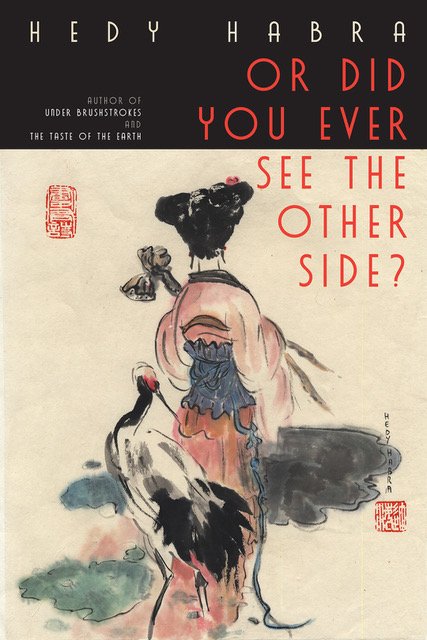
In this warm and engaging collection, Hedy Habra invites one to spend time with her work in an intimate and engaging way and what a privilege it is. By tapping into the ekphrastic model, using art as a conduit, through which we can appreciate both the female gaze and the femininity of the artist, in a variety of settings. Here we discover new and old truths about the writer and those of us reading and absorbing her words and imagistic reflections. This is done utilizing all the skills, such a fine poet has at her disposal and yet her works always manage to feel organic and not manufactured
The collection starts strongly in the first poem ‘Or Did You Ever See The Other Side Of Things?’ uses the analogy of the wood in a table, bearing so much, remembering its past as a living thing, the musing on this inanimate and yet vicariously animate state, foretelling the return for the writer of a vital passion, is beautifully drawn and cleverly, has the reader sat down at such a table, ready to be taken on a journey of the imagination.
In ‘Or What’s In A Birds Song, Unravelled?’ we accompany the writer into an ‘ornithological world’ of flight and the transience of life and love, with Habra cleverly weaving the bird motif through the poem in a way, every bit as visual as had it been by the stroke of a delicate brush.
‘Or Don’t Get Fooled By Her Self-Righteousness’ examines wonderfully the ying and the yang within us all, the tussle between our ‘drivers and our conscience in a linguistically, evocative and playful way.
‘Or Am I Or Am I Not A Knot Of Contradictions?’ is a terrific piece, perfectly summoning up the discomfort of being a writer ‘a desperate critter scratching frenetically’, anyone who has attempted to write will identify with this. The analogy of an old house returning to nature, in some original or otherwise way, is certainly an arresting one.
In the erotic, wistful and charming, ‘Or How Much Of You Remains Within The Walls Of A Home?’ we explore the roots of emotion, through a colourful variety of flora. Once again Habra draws you in, so you ride the emotional roller coaster with her
With ‘Or Did You Think Crushed Hopes Couldn’t Reawaken?’ I am reminded of ‘And Still I Rise’ that great Maya Angelou poem. Here we have a thought-provoking meditation on destruction, survival and renewal.
For anyone who finds it hard to let go, the pantoum ‘Or Call Me A Hoarder If You Will, But Try To Understand’ will resonate. The form chosen, amplifies the examination of memory and the way that all our senses play their part.
The anxious, expectant, under confident and aroused thoughts of new love, are examined from different perspectives in ‘Or What If They Could Hear Each Other’s Heartbeat?’, the poem is both touching and assured in the picture of such moments that it illustrates.
Throughout this collection, the poet has ensured that the way the poems appear on the page assists the reader to fully experience what is before them. This is never more fully realised than in ‘Or Did You Think I’d Never Find The Way Out?’, with its references to the doomed Ophelia, and a passing nod to Tennyson’s The Lady of Shalott, we are taken down a river of painful conformity, to a realization of what could have been and what might be to come.
The writer gives us an index of some of the artists she has drawn inspiration from and one can see from a brief perusal how some of the warm, palettes used and the metaphysical dream like sequences of surrealist’s such as Remedios Varo, have helped Habra in creating such a remarkable, treasure trove, full of personal and universal insights and awash with striking imagery. It was a delight to read such accomplished work.
Bernard Pearson lives in Shropshire in the UK he is a published two novels Where Willows End and In Red Blood with Leaf by Leaf press. He is a published poet and spoken word performer who was a finalist in the John Tripp Spoken Word Competition and The All Wales Comic Verse Competition. He is also a reviewer, biographer and prize winning short story writer.
*****
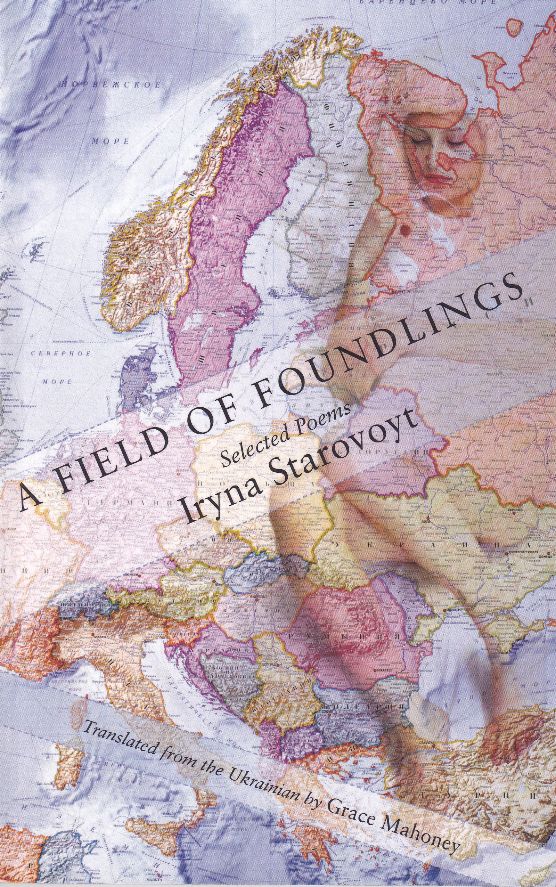
A Field of Foundlings, selected Poems by Iryna Starovoyt, translated by Grace Mahoney. £13.99. Lost Horse Press. ISBN: 978-0998196343. Reviewed by Sarah Lawson
Vladimir Putin and his supporters would like us to believe that Ukraine has no distinctive culture or literature or even language, but there are countless Ukrainian writers making vibrant use of their language and their culture who prove him grossly mistaken.
Lost Horse Press in Idaho began a bilingual series of Contemporary Ukrainian Poets in 2017, and the list has now grown to seventeen at last count. The first collection in the series, the one that inspired the idea of the series, is A Field of Foundlings by Iryna Starovoyt, a poet and essayist who lives in Lviv and teaches Cultural Studies at the Ukrainian Catholic University there. She has published three collections of poetry in Ukrainian, and this selection from them, ably translated by Grace Mahoney, expresses the complicated problems of memory and history in this fraught part of the Slavic world.
Iryna Starovoyt is a member of the generation born in a soviet state but who as teenagers found themselves in a country that was trying to create a new world of experimental democracy. This generation came of age in the transition from one system to another, between repression and a heady freedom, and between officially forgotten historical events and personal memory of them. With its ambiguities and paradoxes, this pivotal situation has been fertile soil for a poet like Iryna Starovoyt.
When A Field of Foundlings was published, the escalation of the war against Ukraine in February 2022 had not happened yet, but as Russia had already invaded and annexed parts of the country, Ukraine was already experiencing the trauma of war. In one of the many striking poems here, Starovoyt says, “The grass under the scythe is still alive at the roots”. There is a strong sense of national identity and national unity in these poems, but also more personal accounts, all expressed in allusive, oblique language.
These poems are a window into a world where the citizens are finding their feet. After all, “the blueprint doesn’t always become a building,/ the forecast doesn’t always become the weather.” The poems in Field of Foundlings bear rereading, because new meanings appear and striking images become more striking. The poems are both conversational and dense by turns, so that just when you think it is a simple narrative, it becomes allusive and metaphorical. Ukraine is a nation of orphans in one sense or another, Starovoyt seems to be saying. (For me it has an inescapable if irrelevant resonance of Langland’s Piers Plowman and the “fair field full of folk”.)
We see through the poet’s eyes “a country younger than us but as old as the world” where (in another poem) “We live in a clay nation, / sculpted from several halves”. It’s a troubled place where “The tomb of the unknown soldier / could be a family vault.”
She reserves some sharp words for the “diplomat-boys with ostrich inclinations”. They are “from countries / where the sun sets” and have no idea about realities in the East.
Some poems are more personal, but still expand into something wider. Starovoyt visits the Cambridge library where Virginia Woolf was denied entrance and addresses some thoughts to her. Now ironically “Adeline Virginia Woolf” is a revered writer and her work and her reputation live on: “life is no longer a dash between dates” because now we all leave a trail online and live beyond our terrestrial existence.
A meditation on her mother’s life tells us that the “woman who never became a pianist” nevertheless became her mother. The bedtime stories about her mother become an exploration of past and present, memory and paths not taken. “Nothing was certain when it was still the future.” Starovoyt’s sly allusiveness is evident when this non-pianist “[had to] read on the provincial school teaching roster / the surname of her unborn children.”
The startling gems in these poems must be partly to the credit of the translator, Grace Mahoney, but any translator of gems has to have original gems to begin with. Lost Horse Press in Idaho must also be congratulated for this initiative of the Contemporary Ukrainian Poets series, allowing us non-Ukrainian-speakers to appreciate the work of poets beyond the Carpathians.
Sarah Lawson was born in Indiana but has lived more many years in London. Her poems, translations, and book reviews have been published widely. Her poetry collections are Below the Surface (Loxwood Stoneleigh, 1996) and All the Tea in China (Hearing Eye, 2005); Hearing Eye has also published her pamphlets, Twelve Scenes of Malta and Friends in the Country, and a haiku collection, The Wisteria’s Children (2009).
*****
 The High Window