*****
Adopting the dialogic form between conflicting parts of the self that Anthony Burgess experimented with in his fantasia, Mozart and the Wolfgang, Jonathan Timbers attempts to clarify his feelings about Andrew Wynn Owen‘s debut collection of poems Infinite in Finite.
*****
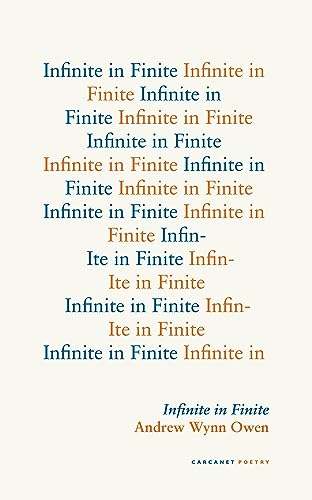
Infinite in Finite by Andrew Wynn Owen. £12.99. Poetry.
ISBN 978 1 80017 347 7
Jonathan
This is a vibrant collection by a fine young poet, full of energy and wit. It explores belief in God, love, life and the power and obstructiveness of language, how we know and what we know. It does all this in tightly rhymed stanzas.
Timbers
There’s certainly a lot in it, too often badly overwritten. It would be better with more personal authenticity and without the flashy technique.
Jonathan
The debt to Auden is obvious. It tends to be early Auden. And there are echoes of Hardy, mainly in relation to imagery, verse structure and diction. The main theme of appearance and reality owes a strong debt to F. H. Bradley’s philosophical work, which influenced T. S. Eliot and in particular his poem The Waste Land, where the crowds and individuals are trapped in their own disconnected worlds. Without going into areas beyond my competence, Bradley argued that modern materialist thought ended up with solipsism, and only a different way of thinking would enable us to encounter the reality of the other. The other may be God or just other people we love, whose reality we acknowledge as equivalent to our own. Or as Jesus put it in St Mark’s Gospel: ‘[The first commandment is] thou shalt love the Lord thy God with all thy heart, and with all thy soul, and with all thy strength. And the second is this. Thou shalt love thy neighbour as thyself’.
Or as Andrew Wynn Owens puts it himself:
Since events are coming quickly and the world is in a jam,
Humans need a theory better than ‘I think therefore I am’.
FH Bradley hit the bullseye but what priest would give a damn?
‘Utopia’
Timbers
It’s problematic that the heaviest stylistic influence is early Auden. The poet could learn more from later Auden: ‘ (to)…ruin a fine tenor voice / For effects that bring down the house could happen to all / But the best and worst of us’, ‘In Praise of Limestone’. Later Auden is more authentic, less rhetorical than the early Auden. More discursive and personal.
Some of the lines and structures remind me of Bob Dylan songs. I don’t necessarily mean that in a good way. They can be corny, like Dylan, but without Dylan’s entertaining irony and paranoia. There’s even a poem with the line: ‘A gale began to howl’, ‘The Owl’, echoing the famous last line from ‘All Along the Watchtower’.
Like Dylan, he uses portmanteau phrases, but he’s less adept at reviving them, twisting them into new meanings and spitting them back. Sometimes it seems unusually heavy handed for a published poet, such as: ‘death’s stagnant throne’, ‘Elan Vital’ or, my personal favourite, the poem title: ‘Hope’s origami’.
I definitely see the similarity with Hardy. Like Hardy, he uses top heavy abstract phrases and peculiar anachronisms. However, Hardy had a modern sensibility and a traditional folky technique in a complex relationship with one another. Owen, on the other hand, not to put too fine a point on it, seems to be showing off.
Compare Owen’s use of ‘englobed’ in ‘The Moment’ to Hardy’s ‘bedrenched’ from ‘At Castle Botteral’. Owen uses his anachronism to set off the more contemporary word ‘plexiglass’ – it’s a self-conscious ploy. With Hardy, you feel he’s doing some hard lifting to set the scene. His scrupulous diction is not quite natural language, but it’s quite close, an indeterminacy that helps set the tone for the intensities that follow.
Owen, like Hardy, sometimes uses top heavy portmanteau phrases such as: ‘grief’s calm recompense’, ‘Mimes (1)’, entirely pointlessly in my humble opinion. Compare this to ‘Life’s old thrall’ in Hardy’s ‘The Coronation’. In the context, the poem is set among the dead in Westminster Abbey, the phrase seems sly and ironic; or ‘the hot faced sun’ in ‘The Musical Box’ where you can sense Hardy trying to double down on his subject matter and give the lines a musical swing.
The reader should prepare themselves for the old fashioned use of capitals at the beginning of lines in Owen’s poetry too.
Jonathan
Yes, Owen mixes anachronisms up with contemporary vocabulary (‘to rook’, ‘standalone’ etc). But that could be just part of the way he’s trying to break through language into meaning.
I think you misunderstand what he’s trying to do. The use of these admittedly lumpy phrases is a comment on language itself, on the way that meaning/ reality has to twist around collocations like a plant growing towards the light. This relates heavily to his use of familiar tropes. The most frequent ones are about mist/ light or being lost in a wood: ‘ the cold woods where I wander when in doubt’, ‘Lutherie’ (echoes of Winterreise there, perhaps?). It’s that cloud of unknowing we have somehow to pierce: ‘ Between us we must bridge our indecision / About the things we can and cannot know’, ‘Ultramontane’.
He also refers to the zodiac and planets, presumably because they traditionally embody the harmonies of creation:
Axial tilt of our elliptical orbit
xxxxxxTillering on through space
………………………..
Depth of our hopes like reeling dynamos
xxxxxxUnspooling at a faster pace”
‘Tilt’
This concern about creation leads onto his ecological poems and a trope concerning an intricate vine that connects all things and transmits emotional connection:
The infinite is intricate, a vine
xxxxxxThat wanders and rewinds
‘Vine’
…the vine’s vast nexus
‘The Frantic’
This finds an echo in an image of the body’s circulatory system which moves from micro to macrocosm:
…the hot mulch of the heart
xxxxxxWhere hope may root
Between young lungs, whose alveoli
xxxxxxAre branches,
Whose rise-and-fall is families of life
xExpanding and collapsing through
xxMillennia of torn
xxxLoss and return”.
‘The Melting’
Timbers
A bit like fungus: the wood wide web, as Merlin Sheldrake puts it.
Some of it feels heavy handed. The rhyming doesn’t help and sometimes dictates the choice of words rather than reinforcing their meaning:
And some will say I don’t define the real
xxxxxxbut now I answer them.
It is the good our lives conceal.
xxxxxxIt is the roses stem.
Down to each elegant destructive thorn.
xxxxxxIt is the child of Bethlehem…
‘The Real’
Do we really want this sort of didacticism back in poetry?
Jonathan
Well, actually, why not? Sometimes I think it works very well as light verse conveying much heavier meanings:
xxxxxxxxJehovah took the grey
Path of obscurity and left us baffled,
xxxxxxxxNot knowing, if we die today,
Whether our hard to pinpoint souls are raffled
xxxxxxxxTo take fresh shapes,
Suddenly cinched and snaffled
xxxxxxxxInto ants or apes,
Or whether there’s some waiting room
xxxxxxxxWith cheese and grapes
Where a silent Angel designates our doom.
‘Mystery’
This collection extends the expressive range of contemporary poetry to make satisfying didacticism more possible. One which is original and surprising, an entertaining flight of the mind. He’s bringing an important strand of poetry – sidelined during the Modernist period – back home.
He can also write descriptive poetry which at the same time becomes universal in its meaning, such as ‘Youth’.
By the way, the collection is threaded through with references to lost youth, even though Owen is, by my standards anyway, quite youthful himself.
Timbers
Well, he clearly has talent. The collection includes some excellent occasional poems like ‘In Praise of Public Transport’. I’m not staying that it’s without quality. But there’s a lot of dross too I spent a lot of time reading it and thinking, ‘Well, this is colourful verbiage’.
And some of it is so Heffalumpish:
Elan vital, by which we must mean life,
xxxxxxxThe opposite of death.
You fall forever like a leaf
xxxxxxxUntil your final breath.
‘Elan Vital’
I mean, death the opposite of life? Whatever next?
Jonathan
To be fair, he’s actually got something significant to say – but sometimes he approaches his subject matter humorously, and sometimes with great intensity. He reaches out to God, the ultimate reality. God is an entity, ‘perhaps transcendent, possibly immanent’, ‘Mind’. We have to somehow find faith through the fog of ourselves. It’s something I relate to as a Christian quite a lot. Faith isn’t easy at all – some people think it is but it’s not, believing of the triumph of love over death isn’t easy to accept. Being overcome by the futility of being is a much easier route:
…heaven is all cush
xxxxxxxAnd honeydew,
Your unrelatable paradise
‘Unrelatable’
He animates the struggle for faith in ways that resonate with my own struggles. But I don’t think you’d have to be a Christian to draw inspiration from what he writes:
An all-surpassingness
xxxxxxxWill re-awaken
Only when broken hopes are done
xxxxxxxWhen we are shaken
To see our needed part within the One’
‘Astral Waters’
Timbers
So finding a reality outside of one’s own subjectivism requires a belief in a supernatural other? If your guru is Richard Dawkins, or even Alice Roberts, you’re going to find this collection really irritating.
But I can see how that helps to explain how the love poems slot in. I was wondering about them. Presumably they’re not included as light relief but to connect to the search for external reality. Again, contrasting them with Hardy, I found his poetry a bit sentimental. I got little sense of the person(s) to whom they are addressed. That sort of undermines the purpose of the collection, as you’ve described it, doesn’t it?
Jonathan
There are sections I struggle with. But that doesn’t invalidate the attempt. I admire the collection’s boldness. I think he succeeds ‘Contact’ when he says: ‘This steeped / Immersion in the other’s tensely furled / Intentions…… / How good it is that all of this is real’.
That’s why I will be coming back to poems in this collection. Sometimes, for me, he just gets it right. It’s that old fashioned trope about the value of poetry: it sums up an experience, a thought, a dilemma and crystalises it in powerful language. He does that for me. To adopt Larkin’s term, the poetry is often ‘memorable’.
Timbers
Hmmm. Well at least, you didn’t get on to the debt to Spinoza
Jonathan
Did I forget that?
Timbers
Thankfully, yes.
Jonathan
There’s a lot more I could say about the collection.
Timbers
But sadly we’ve run out of space.
*****
Jonathan Timbers has been a teacher and lawyer; he’s worked in a tank factory, a prosthetic limb factory and the last cloth cap making workshop in Leeds (at the time). He helped organise and gave evidence. to the UN inquiry on the impact of austerity on disabled peoples’s rights in the UK. He was once the mayor of Hebden Bridge and Mytholmroyd and thinks that Ted Hughes is England”s greatest war poet. He occasionally publishes poetry and reviews; otherwise he lives a life of complete self indulgence, with his cat, Polly.”
 The High Window