*****
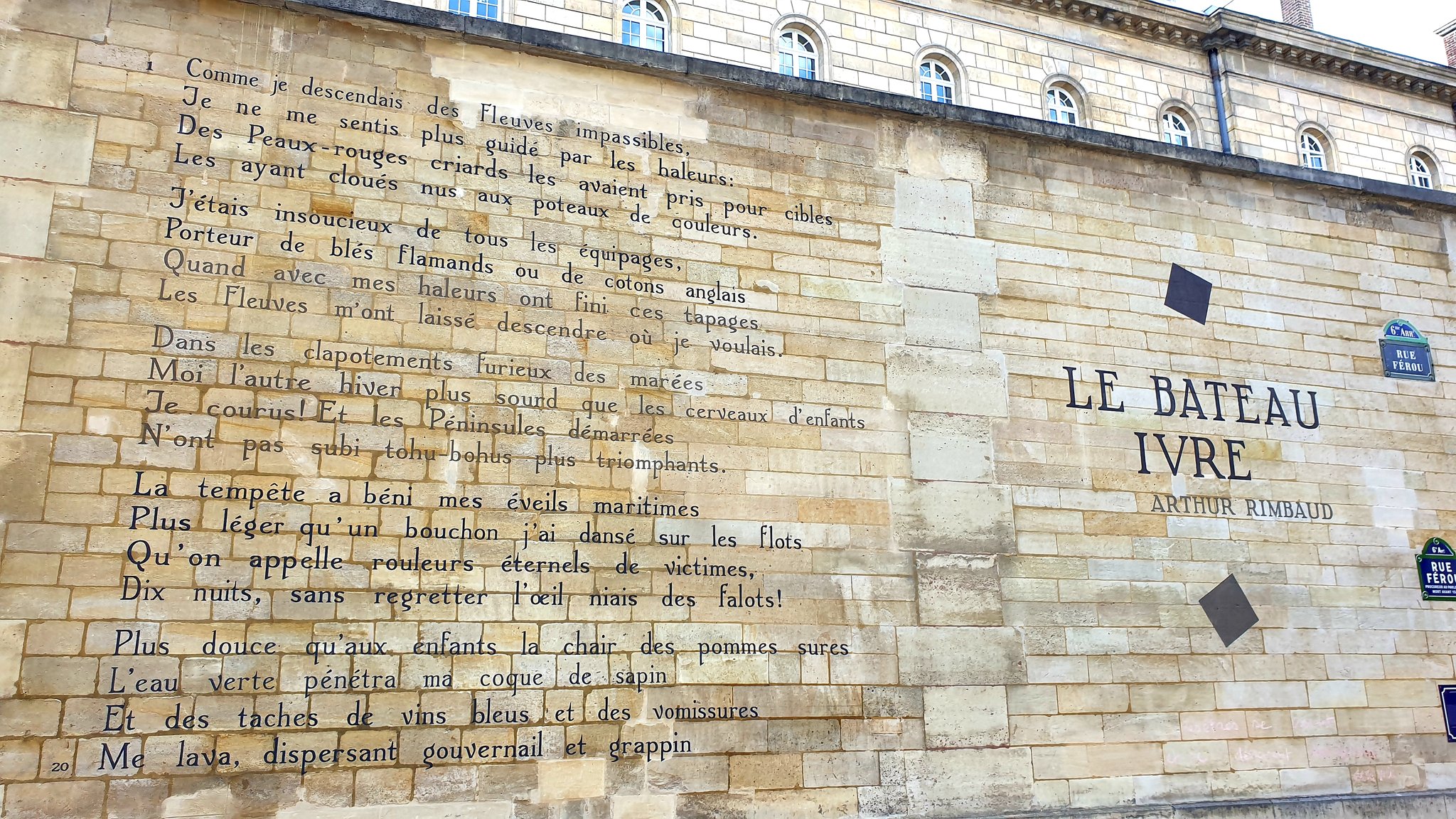
The Drunken Boat (Le Bateau ivre) is a 100-line verse-poem written in 1871 by Arthur Rimbaud (1854 – 1891). The poem describes the drifting and sinking of a boat lost at sea in a fragmented first-person narrative saturated with vivid imagery and symbolism. It is considered a masterpiece of French Symbolism.
Rimbaud, then aged sixteen, wrote the poem in the summer of 1871 at his childhood home in Charleville in Northern France. He included the poem in a letter he sent to Paul Verlaine in September 1871 to introduce himself to Verlaine. Shortly afterwards, he joined Verlaine in Paris and became his lover. Rimbaud and Verlaine had a stormy affair. In Brussels in July 1873, in a drunken, jealous rage, Verlaine fired two shots with a pistol at Rimbaud, wounding his left wrist, though not seriously injuring the poet.
Rimbaud was inspired to write the poem after reading Charles Baudelaire’s volume of French poetry Les Fleurs du mal and Jules Verne’s novel Twenty Thousand Leagues Under the Sea, which had recently been published in book form, and which is known to have been the source of many of the poem’s allusions and images. Another Verne novel, The Adventures of Captain Hatteras, was likely an additional source of inspiration.
*****
NB: You can read the French text of Le bateau ivre by following the link and also listen to a reading of it here.
*****


Rimbaud: ‘The Drunken Boat’ translated by Estill Pollock
…alone, I reach the rapids, guided through
beyond a sense of distance—double-crossed
to screaming savages, my crew
nailed naked to the bull’s-eye totems, lost.
No second thoughts for deck hands: the cargo
scow of Flanders grain, of English cotton,
cast clear of the imbroglio
upstream to catch the careless current down.
The winter runs to tantrum tides, empty
childish fury fuelling my direction,
the breakaway peninsulae,
each tinny coup, slaves for my selection.
I wake to tempests. The oceans sanction
my weightless two-step on the flood, the waves
beneath, breaking towards extinction,
the harbour lighthouse blind to salty graves.
This seepage hull, this apple flesh, this crab-
green infancy of sweetness shoals the seams,
snap-anchor swells that clear the scab
of vomit, wine, this listing bridge of dreams.
And now awash in milky starlight, sea
rhymes sunk to these devouring azures,
nudged by the drowned, pale subsidy
of pain the brooding look of corpses cures;
where, though a sudden cobalt saturates,
measures languid time, beating to the noon,
a manic, boozy chord dictates
a bully red, love’s dregs, its bitter tune.
I know the sky, scissor-cut with lightning,
the waterspouts, the boiling reef, the coves;
I know the night, and dawn rising
dreamily, mounting with the census doves.
I saw a late star stained with hieroglyphs,
a shock of bruised illumination,
a Mystery Play, where sainted stiffs
reveal, fin, the wellspring of salvation;
snow-blind with visions, the night’s green kiss
tracing the sea’s eye, this alien pus
trafficking metamorphosis,
blue alarms, yellows, ballad phosphorous;
these many months, the mustang oceans bolt
along the beaches— following, I know
I cannot break the briny colt,
or save the Virgin from the undertow;
I know these flowers, bizarre sub-tropics
melting into human shapes, the wildcat
eyes, the tattoo’s green italics;
the rainbows rein the deep’s Magnificat;
the stinking marshes mire the world with sinks
of rotting reeds and spent leviathans;
above the falls, the river brinks
on chasm sky to echoing cyans;
glaciers, silver in the sun, a pearly
fire of waves and sky, the seabed’s shipwreck
murk, and then the serpent’s burly
riptide bite— squid-ink, coiling on the deck.
The child in me demands the golden dream,
the leaping schools of blue-finned, goldmine seas.
The tide, flowering on the seam
of journeys, swears to sweeter pedigrees.
Weary of poles and zones, of sacrifice,
of sea swell gentle as a sob, sometimes
I rest, resigned to the device
of days, deep yellow bell flowers, love’s mimes…
This loner’s life confronts the routes, edges
with the albatross between the guano
and the far horizon, pledges
deeper dreams, frail nets and the dead below…
No map marks this tangled voyage, riding squalls,
sky ether without birdsong, this fatigue
of tar and timber, my gunwales
iron salvage for the Hanseatic League;
against heaven, its bulwark rouge, its mists
and clinging indigos, its illusion,
the poem’s trajectory persists
to this preserve, this spit-shine arc, this sun;
eel-volt lights the dark, attendant creatures
scattershot before the twisted hull, heat
hammering the weather’s features
in vortices of burning blue conceit;
deep distance down, a storm-massed entity
consumes these rolling worlds, these epaulets
of sea-stained, stilled eternity;
homesick, I long for Europe’s parapets!
The starry archipelago invites
the drifter with its restless nebulae:
is this the exile shared with flights
of golden birds from depths of prophecy?
This weeping admits the heartbreak dawn, how
the cruelty of moon-phase spawns bitter suns.
Love’s bile swells through this torpor: now
the breached keel rolls, drunk with destinations!
Europe’s element, a twilight stillness,
scents the shade. Regret, the secret spring,
is part of this desire— finesse
of Mayfly wings, fragile, a child’s plaything.
I sleepwalk through the freighters’ wakes, the trades,
the high masts bright with flags. The signals mark
a drowned world and its renegades,
where prison barges’ searchlights cut the dark.
Estill Pollock‘s publications include Constructing the Human (Poetry Salzburg) and the book cycle Relic Environments Trilogy (Cinnamon Press, Wales). His recent poetry collections, Entropy, Time Signatures and Ark, are published in the United States by Broadstone Books. An e-chapbook, And Then, is published by Mudlark. He lives in Norfolk.
 The High Window