*****
Steve Ely: The European Eeel • Paul Eric Howlett: Onebody and other poems • Rennie Parker: balloons and stripey trousers • Paul Sutherland: Only Words
Four Pamphlets published by Melos
*****
The European Eeel by Steve Ely. £12. Longbarrow Press. ISBN: 978-1906175412. Reviewed by David Hackbridge Johnson

It is by no means a given that the threatened demise of flora and fauna in our world is greeted with universal horror – there will be those who, under the guise of ‘vested interests’ will smother whatever personal instincts they possess in the matter for the benefit of whichever clan of industry, government or blood sports club they claim dispassionately to represent. The hopes of the believers in a planet shared for the mutual good of all its life forms can easily be presented as characteristic of but one more clan whose cries can be amplified to demands no less seemingly reasonable but open to the importuning, justified or otherwise, of fanaticism. A feeling of helplessness in the face of artificially opposed camps might attend the person who loves nature but still feels out of it, by nature, or ‘un-nature’, of being a permanent city dweller (this reader puts his hand up) ever further compressed by towers flying up in Vauxhall Cross or Lewisham whose habitants might almost shake hands across the meagre gaps between glass and plastic flanks. Nature books have always satisfied the armchair naturalist – let Thomas Bewick or Gilbert White do the field work while we sit back and trace the fine woodcuts in luxury editions – in our own time let Robert Macfarlane double down on the past by retracing former naturalists’ paths (Nan Shepherd, Roger Deakin, Jacquetta Hawkes) and forge new ones of his own. As the planet seemingly dies the passionately green advocate’s response is misread as tearfully adumbrating pre-nostalgic inevitability – the world is already dead as we read of ancient holloways, fish-filled rivers, mountain paths trodden by goat and deer. ‘Under threat’ means ‘already extinct’ to the lemming-like pessimist charging (incorrectly as it happens – lemmings have better sense[i]) towards the cliff-edge. As one river is cleaned up and its champions win a government sponsored ecology award, a water company is by governmental get-out clause allowed to pollute another. Every healthy fish has a chemically deformed sister.
I don’t think Steve Ely’s intention in writing The European Eel is to add to the pile of nature books that make us fall into ill-conceived nostalgia and regret, although it does sport art work by P.R. Ruby – work that turns out to be of a nature not merely attractive but strikingly apposite to Ely’s project. In his remarkable book-length poem, Ely has forged links between poetry, ecology, scientific observation and inevitably (albeit covertly) politics. In his charting of the life story of just one eel, Ely is able to create a ray-finned epic that is in its own modest way Homeric in import – at least for the fish if it but knew it. That the author is aware of the trap of his inevitably being the human observer gives much of the scientific nomenclature an almost ironic twist – he even admits at one point to capturing an eel ‘Just for the poem’[ii] so he knows he is treading a fine line between wanting a genuine engagement with a creature and wanting something that feels like mere inspiration. Thus the ironies of a weighty vocabulary at the service of a seemingly helpless being. We get words probably new to poetry yet somehow the vast apparatus of science does not cajole the reader into thinking that a descriptive lecture is being laid out for the benefit of a biology student – although we haven’t had lines like ‘and ascending / through the photocline, join the thermonuclear / microplankton of the drifting epipelagic’[iii] since the days when Hugh MacDiarmid wrote things like ‘Hatched foraminous cavo-rilievo of the world, / Deictic, fiducial stones. Chiliad by chiliad’.[iv] Whatever is happening in MacDiarmid’s poem, what happens in Ely’s is that potentially bamboozling detail builds before the reader a startling mise-en-scène, one that seems to stack impossible odds against the creature – indeed it increasingly seems miraculous that survival is possible. A riverine and marine edifice is conjured in all its jostling powers. Although not wishing to disturb Homer too much, there might be a actinopterygian (you see – this science stuff is catching) Odysseus posited here – a journey, fraught with danger, one that puts the protagonist at the mercy of antagonistic currents, temperatures, salinities, acidities, etc. through which the ‘hero’ (in Ely’s book ‘heroine’) must come before us to make the suffering all worthwhile – although it should be pointed out that Homer leaves his hero alive and happily reunited with Penelope, while Ely allows nature to take its course in an ‘oxytocin rush of coitus and extinction’.[v]
The life cycle of the eel in question – one that Ely caught in Frickley Beck in May 2019 – is charted in a narrative that reaches back imaginatively to initial spawning in the Sargasso Sea – the place where all European eels spawn. The transformations from sexless to sexed, from elver to eel from yellow to silver, are just some of the humbling beauties the poet describes. In order that the eel might pivot from captivity back into its natural cycle, Ely releases her in August of the same year. The poet can then predict her movement through an entire topology of progress as she descends by beck to river to estuary to sea – assuming that she survives all of these stages in the journey. A great pendulum of natural forces sees her birth and death at the same point in the Atlantic Ocean, with the rest of her long life forming a great plume across the sea to where she feeds in the streams of northern England. The three months the animal spends in the poet’s aquarium offer him a unique window – an artificial and privileged suspension of sorts – through which to watch and meditate on its miracle of survival. There is a central prose section which movingly describes not the science behind the overarching journey of the eel but Ely’s brief husbandry of her – preparing the tank, watching her burrowing – ‘a plunging whip-crack pluming silt’[vi] – finding out what she likes to eat – ‘She was a picky eater, rejecting sprats and mackerel chunks’[vii] – and finally coming to the realisation that he must return her to the beck – ‘to the pool on the point of the fox-head wood’.[viii] The only time Ely touches the eel he sends the creature spinning in panic.
The interlude of eel and human is as a miniature Tarka the Otter by Henry Williamson or Ring of Bright Water by Gavin Maxwell. But no fanciful names for Steve Ely’s captive – no Tarka or Mijbil – he merely calls the eel ‘little eel’. Whereas Williamson and Maxwell create epics that include to a certain extent themselves, Ely leaves himself out by and large – there is no desire for a twinned view of the universe; it is the eel against the world. When the time comes for her reintroduction to nature, the poet offers her a farewell that he knows she cannot return – this is a prayer of a kind which makes an appeal to ‘the subtle world of spirit’[ix] – an awareness of the ‘otherness’ of the creature with no language other than the shapes it makes in ease or panic. It is a prayer no less fruitless for all that – for buried not too deep in the silt and mud of Ely’s work is the idea of responsibility. A litany of irresponsibility is revealed in gory detail – ‘in the whiff of sewerage outflow; / eel stink tumbling blindly beside her, / grey froth of used condoms and sanitary towels.’[x] – and later in the poem – ‘The sonic assaults of the thundering Humber – / huge screws of the MV Olympic Legacy, / the diesel reverb of the Pride of Zeebrugge’.[xi] Not all these threats are man-made – Ely does not ignore the eel’s many natural predators – the ‘Ghostly vortex of mewling black-head gulls.’[xii] At the point in the ocean where the solitary eel senses ‘her fellow-travelling, / deep-spaced shoal’[xiii] the poet gives us a remarkable erotic of the moment – ‘an ultrasound cacophony / of directional undulations, nerves tingling in the skin; / mucus chemtrails, heavy with hormones, / flooding the cells with sex;’.[xiv] The dance in the ocean as the female and male approach each other is not drawn in traditionally ‘human’ lyric verse – on the contrary Ely keeps the chemistry of fluids to the fore thus making the effect curiously more tender and inevitable. Given he only had one shot at eel-sex, Ely does the creatures proud – this reader found the scene most beautiful – as beautiful as when David Attenborough described the Herculean labours of the pregnant female scarab, burrowing, dragging the dungball into an earth cavern, dying so that her corpse is the first thing her hatchlings see as they emerge from the ball – for after the sex act, death is not far away.[xv]
An eco-poetic then? Yes – but one that appeals not by the battering ram of hysteria but by close attention to a creature that shares the world with us – so that we might learn of journeys as great as ours along the fractured tramlines of history – and as worthy of preservation. Whereas MacDiarmid chose to leave the reader to herself in pursuance of his scientific terms, Ely helpfully provides extensive notes and a bibliography for further research. This is where ecological arguments are laid out in plain prose and can act as tributaries of political thought to the main thrust of what damage we as humans are doing to the planet and its other inhabitants. He thereby shifts the main burden of the science away from the poem despite using words that must trigger the endnotes. This is admirable, for Ely has written a poem and it is not a tract. It commanded this reader’s deep attention and appreciation and I trust it will do others’, perhaps even giving pause to those committed to the arm-lock of vested interests and political givens, those whose imperatives in one direction might give way to imperatives in another.
* **
[i] See the fraudulent scene in the Disney nature film, White Wilderness (1958), where for the benefit of dramatic verisimilitude lemmings were compelled to their deaths for the benefit of the cameras. Cue descending diminished seventh chords and tremolandi strings that evoke the destruction of some rodent Valhalla, watery rather than fiery. View the scene here: https://youtu.be/xMZlr5Gf9yY?si=NG0oXlzYNUm6en6r
[ii] Steve Ely, The European Eel, p. 33.
[iii] Ely, p. 9.
[iv] ‘On a Raised Beach’, The Complete Poems of Hugh MacDiarmid, (Ed. Michael Grieve and William Russell Aitken), Penguin Books, Harmondsworth, vol. 1, pp. 422–33.
[v] Ely, p. 59.
[vi] Ely, p. 34.
[vii] Ely, p. 34.
[viii] Ely, p. 36.
[ix] Ely, p. 36.
[x] Ely, p. 39.
[xi] Ely, p. 42.
[xii] Ely, p. 39.
[xiii] Ely, p. 50.
[xiv] Ely, p. 50.
[xv] Attenborough describes the scarab’s journey as an Odyssey. See a clip here: https://youtu.be/Z7bY2UgLrH8?si=dqBVtEN7o8iuwiAL
*****
Onebody and other poems by Paul Eric Howlett. £12. Waterloo Press. ISBN: 978-1-915241-13-9. Reviewed by David Hackbridge Johnson
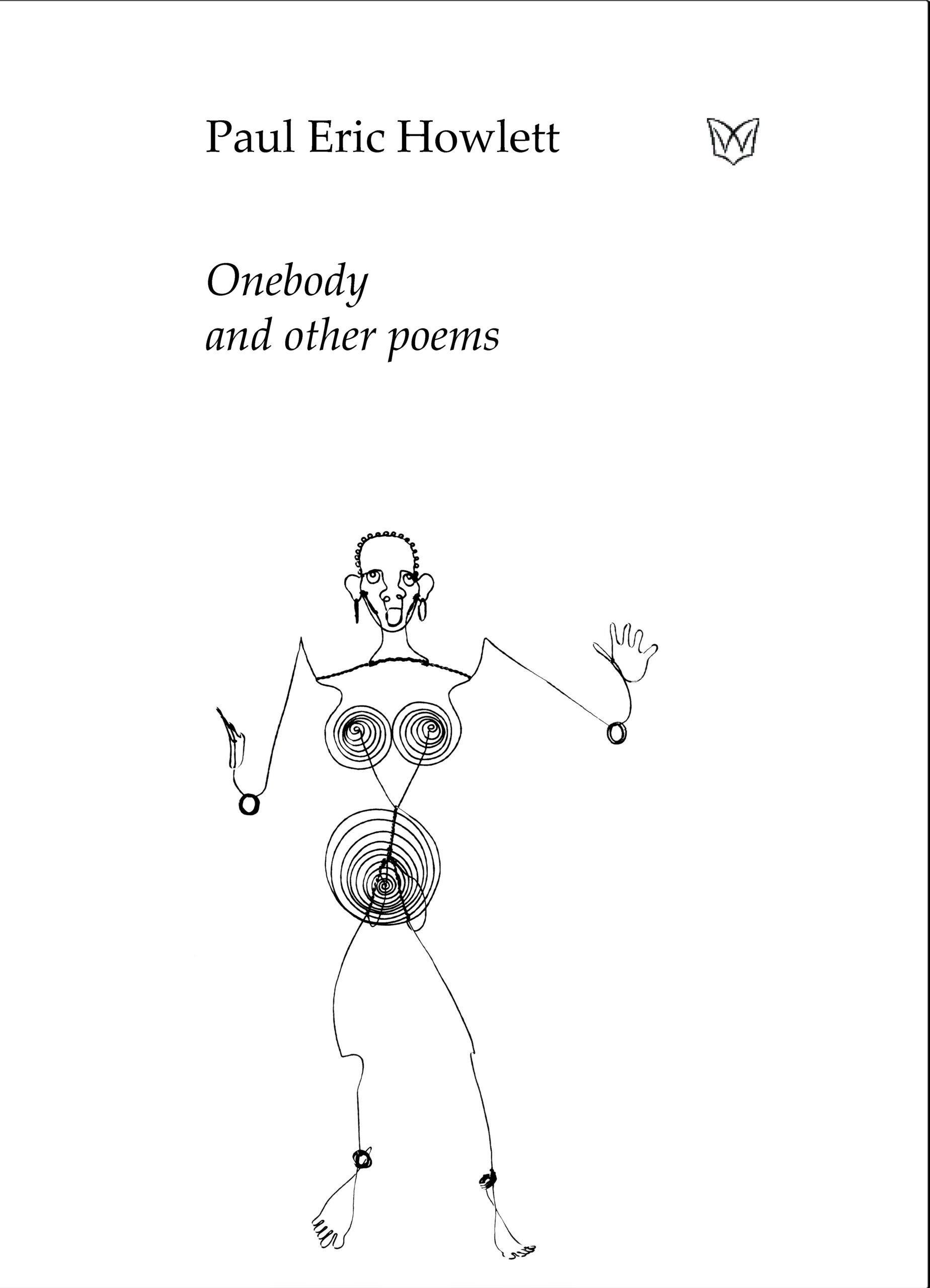
Hot on the heels of his first book for Waterloo Press, The Bedfordshire Boy, comes Paul Eric Howlett’s second, Onebody and other poems. A chance meeting with Waterloo’s editor-in-chief, Simon Jenner at a recent Ted Hughes symposium, allowed me to make the most basic of enquiries about a poet seemingly sprung fully-formed from nowhere into the thick of the poetic firmament. I can confirm that the poet lives, is writing, and that both volumes of his work are selections from manuscript works hitherto not published. No further biographical or bibliographical facts. The poet’s portrait adorns the back flap – a face serious, magnificently bearded, prophetic.
As in The Bedfordshire Boy, Howlett excels in poems that act like verbal signposts to geographical locations – ‘Selig’[i] gives us a procession of Suffolk names: Lavenham, Long Melford, the River Deben with its ‘giant S’, the River Alde with its ‘swung dash’ – and by doing so can dip into history with its ‘icons of time’ and allow real and imagined journeys. But if the title refers to the homelessness charity SeligSuffolk, it may be that Howlett is not merely pinning the tail to the psychogeographical donkey but is tapping into the need for places of haven – SeligSuffolk runs a scheme whereby churches become available spaces for those sleeping rough.[ii]
In allowing for a surreal and experimental admixture in some poems, Howlett has let himself in for some violent yokings – these from ‘Numerals’[iii] : ‘Shame sucking Cambridge without a Darwin / Instinct or reason rags for the nude few’. The conjugations are wild enough to justify the virtuosity and things are being said in the background about the nation and its evolving view of itself: ‘Rolling with millions of rounded grains / The British-kingdom and all its rulers.’ He makes more direct attacks in ‘Pack my Bag’[iv] where the specifics of a Craig Raine-like acidity scald: ‘Television’s nodding-dogs and autocue readers / Incestuous celebrity and game-show feeders’. This poem is one of several that exploit rhyme to achieve a sharp-edged satire – take these deliciously witty lines from ‘A Brief Life of Edith Sitwell’ that seem to both guy and praise a poet whose resurgence might alarm the po-faced: ‘Political customs, the adult zoo / An albatross of love and Tchelitchew’ – or on a more serious note: ‘Blind codicils of Adam and the Lord / Leave Atomic ash and Cain is abroad’ – this a reference to Sitwell’s 1947 poem ‘The Shadow of Cain’.
The fondness for experiment and a complex voice in some ways derived from Geoffrey Hill (even on occasion the curmudgeonly late Hill) are combined in ‘Brooding Slide’[v] where we are at once called to attention by an insistent yet intimate voice that wishes to present state of the nation musings in dense unrhymed octets with something of Milton’s ‘grand style’ about them: ‘Begin. Quiet now with frosty vespers / And no police, the pavement lies.’ An attempted explication of this long poem would explode the bounds of a short review but suffice to say that the voice that muses is on a considered journey through a history and a present that are combined, or rather kaleidoscoped in a dizzying array of hints, totems, taboos, givens, shibboleths – as if rational thought is adrift in an unstable post-modern interpretation of, say, nostalgia, order, corruption, social planning, the media, and colonialism. The poet pins his flag to the mast – one that those that challenge his view might gleefully topple: ‘All candidates for a new Reich shape shift / Parts in our history, and apply to / The School of White Guilt Studies. The daily / Paranoia of offence; uncivil / War is everywhere.’ The poet searches for countervailing forces and finds them, or finds them debased in old supposed certainties such as ‘Our complex erections: Class, Cross and Crown’, or in appeals to the quieter world of the sleepy shires, the mediaeval streets (now a car park), ‘the slow / And green pastimes of farmers’. I don’t think the poem presents a world as an appeal to entirely conservative modes of being – there is more a bewilderment at the multiplicity of messages coming from among others ‘The Daily sly press’. This confusion of utterance with its polarised discourse seems best summed up by ‘Coming sky shrugs off Pentecost (and wounds / In their diversity)’. The poet, in a pessimistic send off in the form of ironic hope, leaves resolution outside the poem – ‘False world, good night, / Tomorrow to fresh moods and raptures new.’ – but in laying out such elaborate concern the poem invites a considered response rather than the easy riposte of cancellation.
In quieter moments of the book, Howlett invites the reader into the intimacy of love poems – ‘Stations of Love’[vi] charts through a series of beautiful and hazy images a passionate attachment: ‘Brown eyes stroked with love / Beyond the known muse // Like twins we divide / From one gentleness // A shut midnight / And late room secret //A strip, tease of light / Locked in a dream cleft’. As a kind of pendant to this poem, ‘Domestic Scene’[vii] presents a fast forward to what feels like the glowing embers of love: ‘we take to the return / along the canal boats tied / to a swan’s neck of the woods / past conversations of late / life and widow duty / to streets that move across / and a choice of stores’.
In a small group of pattern poems, Howlett shows a playful technique harnessed to the shapes of crosses made from words that act like a riddle or as a knot of talismanic figures from history. In ‘Concrete Poem Number Two’[viii], Wordsworth, King Arthur, King Redwald of East Anglia and The Great Wen are the north, west, east and south of a cruciform shape – the main trunk spells out vertically down and up, ‘common Dunstable road epistles / the narrow road to the deep north’. It takes a while to work out that a map of England is attempted here with its heart somewhat anatomically adrift in Dunstable Road, Bedfordshire – not far from the town after which the composer Dunstable took his name. I think the reader can obtain much pleasure travelling around this poem and mulling over its implications. The 4th of the group, ‘For a Stone Abbey’ presents three stark crosses which give locations for Christ as the patibulums whilst the stipes spell out ‘Alban roman saint’, ‘skull crossbones’ and ‘trove of treasure’ respectively. These crosses, like Ruthwell Cross in triplicate, resonate as Anglo-Saxon survivals in verbal form – very much Geoffrey Hill territory. Howlett lets them speak from within their own structure – as stony reminders of faith, long dead saints and as a memento mori of chiselled bones.
Paul Eric Howlett has maintained the high standard set by his first volume – here are poems taking risks with unfashionable stances, mining the past and trying to fix an elusive present, and remaining open to the experiments with words his visions suggest.
***
[i] Onebody and other poems, Waterloo Press, 2023, p. 2.
[ii] https://selig.org.uk/ (last accesses 12.x.2023.
[iii] Ibid. p. 14.
[iv] Ibid. p. 18.
[v] Ibid. p. 31.
[vi] Ibid. p. 42.
[vii] Ibid. p. 59.
[viii] Ibid. p. 63.
David Hackbridge Johnson began composing at the age of 11 and has written works in all genres. His works have been widely performed. and include 15 symphonies, 4 of which have been recorded on Toccata Classics. He is also a poet.
*****
balloons and stripey trousers by Rennie Parker, Shoestring Press, £10.00. ISBN: 978-1-915553-42-3. Reviewed by Stuart Henson
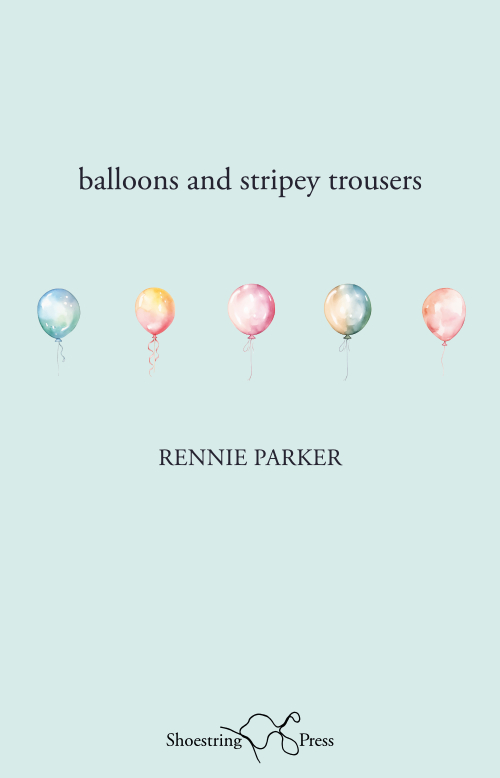
Despite its sugar-blue cover and cerise endpapers balloons and stripey trousers is no kids’ party. If there are clowns then they’re the sinister type that pop up in dreams, full of self- assurance and malignity. For this is a collection of poems largely about the workplace, its mores and its languages, its spoken and unspoken cruelties. And here you’ll find all the survivors and climbers, the managers and manipulators you’d never want to meet—sitting behind their big desks and smiling dangerously.
And Rennie Parker is angry—or at least the persona who speaks in these poems is angry. Some sleight-of-hand has been passed on us; something has taken away the genuine and the honest and has replaced it with the ersatz and the insincere. It’s happened in our lifetime—and we’ve let it happen.
She opens with ‘a warning to the curious’:
a doorway opens in my head and I think dammit yes,
somewhere a person is describing me as refreshing
and where I grew up is remote as Atlantis now, or pre-Reformation
xxxxxxxxxxxxxxxxxxxxxxxxxxxxxxSweden in the age of Gustavus Vasa,
and I’m growing smaller and smaller as your version of me
grows larger: it’s look the district of benefits and no beds,
the wasteland kingdom of straydogs and oilcans
you wonder why I’m not taking up more space in the world,
even though I ran at the future yelling yes, I am beautiful and brave
…
somewhere in life there’s a journalist telling me all this
about my early years, how aid and parcels still thread their way along ginnels
and you wonder why I’m not taking up more space in the world
xxxxxxxxxxxxxxwhen too many people have stolen my life already
If you’ve ever felt like a square peg in a round hole, you’ll understand where these poems are coming from—from one who’s always been adept at finding that most exact, most excruciating of images, like these from the title poem:
I am at the height for sleeves-in-handles, the drink in my hand
xxxxxxxxxxxxxxxxxxxxxxxxxxxxxxxxxxxxxxxxxxxxxflinging backwards
and yes, I have trod on the world’s rake, fetching the broom-
xxxxxxxxxxxxxxxxxxxxxxxxxxxxxxxxxxxxxxxxxxxxxstick flat in my face.
Now there’s clowning for you: the perfection of pratfalls, the poem as circus act.
Parker has always had a penchant for the lonely and the abandoned—the Lincolnshire landscapes of her first Shoestring collection Candleshoe come to mind—and there’s plenty of lovely desolation here in the diurnal life of home and workplace:
The silent houses are holding their breath,
second cars parked like hearses at the rear… (‘no dancing at the Grand Pavilion’)
One day all
of this will be gone,
ephemeral jobs.
Flickering light
and the posters, peeling.
Chairs drag back
as if poised for escape. (‘sent me here for no particular reason’)
It’s a world in which a lot of people are not waving but drowning. Sometimes the tone veers towards the satirical, as it did in Ricky Gervais’s ‘The Office’. Organisation Man, in ‘the habits of successful people’, gets fairly mocking shrift:
your expectations are high/low/not achieved;
your target is x
your lucky colour is greige …
Sometimes the souls at the bottom of the pile are accorded a portion of bleak sympathy, like the out-of-work trainees who sign on for thirty hours a week of state-funded encouragement. Their bureau manager outlines a tree and the speaker of the poem helps them to stick up leaves on which they write useful, positive phrases like ‘it helps when I believe… // I thank you for your time… / I know I can achieve… / opposite empty units where / the businesses have gone.’ There’s the girl who bounces off the walls of her own condition, and the lad whose case is paid-for, with ‘extras, talks, people who know, / decisions in rooms, closed doors.’ Even an Audenesque victim of ‘management despair’ who cracks by degrees ‘as the hand of wildness / grasps the slow heart’.
I guess it could all be rather dour if Rennie Parker didn’t have a sense of humour, which she does, though you get the feeling it’s been honed in the school of hard knocks. These are the kind of poems that need the ironic voicing she’d give them in performance. She’s good at voices. Here’s the mayor (I think) of a small town, setting out his stall:
we are living in a service economy I might add and we have to
xxxxxxxxxxxxxxxxxxxxxxxxxxxxxxxxxxcapitalise on our natural assets
and during my inaugural year I aim to bring about a total
renaissance of our local business economy
through a natural re-focus on what it is our great little town does best
I like the way the vapid management-speak bundles along in ignorance of its own emptiness and broken all-too-tellingly by the rambling long line and stanza breaks. But the build-up is really in service of the final punch-line. He’s worked out exactly what they need to promote. It came to him in a flash of insight when he was taking his grand-daughter to her ‘tumbletots outreach genius workshop’:
I realised what it was. cream teas.
You’ve only got to deliver that stop with just the right timing and deadpan seriousness and the laugh is guaranteed.
Another comedic voice that’s hard to resist is the dreadful, yet almost engagingly needy, supervisor who lectures a trainee in ‘hello can i help you’. Her monologue is patronising and threatening, but in the end it reveals more about the speaker than her hapless protégé, ‘kelley’.
it’s a stressful job you know very stressful this very but i don’t
suffer from stress not really not anymore no not after the counselling
because i’m a peopleperson me and i’m here to serve the public
Again the absence of punctuation and capitals and the elision of words into vogue formulations like ‘peopleperson’ contribute amusingly to the presentation of a character who’s as confident, and about as self-aware, as one of Alan Sugar’s wannabe apprentices.
Pretension is always one of those balloons Parker likes to burst, and in one of the most impressive poems she moves away from the workplace into the photogenic land of Country Living. ‘dreaming about the plenitude’ is a tour-de-force that deserves quotation at some length:
a lifetime of holidays is killing them perfect
with the beautiful children, their artless arrangement:
their mothers, honed down like bone flutes,
that strain – or there, poised quite
like rare ikebana in the classical style
with five types of olives
or delicate at the piano perhaps or stuffing
pimientos with hand-reared lemongrass straight
from a double-page spread about interiors
or careless with artisan bread,
the rich delivery promised: a husband
ironic with stubble and rough linen
cool at his infinite desk, the blond wood and the textiles.
It’s unlikely, I fear, that Rennie Parker will ever get a double-page feature in the Telegraph Magazine: she’s far too determined to keep it real. The poise of that line-break after ‘quite’, the choice of the wonderful ‘hand-reared lemongrass’, the artless arrangement of the children, represented later by ‘a descending line of wellingtons / in their honey-dappled hallway…’ all too skeweringly observed. And she’s too firmly on the side of her speaker in ‘an erasure poem’ who’s ‘uncomfortable in meetings and side-eyed by the Henriettas / and Sophies with their artsy flippant ways’. But this is what we need as an antidote to the world’s obsession with media-induced materialism, with surfaces and glamour. If I hadn’t been forewarned, I’d be tempted to say it’s refreshing. I’d certainly recommend you to help redress the balance and take a chance on this book.
You could always keep it for Christmas, and give it to your line-manager as a present.
Stuart Henson’s most recent collection is Beautiful Monsters (Shoestring, 2022). His pamphlet A Handful of Wasps was shortlisted for the 2023-2024 Michael Marks Environmental Poet of the Year Award. Driving to Bear Lake & Other Stories is due from Postbox Press later this year.
*****
Only Words by Paul Sutherland. £15.99. Vellum Publishing. ISBN: 9781915608062. Reviewed by Richard Lance Keeble

With Only Words, Paul Sutherland restates his claim to be one of the country’s most versatile, inventive and original poets. The eighty-three poems appearing under four headings: ‘Holy Week Sequence’, ‘Poems on the Life of the Prophet Muhammad’, ‘Seven Earth Odes’ and ‘New Mystical Writings’ include both previously published and unpublished works.
The lines of each poem shimmer delicately across the page like grains of sand brushed by gentle waves. Ideas, images, descriptions, memories, reflections, meditations appear fleetingly – often mysterious, often seemingly at random. In the process, Sutherland reveals himself to be a poet at home with mystical musings (both Christian and Islamic) but also grounded in the ordinary, everyday. So his travels take in places as diverse as religious shrines, a cathedral, a tattoo shop, a takeaway (where he bumps into Brother Muhammad ‘whose baby’s poorly’) and an airport.
Delight in nature’s richness, closely observed, is ever present. Thus, in ‘Tuesday’ in the ‘Holy Week Sequence’: ‘Sparse green hawthorn twigs / with infant tenderness / embrace a twisted iron fence. Intrepid Christ stood / among them – arguing from their text – / portraying His peace.’
As a Sufi, Sutherland draws on his faith with both humility and with striking clarity. In ‘The Teller’, he finds himself with a pen in his hand ‘and my heart’s moved / and I don’t understand what else to do. / I’m no historian or holy one myself / too stained by craving and the world / a recorder with some learning behind / a little thought to be scholarly now’. But he continues: ‘He’s made my heart beat / differently. I feel compelled to try to follow his path, that disappears into mystery, / then changes me once more.’
Memories (difficult, ambivalent and painful but also affectionate) of family often intrude. In ‘Another Country’s Hills’, he writes: ‘It seems I abandoned my younger brother, Stephen, / by the bedroom window scared at the yellow moon’s stare / and said under breath ‘it’s his battle, I can’t fight it’ / left him and travelled across an ocean / in search of my name’. But in the same poem he celebrates his grandfather: ‘Grandpa, my feet always ran whilst you limped. / You had a curse of job to make your lousy feet shift. / When you transfixed a tree with your artist’s intent / you stood off-balance, lop-sided.’ Elsewhere, he can draw inspiration from his family: ‘I fall back on my long departed grandfather’s / words, “from our suffering comes compassion”.’
As someone who also, like Sutherland, currently dwells in Lincolnshire (Tennyson’s county after all), I particularly like his descriptions of the countryside around here. For instance, notice how he captures the intensity of his near ecstatic feelings when he writes in ‘On Walesby Wold’: ‘Near the top, by old Walesby Church, / we turned towards Lincoln cathedral / rising from the horizon’s spell, / so much between, dazed in violet. / Through cloud gaps, sun-beams angled / to spotlights, the land a glowing stage.’
This, then, is not a collection only of words but an invitation to join an intimate, mystical journey of reflection, meditation and imagining – towards a deeper understanding.
Only Words, Manchester: Vellum Publishing; ISBN: 9781915608062
Richard Lance Keeble is Professor of Journalism at the University of Lincoln and Honorary Professor at Liverpool Hope University. He has written and edited 50 books on mainly media-related topics and his freelance work includes reviewing contemporary poetry collections. He jointly edits Ethical Space and George Orwell Studies. In 2011, he gained a National Teaching Fellowship, the highest award for teachers in HE, while in 2014 he was given a Lifetime Achievement Award by the Association for Journalism Education.
*****
Four Pamphlets Published by Melos
Paul O’Prey, Mappa Mundi, 9781739489717; Nicholas Murray, The Dictionary Speaks, 9781739489724; Andrew McCulloch, Words and Music, 9781739489700: Michèle Roberts, In Between, 9781739489731. All Melos Press, £7.00.
William Palmer has created a new livery for his fine Melos Press Pamphlets. The yellow of his previous publications has given way to a light grey-blue-green, adorned with an elegant photograph or illustration. His poets have often aspired to that kind of elegance too; in the mould of their publisher, perhaps. As such, these pamphlets and their authors might be seen to have set their face against much of the contemporary poetry world. You would be unlikely to find much in the way of identity politics here. And where a poet such as Nicholas Murray moves into the political realm, it is with a left-liberal bent that often takes the form of a very British kind of satire, as in Murray’s excellent A Dog’s Brexit.
Murray’s new pamphlet with Melos, The Dictionary Speaks is quite a miscellany for Murray. It contains more of his precisely achieved ventriloquizing. The title poem, written in the persona of ‘the volume of the OED / that Auden, at Kirchstetten, used, / plumped as a cushion.’ Of course, the idea that a dictionary will actually define is what Murray seeks to subvert. For the poet, ‘[words] taste and feel, … more vital than the things they Say.’ Thus, Murray appears to suggest, for the poet the ‘meaning’ of the word is rather less important than what it might offer in the music and appearance of the poem. To which one might reply, ‘Up to a point, Lord Copper.’ We can surely agree, as Murray also suggests, ‘Too bad that obsolescence bites: / words don’t keep still, they shift.’ It is not only obsolescence that bites; language is subject to fashion especially when it comes to the notion of fashion. Often that fashion is dictated by the young: do we still use the word ‘bad’ in the way the Michael Jackson used it in the title of an album. What do we do with the words ‘sick’ or ‘cool.’ Of course, these are very small semantic areas. But the job of the poet might also be to pin a word down to a particular, sometimes very personal form of accuracy and precision. As Murray quotes Joyce, ‘words freely spun, not curbed by dogmas of design.’
Murray is also an accomplished nature poet. And his short sequence ‘The Birds and Us’ explores precisely that. In particular, Murray shows the ways in which humans relate to birds in their urban setting, often through both deliberate and inadvertent feeding. Here, the sparrows often ignore the crumbs that ‘fall’ their way, and the feeding of pigeons doesn’t divert from the fact that basically the birds are vermin. And Murray’s take on Heaney’s ‘Death of a Naturalist,’ ‘Birth of a Naturalist,’ looks back on a time when small frogs appeared from a neighbour’s unseen pond; again, to ignore the humans as ‘fussy but irrelevant friends.’
Andrew McCulloch’s Words and Music, also contains a range of poems from the lovely opening poem ‘Aerial’ in which McCulloch depicts him and his father (remembered?) looking up into a windy sky as if trying to see the wind itself. It is, though, the family dog who is the most attuned, ‘his brown eyes say / ‘Of course this is happening,’ and the dog runs off ‘to catch what’s coming at us through the grass.’ That sleight of hand in the last verse of this short poem is powerfully evocative of an emotion which is very hard to capture, a sense of being in each other’s presence and yet taken out of that presence at the same time.
McCulloch’s own sequence is ‘Words and Music’ in which the poet responds to words, some of them poems, from earlier times and voices, among them Cranmer, Vaughan, Tennyson, Larkin and Eliot. Such an exercise might give the writer up as somewhat of a hostage to fortune, a fortune of their own making. For the most part, however, McCulloch’s responses are just that, genuine responses, and succeed in their own terms. Slightly similarly to Nicholas Murray’s ‘The Dictionary Speaks,’ McCulloch’s responses sometimes reexamine the ways in which the earlier poets have used language and how that might affect us now. In that, Eliot plays ‘with all the expectations of a settled art, / pushing lines out beyond their ends / into the suburbs where they curl and shrink, / the open spaces where they scuttle from the sunlight under stones, / stumbling towards what they meant to say / yet try politely not to say.’ McCulloch’s judicious use of Eliot’s own words suggest what Eliot has done for poetry as a whole. He is also able to suggest the ways in which the ‘taste and feel’ of Eliot’s poetics, to slightly miscast Murray’s terms, may affect the many ways in which we approach poetry after Eliot. In his tribute to Larkin, ‘Larkin’s An Arundel Tomb,’ it is Larkin’s combination of the frail and the burning that is how ‘we spend our strength, or that comes to settle us / into a chair, or help us out of one.’ Here, the poet and the poem can lead us into further reading or further action.
The photo on Michèle Roberts’ In Between is of four women in bonnets sitting around a metal table and sipping wine. They are looking at the camera and smiling. As Robert’s poems often depict her half French, half English heritage, it’s possible that the three women are French. And that this is a photo of those who have clearly passed on introduces us to that in-between sense that these poems explore; the sense of both being present and absent. As the poem, ‘In Radnorshire,’ describes, of a dead friend, ‘in her different element // in between heaven and earth // leaving & returning & leaving.’ Without trying to strain the connection too much, like Murray and McCulloch, Roberts is much concerned here with the way in which art, in this case the art of words in poetry, attests both to the memory and the presence. The words of the poem both establish but also show what has changed and what is missing, what is fixed and what is mutable.
And Roberts shows this further in the title poem in which translation is literally that for her and her mother; a translation not just in language but in placement from France to Britain and back again. That translation is part of the etymology of naming that Roberts explores in the poem, itself a sequence; ‘My mother’s father’s surname Caulle / derived from Caux / the pays de Caux /the land of chalk /cliffs on the coast /above the Seine in Normandy.’ As to her father’s name, Roberts, this is ‘A Kentish version of Rabbits,’ thus Roberts becomes almost a figure from Beatrix Potter. And further punning and ‘translation’ occur with her various nicknames.
Amidst all of this is a very precise sense of landscape, as you might expect from someone who has written brilliantly about painters such as Bonnard. Roberts writes of a council estate that the ‘the suburb’s pattern / of nested crescents & / cut-through alleys / the grammar of families / corralled us nearly & dearly. Later, her local countryside is, ‘Fields / of ploughed earth opened / under a vast pearl sky.’ There is an adroit rhythmicality to all this which is absorbing and strong. The short lines with their unemphatic phrases pull the reader into a vivid picture of growing up in the fifties and sixties with both its limitations and its enchantments.
The final pamphlet in this batch from Melos is Paul O’Prey’s Mappa Mundi. The Mappa Mundi has been the subject of recent poems by Philip Gross, Rowan Ricardo Williams, Billy Collins and Grevel Lindop, amongst others. And in an endnote, O’Prey, himself adduces Ramón Lull, Yeats, and the Tudor composers Christopher Tye, John Shepherd and John Taverner. Thus, the poet is not afraid to reach out into both legend and the legacies of both contemporary and older artists.
The technical challenge is not to allow the writing to slide out into the vatic. How do you write about something so steeped in history that the archaic in both language and gesture don’t hijack your project? O’Prey doesn’t completely overcome those problems and the pamphlet, starting off with the title poem, begins, ’Look behind you, pilgrim: ‘ paradise locked / with seas of fire, walls of flame // Look before you, brother: a hill, / a trickle of blood in the dust, / darkness in the afternoon.’ Of course, taking the Mappa Mundi as your subject might necessarily seem to involve more than a nod towards the world view that conceived it and gave it purposes that we simply no longer possess. And O’Prey finishes the poem with the sense that even in those times, it was possible to view the Mappa Mundi with distance, ‘More of a mirror than a map. // Always lost, never leaving home.’
That tussle between the concrete and physiological and the more transcendent and psychological animates much of the poetry in this fine pamphlet. ‘The Circling Sea’ begins ‘The pre-dawn phone call answered half in dream.’ The source and nature of this phone call are never explained but the narrator of the poem appears to have been called to go out to sea, ‘falling / from this floating world // to find you – transfixed / by the airiness of water, / its kinder light.’ That deft subversion of expectations is something that O’Prey achieves throughout this volume. And the poem ends, ‘careless / of my worldish wave, / my wordless shout.’ Whether rescue has been achieved or even requested is something the reader never quite finds out. But O’Prey is good at offering a deft sense of the concrete with an equally well realised sense of something slightly askew and emotionally vulnerable. O’Prey’s pamphlet is of a piece with the others in the evocative, absorbing way they involve the reader.
Ian Pople‘s Spillway: New and Selected Poems is published by Carcanet.
 The High Window