*****
John Greening: The Interpretation of Owls • Martina Evans: The Coming Thing • Jeffrey Loffman: The Hauntings by • Alistair Noon: Paradise Takeaway
*****
The Interpretation of Owls by John Greening. £23.95. Baylor Press. ISBN: 9781481317344. Reviewed by Kathleen McPhilemy

This volume of selected poems is beautifully, indeed lovingly produced, with an enchanting dust jacket, apparently taken from a painting by the poet’s grandfather. This is Greening’s first American Selected and it may be aimed primarily at an American audience. As well as a preface by the author, there is an introduction by the editor, American critic, Kevin J. Gardner, and the book closes with an interview of the poet conducted by Gardner.
John Greening is a highly respected and extremely prolific poet. This volume excludes much previously published work but includes poems with a spiritual slant which he has ‘been reticent to publish in the UK’, but feels may appeal to a less sceptical American audience. It is unclear what exactly Greening means by ‘spiritual’ but the poems are pervaded by a sense of uneasiness and dissatisfaction with the materialism of the present day which is not compensated by any fixed system of belief. This is accompanied by a strong sense of Englishness, or of English landscape and architecture, which is probably where his interests overlap with those of Gardner. Although he is clearly widely travelled, not only through the British Isles but across the globe, the feeling for place is strongest in poems set in Huntingdonshire, where he has lived more recently, and those relating to Hounslow or the Heath (Heathrow), the site of his childhood home. Greening is an erudite and literary writer so that his work travels equally comfortably through the realms of culture as those of geography. Aside from the Huntingdon and Hounslow poems, his imagination seems most likely to take fire when he writes about Egypt or about music.
The book is divided into sections, which, given its length, provide a welcome structure for the reader to hang on to. The first section, ‘Prelude’, is taken up by one poem, ‘Huntingdonshire Psalmody’. It might be reductive to say that this is where the poet sets out his stall, but certainly it introduces many aspects of what is to come. The poem is set in the countryside of a place no longer officially a county and celebrates nature while recognising its transience. The lark is an ‘ethereal minstrel, / blithe spirit, not quite yet extinct’, a Shelleyan echo picked up further down the page ‘higher still and higher’. He incorporates literary reference, elevated lexis and sudden almost banal descents into the demotic:
Quickthorn hurries me on to check if a favourite elm
that looked from a distance as though it had been buzzed
out of existence, has – it has, thank God – been pollarded only.
These lines could easily be written as prose, apart, possibly, from the fastidiously grammatical inversion of the last two words. Later, the poem does use prose, but the structure is sustained through the continuous motif of the skylarks, recurring here amidst relics of the middle ages and further back, ‘some broken Samian ware’, returning again after a nod to ‘pieces of gate that go back to Edward Thomas’, discovered alongside a beanie hat and a ‘slack electric cable’ in a stanza which in its fragmentation, use of white space and disparate reference, creates an uncertainty of tone conveyed through a fluent and skilful use of form which is typical of the poet’s uneasy modernity:
Always the larksongxxxmorsexxshort-wavexxxxmessages
tuningxxxxxxxxxSave Our invisible Soulsxxxxan older way
as a helicopterxxxxxxxxxcrosses itselfxxxxxxxand the cracks open
in a line laid down by weedkiller among the nests
Greening is enormously skilful in the use of form; he can produce sonnets, villanelles, sestinas and a variety of other forms, including those where he has invented his own rules, with extraordinary fluency. Additionally, he is a master of slant rhyme, which allows him to use traditional forms in subtle and novel ways. Occasionally, however, readers may find themselves following the intricacies of the form while losing sight of the content, which is what happened to me with his Little Gidding poem, ‘Nicholas Ferrar and the Pilgrim’, which is a particularly convoluted version of sestina. There are a lot of church poems and poems with settings resonant with religious Englishness, where the poet invites comparison with the high-toned metaphysic of Eliot, on the one hand, and the bicycle clip ‘awkward reverence’ of Larkin, on the other. The preoccupation with Englishness may derive in part from his collaboration with Kevin Gardner in two anthologies, Hollow Palaces: An Anthology of Country House Poems and Contraflow: an Anthology: Lines of Englishness 1922-1922. Greening is a much-travelled writer, critic and teacher who has worked collaboratively with other writers, musicians and dramatists. He could be regarded as a journeyman poet, turning his skills to a variety of tasks, including translation. There are a number of very effective versions of work by German poets, including Rilke’s ‘Orpheus. Eurydike. Hermes’:
She was sunk in herself like one expectant
and did not think about the man who ran
ahead, nor of the path that climbed to life.
Sie war in sich, wie Eine hoher Hoffnung,
und dachte nicht des Mannes, der voranging,
und nicht des Weges, der ins Leben aufstieg.
I like the way Greening has translated ‘hoher Hoffnung’ as ‘expectant’ rather than the more explicit ‘heavy with child’ in Stephen Mitchell’s translation. However, one of my difficulties with this selection is the absence of chronology or provenance in its organisation and, despite the thematic divisions, it would take a scholar rather than a reviewer to trace how these poems fit into the poet’s development. One section which came alive for me was ‘Hieroglyphs’, poems which relate to the poet’s experience of Egypt while on VSO. Some of the energy here may come from poems written in youth, some may reflect the enduring influence of things Egyptian. The poems which work best are those where there is a personal dimension as in ‘For my father’ which recounts his father’s diabetic collapse while staying with his son in Egypt. Greening says in the interview that Egypt gave him his voice, and we can see how he looks back with nostalgia and gratitude in ‘Mr Stuart in Aswan’, a poem where the use of half and slant rhyme is particularly successful:
We stepped out on thin ice, then back, without
blinking an eye. It was a dream, I’m sure,
those two years married up the Nile, so hot
and poor, so hard on lovers. Sky is pure
lazulite today, our thermometer
reads minus and the lawn is wreathed in white:
a flickering cartouche ‘has this report…’
Apparently, many of the poems grow out of walks, including the one from the Prelude, and the poems rooted in landscape are among the most appealing, especially when the consciousness of history and literature come together in place, as in ‘John Donne in Huntingdonshire’: ‘The tower’s shadow ticks. He must have felt the arch / conceal its burden as he touched this warm stone, breathing stained light,’. The deictic ‘this’ unites the poet in the present with the ‘four centuries’ dead poet and divine.
Heathrow also figures very importantly in Greening’s poetic geography, although this is probably even more of a mental landscape than Huntingdonshire. The poet grew up in Hounslow and he refers to the Heath sometimes as the international airport with which we are all familiar and sometimes an imaginary wilderness. The longish poem ‘Homecoming – To My Family’ tries to make sense of this, as does the shorter, ‘In the Garden’, which mixes realism with Edenic longings: ‘In the garden, conversation is only possible / for two minutes at a time’…’I know the garden is the safe level landing / to which I will return.’ … ‘the only way // of getting there is by crossing the Heath.’ The longer poem ends with an acceptance of change and modernity almost bordering on hope: ‘the sacrifices that lie under every holidaymaking runway / shouldn’t shudder – like it or not, poetry has to absorb / such painful undertones, internalise them, and let the rest fly.’
This is a very long book and anyone who attempts to read it straight through may find their enthusiasm and attention fading after two or three hundred pages. However, this poet is at his best when he is writing about what he cares for most deeply and the volume catches fire again when we come to the poems on music, ‘Notes’. I was less sure about the penultimate section, ‘Intimations’ which nodded again at spirituality but seemed more weighted towards things that go bump in the night. Undoubtedly, this is a Greening cornucopia and a treasure trove for the reader who wants to dip and browse. As a perhaps too sceptical and impatient British reader, I would like to see it accompanied by a shorter, updated English Selected Poems.
Kathleen McPhilemy grew up in Belfast but now lives in Oxford. She has published four collections of poetry, the most recent being Back Country, Littoral Press, 2022. She also hosts a poetry podcast magazine, Poetry Worth Hearing.
*****
The Coming Thing by Martina Evans. £12.99 Carcanet Poetry. ISBN: 9781800173453. Reviewed by Patrick Lodge
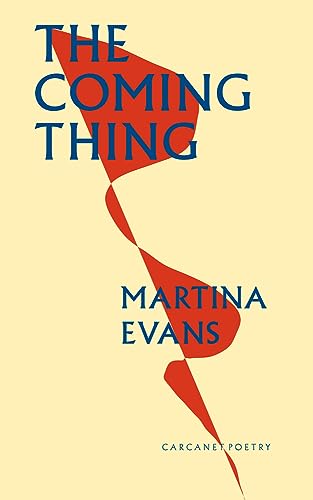
In his 1890 book, The Principles of Psychology, William James pondered consciousness and noted that it “does not appear to itself as chopped up into bits” but that it flowed and suggested we “call it the stream of thought or consciousness, or subjective life”. The Coming Thing – with its hints at the beginnings of IT, a new Ireland, and the importance of transient style to the young as well as the narrator’s personal nemesis – presents itself superbly as such a stream of consciousness, a technique which, in the hands of Evans, encourages the reader to inhabit the world described almost as a subjective participant not a mere observer of the cast of larger than life characters. It is brilliant in its conception and brave in its delivery. In some ways this is not surprising as The Coming Thing is the latest from the prolific and gifted Irish poet Martina Evans whose forays into prose poetry have done a huge amount to elevate the critical reception of that sub-genre. Above all else the sequence of seventy five numbered poems is a rollicking good read which is quite simply hard to put down once begun.
The ’star’ of the narrative is Imelda who appeared in an earlier Evan’s book, Petrol, as an early teen in 1970s Ireland. Here she has grown up and navigates 80s Cork City as it embraces punk music and senses the possibility of liberation from the straitjacket of traditional Ireland. Evans has an ear for the argot that defines a time. She is pitch perfect in capturing the evanescence of style but the totally serious commitment to getting everything right, the life and death decisions and snappy comments about the objectively trivial and unimportant that, for young people, are actually vital, ephemeral and essential all at once – Imelda reflects on her and her friend Dora’s exceptionalism ‘in a way we were thinking we were / extraordinary too. That’s youth for you. It doesn’t last long’. (‘8’) At one point, threatened with a visit of her boyfriend to see her record collection, Imelda, unwilling to appear uncool, jettisons anything not punk enough – “DISCO was only an embarrassment’ (‘20’)
Evans utilises the emotional resonances of the music of the time to provide a backdrop to Imelda’s unromantic ‘coming of age’. After her abortion, the father phones Imelda at the London clinic: ‘Ghost Town was playing at the other end. / I could hear myself crying like an echo down the line’ (‘67’). Imelda describes herself as a “punkette” – though the musical references are more Two-Tone than hard core punk – though seems to adopt the style as a way of belonging as much as anything else – at a Cork gig for The Beat she admits ‘I secretly thought gobbing was pure disgusting’ though revels in the chaos of a live gig, ‘everyone on Pondies (ponderax – a slimming drug with amphetamine-like effects) & cider, screaming & / gobbing lime-green phlegm on MacCurtain street’ (‘10’) with its neat aside to the old Ireland hero, assassinated Sinn Fein mayor of the city, Tomás Mac Curtain. Her response to the query what she was, ‘I said I was a punkette’ is roundly rubbished ‘You are / in your hole you old culchie, Did ye ever hear of a punk with a country / accent?’ (‘14’). Imelda in a car sings Anarchy in UK and is delighted though more concerned with her Fox’s Fruits and chocolate tools bought from the garage. In such detail Evans draws us into sympathy for Imelda’s journey, still a child living within the “punkette”, ‘…eating a chocolate saw, wondering what anarchy / really meant.’ (‘15’). A child who tries to throw bricks at windows on the aspirant Clashduv Estate on a “wrecky” but can’t explain to Dora why she did because “she didn’t / understand about punk & anarchy’. (‘35’)
The group pose and pontificate, referencing Camus, Existentialism, Seances and Absurdism in a superficial knowingness while their lives seem constrained and their agency limited. All is reduced to style – even politics, as the IRA are dismissed, ‘they were / pure cat with their flares and long hair.’ (‘49’).
Imelda’s Ireland is on a cusp of change and Evans captures it well. This is pre-Celtic Tiger and before the collapse of the hegemony of the Catholic church. Imelda went to a convent school and, though she hits the ‘blue Gitanes’ when she gets out, still can think of herself as a ‘bad apostle leaving Gethsemane’ (‘34’) and at one point vomits heavily which feels ‘…like how a Good Confession used to feel – fierce light’ (‘52’). Issues of employment – Imelda is doing Science but wants to be doing Arts and tries to resist the career option of nursing – and how best to evade the cultural straitjacket of conformity are a constant. Imelda and her boyfriend are ‘going out’ but getting contraceptives is ‘An Ordeal’, (‘38’) the older Ireland still exerting a hold. Worse still is getting the abortion that Imelda and Dora will eventually need and which requires a trip to England. This section is told with some humour but the dilemma and the event are desperate. An unreconstructed Old Ireland forces her and Dora into the trip so many Irish women have made and Imelda hasn’t the words to articulate the issues: ‘We couldn’t say the things we were thinking’ (‘51’). When a friend asks her which is the worst existential angst or existential dread Imelda replies “can you have both / at the same time ?’ (‘73’). The experience changes Imelda – she has sex all night with Carl who said ‘we might as well take advantage’ (‘62’) of her pregnancy but she is the one being taken advantage of and feels desperate afterwards. ‘…no matter how hard I tried to think it didn’t matter, it did. It was never the same again’ (’62’). At the end Imelda is preparing for a nursing course, hopefully wiser.
Dick Hebdige in his work on subculture and style has argued that subcultures such as Punk through, inter alia, music, clothing, speech, have for a moment the potential to challenge the dominant hegemony until such resistance is co-opted and commodified. For the naïve punkette Imelda, subculture doesn’t get beyond mere style, a survival strategy rooted in belonging, more in line with Stuart Hall’s argument that subculture offered ways to handle the “raw material of social…existence”. Evans captures this brilliantly. This is a collection that glitters and sparkles with a Day-Glo phosphorescence but repeatedly requires the reader to catch themselves on and think about the kind of lives being lived by the intertwined characters, the consequences of their actions and of the ineluctable narrative as it pays out. It is a brilliant evocation of a moment in mid 1980s Cork when the Arcadia, with its strict ‘no disco’ policy, ruled supreme and offered some challenge, albeit fleeting, to a Haughey-dominated politics and a culture still fixed by the church-dominated old guard.
The documentary “Leeside Creatures” argues persuasively that Punk and New Wave became something different in Cork. As Ed Power wrote in 2022 the music scene of Cork in the 80s plugged “into the Irish tradition of surrealism” while the musician Gordon Ua Laoghaire put it more simply in saying that Ireland is almost an absurd place anyway. In steering Imelda and her cohort through 80s Cork, Martina Evans seems to have taken this to heart in a deftly handled, kaleidoscopic, hugely entertaining and significant collection which never lets you forget the reality behind the gloss.
*****
The Hauntings by Jeffrey Loffman. £10.99 Valley Press. ISBN9781915606068. Reviewed by Patrick Lodge
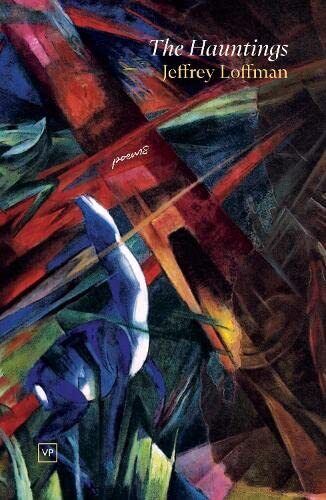
It is good to see Valley Press continuing to produce excellent poetry in well-designed books that are a pleasure to hold and to read. This offering is a substantial collection of new poems with some “revisited” from previous publication. It is erudite, comprehensive and a constant reminder of the utility of precision in language and the wide range of subject-matter that good poetry can encompass. Through it all, though, permeates a poet’s concern for what being human can mean, not least when that human is interacting with the natural world. The collection makes full use of the various meanings of “haunting’, notably that sense of qualities that linger and are not easily forgotten, that are evocative and emotional and must be recovered.
There is a strong reflective, almost spiritual, quality in many of these poems, almost valedictory. Even something as mundane as the recollections of a football fan can prompt more : ‘C’Mon Town’, a paean to watching Halifax Town, while it celebrates the obsessions of the fan, ‘Under cloud cover. / Under floodlights. / In all weathers’, offers a more philosophical perspective on the ephemeral nature of existence, of those who ‘…walk by and are gone, / and the game goes on’.
Frequently, such feelings of transcendence and ephemerality are prompted by recognition of the insignificance of the individual in the immensity of the natural world. You can watch it all from Boggle Hole on the Yorkshire coast with a cup of coffee and ‘Contemplate what relevance this / or my mug’s blue-and-white emptiness / has beneath / this vast unfolding sky.’ (‘Singularity at Boggle Hole’). Loffman is excellent at placing the individual in a wider landscape, capturing the essence and teasing out what wider meanings there may be. ‘Scree at Pendle Hill’ is thus a neat well-worked poem that blends landscape, herbalism, Quakers and ageing seamlessly and powerfully. Loffman handles strong feeling well – no sentimentality but honesty. ‘Where Hart’s Tongue Dwells’, a poem addressed to an absent climbing friend, fingers precisely the joy of climbing in its spirituality: ‘it was the essence of being, to flow beyond time’.
Loffman clearly likes to walk and climb in the great outdoors and is able to capture the remarkable qualities of these pursuits in elegant and engaging poetry. The excellent ‘A Still Passing’ with its epigram from Robert MacFarlane, author of ‘The Mountains of the Mind’, combines the physicality of a climb with a strange meeting, a ‘frozen Buddha’ and the peace of the summit: ‘We catch our breath, quietus, / this unexpected find’. Even an evening stroll to a local church becomes something more transcendent, a pilgrimage, ‘We meander between the sacred and the secular… / an ochre ray of sun descends / upon this journey…’ (‘Evening Pilgrimage’). Dylan Thomas once wrote “I wanted to write poetry in the beginning because I had fallen in love with words” and this might well describe Loffman’s approach as his delight in image and words is strongly evident. Though at times a little overcomplex, his allusive imagination and clever layering of meanings makes some poems shine. ‘On Dungeness Beach’, for example, a poem dedicated to a member of the Tart family who were one of the founding families of the area, “sixty or seventy gulls standing still’ become a vigil for the people who worked the shoreline. Especially the lifeboat men who saved two hundred in sixty years and where the clever use of ‘remember’ brings a feel of cenotaphs and memorials and endows the scene with solemnity and the sense of remembrance.
There are two extended poems in the collection – ‘Trying to Find Charles Olson’s House’ and ‘There are Two St Augustine’s, Matt’ – both of which work very well. The former is a clever integration of several perspectives and keeps flow and focus well. The latter again cleverly intertwines the ancient and the contemporary with erudition and grace and its close with the offer of a ‘a new felicity, life full/ and worth living’, with its connotations of Christ’s promise as record in John 10:10, is pretty much what this collection offers – consistent affirmation of the joy of being alive.
However, these days it is impossible for any lover of nature not to recognise the damage that humans are doing to the environment and the potential for disaster that the climate crisis represents. Again, Loffman makes clear his perspective without excessive preaching. He is softly apocalyptic and prophetic in ‘Future Hauntings’ where the clock is ‘close to midnight’ and ice melts, storms collide, crops blight but experienced, and thereby, distanced via the screen where ‘your internet blinks in the thunder-wave’. The poem closes with a powerful line, ‘ I am flood and wildfire, coming closer”, redolent of the old slave song where ‘God gave Noah the rainbow sign / no more water, the fire next time’. In the face of this threat there is little to offer except a gentle, bold lyricism: ‘This earth cannot be bought / or sold. We are the carers for sundew / and starred bog asphodel. Nurture / this England, as a child in your arms, / for all our tomorrows.’ (The Long Walk Home’). Similarly the excellent poem, ‘From the Quaker Graveyard in Idle’, blends his love of walking the countryside with the testament of others past and a strong sense of place – a place he never leaves and which seems to represent Loffman’s ideal, ‘where peace is neither the absence of violence / nor sound on mute / but all is contained / as in an open meeting on open ground / open to the wild / and holding fast.’
This is a collection which reveals itself slowly and which benefits from careful reading. Though at times maybe guilty of trying a little too hard to impress, there is much in these poems to warrant time spent with them. Loffman is at his best when allowing his simple sense of the lyrical potential of person in place, the powerful feelings raised and contemplated, to take the front row in his conviction that, ‘Surely, the disease insists / a cure, / some meaning / maybe found.’ (‘Circling the Ash (2)’)
Patrick Lodge’s work has been published, anthologised and translated in several countries and has read, by invitation, at poetry festivals in England, Scotland, Ireland, Kosovo and Italy. Patrick has been successful in several international poetry competitions. He reviews for several poetry magazines and has judged international poetry competitions. His collections, An Anniversary of Flight, Shenanigans and Remarkable Occurrences were published by Valley Press. A poem from the final book was put to music and performed at the 2017 Leeds Lieder Festival. He is currently finalising a fourth collection provisionally entitled There You Are.
*****
Paradise Takeaway by Alistair Noon. £10.99. Two Rivers Press. ISBN: 978-1-915048-09-7. Reviewed by Nick Cooke
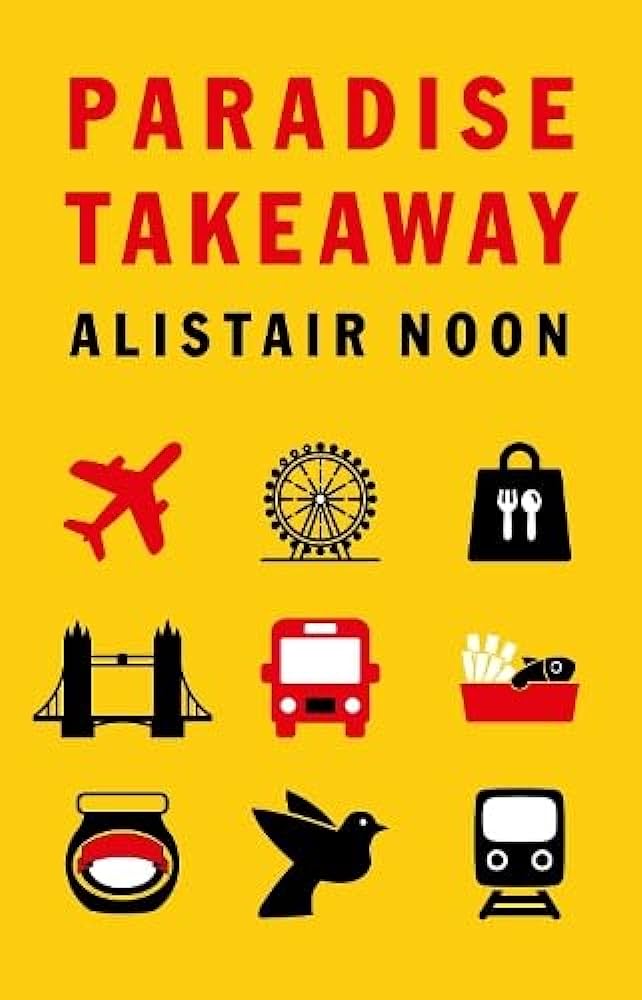
A contemporary homage to Germany: A Winter’s Fairy Tale, Heinrich Heine’s long poem on returning to his native country after thirteen years in Paris, Noon’s third full-length collection wittily and often touchingly traces a poetic journey of his own, beginning and ending at that cultural hub immortalised by actress and model Lorraine Chase, who in a Seventies Campari add responded to a refined suitor’s question ‘Were you wafted here from Paradise?’, with ‘Nah, Luton Airport!’, thereby inspiring a well-known novelty single. Using Heine’s ‘Ancient Mariner’-style quatrain verse form throughout, with a largely ingenious array of rhymes, Noon presents an outsider half longing to find some way of integrating back into his homeland, half wishing he had stayed well away.
The book’s title suggests its central theme, the disposable dreams and aspirations of a modern Britain suffering from its own form of attention disorder, if not hyperactivity. Noon’s unchosen physical presence in the new world is juxtaposed with his resilient clinging to an older, more civilised, less ephemeral one:
I stepped across the thick white line
to get my mirrorbook checked,
but somehow mixed it up with my
One Hundred Poems of Brecht.
In this particular case he finds a rare kindred spirit, in a ‘Lady of Passport Control’, who spots his book and proceeds to hold forth on matters of great political and artistic moment, even though she reveals herself as ‘one of your sceptics’ regarding the author:
I must admit I’m not so keen on
In Praise of Dialectics.”
Later on, Brecht’s (and Heine’s) compatriot Karl Marx, at his graveside in Hampstead, comes under some gently lampooning scrutiny from the poet-traveller, something of a lapsed leftist it seems, who is prepared to risk the probable censure of some present-day observers, by mocking the great man’s accent:
Here vere I’m stuck, some haff got fatter
and uzzers are still in zeir fettas.
Tell me, oh trafller betveen zese lants,
Is it in Germany better?
More typically he is alone in the crowd, surrounded by folk whose diet is more literal than literary, as when he steps through into Luton Arrivals:
Yes, there it was, my college of food!
My culinary alma maters
and gastrotutors – burgers and whoppers.
hot bangers and chipolatas!
He can’t escape the fast-food-littered scenery, even as he begins his journey towards London by boarding a bus to Aylesbury:
I’d made it all the way to the top
to the front where the regular seats are,
the mobile first-floor glass around me,
with a slice of last night’s pizza.
Once more trying to rise above the detritus, he visits the statues in Aylesbury’s Market Square, celebrating Buckinghamshire’s most eminent historical figures, including Civil War Parliamentarian John Hampden,
who libelled the king, defended the liberty
of printers yelling disquiet
at royal expenses, and later sent
the rifles to fire on a riot.
Time and again the skilful and often hilarious rhyming provides a needed lighter touch for what otherwise might come across as slightly self-righteous, with Noon frequently sending himself up almost as much as others, such as when even he gets caught up in the ritual channel-hopping aimlessness of twenty-first century urban life:
Forward I’ll go and back I went,
I zap to the audio commentary
both on the disc and live on the couch
as my girlfriend gets derogatory.
Perhaps my favourite rhyme of all, following a nice internal one for good measure, comes during his visit to the City, after he has referenced the Gherkin, then described ‘the Glass Carrot’, before turning to
the Twin Courgettes that serve junk debt
and the share-backed pension plan,
where the song they hum on the trading desk
is Je ne regrette rien.
By the time he returns to Luton Airport, his English sojourn over, our unlikely hero implies that his ongoing issues with poor-quality nutrition, though still almost all-pervasive, have now been tempered by a nod to aspects of modern British life that bear comparison with older cultures, in that they embody a true spirit of resistance and unique identity, as well as an inclusive openness:
Beside me, a solemn young man with dreads
and a baggy hat leant back
with Malcolm X and a snap of a double
egg and tomato snack.
My only quibble is with some of the scansion, which does not always maintain what one supposes should be the right stress-pattern. Quite frequently, the effect of the stanza’s final line is marred by rhythmic clunking, such as here:
We barged aside that scratching claw
cruised past more teenage haunts,
the pubs where no one sits, revived
as fully-reserved Thai restaurants.
Or here:
…leaving a pair of shapes in black.
Was it them? Two Twix in a packet,
they turned and murmured into their radios,
topping up air on a life jacket.
Even allowing for the flexibility afforded by English being a stress-timed language, there does not seem any way that these fourth lines can be uttered with only three stresses. This contrasts unfavourably with the original poem, in that although my understanding of German is poor, I do know how it is pronounced, and I cannot find any similar lapses in Heine’s metrics.
That said, this is overall a thoroughly enjoyable subversion of the voyage-of-discovery poetic archetype, with all its other types of bathos fully deliberate, and often exquisite in their encapsulation of an era in which anticlimax and deflation have come to dominate.
Nick Cooke was a contributor to the inaugural issue of The High Window in 2016 and has published around 55 poems and 30 reviews, along with some short stories and several articles, in a variety of outlets. One of his poems has won first prize in a Wax Poetry and Art competition. He has also completed a number of novels, stage plays and film scripts, as well as two memoirs. He lives in West London, where he works as a language teacher and teacher-trainer.
*****
 The High Window