*****
Eiléan Ní Chuilleanáin: The Map of the World • Joanna Guthrie: Her Whereabouts • Bob Cooper: Listening, listening
***
Reviews published earlier in this quarter:
Katherine Meehan: Dame Julie Andrews’ Botched Vocal Chord Surgery • Pratibha Castle: Miniskirts in The Waste Land • Emma Storr: The Year of Two Winters • Sue Wallace-Shaddad & Sula Rubens: Sleeping Under Clouds • Brian Swann: Imago • Paul Eric Howlett: Onebody and other poems • Home Poems by Antony Johae • Losing Ithaca by Christopher Southgate
Four Pamphlets from Rack Press
*****
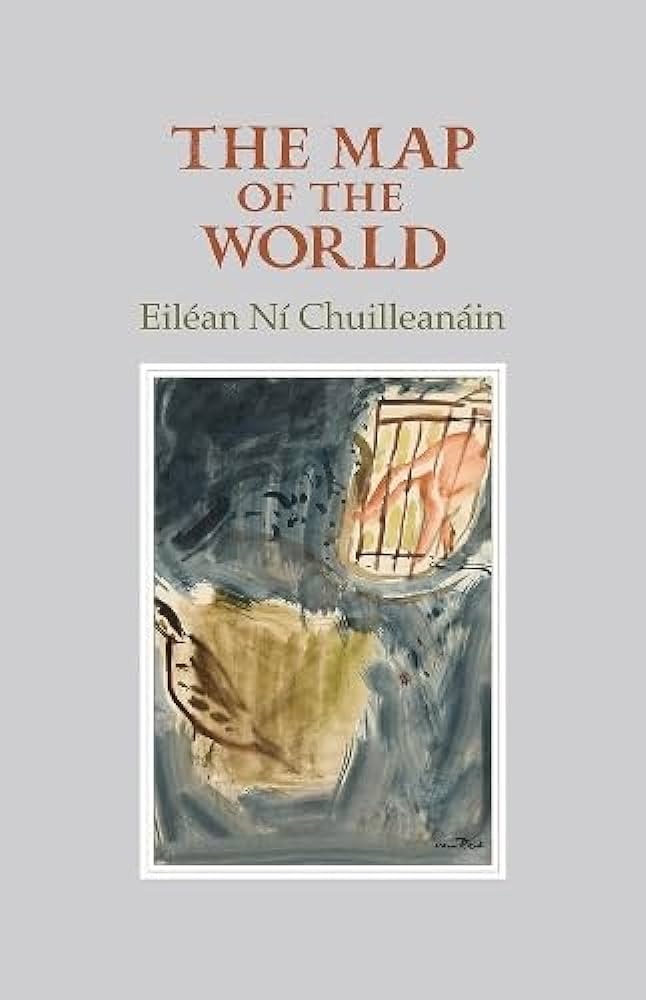
The Map of the World by Eiléan Ní Chuilleanáin. £10.50. Gallery Books. ISBN: 9781911338642. Reviewed by Belinda Cooke
Reading Eiléan Ní Chuilleanáin’s rich and challenging poetry feels like clinging to Ariadne’s thread in the pursuit of shape-shifting forms. Her light, shade, and colour, her interiors, landscape, art and language, and her myriad voices all enhance the experience – with poetic structures attuned to such subject matter. Take the taut iambic dimeter, and ‘d’ alliteration, of these lines:
Settled in their orbits
the distances determined,
dependent on each other –
the bodies keep their measure.
This is where the truth lives.
(‘Where Truth Lives’)
only to be flipped on their heads with long vowels and enjambement to show the impossibility of grasping ‘where the past lives’ due to our constant shifts in perception:
The separated bodies, the space debris
(because they move in orbit and catch
light from each other, the glance in a crowd
a crooked reflection, that gazed curve
where light flashes elated, speaking
the many forms of connection)
She gives us history’s many truths rather than any grand polemic, though always empathetic to the dispossessed, here skilfully suggesting movement via these open-ended lines, with their long vowels and soft consonance:
The map had told us already what would happen to the peoples of the west –
long promontories hurrying them out into the salty open fields,
roads that twisted around inlets constantly promising a place to rest –
(‘Air: The Map of the World’)
Voices shift in and out of the collection like these emigrants where the ‘cards were slapped down on suitcases’ in the crowded carriage, all wanting to share ‘their stories elbowing each other out of the way,’ Ní Chuilleanáin always the non-partisan chair letting everyone have a say.
‘The Miracles’ takes us on a walk that vividly reveals Ireland’s forced migration where: ‘emptied houses / lay open to the weather’, zooming in to make it visceral: ‘shifting planks / greased with a season’s flattened leaves.’ Here we learn of how the Virgin Mary intervened to prevent an execution, but also the more amazing miracle of the destitute’s depiction of their own suffering in a work of art commemorating the event: ‘made from wooden spars and their own old clothes…. // the tall tree of human revenge, dressed up / to look like justice instantly bending its branches / loaded with mercy like fruit.’ The poem then makes a dazzling leap to life’s ultimate miracle – that undefinable thing in us that drives our humanity:
just as tonight the parent climbing the stairs
after three warnings feels the brush of her sleeve,
swallows back the word that can’t be recalled if spoken,
and goes quietly down again.
And this ‘brush of her sleeve’ prepares us for the collection’s disparate voices that includes the living and the dead, the real and the fictional. Along with richly associative poems like ‘The Miracles’ there are plainer narratives that are just puzzling. Who is the boy in ‘Let Me Explain’, for example? All we know for sure is that he feels threatened and is being cast as guilty for some unknown deed. But such mysteries, only reinforce the fact that any account, is just one of many. ‘St Brigid’s Well’ focuses, with some humour, not on the well but on the visit there, with passers-by suggesting to her what should go in the poem. Only in the conclusion does she connect the people and water:
I heard the mill stream splashing downhill,
into its prison pipe, out of the brimming pond
that I had not seen. Could I have forgotten the
excess of water, the excess of all the stories
I might have heard, as I searched for St Brigid’s well?
‘The Universe in 1300’ gives us cryptic voices from Dante’s Inferno before a shift to the present day that continues the motif of shadows, light and reflection to reinforce how ‘truth’ in the natural world will always remain a mystery:
Years ago, far away, in daylight
stronger than summers here,
we sat under the gazebo
and the voices and their questions
brought out by the light, their explanations
reflecting light as glass flashes.
(3)
A particularly moving poem connects with the sense in ‘Miracles’ of spiritual presence, where she pays tribute to the much-loved Irish poet and novelist Philip Casey who died in 2018 – her poem a response to his own words: ‘…and when I die, / will I be transformed into a thought / travelling at the speed of light’:
The shiver travelling up the cat’s backbone
when something flutters in the garden,
a shiver in water moving under thin ice –
that’s the nearest thing to the live
thrill in the air that is Philip now.
‘The Conversation’
Ní Chuilleanáin also frequently writes on interiors, and is noted for her painterly quality. We see this again in, ‘A Shadow in Her Notebook’, ‘Two Paintings by Nano Reid’ and ‘Instructions to an Architect’. All three will have you digging into a deep ever giving well. ‘A Shadow in Her Notebook’, in particular, dedicated to the stained-glass artist Helen Maloney is a wondrous interplay of the actual window and its evolution on the page, as well as consideration of the access to light for the cloistered orders.
…The lion raised his paw,
coloured like the sun, glowing now
against a glass curtain, such a blue
it seemed a kind of night. The darkened interior
sucked in colours. Always the voice in her head
objective: But could it not just be clear glass?
No. the shadow of the bell tower, the woman
dressed in brown, a shadow behind a screen:
they gathered around her clean white page, demanding
indigo glass for the narrow tight window
and oyster white, a little off-centre for the loaf
As is always the case with her poetry, a review can only nibble around the edges. She has a number of poems in Irish and the book is also a gathering of numerous commissioned poems for various projects and anniversaries, which makes it all the more surprising that it should hang together so well as a collection, but, somehow, they all feed in to her current concerns. She also includes poems of how war impacts on women in particular.
But, perhaps, best to conclude on how wonderfully she writes on loss, having been widowed now for five years since her husband, the poet Macdara Woods passed away in 2018. Two absolutely magical poems, ‘The Ash-tree at My Window’ and ‘Seasons of the Lemon House’ are both rich in meaning and delightfully life-affirming, both of life and poetry. To close, the former is worth quoting in full to reveal life’s continuance:
As in a landlord’s dream the houses
change their shapes according to the season,
they bulge and they shrink.
For five years nobody lives beside me,
my bones are bare, my spine is a tree stem
threatened with dieback.
My room on the top floor is a green cage,
Spring is here and the ash-tree is flowing
up to the window,
as a tall cloud wandering may drift
upwards a little, and closer, and
probe a tidal edge.
No need to make sense. It is there,
it whistles and tumbles. Think of a cloud,
we could not live there,
but engaging with air and element
it offers the terrace a space while it grows –
a cat on patrol.
The bare ideogram announcing Tree
changes annually to a flourish
of intimate leaves,
their tips barely moving, their pale approach
floating up from the shady depths. Please,
hide me in summer.
Belinda Cooke completed a PhD on Robert Lowell’s interest in Osip Mandelstam in 1993. She reviews widely and has published many poetry collections: Resting Place (Flarestack, 2008); The Paths of the Beggarwoman: Selected Poems of Marina Tsvetaeva, (Worple Press, 2008); (in collaboration with Richard McKane) Flags by Boris Poplavsky, (Shearsman, 2009); Kulager by Ilias Jansugurov (Kazakh National Translation Agency, 2018); Forms of Exile: Selected Poems of Marina Tsvetaeva and Stem (The High Window, 2019). She recently published a memoir on her mother’s life: From the Back of Beyond to Westland Row: A Mayo Woman’s Story (The High Window, 2022), and her latest collection Days of the Shorthanded Shovelists is forthcoming from Salmon Poetry.
*****
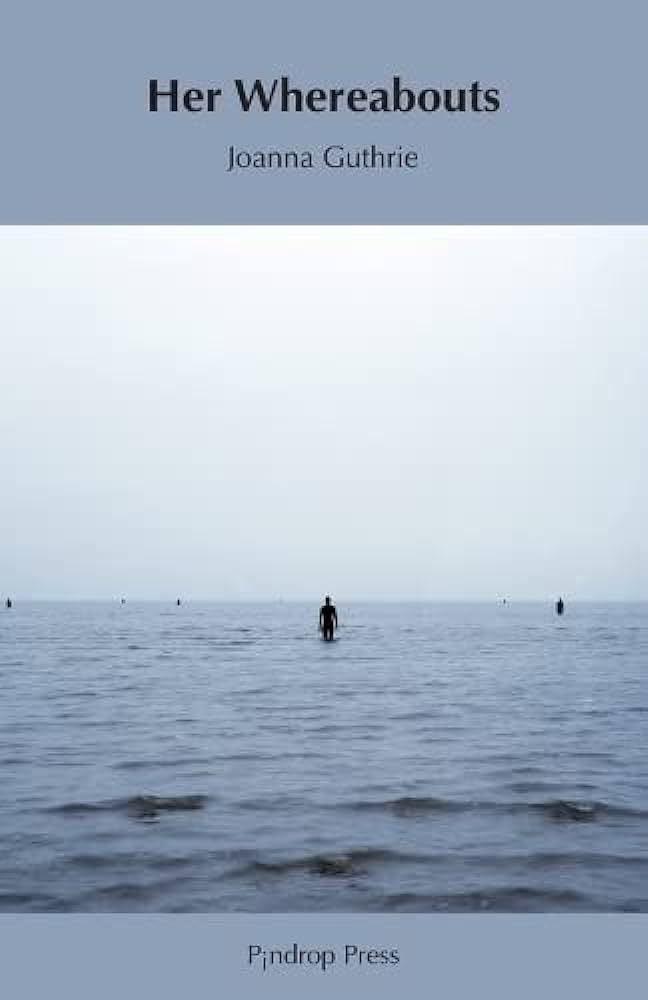
Her Whereabouts by Joanna Guthrie £10 Pindrop Press. ISBN 9781838437374. Reviewed by Patrick Lodge
This is a classy collection offered by Pindrop Press who have developed a well-deserved reputation for high value production and careful choice of poets. The collection is divided into three sections but all are suffused with a sense of loss, both personal and ecological. It is by no means a sad book though, with love, joy and hope lighting up the poems. TS Eliot, reviewing Marianne Moore’s Selected Poems wrote, ‘ we all have to choose whatever subject-matter allows us the most powerful and most secret release” and Guthrie’s choice of subject – her decision to write so honestly about these events – encourages powerful work with strong emotions felt, held and expressed in delicate, subtle and perfectly crafted poems where the dissociative shock is worked with and tentative feelers are extended towards a coming to terms, an understanding and an effort to make things whole again. It is to be hoped that the writing of this excellent book allowed some personal release.
The first section focuses on Guthrie’s mother – though her presence is there throughout the book – who suffered, but survived, a series of strokes in 2016 a year in which there seemed ‘a hex on things’ (‘To 2016’). Guthrie’s descriptions of a world suddenly out of joint have an apocalyptic, almost Biblical resonance: ‘It rained fish. This was the herald’ (‘The Start of Something Going Wrong’). At a music festival when hearing of the first stroke – ‘lying there on sheepskin, / my little tent all orderly’ (‘I was dancing then it happened’) – Guthrie is cast into chaos where nothing is the same – ‘all laws gone’ (‘Cake or Death’). She explores this state with honesty and a expressive panic – the poems of this first section are structurally disjointed, sometimes hectic, diverse, broken up in keeping with where she is. The imagery is superb, both leftfield and precise in its evocation, the raining fish ‘thumped down on the hillside like silver blades / or loose tongues sliding whole from heads.’ The sudden emptiness inside filled “with sticky dust / like the crushed wings of insects / or the bottom of a pocket where sweets have lived.’ (‘The start of something going wrong’). Through it all are descriptions of her mother – ‘cryptic empress’ – so evocative and full of love under stress and at the far end of its tether that she never appears as victim but as a person who is herself the poem, ‘you’re reclining on / the poem of you still trying to write itself’. ( ‘Small ruin’). Guthrie, the daughter, seems at times to lose agency in the flow of events – ‘What dreams me this afternoon…/ Who dreamt me up / but you / …Sometimes you’re poured into me / and I’m a jug walking around brimming unsteadily’ (‘Bobbing along’) – but Guthrie, the poet, never loses her precise touch and her ability to expose herself fully but remaining acute in her understanding and expression, never becoming sentimental.
Guthrie is rightly concerned too with society’s link with the natural world and the pressing issues of climate change and the climate emergency. No polemics here but Guthrie leaves no doubt as to where she stands. Her relationship with nature is one derived from close observation and made intimate: ‘We just sat, watched, waited. / We realised the hedgerow and us / were more or less the same thing.’ But this is no pastoral idyll – Guthrie is well aware that the world is on an edge. In a hint of August 1914 or the phony war of 1939 she ends the poem ominously, ‘We were just waiting for winter. / And after winter. The things after that.’ (Waiting’) – things that, as the world enters uncharted territory, cannot be named, predicted or even imagined.
Climate change is real, the threat is real and Guthrie captures a sense of slow inevitability, like the fabled frog in a pan of water being heated, that may result in disaster, a sense that if we don’t change we might as well get it over with: ‘How close am I to nudging // the sea at this second and saying: rise up / get on with it, lose us altogether, now you’ve started.’ (‘Longshore Drift’). In ‘Artic ice wakes up as a liquid’ she adopts brilliantly the voice of a ‘chunk of a / cliff of ice’ that cracks off and floats away.
Guthrie has a developed sense of the loveliness of the natural world and ‘some immanence’ that resides in it but retains a telling humility in her placing of herself within it, though at times the relationship is almost sensual – floating under a riverside tree’s branches, ‘ I find I’m thanking you repeatedly. / I want to tell you I am yours.’ (‘Under the chestnut tree floating’). Guthrie is ‘…dwelling in the sort / of beauty one is lucky to catch oneself / noticing;’. But she does notice it all and her skilled wordplay and image-making brings the reader to it also. The poem from which the last line is taken – ‘On Redgrave Fen’ – is a poem of delicate sadness on the fen’s beauty made transcendent by its address throughout to a ‘you’, who may be her mother, who had appreciated this beauty also. The close sees a shift from ‘you’ to ‘I’ which gives a desperate sadness to the lines, ‘where do I go from here with this if I / can’t bring you to the marsh the rushes / like spears the heart beating in the water / the bird’s voice as if tending to you?’.
Wallace Stevens wrote of work that went beyond the frontier of writing where “the imagination presses back against the pressure of reality” which is precisely what this exceptional collection does. There is courage, optimism, a brutal honesty and a commitment to the utility of strong poetry in meeting the world head-on. In the end there is hope – the subject of the cleverly observed and humorous ‘The sun falls down’, could be her mother, the natural world or any of us but in the end, ‘We don’t mind if she has fallen- / we’ll help her up, of course we will.”
Patrick Lodge’s work has been published, anthologised and translated in several countries and has read, by invitation, at poetry festivals in England, Scotland, Ireland, Kosovo and Italy. Patrick has been successful in several international poetry competitions. He reviews for several poetry magazines and has judged international poetry competitions. His collections, An Anniversary of Flight, Shenanigans and Remarkable Occurrences were published by Valley Press. A poem from the final book was put to music and performed at the 2017 Leeds Lieder Festival. He is currently finalising a fourth collection provisionally entitled There You Are.
*****
Listening, listening by Bob Cooper. £9.99. Naked Eye, ISBN: 9-781910 -98111290. Reviewed by Rona Fitzgerald

This is Bob Cooper’s third full collection of poems. In a career spanning five decades, he has also produced six pamphlets. Cooper, who was born in Teeside, has been listening to people and then, listening again. His poems are inspired by their lives and by their interaction with the world.
People often listen to other people but they don’t necessarily hear what they say or imagine their lives other than surface impressions. For Cooper, listening involves hearing, it also sparks empathy and then, the telling. The poems are grounded – that is they are about place and the people who inhabit those places.
In the poem, ‘Before sunrise eating muesli, I decide that’ Cooper sets out his intention to really listen to a passenger he sees/hears regularly on the train:
‘I won’t window stare but really listen to him
who gets on each day at Leasowe, who breathing’s as loud
as everything he says, whose laugh, then cough, is as growl – heavy
as the broad zip on the scuffed Adidas bag…….’
In these details, we see already that Cooper is observing and listening to his fellow passenger. He decides to ask him ‘about things we may share.’
I really warmed to Bob’s poems, his writing is skilled and empathic. His learning is worn lightly. As other commentators have remarked there are no frills. Cooper allows poems to speak for folk, and to speak to us, the reader.
There is daring here. A new element to the poems is the use of historical literary figures to write about everyday situations like visiting the supermarket – a poem outlines a radio recording of W.B. Yeats and Ezra Pound in a supermarket. In addition, he has the famous five including Keats, Wordsworth, Constable, Turner and Miss Bronte going on holiday and a pint or so with Seamus Heaney in Wetherspoons.
The scenario’s go on for quite a few poems drawing us into consideration of the characters/writers themselves and Cooper’s sense of them as part of our landscape.
While the title is Listening, listening, which implies seeing, there is a lot about not seeing as well.
In the poem, ‘What the district nurse never included in her report’ there is such important details of the patient that are central to understanding how they really are:
How his smile muscles were so under used that
when thy twisted, tightened, I was always surprised
or how he let slip the holiday he’d chosen unexpectedly
never happened, as, after closing his suitcase –
his coat buttoned up – he’s made a mug of tea, sat down,
had a sip, then another and ignored the taxi’s beeping horn
The poems read like reports. They are full of poignant, tragic even surreal accounts of everyday lives. There are so many poems to read, full of energy, of details and of sadness.
I found the poem, ‘Commuters and Icarus in the Brexit snowstorm’ powerful and wonderful. A subtitle tells us the ‘Poem is launched from W.H. Auden’s Musee des Beaux Arts.
For me, the poem underlines the loss of culture and fellowship through Brexit. Cooper’s uses both the painting by Pieter Bruegel of Icarus’s fall and the observational qualities of the artist himself to highlight losses that people are unable to see:
Beyond Seacombe terminal’s high-reaching arch, snow falls
silently, large flecked, through every streetlight’s glare
but it does not concern them
xxxxxxxxxxxxxxxxxxxxxxxxxxxxThough Pieter Bruegel notices
from beneath his broad-rimmed hat how it touches
umbrellas, beanies, hoods above the head-bowed faces
of those who don’t look up as a young man flies past,
flaps his slow wings, looses height, reaches the Mersey,
then soundlessly sinks
The poem extends the idea of Pieter Bruegel’s observations in the next two stanzas. Once again, the detail is acute and striking. A further stanza tells us:
xxxxxxxxxxxxxxxxxxxxxxxso Pieter Bruegel watches
those who don’t notice as they shuffle in the queue
how the pavement and road now resemble a shroud.
Snowflakes stick to eyelashes, melt, people blink
as they long for the bus to offer them noise and warmth,
away from what they don’t know has happened;
from what will make grief rise up in people like them
when they come to know
The poems have many layers. They can echo many of the current situations in Europe and beyond. It touches on all the things we don’t want to see such as death, violence and decisions that hurt many lives. I highly recommend Bob Cooper’s poems in this fine book about listening, seeing and hearing.
Rona Fitzgerald was born in Dublin. She now lives in Glasgow. Rona writes poetry, stories and non-fiction. She is published in a range of online and print magazines including; The Stinging Fly, Oxford Poetry, the Blue Nib, Dreich, Littoral, Marble Broadsheet, The Storms, Fixator press and Culture Matters. Her fist full collection, Aftermath: Poems of Repair and Renewal, was publishesd in September 2023.
*****
 The High Window