*****
Katherine Meehan: Dame Julie Andrews’ Botched Vocal Chord Surgery • Pratibha Castle: Miniskirts in The Waste Land
*****
Dame Julie Andrews’ Botched Vocal Chord Surgery by Katherine Meehan. £10.99. Two Rivers Press. ISBN: 978-1-915048-11-0. Reviewed by Rowena Sommerville.
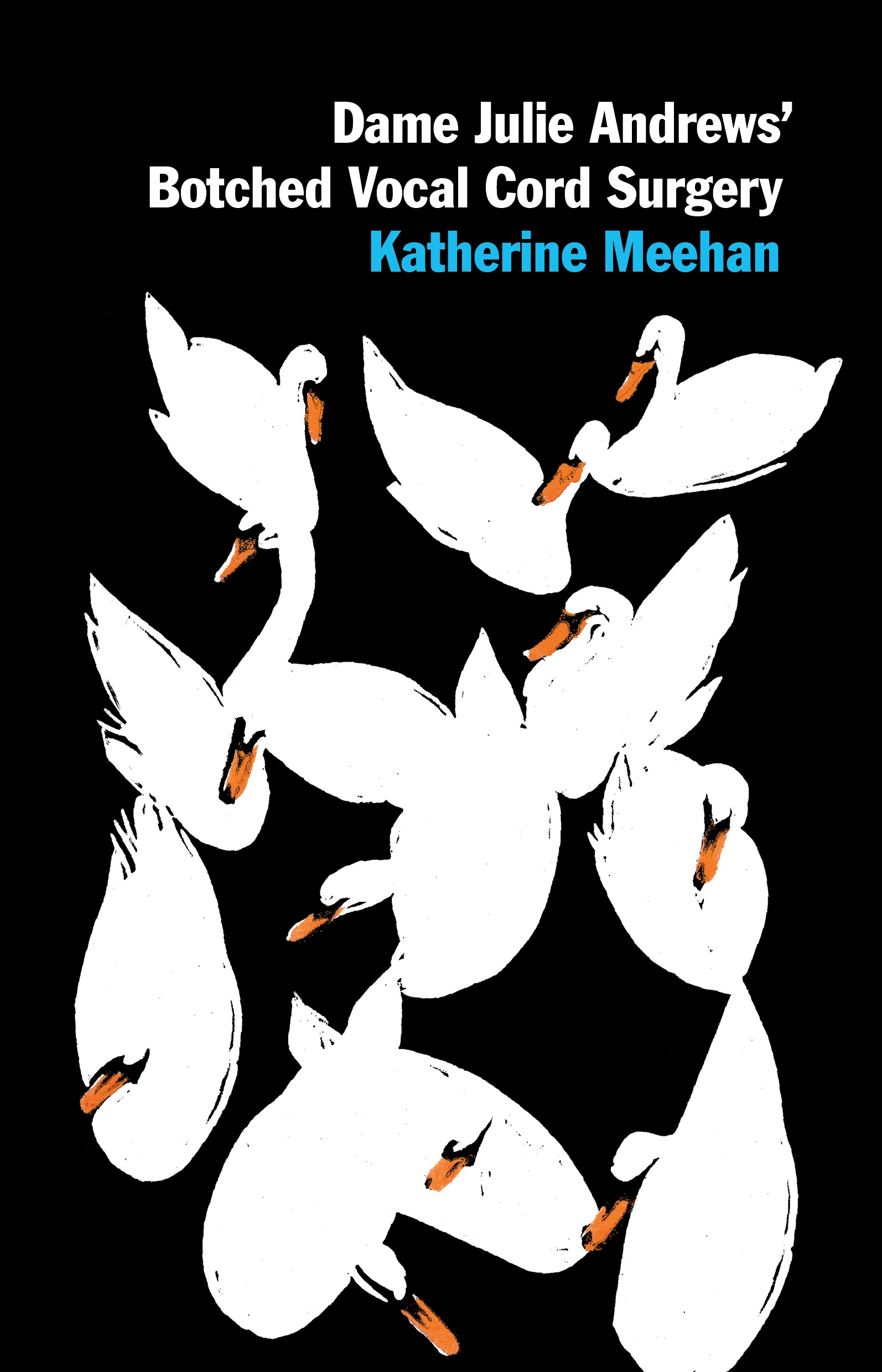
Dame Julie Andrews’ Botched Vocal Chord Surgery is the intriguing title of this debut collection by Katherine Meehan, an American born UK-based poet, whose poems explore the world, love and loss with insight, wit, irony and unexpected frames of reference, sometimes reminding me of Tony Hoagland (which I truly mean as a high compliment) in terms of dry deadpan humour disguising/revealing serious concerns and profound feelings. On the back cover James Womack says, ‘poems which seem both spacious and confidential at the same time’ and I think that is exactly right.
Meehan is good at titles (‘Thinking About the Chicken Bridge Murder While Riding in a Truck’; ‘The Rail Replacement Bus at Surbiton’), and the subsequent poems often veer off even from the surprising titles, so reading them frequently delivers the unexpected. The book’s title poem explores the unsuccessful (and thus silencing) surgery as referred to, referencing the cataclysmic wipe-out of the dinosaurs, the death of the philosopher Martin Buber, and an unidentified but seemingly more personal loss along the way – which does seem a bit harsh on the surgeon in question, I have to say, as Dame Julie presumably did undergo the surgery because she already had a problem with her glorious vocal chords, but setting that issue aside, I really enjoyed the brio and breadth of reference of the poem, and its ‘unspoken’ implication of the damage that can be done to the world.
In ‘Desiderata’ Meehan lists various desirable things (many of which hint at serious personal and/or health issues and experiences) including dissolvable stitches and marriages where ‘no one/ dreams of endings’ and concludes with:
the feeling of endings
that never arrive,
like train delays
at peak time
if you’ve got wine in a can
and no responsibilities.
She often writes about the natural world, referring to previous wipe-outs and to those surely coming, and blending ecological concerns with more personal ones. In ‘The Elvers’ she explores the strange life cycle of eels:
But most of us get EATEN!
The elvers squealed, see-thru
babies, cooked till opaque.
and the poem ends with:
No one will ever cut you slack
like your parents did.
In ‘The Rail Replacement Bus at Surbiton’ she refers to ‘the feral parakeets’ and at the end of the poem, addressing either all her readers or a particular one, she says:
I cannot
wish you
every
happiness;
I wish you
wild green birds.
For me, some of the poems did not quite live up to their ‘titular’ promise, remaining either a bit obscure or not quite taking flight (given their wonderfully engaging and promissory titles) and the tropes of ‘seemingly’ haphazard or faux naive lists and semi-repetitions did not achieve magic every time, even though I admired the skill and ‘sofistikashun’ as Hoagland might put it – but, overall, there are ideas, entertainments and provocations aplenty.
In ‘The Wedding at Cane Creek Farm’ she describes being at a wedding of two friends, genuinely wishing them well, but also feeling your own ‘private disappointments’, and perhaps staying too long in the gradually emptying marquee. She says:
I talked with two or three other people for whom things had also not worked out.
At the end of the night we danced near the fire like people who once loved dancing.
In ‘Enta Geweorc’ (referencing an early medieval poem about a ruined castle, possibly near the City of Bath, and a great influence on JRR Tolkien, I gather) there is an implication of ruin and loss, and a sort of ‘gather ye rosebuds’ while you can spirit. The poem opens with ‘Get in the ancient hot tub, sexy friend!’ and concludes – beautifully – with:
We will drink an Albarino
that tastes like green apples,
we will throw the moonlight over
our shoulders like salt.
That last couplet presumably referring to the belief that salt thrown over ones shoulder will land in the eye of any chasing devil, and thus defeat him in his pursuit of you.
I enjoyed this characterful debut collection and I recommend it – I look forward to reading more of Katherine Meehan’s witty and powerful work.
Rowena Sommerville is a writer, illustrator, singer and project producer, and she lives on top of a cliff looking out to sea in beautiful North Yorkshire. She has worked in the arts for all her life, sometimes successfully! She has had numerous poems published in magazines and her first collection – ‘Melusine’ – was published by Mudfog in 2021; she had five poems published in a Stickleback leaflet by Hedgehog Press in 2023. She was the Visual Artist in Residence for The High Window in 2022.
*****
Miniskirts in The Waste Land by Pratibha Castle. £8.99 incl p&p. Hedgehog Press. ISBN 978-1-913499-74-7. Reviewed by Anne Symons
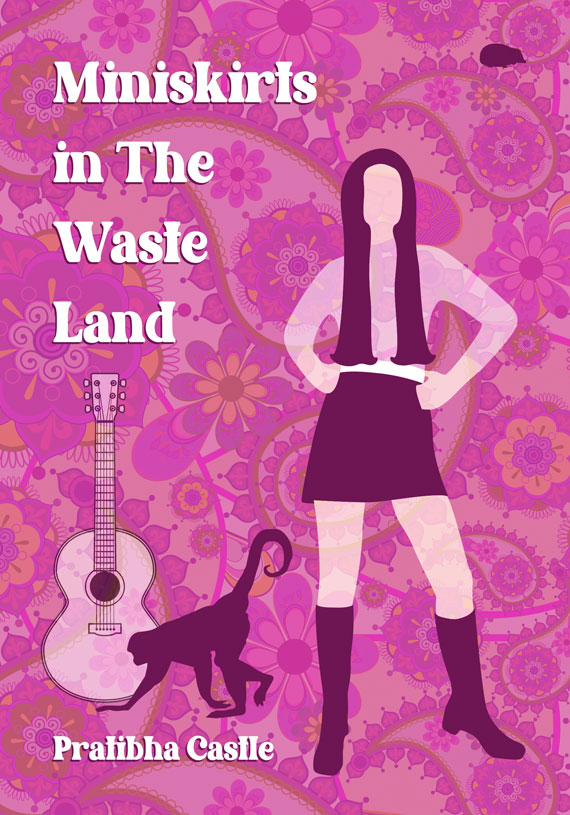
This second pamphlet from award-winning writer Pratibha Castle sparkles with the exuberance of youth and the exoticism of 1960’s India. Castle offers a kaleidoscope of personal experience, from convent school sixth form through the streets of Nottinghill and the bazaars of India to the ‘queendom’ of motherhood.
This is rich writing. The opening poem, which gives its title to the pamphlet, is packed with layer upon layer of sensual imagery:
[ … ] music listened to in bed
when she should have been asleep
but was trialling budding pleasure.
A bloke, can’t get no satisfaction, old enough
to be her dad, greets Susie with a blasé barter
of saliva
In this poem, as with many others, there is a darker current, the harsh reality of the world intrudes, ‘a Buddhist monk / ablaze’ on a TV screen:
[ …] while Sally in a Surrey orchard contemplates
flesh, his and hers, pawed by fingers
in the fashion of Sassoon.
Beneath the heady excitement of adolescent discovery lies the ever-present apprehension of unwanted pregnancy, ‘all week she checks her knickers’,
the blood clot /that might have been you / slipping out from between my legs.
In ‘Reflections’ the joy of colour and a new day in Portobello ‘sunlight, splintering a window’, ‘my skirt / a swirl of orange silk / and mirror discs’ give way to the sadness of betrayal and loneliness, ‘You, kissing her, / beside The Sun in Splendour’. Clouds ‘coffin-heavy’ hang over the image caught in a bus window ‘a girl wept my choked-back tears.’
Castle is unafraid to use white space to support her purpose – stanzas in ‘Lizzie’s Trip Down Portobello’, for example, range from 2 lines to 8. The verse flows freely from this confident writer. She also uses form to good effect, the tight tercets of ‘In The Attic’ holding memories evoked by an Afghan coat, ‘a long-ago rendez-vous / with a man who failed to show’:
His maestro’s hands that night,
white and fluent, charmed
you, all aquiver, from your lair
of convent niceties, and doubts.
Castle experiments with voice, using first, second or third person narrative as the writing calls for it. We meet a range of characters, Sister Bridget, Sal, Lizzie, Susie, and the ‘man in a baggy cardi.’
This variety captures our attention, each poem is a new adventure for the reader. We are surprised by the vivid sensuality of ‘Artichokes’, as they ‘strip each other’s selves / like plucking leaves / off artichokes.’ We wince at the detail of ‘St Jude Of The Lost Cause’, ‘the baby beetroot / swelling in the dark / like clotted blood’ but rejoice as the midwife:
[…] snips
the lardy cord still linking us,
that’s when I know
St Jude has come up trumps.
The poems often begin in beauty, luxuriating in imagery:
Parrots squawk matins, split the air
with emerald-scarlet swoops,
spatter Krishna’s blue face.
Breeze wafts jasmine, wood smoke, scousers,
temple bells.
yet sting us at the end:
Ants chivvy a dead scorpion across my foot.
I torch your cast-off hat.
These patches of memory are drawn together in the final poem, ‘To The Beach’. Mangoes, palms, jasmine create an idyllic scene, and then the touch of a butterfly’s wing recalls ‘eyelashes / against her cheek’ and a bird’s wail:
becomes her mother’s song
soaring above smoke
coiling from an altar boy’s censor.
This reference to her mother, to the past she has escaped from, leaves her with ‘jangled thoughts’ and ‘Heart-beat waves / sigh beyond the trees.’
Castle’s latest pamphlet surprises and delights, entertains and provokes – put it on your Christmas list.
Anne Symonsbegan writing poetry in retirement after a career teaching deaf children and adults Her work has appeared in a range of poetry publications, including Agenda, Dreamcatcher, Ekphrastic Review, Ink Sweat & Tears, Orbis, Poetry Salzburg Review, Steel Jackdaw, The High Window and The Atlanta Review. Anne has completed an MA in Writing Poetry at Newcastle University and the Poetry School in London.
*****
 The High Window