*****
Emma Storr: The Year of Two Winters • Sue Wallace-Shaddad & Sula Rubens: Sleeping Under Clouds
*****
The Year of Two Winters by Emma Storr. £9.50 +p&p. Indigo Dreams. ISBN: 978-1912876778. Reviewed by Carole Bromley
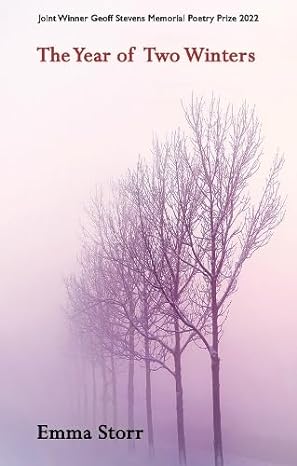
The Year of Two Winters follows Emma Storr’s pamphlet, Heart Murmur (Calder Valley) and a recent collaboration with Bob Hamilton, Offcumdens (Fair Acre Press).
A big fan of her work, I was eager to read this book and was not disappointed. The poems are often moving, sometimes surreal, always accessible and clear in Emma’s distinctive voice with its delightful wry humour.
In the opening poem, ‘Heritage’, she traces her Viking ancestry in a poem peppered with Old Norse and from the off I knew we were in safe hands. Emma is wonderful at evoking the senses and the childhood poems made me hungry for cheese sandwiches fried in a battered pan. There is an undercurrent of violence and the macabre in poems like ‘Devotee’ and ‘Yorkshire Pudding’ in which the speaker plunges a fork ‘into the bulging veins’ of a foul-mouthed man and I loved the ending ‘She scraped the pudding up. Closed the door.’ A similarly independent voice rings loud and clear in ‘Explorer’:
‘At night, I’ll shake out my clothes, my stiff legs,
Lie in a scoop of sand under constellations
I can’t name, a nomad at sea in heatwaves, salt.
I will trust only the camel and go on.’
Her intimate knowledge of the human body which made the medical poems in Heart Murmur so powerful and memorable is used to good effect again in poems like ‘Ode to the pancreas’ in which the speaker bargains with ‘the quiet organ/of small waterfalls’ which is often overlooked. Here she imagines its daily work and begs
‘Please don’t surprise me
At the end. Don’t make me swell or turn
A greenish-yellow and I’ll try not
To poison you…’
Back to the county she now calls home in the beautiful, rather poignant poem, ‘Midhope, Yorkshire’ in which a couple on a walk agree to separate and take different paths back to the car, a poem which works powerfully on two levels and this is subtly done and very effective, this effect strengthened by use of white space;
‘Weeks later
xxxxxxxxxxxsaw a hare
carved in stone.
I thought of us looking
xxxxxxxxxxxnot finding each other
on that moorland walk
chasing spring
xxxxxxxxxx after spring had gone.’
Elsewhere the poems (sometimes, like the wonderful ‘how to prepare for visitors’, familiar to me from poetry discussions in Leeds and on Zoom) made me laugh out loud;
‘Rely on
your guests’ cataracts
to dim their view
of your home, dressed in
its favourite coat over
exhausted underwear’
In ‘This service includes all removable components’ the speaker calls in the experts! I recognised that shame only too well! He doesn’t bat an eyelid and the poet spares us none of the detail of that dirty cooker, before ending;
‘When he suggested silicone, a sheet
to catch a careless spillage from a roast
or baking tin, I nearly kissed him.’
In ‘Arrhythmia’ she returns to poetry about the world of medicine. This is a huge strength and nobody does it better. Again, skilled use of white space gives a staccato effect to a poem in which the speaker engages in dialogue with her own misbehaving heart.
‘And I can’t helpxxxx wondering. xxxxxWhy xxxxx me?
Whyxxxxxnow?
Howlong?xxxxxHowxxxxx long?
Have wexxxxx?
Another poem, ‘Right hand talks to left’, relates the frustrations and difficulties of living with a fractured wrist. I felt this one was unusual and particularly strong. She is so good at writing about the body.
In ‘Rhubarb’ she presents us with a clever shape poem, representing the Yorkshire ‘rhubarb triangle’ and capturing beautifully the strange magic of the growing rhubarb. I can’t do this one justice so you will just have to take my word for it or, better still, go out and buy this wonderful collection, such a deserving joint winner of the Geoff Stevens Memorial Poetry Prize 2022. I enjoyed it so much I am off to read it over again…
Carole Bromley has five titles with Smith/Doorstop Unscheduled Halt, Skylight, A Guided Tour of the Ice House, The Stonegate Devil and Blast Off! She also has one collection, The Peregrine Falcons of York Minster with Valley Press and a pamphlet, Sodium 136 with Calder Valley.
*****
Sleeping Under Clouds by Sue Wallace-Shaddad & Sula Rubens. £10. Clayhanger Press. ISBN 9781739177027. Reviewed by Rodney Wood

It’s a delight to hold this high quality pamphlet in which poet Sue Wallace-Shaddad responds to a series of paintings by Sula Rubens. Sue Wallace-Shaddad has an MA from Newcastle University, worked with the British Council before retiring, has been Secretary of Suffolk Poetry Society, had a pamphlet, A City Waking Up, published in 2020 and has had many poems featured in magazines. Sula Rubens graduated from St. Martins School of Art in 1989. Since then she has practised as a painter and printmaker. She has lived in France, Spain, Greece and Ireland, worked and exhibited in Amsterdam, Gdansk, St Petersburg, and collaborated with artists, poets and musicians. In 1922 she was elected a full member of the Royal Watercolour Society.
The pamphlet consists of an opening section of seven poems by Sue Wallace-Shaddad who recognizes that she:
…can never hope to understand
the language of their pain, or see
the images that fill their sleep
at night. They have to keep going,
struggle past those memories which
cannot be erased from their minds.
xxxxxxxxxxxxxxxxxxxxxxxxxxxxxKeeping Going
This section explores the feeling evoked by an overview of Sula Rubens’s series of painting entitled Kin which portrays people, especially children, who have been displaced and forced to move to an unknown land and future. The haunting images and the sombre tones are especially effective as are the way they are painted on old maps of countries that perhaps no longer exist and the roads and borders are our lifeblood. It’s so easy to get lost in these 21 watercolours, oils, acrylic because they are tender, haunting and feature such recognizably ordinary scenes of playing football, holding a cat, sleeping or sitting on a sofa.
In the main section, Kin, Sue Wallace-Shaddad responds with a poem to a painting by Sula on the facing page. Poems often short, simple, surrounded with white space to showcase this is a conversation we need to have. ‘Watch Out’, for example, consists of twelve lines, both comments on and adds another dimension to the picture. A pair of leopard print legging on a washing line in the painting turn into a real leopard in the poem which wants to eat a lamb a young boy holds:
but you are not afraid
of some phantom in the wind.
You hold a heating heart.
I was overwhelmed with a feeling of such pleasure, sadness and understanding as I read the other poems. One of my favourite poems and painting depicts a group of children who wander up to a sofa which is lost in a landscape, perhaps stranded on a beach, exposed and alone. The children: ‘arrange themselves / chat as if waiting to be photographed. ‘
The last poem in the book, ‘Passage’, and painting, ‘Sleeping Child in a Landscape’, and the child holds: ‘A ragged bear / a small comfort by his side.’ He knows that the next day means he must travel once again in a seeminingly never ending cycle:
Each footstep marks the distance
travelled, shoes wearing thin.
Gripped by a steady hand or carried
shoulder-high, the child holds tight
till night falls and he sleeps again.
It’s not only land people have to cross:’The sea is a foreeign place. / Not all will escape.’ After finishing I want to pick up the pamphlet again and enjoy the irony of such beautiful paintings and poems set against a backdrop of fear and rootlessness.
Rodney Wood has published many poems, hosts an open mic in Woking and has published two pamphlets, Dante Called You Beatrice and When Listening Isn’t Enough.
*****
 The High Window