*****
Home Poems by Antony Johae • Losing Ithaca by Christopher Southgate
•
Four Pamphlets from Rack Press
*****
Home Poems by Antony Johae. £12.00. Orphean Press. ISBN 978-1-908198-24-2 Reviewed by Peter Ualrig Kennedy
Antony Johae, who has a PhD in Comparative Literature from Essex University, has taught at Essex and in Ghana, Tunisia and Kuwait. Since retiring in 2009, he and his wife Thérèse have divided their time between Lebanon and Colchester. His knowledge of the world and its places informs much of his poetry and his poems never fail to stimulate and intrigue, written in free verse, with a fine eye for situations both tragic and comedic. His poetic voice is very much his own; in this collection of Home Poems Johae proves himself a master of locality – places loom large and have their own character. Johae arranges the collection in seven specific sections. In the section ‘Colchester / Camulodunum’ his poem ‘Flying camels’ starts:
My road is Roman;
it straddles the old wall
down to the Quaker burial ground.
And indeed it is the very road where the poet himself lives in Colchester, with its distinct traces of a Roman past. As well as a sense of history, Johae’s poems often contain a certain charm and artifice. In ‘Invitation to dance / for Tim’ – written for his brother – we read:
You took every chance to dance, like a firebrand,
with all and sundry at the Club
in those early days at the Albert pub
with Tom Collins and his trad jazz band.
Antony Johae has a special and highly individual way with words, and with the well-chosen adjective. There is an occasional foray into prose poetry, as in ‘Will Kemp’s jig’ from London town to Norwich: “Pity his pains to jig in nine days near on ninety mile.” The first four of his sections deal with place; when he comes to the fifth grouping ‘Offspring’, evident charm and love fill his lines. Humour is there as well, in ‘Ironing man’:
to flatten, sweating, with heat on high
Making them fit for baby to lie on.
If I’m going to keep up, I’ll need to be a man of iron.
And sometimes the humour is dark. ‘Madonna and book’ juxtaposes a statuette of the holy Madonna with Fifty Shades of Grey on the shelf below. But he finds beauty in the undervalued, as in ‘Dandelions in a vase’:
You are no unwanted weed.
I picked you
between nettle and grass,
saved you for my green vase.
This poem is mirrored by ‘Tulips in a vase’:
You are no still life
framed on a white wall.
Your stems do not pose;
splayed, they bend and lean.
Johae confesses his feelings of guilt at witnessing the ‘End of an old oak’ in the Eco poems, but intriguingly it is the guilt of the executioners that is reflected back on to the conscience of the viewer of the dispatch, the slaughter, which seems a martyrdom:
The men stand back and gape at
wide-girth trunk,
branches snow-scattered.
I feel guilt for them
these executioners of civic orders,
men whose lives depend on it.
They’ll rest easy with their wives tonight
and come back tomorrow to burn you.
As well as having a conscience, this poet knows his ornithology. In ‘Poet’s gallery of waders’ he details the features of a veritable flock of wading birds. In the same Eco poems section appears the prose poem ‘Red list’, enumerating some endangered birds (amongst them appears the mythical “bunnock” – an unfortunate typo for “dunnock” but that should not spoil the poignant message):
If these were gone from Britain’s shores, so too their airs, ambient hues, numinous names – and what’s more, they’d fade from every poet’s word-store.
Johae’s last section incorporates ‘Creative, critical, philosophical’: poems that are variously deep, amusing, or indeed philosophical.` In ‘Choosing boxes’ there is a delicious conundrum:
In my dream, two boxes hang in the air.
I know one to be pepperoni,
the other four cheeses.
How to choose from these choice boxes? Or in ‘Flying’, the wistful:
Take a trumpeter hitting a high note,
How he makes it stretch towards the sky.
O that I could fly so with verse!
And he manages a good deal of variety in this final section, with several brief admonitions, a brace of (perhaps unconvincing) haiku, a short poem of six couplets in French ‘Hommage à Hollande’ with its corresponding English translation, and a warning of the perils of smoking. ‘Smoke’:
Constant coughing shakes the frame;
expansion of ribs, contraction of diaphragm
falter into final fall.
‘Campervan-haiku-calendar’ is a novel exercise in seeing the year through, with a dozen month by month three-liners from the point of view of his motorhome. And possibly his most unusual piece is ‘Prostate process’ which takes one through six months of investigation and treatment from ‘Check up’ to ‘Ode to the knights of the NHS’. Johae is nothing if not versatile in his choice of subject!
The penultimate poem is a love song ‘Gift’, for his wife Thérèse:
This present’s for you my jewel,
diamond strong, clear as star,
permanent in the firmament.
The collection ends with the mystical prose piece ‘Looking west’ in which the poet sees a figure silhouetted in the lowering sun. A figure, a living halo, who has come to take in the harvest …
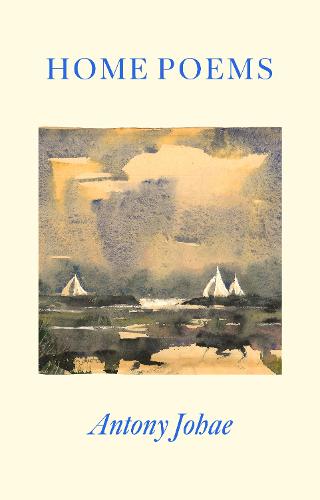
Such an intriguing selection of poems. Johae’s style is individual, and clear, and it comes across strongly in this admirable collection, whose cover-page watercolour ‘Sails on the Deben’ is by Antony’s brother Tim Johae – a nice tribute.
Peter Ualrig Kennedy, retired physician, is lead organiser of poetry collective Poetrywivenhoe. His first published poem, other than student ephemera, was in Time and Tide in 1958. He has been trying to catch up with himself ever since, with poetry published in journals in print and online. His debut collection ‘Songs for a Daughter’ was published by Dempsey & Windle in 2021. He edited the contemporary poetry collection ‘Days begin…’ (Wivenbooks 2015), and three Poetry in Lockdown anthologies for Watermelon Press.
*****
Losing Ithaca by Christopher Southgate. £10. Shoestring Press. ISBN: 9781915553256 Reviewed by Patrick Lodge
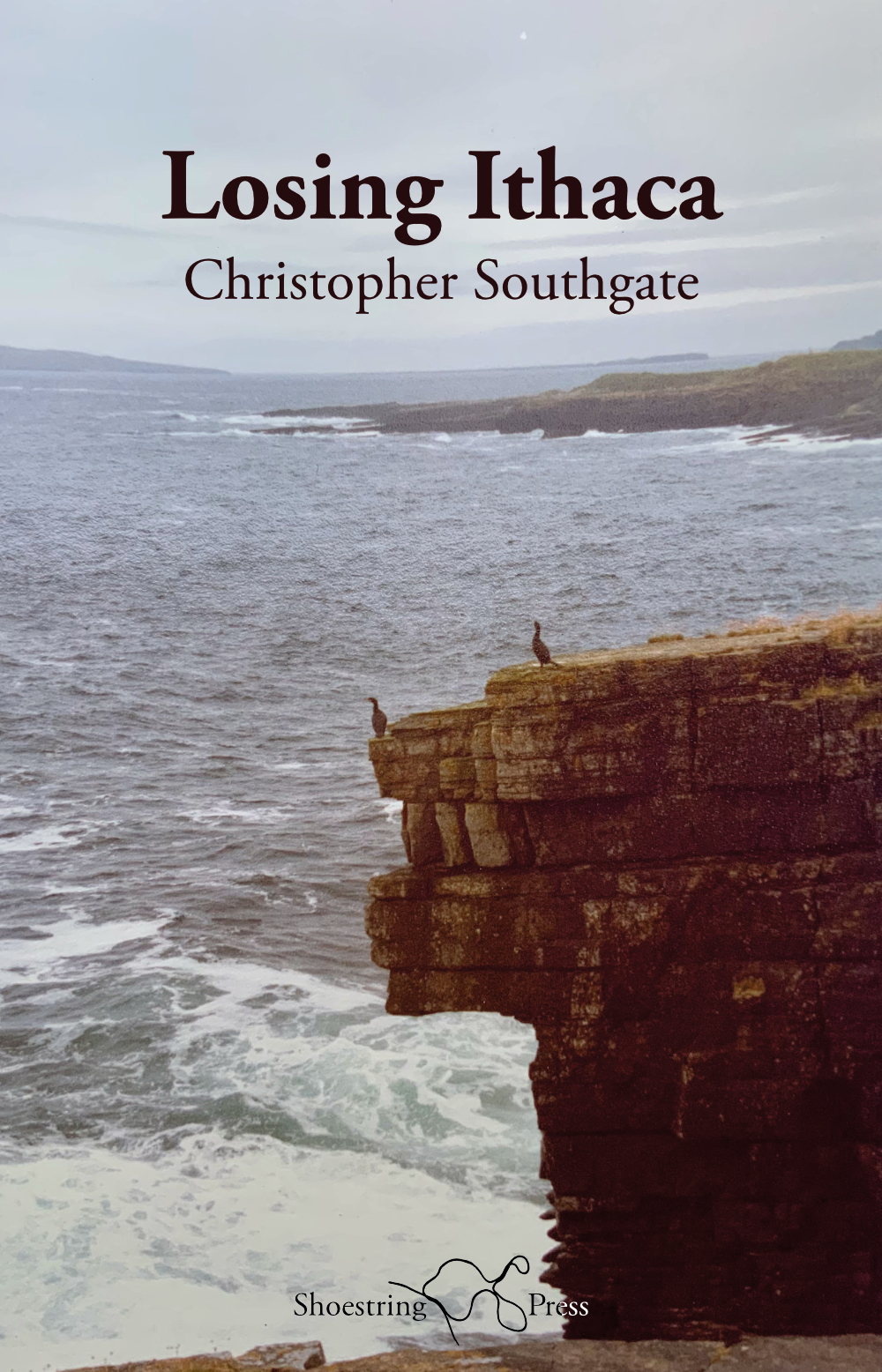
In his Bridport shortlisted poem ‘Notes From A Ditch Near Troy’, Christopher Southgate, an established poet with a background in theology, writes “when we shuffle out we are ourselves, / Each with our own dust in our hair, / Each wrapped in a torn scarf of memory” and, indeed, it might be said to be the honest persona which he brings to the writing of these poems. Losing Ithaca is a lyrical and elegant collection that covers a wide range of subject -matter with a strong emotional bottom of humanity across the poems.
The collection is broadly organised into six sections, some – like the second section which takes “6” as it theme -seem a little arbitrary and contrived, while others – such as the opening section, which explores powerfully issues of loss and grief, offers a courageous set of meditations on a difficult theme. Indeed, you could say that Southgate does grief very well and it showcases his craft. He has an eye for the telling, subversive descriptive; the opening poem focuses on a funeral where the women weep “Tugging at little-worn business shirts” (‘Notes From A Ditch Near Troy’). The exquisite ‘Rose-Petals’ weaves weddings and funerals together around the motif of rose petals – an emotionally packed poem written in a sparse and simple manner that works perfectly. Southgate shows his craft with dexterous and subtle use of line breaks, space and telling images – “She threw beauty at her loss” – to explore the joy and sadness of enduring love.
Southgate has a knack of placing himself in an historical context, standing next to players in well-known scenes, and drawing out meanings. Section III has several poems focusing on the Christian story – no surprise given his involvement in theology. Thus he explores Christ at His crucifixion wondering if he heard bird song “on the last morning of his life?” and, in an exquisite line, noting the contradictory agony of the Christ’s fulfilment of His mission, “Every dragged step of that last climb / was being alive”. Other poems focus on Judas, Mary, the meeting at Emmaus and Paul’s thorn in the flesh (Corinthians 2) which is given a suggested homo-erotic dimension, in what is one the most consistently compelling section of the collection.
A similar approach – inhabiting the unexpected moment of a well-known person or event and suggesting an alternative narrative or back story – is taken with positive effect in several poems. Thus Keats gets inspiration for “Bright Star” gazing out of the window over the Spanish Steps, the eponymous girl with the pearl earring gazes at Vermeer, taught by him “…how love can give itself away / in an over-shoulder look.” (‘The Pearl Earring”). By far the best poem in this theme – combining Southgate’s lightness of touch and humour – takes as its starting point Gerard Manley Hopkins admission, when lecturing about Helen of Troy, that he had never seen a woman naked. On a Greek quayside Southgate allows him (or at least his cover photograph on the book he is reading) to meet a woman, “Tall, slim wearing nothing but a bikini bottom”. The ensuing discussion seems beneficial “He offers to hear her confession. / His lectures on Helen of Troy are greatly improved” (‘Hopkins on Symi’).
It is not all merriment – serious issues are dealt with but again Southgate can manage this with a gentle, almost whimsical tone or an eye for a killing image. An imagined eulogy at the memorial service for a glacier makes its point about climate change without tendentiousness – strong words softly spoken, as Tony Lucca might have sung. ‘Malignant Sadness’ – the title taken from Lewis Wolpert’s book on dealing with depression – offers one of the best descriptions of its malignant effect I have read. Southgate answers the question, ‘what is Depression’ simply – “Toughened glass / between the soul and joy”. He can write powerfully about joy though. A series of poems explore wild birds as symbols of hope and inspiration with swifts and goldfinches offering an affirming link between nature and the human spirit. In the delightful ‘December Jay’, possibly dedicated to his wife Sandy, the flash of the bird in a wood is an inspiration, “I know it is there, beyond these lightless days / with and electricity, blaze / of laughter and pride and protest. / I know it is there”.
Occasionally the slick sheen of craft may shine from a poem or the whimsy may get in the way but overall this is a collection very much worth reading. The marvellous final poem, ‘A Place For Poetry’, posits a fantasy on the perfection of poetry and the content associated with it – “I write in the mornings, in fountain pen, / Interrupted only by my wife bringing tea”. Indeed if such a place for poetry exists then Southgate’s “Losing Ithaca” will find a worthy place there.
Patrick Lodge lives in Yorkshire and is of Irish/Welsh heritage. His work has been published widely in the UK and abroad. He is currently working on a sequence commemorating captain Cook’s first voyage to New Zealand in 1769. He has published three collections with Valley Press: An Anniversary of Flight (2013), Shenanigans (2016) and Remarkable Occurrences (2019).
*****
Steve Griffiths A Twist in the Stairs 9781838230357; Michele Hutchinson The North Wind 9781838230371; William Palmer At First Light 9781838230364; Tuesday Shannon The Rough Guide to Ilkeston 9781838230383. All Rack Press, £6.
Nicholas Murray’s Rack Press pamphlets in their lovely soft grey card covers and pale lemon paper must, surely, have reached the level of a poetry ‘national treasure.’ Clearly, I write as parti pris since Murray was kind enough to produce one of these lovely objects for me. The pamphlets are produced often in groups of four and bring to public attention a range of writers from those with status, such as David Harsent, Christopher Reid and Rory Waterman, some who are reaching some eminence such as Martina Evans, Martha Sprackland or Samantha Wynne-Rhydderch, and others whom Murray has brought to public attention for the first time, Susan Grindley or Rόisín Tierney. My apologies to the many Rack poets not mentioned above.
Steve Griffiths has published a number of full-length collections including a Selected Poems and A Twist in the Stairs is his second pamphlet with Rack. There is a stylish surrealism to the poems in this pamphlet. Their titles have a stocky, prosaic quality: ‘Ideas,’ ‘From “Home is a half-familiar time,”’ ‘We need a definite programme.’ And the poems respond to the titles or, perhaps, the titles respond to the poems with an adroit obliqueness that is resonant and engaging. The poem ‘Hard question’ begins, ‘I begin to see how a poet / might call it a day / when the dreams get so vivid / that the gates / to the waking hours / swing loose / at the abandoned border post.’ Griffiths’ skill here is to poise the writing between the declamatory first person of the first line and the evocative nature of the final line quoted here. And Griffiths creates that poise in the fourth, central line with ‘gates’ being the first concrete noun of the poem. That opening line establishes both a kind of collusion with the persona of the poem and also a casual ironic quality which is brought into the second line.
It is that skilful amalgamation of the casual and the lyrical which sustains the surreal quality of these poems. The poem ‘Order’ begins, ‘But who am I to use this word? // One among many.’ And moves through ‘sandflies hopping and darting on a white scrap of paper’ to its final line relating to a fallen cedar of Lebanon, ‘Resin used to preserve the bodies of the Pharoahs.’ There is an impressive control to Griffiths’ poetry which is both surprising and solid in one and the same moment.
Michele Hutchinson’s The North Wind is an example of Murray’s ability to publish very satisfying first collections. Although Hutchinson has a stellar record as a translator, in particular of the Dutch writer Marieke Lucas Rijneveld who won the International Booker Prize, The North Wind is Hutchinson’s first collection. Donald Gardiner is quoted on the back of Hutchinson’s pamphlet as saying that the poems are ‘deceptively plain’ where ‘emotional intensity is conveyed by understatement.’ And, up to a point, that plainness is true. What moves the poems from their seemingly prosy presentation of emotional states is the focus that Hutchinson achieves. ‘I am the lady crying in the train’ starts with the italicised line ‘Look Mummy, that lady’s crying!’ and carries on, ‘I turn to the window, / study the slate skies, / the flat green fields, windmills, / the first layer of snow.’ Which we might see as a pleasant reportage were it not for the way in which the ‘I’ of the poem, although clearly the writer, simply envelopes the reader. Because the poem completely withholds the reasons for the emotion, the writer’s state becomes our state. So that the ending of the poem becomes a moment with which we completely identify, ‘That lady stops crying at last / and puts her wet tissue in the bin. / More fields, ditches, swans, cows, / bare trees with branches at their feet.’ That last line has an extraordinary resonance.
William Palmer’s At First Light is his third pamphlet with Rack, along with the full collection, The Water Steps. Palmer’s poetic impulse is to see the lyric moment; an impulse which is fully suggested in this pamphlet’s title. In At First Light that lyric moment is often one which may emerge from memory or even dream. In ‘The Suitcase’ the narrator reports the dream a woman who appears to be a refugee. The woman decides to leave her suitcase in the road, and the poem finishes with the woman wanting to reclaim the suitcase, ‘some other day // when she would need no proof / of who she was / or where she was to go, / the handle forming to her hand.’ Again, it is the resonance of that last line that opens so many possibilities for the reader and also washes back over the course of the poem. There is the pun on ‘handle’ as a word for a person’s name. But, perhaps more importantly, it is the solidity of the possession forming to the hand, a rather unusual preposition, seeming to give the suitcase a kind of agency as though it were clinging to the hand rather than the other way round. With the ambiguities – this is a dream, after all – Palmer gives the dreamed experience of the woman a strangely concrete nature. And this nature, seen through the narrator’s report of the dream of another and written up in a quiet, sober manner, has a quite piercing quality; this is a refugee experience which haunts.
There is much about loss in Palmer’s deft poems; ghosts emerge but, inevitably disappear, as does ‘The Lost Father.’ And Palmer’s emotional intelligence knows that there are limits to what the lyric impulse might deliver. ‘They have taken down the trees,’ laments just that loss, embodied, if that is the right word, in the two swans that live in the pool beside the lost trees. Palmer sums up that loss with deadpan but devastating skill, ‘Forever symbols in somebody’s poem: / what these swans are is what they do. / They have no though or use / for us, their watchers, or for the men / more distant in the fine spring rain /dragging their clubs across the green.’ The men are evocatively drawn behind the fine spring rain, but it is their accursed golf that the poem implies has caused the loss of the habitat.
Tuesday Shannon’s The Rough Guide to Ilkeston is also a first collection. And, in that deathless phrase, The Rough Guide to Ilkeston does what it says on the tin. The poems pull no punches about life in this small Derbyshire town and the poems often start as they mean to go on: ‘Between a boarded-up chippy / and a boarded-up florist / second- or third-hand / refrigerators lean to attention.’’HOPE’; ‘When they dragged the carcass / from the canal-bed,’ ‘Dredging’ (it’s a bicycle, by the way!), ‘are dying’, which follows on from the title of the poem, ‘The Flowers.’ And if this all sounds a bit misery memoir, it isn’t. What Shannon captures very movingly is the sense of living in a world where it is genuinely difficult to get much purchase on one’s surroundings. In the above mentioned, ‘The Flowers,’ Shannon writes, ‘There’s too much to do and we don’t know / how to do it and we need / butter and bread and milk and cheese / but people bring flowers / and there’s nowhere to put them so the flowers / are dying.’ This very plain style with its repetitions and listings conveys with great verge and accuracy the claustrophobic mental state of the narrator.
This exact and poignant pamphlet ends with a sequence called ‘The Regulars.’ It’s four parts are narrated by the barmaid at a pub. And, as the title suggests, the poem focuses on four lives who frequent the pub. These are male lives and the female narrator shows these men as living on the edges of their own existence. The first of the men repeats the ‘same lie he’s told me seven times this year,’ about the job interview he’s come for. And although the barmaid feels ‘obliged’ in serving him the alcohol, Shannon’s skill is to show that ‘obligation’ as not the service to the customer, that ‘obligation’ is to witness and record the struggles of a fellow human being. And those struggles are self-evidently, the stories we need to tell ourselves. Another part of the sequence ends ‘the glass / sweating as the tremors still.’ The sequence ends with the barmaid wiping the place down, and preparing it for ‘The Regulars’ who will arrive same time, same place, tomorrow. These are the haunted lives of those living in a forgotten part of England. Shannon’s triumph is to witness for those lives in a way which is never patronising and which is deeply engaged and supportive.
Ian Pople’s Spillway: New and Selected Poems is pub lished by Carcanet.
*****
 The High Window