*****
William Carlos Williams: Paterson • Donald Davie: Selected Poems • Paul Stephenson: Hard Drive • Carole Coates: Dead Letters • Estill Pollock: Ark • Charlotte Harker & Louise Warren: Sometime, in a Churchyard • Julie Sampson: Fivestones • Darren Donohue: Secret Poets • Roger Elkin: Small Fry • Michelle Penn: Paper Crusade
*****
Paterson by William Carlos Williams. £20. Carcanet Classics. ISBN: 978-1800173613 reviewed by Tom Phillips

The poetry that falls within the broad category of modernism however we want to definite that exhibits two opposite tendencies, both driven by a desire to – in Ezra Pound’s words – ‘make it new’: one essentially minimalist, the other essentially maximalist. On the one hand, there are haiku-esque Imagist miniatures; on the other, The Waste Land, The Cantos, Four Quartets, Paterson, Maximus Poems, Briggflats and so on. Despite the flourishing of the former, long or at least longish poems are as much a part of the landscape of modernism as they are of romanticism, neo-classicism et al. Don’t just make it new, in other words, make it big.
Most immediately, perhaps, the principle difference between virtually all long modernist poems and their antecedents is that an overarching narrative is no longer the key structural principle. They contain narrative material, most often in fragments, but they tend not to be centred on and driven by an overarching narrative as, say, The Odyssey, The Rape of the Lock, The Rime of the Ancient Mariner and Don Juan are. Pound’s Cantos open in Homeric neo-epic mode (‘And then went down to the ship …’), but this apparent narrative coherence starts to disintegrate in the last few lines of Canto 1 before at the beginning of Canto 2 (‘Hang it all, Robert Browning …’), the poem plunges into the densely allusive collage technique that will become its chief modus operandi. It’s as if Pound gestures towards a conventional narrative mode before rejecting it almost immediately. Canto 1 demonstrates what the rest of the poem is not going to be like.
Newly republished by Carcanet, the five completed books of William Carlos Williams’ Paterson exhibit a similar tendency, moving away from conventional narrative structures in favour of collage, juxtaposition, multi-perspectival interpolation, albeit from a more localised, more grounded perspective than Pound’s sprawling palimpsest of a poem. In fact, in one sense, Paterson does have an overarching narrative in that it is ostensibly about a poet travelling through a city and encountering both its inhabitants and evidence of its history – at the Passaic river and its waterfall in Book 1, in the park in Book 2, at the library in Book 3 and so on. Jim Jarmusch’s recent film of the same name effectively takes this line, constructing a narrative about a bus driver-poet called Paterson travelling around the city of Paterson and writing poems about what he sees and hears. And this seems a valid reading of the narrative that unfurls, not so much in William Carlos Williams’ Paterson as behind it. The story of a wandering poet, however, acts as a carapace beneath which its other multifarious elements collide and drive the poem forward through the energy those collusions. It is, in short, a meta-narrative rather than a narrative per se. Much the same could be said of other long modernist poems too: it is possible to translate their structural features into an essentially narrative pattern, either by tracing them onto an archetypal arc (The Waste Land as a version of the Fisher King myth etc) or the poet’s own life (Pound’s Cantos enacting an essentially rise-and-fall narrative that might be applied to their author’s own biography). Even so, such narratives do not constitute the foreground of these poems. We can decipher them if we choose to do so, but the texts themselves draw our attention to other things, in many cases – and Paterson is no exception – questions about language, perception, culture, communication and the nature of poetry itself, especially with regard to how it might respond to, negotiate with and exist within the world as it actually exists – questions deriving from phenomenology, whose arrival and development as a distinct philosophical category runs in parallel to the arrival and development of modernism as a cultural phenomenon.
Even those who have not read Paterson in its entirety will no doubt be familiar with Williams’ oft-cited dictum ‘No ideas but in things’ that makes a number of early appearances in the poem, articulating the essentially Imagist approach embodied in much of his previous work, most notably the equally oft-cited miniature ‘The Red Wheelbarrow’. How to translate this thought into practice, however, is a concern that recurs throughout Paterson, as in the passage from Book II in which voices whose owners remain ambiguous openly spar:
Go home. Write. Compose.
Ha!
Be reconciled, poet, with your world, it is the only truth!
Ha!
– the language is worn out.
Further on, in Book III, an essentially phenomenological assertion has it that ‘The province of the poem is the world’ and another more lyrically minded, perhaps even romanticist one that ‘song but deathless song’ is what might ‘bear us past defeats’. Such optimism of outlook, however, is offset, not only by the recurrent image of a burning library that runs through Book III, but also by repeated returns to the idea that the language with which the poem engages with the world and through which a song might become deathless is worn out or somehow defective. ‘The words are lacking’, the poem states while, elsewhere, Williams has a (possibly imaginary reader) observe of Paterson itself: ‘Oh, Geeze, Doc, I guess it’s all right/but what the hell does it mean?’ The idea that writing such a poem may be impossible resurfaces in Book IV when Williams (or, again, his alter-ego, the poet also called Paterson) describes himself as being ‘Waken from a dream, this dream of the whole poem’.
For readers, this question of how you write such a poem inevitably translates into the question of how you might read such a poem. A linear narrative, after all, invites a fairly straightforward approach: you begin at the beginning and keep going until the end. The route through Paterson is less clear. There are abrupt shifts in material and surface texture that interrupt an easy straight-line reading. Episodes and scenes come into focus (a preacher’s autobiographical monologue in the park, Phyllis and her sexual encounters in Book IV etc), but they are invariably interrupted, by the intrusion of a different voice or, most commonly, Williams’ inclusion of – for the most part – found prose material such as letters, newspaper reports and, at one point, a geological survey. Similarly, there are recurrent phrases, images, voices that inevitably invite us to go back and reconsider (the suggestion that the burning library in Book III is Alexandria’s or at least might be a temporal echo of it, for example, comes very late in the poem), that foregrounds the circular rather than the linear, the musical rather than the narratorial, the associative rather than the logical.
This, of course, creates a paradoxical reading situation. On the one hand, the absence of linear narrative means it’s possible to read the poem in a non-linear or excerpted way; on the other, its recurrences and circularities resist that, foregrounding the other structural principles that hold it together and provide its particular kind of unity. The section late on in Book V describing the poet Paterson ‘tending his flower/garden’ à la Voltaire, for example, loops back to earlier passages describing flowers and nature, not to mention the snake and unicorn that make an appearance here, so that, although it’s entirely possible to read it as a self-standing piece, it also clearly operates on multiple levels, encouraging the recognition of interconnections with earlier parts of the poem. It can survive on its own, but it fully comes into existence as part of a more complex whole.
Over the course of the whole poem, in other words – which, let’s not forget, was written over the course of whole decades – Williams is juggling plates, continually experimenting with, not only different ways of perceiving and considering the things that make up an actually existing dwelt-in world, but also with the tools and resources available to him as someone actively seeking to describe that world in language which may or may not be ‘worn out’. Where Williams differs from Pound on the question of the success or otherwise of his attempt to create ‘the whole poem’ in a modernist context becomes especially clear in the final moments of Book V. Pound famously signed out of the Cantos with the last in a series of increasingly self-piteous claims – ‘I have tried to write Paradise’ – and requests for forgiveness – ‘Let the Gods forgive what I / have made / Let those I love try to forgive / what I have made’ (Canto 120), whereas Williams heads off in a different direction, acknowledging failure, but also directing us back towards what we have by way of compensation in the troubled coexistence of love and death:
We know nothing and can know nothing
but
Satyrically, the tragic foot.
Edited, introduced and scrupulously annotated by Christopher MacGowan, and including the notes and fragments of Paterson Book VI that Williams never completed, Carcanet’s republication is a timely event. In its divergence from the high-end modernism of Eliot and Pound, Paterson can be read as a precursor to whole strands of late modernism that variously emerged in the work of Objectivists like George Oppen, Projectivists like Charles Olson, the New York School (Frank O’Hara, Edwin Denby et al), the Beats (Allen Ginsberg’s letters to Williams form part of Paterson’s structural armature in the latter stages) and, on the other side of the Atlantic, the often regionally based British poets who had the temerity to be influenced by American poetry at a time when the proponents (but not necessarily the poor conscripted members) of the movement known as – with such imagination – The Movement were busily advocating a return to four-square ‘proper’ poetry in England as represented by the likes of Philip Larkin and effectively decrying engagement with all that weird – as they saw it – American, European and global stuff. It is also a poem that, for the most part, avoids the allusive bombast of high modernist style. Common ground emerges through the closely observed description of the temporal particular rather than through the imposition of ready-made generalities, myths and allegories onto experience – which seems to be the direction that the high modernists were chasing, the mapping of current experience back onto archetypal patterns, whether those patterns happen to be ancient Greek myths or a Dantesque topography of the afterlife. Read now, in the aftermath of the various directions that the modernist experiment took as it morphed into the post-modernist (whatever that might mean), Paterson can’t but help feel like the result of a different kind of mapping or, at the very least, an attempt at a different kind of mapping, one that is less prone to starting with the accumulated knowledge stored in the library that will potentially burn down and one that favours beginning with the immediate and tracing the connections that the immediate has in store – those ideas that exist in things rather than the things that are made to come into existence because of ideas.
Paterson is, in many ways, a difficult and surprising poem, especially surprising to those who’ve only encountered William Carlos Williams through those much-anthologised minimalist poems like ‘The Red Wheelbarrow’ or ‘Spring and All’, but difficulty – and indeed surprise – are relative concepts. They depend to some extent on our expectations. On that initial question that must inevitably come when encountering a new work: ‘So what, exactly, do we have here?’ With the long modernist poems that many of us have been taught in school or university, like The Wasteland or the Cantos, there are now already existing answers that we might make a choice from. With poems like Paterson, the field is more open and this suggests to me that it is precisely with these poems that we should begin to re-examine how a long poem works and what actually constitutes the relationship between, as William Carlos Williams has it, ‘the province of the poem’ and ‘the world’.
Tom Phillips is a poet, playwright and translator living in Sofia, Bulgaria. His own work has been published internationally in journals and anthologies, as well as in pamphlets and the full-length poetry collections Unknown Translations (Scalino, 2016), Recreation Ground(Two Rivers Press, 2012) and Burning Omaha (Firewater, 2003). He currently teaches creative writing at Sofia University St Kliment Ohridski. He is indebted to Angel Igov and Bozhil Hristov for their help with translating the poetry of Geo Milev.
*****
Selected Poems by Donald Davie, edited by Sinéad Morrissey. £12.99. Carcanet Classics. ISBN: 9781800172906
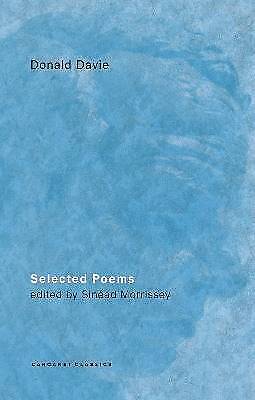
Donald Davie is an odd one for me. I want to like the body of his work much more than I do, but there are a dozen or so poems by him that I like as much as, if not more than, anyone else’s. Those poems were among the first poems I took very much to heart when I started to read and write poetry more seriously in my late teens, early twenties. For me, there is no finer poem than Davie’s ‘Ezra Pound in Pisa’. I found these poems in his Selected Poems, published by Carcanet in 1985 – a book with a dull red cover that I came across in a second-hand bookshop. The choices were Davie’s own, which made it an even more interesting selection. Imagine my surprise and dismay, then, when I turned to the contents page of Sinéad Morrissey’s choices for this new Selected Poems to find ‘Ezra Pound in Pisa’ and many other of those amazing poems missing. To be fair to Morrissey, she does say that her selection is ‘highly personal’ and should only be used as a starting point into Donald Davie’s huge oeuvre, with which I wholeheartedly agree.
Born to Baptist parents in Barnsley in 1922, Donald Davie won a scholarship to Barnsley Holgate Grammar School and then, in 1940, won a place at St Catharine’s College, Cambridge to read English. A spell in the Royal Navy during the war interrupted his degree but he returned to Cambridge and completed his BA, MA and PhD there. He spent 20-odd years teaching at a series of prestigious universities in England, Ireland and the United States. Despite his many years spent abroad in a variety of countries, however, Davie remained an Englishman at heart. His publisher, Michael Schmidt, once differentiated between two kinds of expat. There were those, like Davie’s friend Thom Gunn, who shed their skins and assimilated themselves thoroughly and wholeheartedly into their new culture. The other kind, however, do not; instead the old country looms larger than ever and is longed for even more keenly. Davie was the latter kind. He wrote ‘The Shires’, a poem for every county in England, while living in California, for example.
Concerning his life as a poet, Davie himself said that he was ‘not a poet by nature, only by inclination; for my mind moves most easily and happily among abstractions, it relates ideas far more readily than it relates experiences.’ His poetry can err on the side of didacticism so that we often get a report of an event plus its significance, rather than just the event itself. He is the antithesis of William Carlos William’s dictum ‘no ideas but in things’. This is illustrated very clearly and well in the opening line of his 1955 poem, ‘Poem as Abstract’: ‘A poem is less an orange than a grid;’. This abstract side to his writing found fuller expression in his role as a critic. As a critic, Davie was extremely prolific, writing two books on Ezra Pound and many essays on Hardy and Lawrence, Robert Graves, David Jones and other First World War poets, Basil Bunting, and then later figures such as Hugh MacDiarmid, Roy Fisher, Charles Tomlinson, Geoffrey Hill and Ted Hughes. While his reviews might not be up there in such august company as T.S. Eliot or William Empson, or Coleridge before them, they do show a pretty comprehensive knowledge and understanding of contemporary American, European and Slavic poetry.
Davie’s early poetry showed a steadfast adherence to traditional, conventional forms, relying heavily on regular metre and end-rhyme. But, as he got older, he took on board the influences of his readings into the Modernism of Pound and Bunting (about whom he also wrote a book) plus, occasionally, the freer, looser style of American poets like Frank O’Hara and the American Objectivists, whose work he encountered during his many years in the US. Surprisingly, when it was published by Carcanet in 1989, he even wrote an overall favourable review of A Various Art, an anthology of British postmodern poets including J. H. Prynne and Douglas Oliver, edited by Andrew Crozier and Tim Longville. Most of all, however, Davie sought inspiration and instruction from a whole host of Slavic and Russian poets, Czeslaw Miloz and Boris Pasternak in particular (Davie was stationed in Russia during the war, taught himself the language and read Russian poetry in the original).
But, however enthusiastic he was about Briggflatts or the Cantos, Davie could never reach those dizzy heights of compression, expression and erudition. His poetry always retained a cosy, conservative feel. The modernist strain in Davie’s later work is the strain that speaks most to me. In these freer poems, Davie frequently rejects end-rhyme, regular line length, etc, and instead pilots and lands the poems in unusual and unexpected places. His amazing poem ‘The ‘Sculpture’ of Rhyme’, for example, ends with the line: ‘And a mouth to graze on feldspar.’; while ‘Gardens no Emblems’ ends thusly:
But forms of thought move in another plane
Whose matrices no natural forms afford
Unless subjected to prodigious strain:
Say, light proceeding edgewise, like a sword.
Indeed, it is this conflict between the concrete and abstract (the orange vs the grid) that runs throughout Davie’s work and, therefore, I would say is its defining feature.
After many years in the US, Davie returned to Britain in 1988 and, the following year, he published his final volume of poems, To Scorch or Freeze. Written after Davie had converted to Anglicanism, To Scorch or Freeze takes its cue from the Psalms and, technically speaking, from Pound’s Cantos. It is a late flowering of religious meditations riddled, as it should be, with doubt and contradictions. As Davie’s own Selected Poems had come out in 1985, one advantage Morrissey’s selection has over Davie’s is that she is able to include poems from that collection. Indeed, she chooses more poems from To Scorch or Freeze than any other of Davie’s collections. Shortly before his death in 1995, Davie wrote one last poem, a sequence entitled ‘Our Father’, often thought of as the finest of his religious poems. Another advantage of Morrissey’s selection over Davie’s is that she is able to include this, too, in her selection.
Davie’s output is truly astounding in its range and volume – his Collected Poems alone runs to more than 600 pages – but, to my mind anyway, I feel he never really got a grasp on where he stood stylistically. Torn between the conservatism of Hardy on one side and the radicalness of Pound on the other; drawing on the dry, dusty Augustans as well as the free jazz of late 20th-century American poetry, Davie never really found the right footing. His masterpiece is almost certainly Essex Poems 1963-67, composed during a happy time in his life when he was Chair of Essex University. He covered so much ground over such a long period of time that there will undoubtedly be something for everyone in his work. Sinéad Morrissey’s Selected Poems provides a good tour round the decades of Davie’s life as a poet but, for me, it is those dozen or so poems first encountered when I was a teenager that continue to ring through the ages.
Richard Skinner has published seven books of poetry. His most recent collections are Dream into Play (Poetry Salzburg, 2022), Cut Up (Vanguard Editions, 2023) & White Noise Machine (Salt, 2023). Richard is Director of the Fiction Programme at Faber Academy. He also runs a small press, VanguardEditions, was the co-editor of Magma 80 and is the current editor of 14 magazine.
*****
Hard Drive by Paul Stephenson. £12.99. Carcanet. ISBN: 978-1-80017-327-8
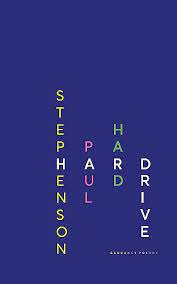
Hard Drive is Paul Stephenson’s first full collection, but rather than drawing on material from his three pamphlets, this substantial book of nearly 130 pages is entirely devoted to poems about the death in 2016 of his civil partner, Tod. The first three sections (“Signature”, “Officialdom” and “Clearing Shelves”) concern the death and its immediate aftermath, the next two (“Covered Reservoir” and “Intentions”) focus on memories, while the last (“Attachment”) is about the writing process itself.
Details are revealed only gradually. The second poem, “What Jean Saw”, is a haiku:
Through the letterbox
the little bald patch of you
asleep on the floor
Nearly twenty pages on, the reader’s inquisitiveness receives an implied rebuke in “Interrogative”, which deals with intrusive questions being asked about the cause of death. The poet (‘unsure if he really knows for certain’) doesn’t provide the answer until two pages later we have “Cause (2016)”, beginning ‘Soft heart failure / Hard heart failure/ Short, sharp heart failure …’ and continuing through more and more fanciful descriptions before ending with ‘Oven-ready heart failure’ (the crematorium oven is the subject of another poem, “Retort”). Whatever the cause, the fact is that he’s dead.
Lists form the basis of a number of the poems. “Your Name” runs through the many possible meanings of Tod, including ‘das Tod (death), der Todesangst (a fear of dying)’ and ‘in Spanish, todos (everyone), todo (everything), en todas partes (everywhere). “Clearing His Shelves” catalogues an extensive range of titles and “Clinically Proven” lists various brands of face cream (‘They’re in the bathroom drawer. / Some empty, some on the go.’) He also makes use of repetition, including anaphora.
Stephenson’s experiments with form can give the impression that he is trying to distract himself from his partner’s death, but he also uses them to evoke a state of mind. The first poem, “The Thesis”, describes the poet, away from his partner and busy supervising students, being distracted by the feeling that something is amiss. The repetition of ‘I knew something was wrong’ and ‘student’ or ‘students’ throughout the poem creates a sense of agitation. “Collecting You from Golders Green” presents alternative words at the end of each line, but rather than being a postmodern unpacking of the creative process, for me it encapsulates the difficulty people under severe stress have in making decisions:
The young woman / lady / female
behind the desk / counter / reception
spoke gently / softly / calmly
seemed genuinely moved / emotional / upset
and I thought how generous / kind / ridiculous
for she never knew / met / was acquainted with / you
In “I can be happily”, he omits rather than adds words:
engrossed in some
xxxxxx have my head stuck in
looking out at the
xxxxxxnoticing the new
which neatly demonstrates the mundanity of the activities (we can fill it in the blanks for ourselves), the poem making a series of feints before the final punch hits home:
looking forward to a
xxxxxxwhen suddenly I
out of nowhere
xxxxxxpicture you
In “Nurture”, key words are replaced by ‘tomato’ or ‘tomatoes’.
Stephenson is a linguist and words themselves are key. “Retort” plays on the fact that it can mean both a riposte, or comeback, and a cremation chamber, from which there is no coming back. He is not above inventing words (“Better Verbs for Scattering”) or using them in new ways to try and capture his partner’s indefinable qualities:
The app of him, the bop of him, the cap,
xxxxxxthe cop of him, the cup of him, the dip;
the fop of him, the gap of him, the hip,
xxxxxxthe hop of him, the jip of him, the lap.
(“The Hymn of Him”)
“Starchitect (2016)”, another paean, apparently uses words added to the Oxford English Dictionary since 2016.
More often, Stephenson’s very self-assured poems use a plain style that can even be matter-of-fact, when dealing with officialdom, or as here in “The Description of the Building”, where:
No reference is made to the red gloss
paint of the door, or to the red gloss
of the gates to the right …
The point is to contrast the way that the mortuary is described online (‘homely in style, / double-fronted and two-storied / with gable dormer windows in the roof’) with what the poet actually sees. His experience of it is deeply personal and descriptions provide only a version of the truth. We learn about:
… how the place played a crucial role
in ‘Operation Mincemeat’, informed
the international non-fiction bestseller
The Man Who Never Was.
The irony of ‘non-fiction bestseller’ is that Operation Mincemeat was a wartime ruse, in which a dead tramp, dressed in military uniform and carrying false documents, was deposited off the coast of Spain in order to deceive the enemy about the Allies’ plans to invade Italy. The whole thing was a fiction, though this isn’t spelt out.
Stephenson likes to leave his readers with work to do for themselves. “The Only Book I Took” (in “Clearing Shelves”) doesn’t reveal that The Year of Magical Thinking (‘Hadn’t read it, knew you liked it. / Hardback edition. Alfred A. Knopf’) is a memoir about bereavement. In “The Mid-Morning Dictator. Gori” Stalin isn’t mentioned by name. The withholding of information is used to especially good effect in “The Shortest Day”, when we have to infer that it’s about the surreptitious scattering of ashes—which is appropriate, given the need for subterfuge.
Although the poems are highly imaginative, they nevertheless inhabit the real world and a contemporary one at that. The title poem, “Hard Drive”, pictures his life with his partner being held on a hard drive in the iCloud:
I will get a man xxxxxxxxxxxxxxxxxxxxx to locate our life
to retrieve xxxxxxxxxxxxxxxxxxxxx our life our love
and transfer it xxxxxxxxxxxxxxxxxxxxx so I can relive it
“Masterpiece Theatre” and “Not Dead” fantasise that the death is a hoax, arranged either as a private prank or as part of a TV show. “Paddington” plays on Tracey Emin’s light installation (‘I want my time with you’). There’s a voicemail, Googling, Spotify and Wikipedia, as well as self-storage facilities and bikes in basements. His experimental use of form is also up to date. There are prose poems, poems with words carefully patterned on the page and poems printed in landscape. It was only in the final section where I felt that the redactions and cancellations in “Your Brain” and “Bad Conference / Attachment” (the second poem being about the circumstances in which the first was written) ran the risk of being simply modish. And “Grief as the Preamble of the Maastricht Treaty”, with which the section ends, although an intriguing idea, remains just that. Using the rubric of an international treaty as the framework for the poem implies that Stephenson is bored by his grief and that the process has come to a natural end. You could say that this makes it true a reflection of the poet’s mood, but he seems more emotionally engaged in “Writing to Your Mother”, where he is unsure what tone to adopt or even whether to mention her son’s name, or in “Putting It Out There”, in which he worries that he might be commodifying his partner’s death (he isn’t).
The book ends with a coda, “Wedding in Limousin”, that begins: ‘I’m writing this in the swimming pool’ and ends:
All this way. I have come to represent you
But I’m also here for me. Hey, a swallow
just skimmed the pool, was off again.
Sixth in a row. A swallow for each year
you’ve been gone. It’s time to swim.
It’s a beautiful poem about emerging from grief and taking a renewed interest in the world around. His notebook may be covered in wet patches, but these are from pool water rather than tears.
Paul Stephenson has already won prizes for his pamphlets, but I would agree with his own assessment (in a promotional video he made for Carcanet) that Hard Drive contains his most accomplished work to date. These are sophisticated poems that use a variety of forms to explore and express grief and do so in a way that is both acutely intelligent and deeply felt. Even those about which I had some reservations, I thought earned their place in the trajectory of grief that Stephenson so accurately plots.
Stephen Claughton’s poems have appeared widely in print and online. He has published two pamphlets: The War with Hannibal (Poetry Salzburg, 2019) and The 3-D Clock (Dempsey & Windle, 2020). He reviews for The High Window and London Grip and blogs occasionally at www.stephenclaughton.com, where links to his poems and reviews can also be found.
*****
Dead Letters by Carole Coates. £8. Shoestring Press, 2023. ISBN 978-1-915553-22-5
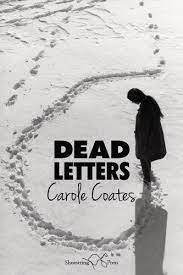
Carole Coates has already written about her late husband, John, and their shared lives, most recently in her full-length collection When the Swimming Pool Fell in the Sea (Shoestring Press, 2021). Now she writes to him in a sequence of twenty-five untitled letters (poems)— letters which can never be answered (hence the title of the collection) — ranging across all that’s built up a long and lively marriage, their shared love of books (and each other) and the minutiae of daily life. Death doesn’t end their warm discourse and shared humour nor do these ‘letters’ exclude the reader: instead, they manage to lead us back into our own lives, as the best poetry does.
The directness of the first ‘letter’ (i) sets the direct and conversational tone:
Dear J,
I haven’t heard from you but that’s what I expected
and only hope you’ve got enough books where you are
and soap too, a good razor and some decent after-shave.
Pears soap of course — ‘a sign of grace’ — you said that to me
when I bought Pears soap in those very early days
which I thought was weird but carried on buying it.
Soap and grace, cleanliness, godliness but that’s
not what you meant. When I asked you much later
you said you were just a silly young man then,
changed the subject.
The spiritual dimension slips in so quietly you hardly notice it at first, next to the Pears soap, but it is part of the mix of memory, enquiry, and meditation on what an afterlife might might be like, built on the serious library of literary and religious texts whose titles emerge deeper into the letters.
Each ‘letter’ begins ‘Dear J.’ and ends ‘Yours ever, C.’ and between are three ten-line stanzas. The regularity of this consistent form — and the way it fills the page so neatly — matches the lives within the poems. All but one of the ‘letters’ have a P.S., either as an additional question or as a comment. It’s as though the dialogues can’t and won’t stop, as though they need these last words of domestic conversation. ‘P.S. Why four copies of Sir Gawain and the Green Knight?’ ‘P.S. ‘Marriage is memory. Marriage is time.’ Who said that?’ It’s only with the final letter (xxv) that the need for a P.S. is settled, when Coates has reached her own resolution:
Three years exactly since you went, so quietly, away.
Since then I’ve built a room in air where I can speak
to you. A room of words which you can airily inhabit
or so I tell myself. You’re finishing the book you left
on the pillow, half-read. The Crime of Sylvestre Bonnard,
(Anatole France), your bookmark a note on Charles Lamb.
Mug of hot chocolate, English muffin oozing butter,
the Serious Readers lamp behind you. I’ll give you
firelight too and twilight deepening. You’ll stand soon,
reach up, pull down the blinds.
xxxxxxxxxxxxxxxxxxxx Yours ever, C.
In the best sense these are two closely-matched people, recognising each other from their earliest days in literary reference, crowded bookshelves, shared jokes, and an accumulation of details and questions about how to live. Quotations, sharing and identifying, matching and overlapping, thread through the poems. In the Acknowledgements Coates avoids the heaviness of footnotes, giving instead her ‘thanks to the many writers whose words I’ve borrowed.’ It’s a substantial list and not all from the historic literary canon; I’m pleased to see Elizabeth Strout and Louise Gluck alongside the expected names — pleased, too, to find others whose conversation runs on quotation and literary jokes.
The sifting of books, deciding which to keep and which will have to move on, is more than a metaphor for processing memories; it’s a necessary task, with necessary choices. This, from the beginning and end of (v):
Dear J,
I woke at three saying out loud ‘despite the snow’
expected a response. Silence. Muffle of black air,
a street lamp’s slice of light. You would remember
the poem and poet, would finish the quotation —
‘Despite the snow, despite the falling snow.’ Perfect
pentameter. This is what we’ve always done —
chimed words together, lines, played counterpoint
with poetry. A silly thing to miss but, yes, I do.
A rose to whose bright ‘crimson joy’ I quoted Blake
dropped three petals in reply.
[…]
Guess what I’ve found — that Peter Berger text
A Rumour of Angels, pounced on by us, keen
to recognise the signals of transcendence
in ordinary life. Hippies, we sought those gleams
in the continuous grey rain of our quotidian
traipse. Ghost-bibbers as we were and also fans
of Bertie Wooster’s Drones Club, we were glad
to find that humour was a supernatural sign.
So I’ll keep our Wodehouse books — despite the snow,
despite the falling snow.
xxxxxxxxxxxxxxxxxxxx Yours ever, C.
P.S. I’ve always liked the title of that Graves’ poem — ‘She Tells Her Love While Half Asleep.’
I’ve deliberately given long quotations from Dead Letters to show how conversational is Coates’ tone, and also how she holds the reader’s attention with the unwritten questions: what would you keep? where are your memories? This collection is a master-class in avoiding the merely anecdotal and introspective and also in demonstrating how the personal connects to the larger, wider world. Memory stretches from Carnaby Street clothes, shillings for the gas meter, and Black Magic chocolates up to Netflix, Covid and that Serious Readers lamp via Schrödinger’s cat, Old Spice, the fifteen volumes of Coplestone’s History of Philosophy, and a biography of Dennis Wheatley.
Yet these never crowd out how ‘Everything suddenly became the past / when you went, leaving me in a blank space, / a silence of stopped clocks.’ In Dead Letters Coates answers her own question — ‘Why do I write if not to remind us / both of what you were?’ — and these poems rise beyond an extended elegy to a conversation continually turning over the past to keep John alive. It’s a warm, funny, humane and joyous celebration of life.
D.A.Prince lives in Leicestershire and London. Her second full-length collection (Common Ground, HappenStance, 2014) won the East Midlands Book Award 2015. Her third collection, The Bigger Picture (also from HappenStance) was published in 2022.
*****
Ark by Estill Pollock. $26. Broadstone Books. ISBN 978-1-956782-43-1. [NB. In Novemeber, Ark will be available in the UK through Blackwell’s (Oxford) online catalogue.] Reviewed by Timothy Dodd

Wasting little time to follow up last year’s Time Signatures, Estill Pollock’s new collection pulsates with urgency and echoing haunt. While maintaining the lyricism, gait, and rhythm of its predecessor, Ark moves from a focus on history and nostalgia to something that feels much more immediate, more pressing, and is in some holistic way an addressing of the Now. In places such as Part Two’s Waves, “London in Those Times,” an exquisite ten-page poem looking closely at life in the 19th century metropolis, Ark is every bit as historical as Time Signatures. “Battersea Reach from Whistler’s House” would also fit quite snugly in the previous collection; poems circling around Kabul or Texas cheerleaders, however, not so much.
Yet make no mistake, Pollock’s conversation with the present is not shortsighted syrup or a modern glaze to mirror the lifestyles, ideology, and aesthetics of the so-called contemporary age. Pollock’s world view is not tethered to a narrow-minded preference for our own epoch and location, and in fact laments that we seem to wallow in them and fail to reach for any greater understanding. As such,wired by lexiconic virtuosity, these poems move far from the backyard boardwalk into all directions of space and time (historical, prehistorical, ahistorical and mythical) while carrying our own short moment of human experience through it all.
Indeed, the overall thrust of Ark comes from an interwoven examination of where humanity currently sits (or stands) in our journey upon earth. Along the way, and particularly evident in poems such as Part Two’s “How We Heard the News,” the veteran poet ponders how much more our age can consume, asking how and when we will come to terms with our vast post-industrial sowing. Take the ending to “Iron Gutter Eves,” for example, the fourth poem in Part One (Weather):
Now empire, heavy water tars, Dhaka
Denim mill race, death cycle rivers, fish ghosts
Sprig nets acid orange, pall indigo testament
Download, old altars
Older gods
Yet this snippet reveals much more: that readers must ultimately come up with their own questions and conclusions, for Pollock’s poetry is nothing if not images and snapshots of the moment, foregoing ideology and the scourge of sermon. Still, there is no absence of urgent voice-bubbling within the imagery, and one need not trample halfway through the collection to find it.
It must be stated that it takes but a short flip-through of the book to note that Ark’s major, generalized theme is “weather.” Global warming and the catastrophic changes due to it have thrusted the modern, industrial world’s concern with climate far beyond those inconveniences countered by sunglasses and umbrellas. Yet Pollock is a poet, and a visionary one, not a TV weather forecaster. His lens is not narrow and when a thundercloud appears over the front lawn, one can be sure this means more than an afternoon of gardening ruined. This is to say that any close reading of Ark will reveal that weather and climate are much more a vehicle than simplistic theme, a topic of transport that takes Pollock’s poetry wherever it wants to go. “Snow Snagged in Hedges,” for example, is a poem that ultimately delivers us toward quietude, a poem that feels as if we’ve just turned off the lights to eternal sleep. And then after “long cold” and “dry winds,” in the poem “In Places We Invent,” a haunting little poem echoing humanity’s ultimate ineptitude, carries us to a place birthed by a line like this one:
Outside, a dead lung, a thousand years from Earth
Numerous other poems of the collection, poems like “Under the Sahara” and “Neanderthals in Paris,” forge trips via the weather toward those greater contemporary ironies, indeed hypocrisies, mentioned above. In Ark, Pollock reaches into all manifestations of climate, evoking and calling out aspects of the weather that signify the greater elements and earth itself, moving us toward the primordial as well. Landforms, natural disasters, geography—we are transported by words toward an understanding whose magnitude very quickly wraps us up in transformation, from the simplest concepts of weather into all things life, existence, and the interrelated human experience.
Ark begins to feel even more personal in Part Three (Sanctuary), digging into our choices, behaviors, tendencies and experiences as human beings, our own gales and tremors, our own droughts and soakings that are not separate from the natural world even when we attempt to keep them distant. Much of it is seen in the poem, “A Song.”
[…] The winking jet exhaust, so high
And far, attracts ground-to-air response
Like whale song sounding in the deep, and still
Artillery cudgels orphans in their cellars—the ceasefire
Ragged as the curtains
On railway platforms we say goodbye
To little lives, to little preferences
For park-bench chess and Sunday roasts, with
Everyone aboard and visas stamped
As we return to shell holes named for cities
The gristle of burnt terrain
Is ours, patriot frenzy or cool resolve, both
With their place, where unclean spirits
Stew in native fire, met each to each
With songs of blood and heaven out of reach
More importantly in my view, in its illumination of all things related to weather, Ark ties everything that is ‘us’ to that which not only preceded, but that which comes after humanity. Lines from “A Thundersheet” reads:
Deeper than the first grave, time sleeps
There is neither rain, nor the memory of it
This meeting with the primordial is alive in “Spirit Animals” as well, whose final stanza exhales:
The world is frail, each breath the last
Until we wake in older light, in the counterfeit of days our
Lasting memory, fire—the fall from grace
That ends as it began, our shadows flickering
Across cavern walls
As such, Ark is a whirlwind, a blasting volcano, a far-reaching tsunami, and cumulatively haunting. It is at once focused and all-encompassing, outward-looking in the extreme while simultaneously introspective. Suffice to say, it is a mature collection from a poet whose world view is as immense as his poetic talents. Estill Pollock’s Ark, as with his greater body of work, should not go unnoticed.
Timothy Dodd is the author of Modern Ancient and Fissures and Other Stories, and first published in The High Window.
*****
Fivestones by Julie Sampson. £10.00. Lapwing. ISBN: 978-1-7391642-7-0
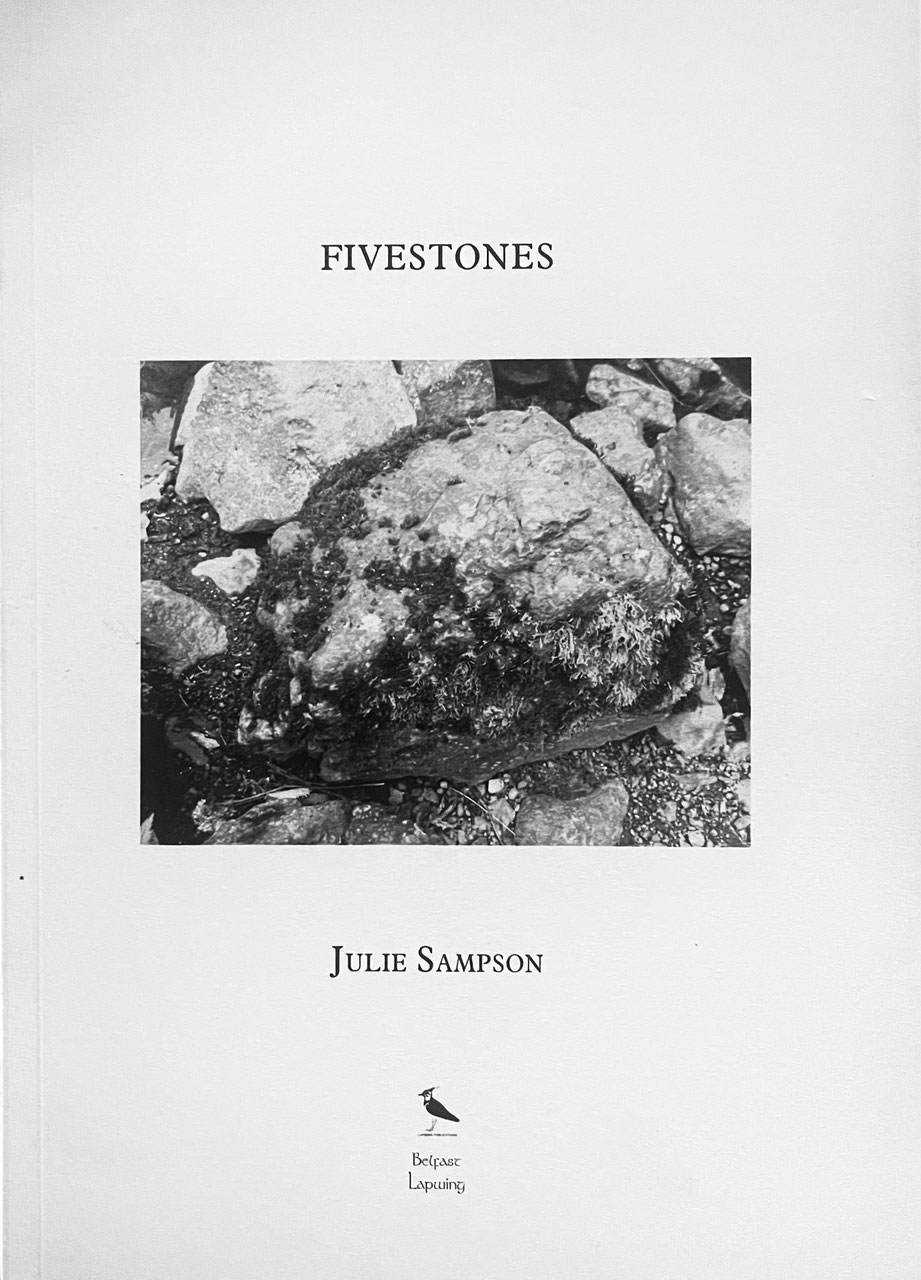
The title poem of this engaging and evocative collection addresses many of the author’s key themes – childhood, memory, the changing rural landscape and/or significant personal landscapes, and the poem ends with a reference to Nemetona – Celtic goddess of the sacred grove:
and Nemetona,
She grounds the dissipating energies
anchors us into rootedness.
Nemetona (I will confess I had to look her up) is absolutely the governing spirit of the collection, anchoring Sampson into her roots, honouring and reverencing those woods and rivers and groves, and celebrating the work of some ‘goddesses’ of poetry. Additionally, Nemetona is Celtic but – I gather – often linked with the Roman god Mars (god of war and agriculture), and Sampson is appropriately conscious of the history of the Roman legions in her part of Devon, and the recent archaeological finds linked to them, not to mention the ubiquitous and transformative effects of agriculture on her significant landscapes.
Writers referenced include Louise Gluck, HD, Mary Coleridge, E M Delafield, Sylvia Plath and Eavan Boland among others (often having links to Devon), and, while many fine poems are produced, I was not sufficiently familiar with all the life stories or works of the i.m.poets to be entirely sure how much of the verse was new or in direct response or referencing, or even quoting, the other writers’ works, although some notes at the end of the book are helpful with this.
Sampson’s nature writing is vivid and well-informed – by plant and animal knowledge and by lore and mythology. In ‘Narcissi in North Devon’ she says:
Stranger-angels
gathering in your coteries
along the grassy hillocks and hedge-line banks
come from the eyrie of your under other worlds,
it’s your star-studded moment.
And later in the poem:
When I turn toward home
Hades will swoop,
draw you back to the back holes of his subterranean world.
Tossed by gales and filthy rain
In ‘Denbrook’ she describes that very contemporary (and evidently locally controversial) addition to the landscape, a wind farm:
Child wide-eyes
nine Tyrannosaurus Rex
contort acrobatic stunts,
jaw-blades rising
high to sky,
they twist wheels of white-noise,
while silvering time away.
And later in the poem she refers to the turbines as ‘nine great wind Sky-Gods’.
I learnt several intriguing new words from this poet – always welcome – not only the goddess Nemetona, but Nemetostatio, which is an actual site in Devon, whose name is thought to refer to a former roman encampment ‘in a site of sacred groves’; ‘herepath’ which is a military road; and ‘carrus’ which means a wagon and/or a wagon load (and Google tells me is the name of a chauffeur company and a car parts business which both must be more classically informed than I am).
Her use of these old country-lore words is often evocative and atmospheric – in ‘Death-Winter’, which is about the harsh winter of 1962/3 (and in both the title and body of which there are implicit references to Sylvia Plath’s death during that period), she says:
……the latest bereft ewe’s lament
echoes across our ridge, from linhay over lychgate,
rising in air above the quieted rookery,
speaking inconsolable love.
A ‘linhay’ is an open-fronted barn structure, once common in Devon, and now common in the names of rural holiday rentals, I learned when I looked it up.
I did find some of the punctuation choices a bit muddled – I personally prefer a poem to have either almost no or else ‘complete’ punctuation, rather than a mix (unless there’s a very clear stylistic choice, making a poetic point), and some individual lines are indented by just one or two spaces which I didn’t see any cogent poetic reason for, but these are small criticisms given the overall pleasure and interest of reading the book.
In ‘Geni-Loci’ Sampson says:
as you stroll through grass or bend to pick the
pretty flower, ponder on this – each stem from a
seed sprung from us under this tongue of
Devon’s red earth.
No, it wasn’t easy for us.
Find us here in the old groves
trace the ancient way to its source.
Allow the dowsers with their rods,
they might find what you will not.
I think that Sampson writes very much as a dowser, whether for old herepaths, for underground waterways, or for histories – her own and those of other writers. I enjoyed this atmospheric collection and I recommend it, particularly to country lovers and others who are aware of the histories written in and on our changing landscapes.
Rowena Sommerville is a writer, illustrator and singer and lives on top of a cliff looking out to sea in beautiful North Yorkshire. She has worked in the arts for all her life, as a creative and as a project producer. She has written and illustrated several children’s books (Hutchinson/Random) and has contributed numerous poems to anthologies and magazines. Her first adult poetry collection was published by Mudfog press in September 2021. She was The High Window Visual Artist in Residence for 2022. She also writes for and sings with four-woman acapella group Henwen.
Sometime, in a Churchyard by Charlotte Harker & Louise Warren £12.50 Paekakariki Press. ISBN: 9781908133489

Sometime, in a Churchyard is a rather lovely, limited edition pamphlet of poems by Louise Warren and black and white line drawings by Charlotte Harker. A collaborative project, beginning in 2020 (according to the back cover blurb), it is inspired by the ancient churchyard of Old St. Pancras in London with its links to Thomas Hardy, Mary Shelley nee Godwin and her mother Mary Wollstonecraft. ‘The drawings do not illustrate the poems but rather respond to them and in some instances, the poetry was created in response to the drawings which reflects the fact that the working process between artist and poet is more in the manner of a conversation.’
The physical softback book, with its detachable dust jacket and a beautifully drawn image on at least every other page is a pleasing object in its own right – a collector’s piece given its limited edition status.
The poems and images that form the contents are constructed like a visit to, or a walk around, the churchyard. The opening poem begins with a walk:
So, after the news that my mother had died
I decide to go for a walk, an hour
maybe two days later,
around the churchyard at Old St Pancras
And the walk continues for the duration of the poem and the pamphlet as a whole. Indeed, it is not always totally clear where one poem ends and another begins. Other than the final poem ‘Fallen’, which was added to the pamphlet in 2023 following the fall in December 2022 of the tree in the cemetery linked to Thomas Hardy, none of the poems have titles and few poem segments have full stops to indicate endings. It is possible to read many of them as an extended exploration of Old St Pancras, a continuous poetic flow. Though it is equally possible to consider them as separate segments or poems. Where initial capitals and concluding full stops do appear to delineate separate poems, the themes and images that weave between and through them maintain a sense of continuity and gestalt.
Not surprisingly for a churchyard, themes of death and life are constant. They are interwoven with explorations of motherhood, references to one and/or other of the Marys, and one relevant other bearing the name, and snapshots from the Mary’s lives. All are embedded within images and physical descriptions of the churchyard itself:
A singular crocus
striped circus tent – upended
wide open – spent
and:
Grass of the scuffed prayer kneeler,
tapestry of crocus under a fretwork of trees,
oily dark of a green hedge, leathery and dripping iron.
Squeal of a gate. Midland Road.
Mary going round and around
winding herself up like a clock.
There is a fittingly elegiac quality to the poems, a sense of things passing as well as life continuing, especially in terms of nature:
murmuring of clover, the loss of orchards,
the sweetness of ivy.
A sadness of bees, swarming.
A choir of bees, humming.
A congregation of bees, mourning.
In a graveyard, the dead of different centuries lay contemporaneously side by side, no longer separated by time. In the poems, time is equally ambiguous and undelineated. All times are immediately and constantly present in the use of the present tense in the poems. Lives being lived are as significant as lives ended. In the opening stanzas quoted at the start of this review it is immaterial whether the walk takes place an hour or two days after notification of a death. This sense of all times and none culminates in the belatedly added poem ‘Fallen’ about the collapse of the Hardy tree, where life and death are present simultaneously:
and I am now in motion
wrenched from my birthplace
one minute later dead
and all this time I have been constant.
What it is to lay myself bare.
my insides exposed, soft and tender
as new born flesh.
This is a slim pamphlet with a deep existential reach.
J.S.Watts is a poet and novelist. Her poetry, short stories and non-fiction appear in diverse publications in Britain, Ireland, Canada, Australia, New Zealand and America and have been broadcast on BBC and independent radio. Her published books include: Cats and Other Myths, Songs of Steelyard Sue, Years Ago You Coloured Me, The Submerged Sea, Underword (poetry) and A Darker Moon, Witchlight, Old Light and Elderlight (novels). For more information, see her website https://www.jswatts.co.uk/
*****
Secret Poets by Darren Donohue. €13. ISBN: 978-1-913598-30-3
Secret Poets is Darren Donohue’s debut collection, but as an established and admired playwright and poet, he is far from being a beginner, something which is reflected in the skill and range of these poems. They are gathered over a period of years and could be described as occasional in the best sense, in that they seem to be the offcuts of a lived life, whether in the personal, political or intellectual sphere. Although the persona presented in the book seems to have a relatively comfortable, middle-class way of life, the collection is pervaded by a deep sense of uncertainty and threat. Sometimes this is made explicit: at a personal level, when illness intrudes, as in ‘Crocodile’: ‘Languidly, a crocodile stretches across / the hospital waiting room floor.’ In this poem, as in many others, Donohue resorts to the surreal to express the unfathomable. The crocodile of suffering is mysteriously linked to Jeanne Hebuterne, who killed herself following the death of her lover, Modigliani. The conflation of the suffering and sorrow in the waiting room with the suffering and sorrow in the historical event somehow console and detach the poem from the pain. The dangers of history and world events are a dark presence, from the opening poem on the death of Lorca which proclaims the inescapable involvement of the poet, ‘dictators kill poets’. In a sense, this poem contradicts the book’s title, by recognising the poet’s public role; perhaps, more grimly, it also underlines it, with the depiction of furtive, night-time murders, ‘Surprised in their pyjamas, / stolen from their beds’.
‘Woke’, the second poem, seems to be an exhilarated expression of confused revolution, a reaction to Black Lives Matter and Me Too, to ‘a purging righteousness slicing through brick, glass and steel to find the city’s naked heart’ which is both welcomed and feared. The sense of being overtaken by events is more fearful in the dream poem, ‘Re-enactment’, also a type of prose poem, which moves from Ireland’s civil war in 1922 out to Chinese tanks and Russian bombers. I found the ending of the poem a little predictable, but the message that none of us can withdraw from the problems of the world or society is the same:
[The man] asked if I wanted to be a soldier, a prisoner or a refugee? I couldn’t think what to answer and simply gestured toward my garden. The man smiled, and said, in the end it would make little difference, I’d still help to feed the ovens.
Donahue’s almost diaristic approach to poetry allows him to experiment with form, to range across subject matter and shifts in tone, from the playful to the terrified. In ‘Selfie’, a poem about Philip Larkin, he plays with a quatrain rhymed (more or less) aabb; the form is clever, but I don’t feel it leaves us much the wiser about Larkin. ‘Kitchen’ reads like a foray into Martianism and amuses with its images: ‘All the light switches have deformed faces, / without eyes or mouth, only a pert nose // continually sneezing, on and off.’ ‘Sister’ seems so personal as to elude interpretation, while managing to suggest pain and loneliness. Other poems, especially those dealing with his own childhood, parenthood are straightforward and delightful. The title poem, ‘Secret Poets’ could be, at one level, a description of birds preparing for migration. Yet, subtly, the poet uses metaphor and simile to suggest an artistic unity and perfection. As in other places in the book, he suggests this is denied to him: ‘With a climax, / beyond me, / they rise.’ The placing of the commas imply that not only is this perfection something he cannot achieve but that it is outside his ability to understand. Similarly, ‘The Hare’ ends, ‘Quick as a sigh, she’s gone, / disappeared into what is not for my seeking’.
In ‘Prayer’, Donohue asks ‘Is there anything as tragic / as an unfinished poem?’ I found myself responding, ‘Yes, one with a duff ending’. It is notoriously difficult to end a poem successfully and finding the right last line is particularly difficult as the poet steers between stating the obvious and something so open that it loses all impact. I felt that Donohue’s uncertainty about his own relationship with language is reflected in some endings which were unconvincing. The last lines of the opening Lorca poem are almost banal, rather than bathetic: ‘dragging the poet / from his balcony of stars / into an unmarked grave.’ ‘After Surgery’ is an attempt to express ‘a rich emptiness’, something almost inexpressible, but the ending is so full of polysyllabic abstractions, that it is itself meaningless:
And outside.
a deeper tenebrosity looms
an unanchored vastness
adrift with meaningless precision.
‘I Found the Words’, a poem about the writing of poetry, expresses the poet’s frustration with language, but I don’t feel that the last stanza, which has the misfortune to be on a second page, adds much to the poem.
However, these quibbles should not deter the reader; this is an open, honest and rewarding collection where the poet refuses to close his eyes to the realities of our world. Poems I thought really worked included ‘Sunday Bath’ where the viewpoint pivots between child and adult and finishes perfectly in a retreat away from the bathroom, as ‘Evening’… paint[s] a solemn moon into every puddle.’ ‘Your Swinging Gates’ combines memory and sadness, again with a perfect multi-layered, understated close: ‘Everything in motion, dancing toward me and spinning away, / the canal dipping in and out of view.’
‘Ryan’s Field’ is simple and joyous. ‘Refugee’ is about a stray cat, but of course, not about a stray cat and ends powerfully:
Beyond our yellowing rim
the wind howled, the stars refused
to shine, the freezing hail bared its teeth.
‘Caving at Kilcorney’ is, I think, Donohue’s most successful attempt to deal with the ineffable. ‘[The monks]desire to be silent, // their understanding / of the absolute need for it, / irradiate these caves…’
Kathleen McPhilemy grew up in Belfast but has spent most of her adult life in England and now lives in Oxford. She has published four collections of poetry, the most recent being Back Country, Littoral Press, 2022. She is currently hosting a poetry podcast magazine, Poetry Worth Hearing.
*****
Small Fry by Roger Elkin. £9.50. Littoral Press. ISBN 978-1-912412-47-1
It is a privilege and delight to read Roger Elkin’s virtuoso collection Small Fry where we see his technical mastery at full range. This is his 14th poetry collection where he finds inspiration in the richness of the natural order, just as he found ‘poems-a-plenty’ in his previous masterpiece about the political tragedy of the Irish famine, ‘The Leading Question’. These two contrasting collections are testimony to Elkin’s handling a wide range of subject matter as well as to his deep moral response to the human condition. In his celebration of nature’s bounty on the one hand and on the other his lament over its political exploitation, the reader discovers unexpected connections between the two.
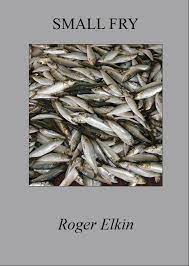
Although he declares, ‘I’m merely gardener / the overseer of Nature’, ‘piecing the words together’ this collection celebrates his deep, imaginative response to the natural order, from the garden, wood and rivers to city streets and the cosmic limits of space. While nature is a traditional symbol of hope, it is an arena for exploring some of the vexed issues of our age, too, ‘the truths… / of beauty and pain’. The reader waits until almost the last page of the collection to understand the significance of the title poem, ‘Small Fry’, which sensitively describes a relative collecting of minnows during his childhood, and compares it with his adult request for a meal of fried whitebait before being himself ‘collected’ by terminal cancer, and becoming a dead-eyed, gawping fish. We might think Elkin considers that in the end we are all nothing but ‘small fry’, hence his choice of collection title, a feature complemented and underpinned by the striking cover-image of a pile of whitebait. ‘Acanthus Spinosus’ explores the similar claims of innocence in a world of predation and the place of humanity in creation. Time and again, instinct and civilisation are set in tension and confront one another as in ‘Foxed’ when a fox is caught in the beam of a lamp, and in ‘Gift-horse’ when the poet encounters a road kill. The crime of egg collecting in ‘Perfecting your collection’, echoes Wordsworth’s plea, ‘We murder to dissect’ in his great poem ‘The Tables Turned’, when perfection can be admired only as a dead husk. In ‘The Gentry Weed’ the rhododendron outstares with the ‘non-understanding of Nepalese children’ as if humanity has yet to find its place in the world and nature may offer a lead. Nature ‘gives permission’ and ‘claims attention’, ‘Laburnum / pretends to let you inspect / its innernesses,’ while the many creatures Elkin describes return us to the primordial, ‘ghosting through prehistory’s galaxy’ from the time of the ice- age hunters in ‘The Last Irish Elk’, to Anglo-Saxon chainmail, the legacy of the Enlightenment’s collecting mania in ‘The Plantsman’ and the modern Geiger counter.
Elkin’s style in Small Fry draws on the moods of nature, at once a tender and nurturing pageant of glorious flowers, as well as a reference to vigorous sexual performance in ‘Queen Bee Speaks’, the ‘letching’ wood pigeon and the destructiveness of unabated fecundity and radical subversion of coltsfoots, ‘a conspiracy working underground’ in ‘The Darkborn’ and again in ‘Moles are holy’. Never reluctant to craft a potent image, he imbues flowers with human characteristics: here we encounter ‘Paeony’ and ‘ big Mama in her best festival hat’. In ‘September Sunflower’ there are ‘Clown-sad sentinels’ and ‘shrunken old men’ while in ‘Pear Blossom’, ‘a wedding-confetti petal-fall’, as well a reference in ‘Garden Fern’ to ‘Viking longboats’. Mythological characters like Apollo, Hercules, Chiron the Centaur and Pan in ‘Goatsucker’ populate the collection as well as the catastrophes of Nagasaki and Hiroshima in ‘Cornflower’. Elkin draws brilliantly on the expression of astonishment in Greek Drama, when we hear the call ‘ai, ai’ in ‘Hyacinth’.
By drawing the reader into intense observation the collection also explores spiritual themes as well a number of reverential expressions. In ‘Hyacinth’ we read of ‘the resurrection’, in ‘Fireside Survivors’ ‘a resurgence’ while in ‘Scarlet Lily Beetle’ we find ‘Consider then, this is God’s gift, too’. The poem ‘History’s Footnote, the fly’ tells how ‘Cromwell was resurrected’ and in ‘Elemental’, ‘dust in the Garden / … rising to Adam / genesis of mankind’s woe’, along with the beautiful line, ‘a heaven-lit rose-blush benediction’.
This collection shows Elkin’s deep enjoyment in writing.
He celebrates the skill and comic potential in re-building a dry stone wall. In ‘Points of Reference’ and ‘Pond Talk’ he hears the voice of the river and imagines its phonology and syntax as the flowing water describes its autobiography. We also encounter his verbal dexterity and inventiveness with expressions such as ‘isness’, ‘a starkness’, ‘nowness’ and ‘innernesses’, ‘specialness’, ‘wetness’, ‘deepenings’ and ‘riverings. These delightful terms alert the reader to the poet’s fresh perceptions.
Such inventiveness provides a phantasmagoria of colour and movement, associations and sensations as the poet is almost overwhelmed by the display. In ‘A timeless heraldry’ a Red Admiral ignites his imagination, ‘leaf- like’, ‘with old man’s shoulder-shrugs’, ‘legs unhinging like deckchairs’, ‘their curled tapestries’, ‘pattern of turned-back rugs’, ‘shrimpish faces’, ‘like sieving flour’, ‘their me-ness will be spent’. In ‘Garden startled’, the poet even draws on Coppola’s film Apocalypse Now when he sees in the flight of craneflies the ascent of gunship helicopters.
In the bird poems we see Elkin’s full technical mastery as he explores their instinctive behaviour, their sounds, as well as their needs and even where they go to die in ‘Where do all the birds go’. In the poem ‘Twitching Sixers’ the crow becomes, ‘a swaggerer / of some backyard Jacobean Tragedy.’ In ‘On a Wood Pigeon Proposition’ we read, ‘its wings battling forward and back / like the oars of the Oxbridge boat race’, and ‘its wings akimbo like cliff hurlers’, ‘like a child’s paper plane’, ‘its bill rolled gold’, while its song inspires a love poem, ‘Coo-oo-cou…Love you…’. Some of these bird poems explore moral issues, too. Troubled by his casual disregard of a dead redwing, he is haunted ‘by the way we treat our old folk. /Much the same, bundling away’ and the more strident, ‘possession is not love, remember. It isn’t love.’
This collection shows great lyric versatility and masterful precision. Small Fry is an aid to our survival in the world in which we grow with each other.
John Williams studied English at Durham with postgraduate work at Manchester and Newcastle-upon- Tyne. He taught in schools, lectured in English at University College Chester and was awarded a NATE Fellowship at the University of Melbourne in Victoria, Australia. He was the Director of the Bridge Arts Centre in Widnes and has published three poetry collections. His fourth Wild Ride is forthcoming from The Wrecking Ball Press in 2023.
*****
*****
Paper Crusade by Michelle Penn. £9.99/£4. Arachne Press. ISBN: 978-1-913665-67-8
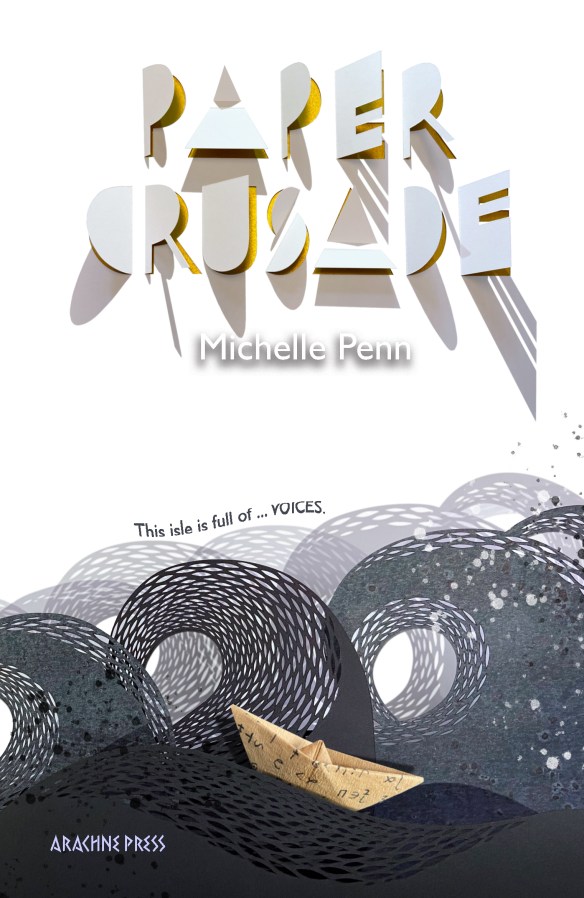
Paper Crusade is a unique reimaging of Shakespeare’s The Tempest inspired not only by the play but also by a dance performance of The Tempest Replica, choreographed by Crystal Pite. Penn’s response to the interplay between art forms has been successful in producing a poetic storytelling with an urgency of movement between characters and action which led me to read the book in one sitting. This was a play I had a vague recollection of seeing and studying somewhere in my English Literature education, however Penn has created a complete world where there is no great need to delve back into the original text.
We are introduced to: ‘an island of perpetual sun’ the father and his ‘white-clad army’ prepared for the oncoming ‘quest for revenge’.
From the striking opening poem: ‘The Sea, offended’, we are drawn into another realm of well-defined voices. These voices are distinct both in character and format on the page which brings an enchanting aesthetic. Penn’s ever-present sea persona delightfully takes the centre stage from the very beginning and will accompany us throughout as we step into her dominion:
~ I am no mother
xxxxx bearing life ~in my depths ~
xxxxxxxxxxxxxxx ~ I am black ~ opaque
xxxxxxxxxxxxxxx ~ keeper
xxxxxxxxxxxxxxxxxxxxxx of the bones ~
xxxxxxxxxxxxxxxxxxxxxx ~ bodies foundering ~
Poems in her voice allow us to quietly observe others. In ‘The Sea watches The Father at his favourite game’, we see the vengeful father:
~ He strokes the old books
xxxxxxxx leather fissured ~ calligraphy
xxxxxxxxxxxxxx rippled ~ parchment
xxxxxxxxxcrusted with salt and sand ~
xxxxxxxxxxxxxHe could hurry ~ but he savours
xxxxxxxxxx the wait
Paper Crusade breathes new life into all of its character: a father, daughter, brother, boy, winged Spirit and an indigenous being known as ‘C’. We visit each one in turn exploring their stories as the plot unfolds.
We see a glimpse of the ‘delicate’ but ‘dangerous’ daughter’s spirit in the wonderfully titled: ‘Inside a crevice of The Daughter’s mind’:
…i am … a glorious monster…
xxxxx…floating on the bend…
…of the waves…
xxxxx …they guide me… deep…
xxxxx … to my private recess…
xxxxx…of the sea…
…billow and curl… billow and curl…
xxxxx…bell this suit to a dress…
xxxxx xxxxx …bulbous then slack…
We are witness to the mourning’s of downtrodden ‘C’ longing for happier times and dreaming of escape:
/ i – i – i am not a-afraid / / not afraid / / the s-sun no
longer a t -torment / / its touch spare / / a warm hand /
/ crowning me / / i – i am a pearl / / a hard sea /
/ f-father’s face a flat stone in my palm / / buckling /
/ crumbling /
Later poems weave together voices almost as a dance. In ‘While sleep refuses The Boy — and The Girl’ we see the relationship between the daughter and boy in the contrasting imagery of lightness and darkness which is threaded through the book: ‘sun, sun and sun / night crushed by constant day / then the searing light’ and the daughter’s: ‘ boy… you carry / darkness… and in it… / …i’m awake…’.
These poems do indeed conjure the Paper Crusade to life. This is a story of betrayal, love and revenge, We may believe we are familiar with the ending, but Penn’s journey, twisting through the inmost thoughts of the characters is certainly one to be revisited.
Ness Owen is from Ynys Mon (Anglesey). Her poems have been widely published in journals and anthologies including in Mslexia, Poetry Wales, The Cardiff Review, The Atlanta Review and The New Welsh Reader. Her first collection Mamiaith was published by Arachne Press (2019) and her second collection Moon Jellyfish Can Barely Swim was published by Parthian (2023). She recently co-edited the bilingual poetry anthology A470, Poems for the Road/Cerddi’r Ffordd and won Greenpeace’s Poem for the Planet 2022.
 The High Window